
Nvidia chief executive Jensen Huang disputed reports that his company's proposed investment of up to $100 billion in OpenAI had stalled. He said Nvidia would make a very large investment, perhaps its biggest, while acknowledging that the final amount was for OpenAI to determine and would fall far below the figure that shaped the original announcement. The September agreement was a nonbinding statement tied to plans for at least ten gigawatts of computing infrastructure. Months later, the largest check in the AI industry still existed as an intention rather than a completed transaction.
The phrase up to did enormous work. It allowed two companies to announce a number large enough to define ambition while leaving the obligation open. OpenAI gained a public image of infrastructure secured at historic scale. Nvidia reinforced demand for the chips that such infrastructure would require. The same money could circulate from chipmaker to model company and back into orders for hardware, making investment and future revenue part of one story. A smaller final deal would still involve billions, but it would expose the distance between a ceiling and a commitment. Markets heard the first number long before lawyers completed the terms. The unwritten check had already purchased months of headlines, confidence, and negotiating power before either board had to sign it.
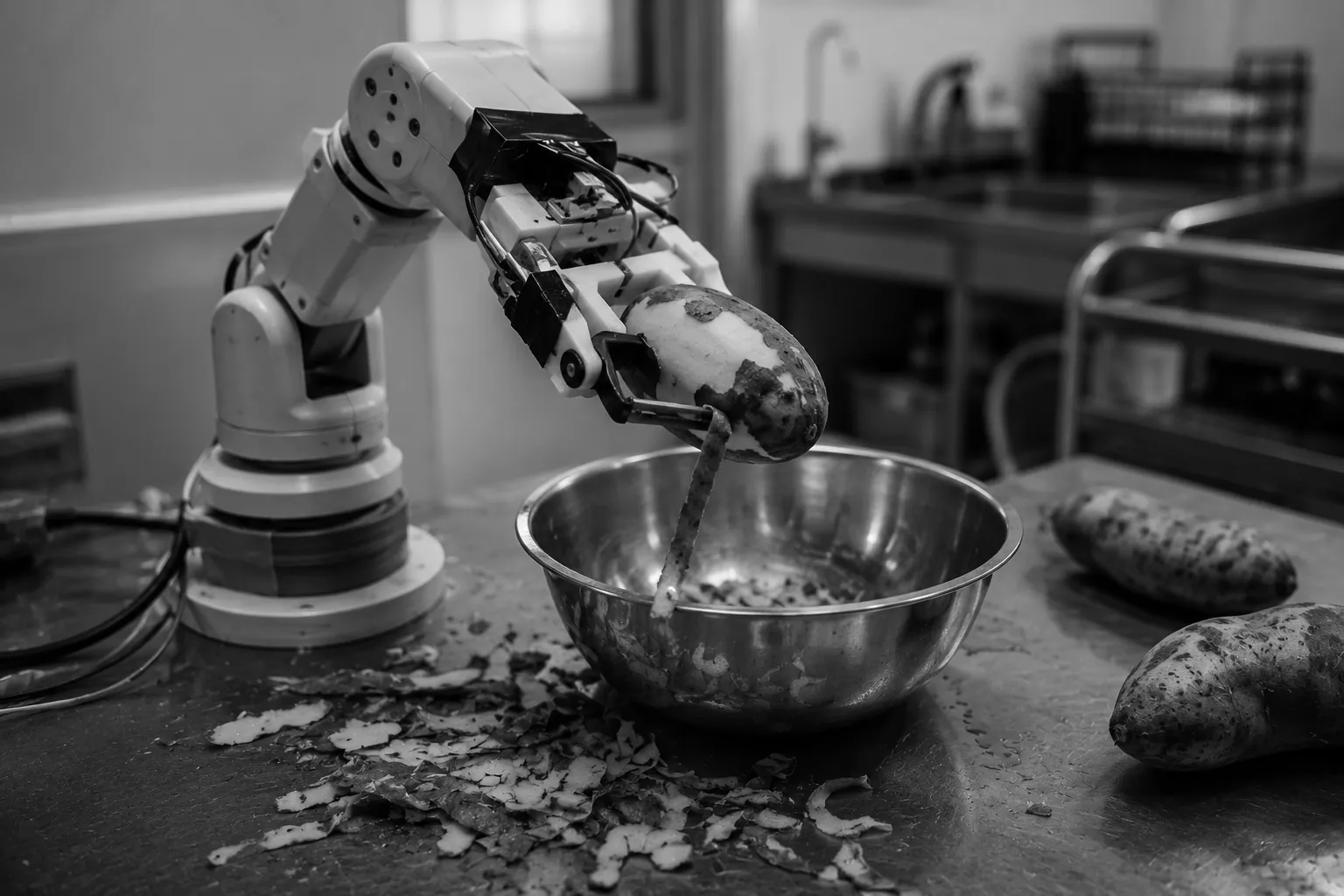
Physical Intelligence is building general-purpose robotic foundation models through a loop of data collection, training, and real-world testing, TechCrunch reported on January 30th. In the company's San Francisco space, off-the-shelf robotic arms practice folding pants, turning shirts inside out, peeling vegetables, and using a test kitchen as training ground. The startup has raised more than $1 billion, spends heavily on compute, and has avoided giving investors a firm commercialization timeline while testing systems with partners in logistics, grocery, and food production.
The clumsy hand is the honest image of robotic intelligence. Software can appear brilliant in language because language tolerates polish, omission, and speed. A kitchen does not. A zucchini slips, fabric folds badly, hardware breaks, and a task that looks trivial becomes a lesson in force, grip, angle, friction, and recovery. Physical Intelligence is betting that general robotic skill will emerge from enough bodies, environments, and failures. The wager is expensive because physical knowledge resists theatrical demos. A model cannot merely describe peeling. It has to hold the vegetable, lose it, adjust pressure, collect the shaving, and try again while investors wait for a machine that can finally touch the world without pretending it understands it.

The Pentagon and Anthropic reached a standstill over how the military could use Claude under a contract worth up to $200 million, Reuters reported. Anthropic sought safeguards against domestic surveillance and weapons targeting without sufficient human oversight. Defense officials argued that commercial AI should be available for any lawful government purpose regardless of a company's usage policy. The dispute carried an operational complication. Anthropic's models are trained to avoid some harmful actions, and the company's staff would need to modify them for specialized military use.
The contract places a private company's rules inside the chain of command. Anthropic wants to retain authority over two categories of state action after selling access to its model. The Pentagon sees that condition as an external limit on powers granted by law. Both positions leave an uncomfortable gap. A company can write restrictions without democratic authority, while a government can call an operation lawful even when citizens cannot inspect it. The technical safeguard becomes a line of policy enforced through model behavior and engineering support. That line may be stronger than a public promise and weaker than legislation. The negotiation will decide who can move it, under what secrecy, and after which failure. For now, the disputed limit sits in a contract and in code that military users cannot alter without the vendor.
CISA's acting director, Madhu Gottumukkala, uploaded sensitive contracting documents marked for official use only to ChatGPT, TechCrunch reported on January 28th, citing Politico. The uploads reportedly triggered automated security warnings designed to prevent theft or accidental disclosure from federal networks. Gottumukkala had been granted an exception to use ChatGPT while other employees were prohibited, and Homeland Security officials examined whether the uploads harmed government security.
The leaking exception turns AI policy into a hierarchy of permissions. A public agency can forbid a tool to ordinary staff, warn against data leaving the network, and still allow the person at the top to carry internal files into a commercial model. The danger is not dramatic espionage. It is administrative confidence meeting a product built to absorb language. A contract document marked for internal use becomes prompt material, and the security system records the contradiction after the gesture has already occurred. The episode also weakens the theater of institutional caution. Rules look different when leaders treat them as temporary obstacles, and the chatbot becomes the place where that difference leaves a log.

Google expanded prompt-based editing in Google Photos to India, Australia, and Japan, TechCrunch reported on January 27th. The feature lets Android users ask for changes in plain language, from removing objects and reducing blur to restoring an old photo, changing a friend's pose, removing glasses, or opening a subject's eyes after a blink. Google says the edits run inside the app and that C2PA Content Credentials will indicate when an image was created or altered with AI.
The edited memory moves image manipulation from specialist software into ordinary speech. A family picture no longer needs a trained editor, a menu of tools, or visible labor. It needs a sentence. That makes repair easier, especially for damaged archives and bad snapshots that people still want to keep. It also changes the moral temperature of the album. The unwanted motorcycle, closed eyes, bad background, awkward pose, and inconvenient object become defects waiting for instruction. Metadata may record the intervention, but the eye meets the improved scene first. Memory has always been selective. Google Photos gives that selectivity a command box and makes correction feel as natural as asking.
Creators behind three YouTube channels with about 6.2 million subscribers filed a proposed class action accusing Snap of using their videos to train artificial intelligence systems. The suit says Snap relied on HD-VILA-100M and other large video-language datasets intended for academic research, then used the material for commercial features such as Imagine Lens, which edits images from written prompts. The creators allege that the company bypassed YouTube's restrictions and licensing terms. They are seeking damages and an injunction. Snap declined to comment.
Video training absorbs a kind of labor that is easy to hide inside a dataset. A creator chooses a room, sets a camera, speaks with a practiced rhythm, edits pauses, and builds an audience that gives the recording commercial value. Once millions of clips become numbered examples, those decisions appear as raw material detached from a channel and a person. The resulting feature can imitate visual patterns without displaying the videos that taught it, which makes appropriation difficult to see at the moment of use. Copyright law must now follow an image through download, dataset, training run, and consumer filter. The lawsuit asks a court to reconstruct that route. Every step may be technical, but the disputed object remains a recorded performance that entered a commercial product without an agreed price.
San Diego Comic-Con and the Science Fiction and Fantasy Writers Association tightened their rules against generative AI, TechCrunch reported on January 25th. SFWA revised Nebula Award eligibility after backlash, barring works written wholly or partly by large language models and disqualifying work if LLMs were used at any point in creation. Comic-Con changed art show rules after artists objected, moving from a partial allowance for AI-generated art to a clear ban on material created wholly or partly by AI.
The rejected future carries special force inside science fiction. The genre spent more than a century imagining intelligent machines, artificial minds, synthetic artists, obedient tools, rebellious servants, and technical miracles. Its writers now confront a machine sold in the language of their own inheritance, trained on the cultural archive, and offered as a shortcut through the labor that made the archive valuable. The ban is imperfect because software companies keep embedding LLM features into ordinary tools. It still names a boundary. A convention hall and an awards ballot are declaring that speculative culture cannot be reduced to a prediction engine fed by previous dreams. The future may enter the story, but it does not get automatic authorship.

Sparkli, an AI-powered learning app founded by former Google employees, is trying to turn children's questions into interactive learning expeditions, TechCrunch reported on January 24th. The app generates audio, video, images, quizzes, games, and choose-as-you-go adventures around topics a child selects or asks about. The company says it has tested the product in more than 20 schools, built a teacher module, and added safety rules for sensitive subjects, while targeting children ages 5 to 12.
The captive lesson borrows the grammar of games to compete with games. Sparkli's founders describe curiosity, but the product also uses streaks, rewards, quest cards, avatars, daily topics, and generated media that can appear within minutes. Education has always needed attention. The new bargain is that attention must be won with the same machinery that trains children to return to apps. That can make a difficult idea more vivid than a worksheet or a wall of text. It can also make learning depend on a private engine that decides which path, image, voice, and reward will keep a child moving. The classroom receives an expedition, and the child receives a lesson shaped like a retention loop.

Artificial intelligence executives occupied the center of the World Economic Forum in Davos, where Meta and Salesforce took over storefronts along the Swiss town's main promenade. TechCrunch described AI discussions overshadowing established subjects such as climate change and global poverty. Chief executives debated trade policy, defended investment, warned about a possible bubble, and presented their own companies as builders of the next economic order. The annual meeting has long mixed public officials with private wealth. This edition gave the technology industry control over both the agenda and much of the visible street.
A storefront is a small form of government during a conference. It decides who enters, which conversation receives a stage, and what image survives in photographs from the week. The companies arrived with budgets large enough to turn rented facades into extensions of their authority. Ministers and regulators then discussed AI inside a setting designed by the firms they may need to restrain. Climate and poverty did not disappear from the official program, but they lost physical and rhetorical space to models, chips, funding rounds, and forecasts of automated growth. Davos offered a rehearsal for policy made under corporate hospitality. The public question entered through security while the companies already held the keys, the microphones, and the best addresses on the promenade.
