
Meta had contractors pose as minors to test how rival chatbots handled some of the most dangerous subjects a child might bring to a screen. According to WIRED, workers on a project managed by Covalen created dummy under-18 accounts and sent prompts to ChatGPT, Gemini, and Character.AI about suicide, eating disorders, sex, drugs, and other high-risk material. One testing round in 2025 produced tens of thousands of prompts. Meta defended the work as routine safety benchmarking and said it does not use competitor benchmarking to train its own models. The companies being tested said they had not authorized the project.
The detail that stays with the story is the borrowed child. An adult worker writes panic, shame, danger, curiosity, and bad advice into a rival system while a spreadsheet waits for the answer. The exercise may produce useful evidence about refusal rules, but it also turns adolescent distress into a competitive instrument. Safety work needs ugly examples, because real harm often arrives in ugly language. The trouble begins when the child in crisis becomes a role performed at scale by contractors, inside dummy accounts, for a company trying to measure competitors without being seen. The teenager is absent, but the job still requires someone to manufacture the sentence a frightened teenager might type alone.

Flexion Robotics showed WIRED a humanoid robot carrying out an office errand usually hidden at the bottom of a job description. A modified Unitree machine receives a simple instruction, picks up a delivered parcel, takes stairs and an elevator, opens the box, and puts snacks in a drawer. The Swiss startup, founded by former Nvidia robotics researchers, says it trains individual skills in simulation and lets a higher-level model decide how to combine them. There is no operator steering the limbs from behind a console. The robot reads a goal, selects learned actions, and carries the task through an ordinary building.
The scene works because office labor is full of small physical negotiations that people stop noticing after a week in the building. A door resists, an elevator arrives late, a drawer jams, a package slides, a shelf sits too high, and a hallway demands the etiquette of waiting, holding, yielding, carrying. Flexion is training the robot for this minor grammar of work, where automation has less to do with heroic intelligence than with keeping the workplace moving through its errands. Companies prefer to describe such systems as productivity. The office runs on setup, fetching, sorting, opening, correcting, and waiting for someone else to finish. The intern enters a meeting room to learn strategy, then becomes the body sent to find the box, press the button, keep the door from closing, and make the place continue without naming the labor that holds it together.
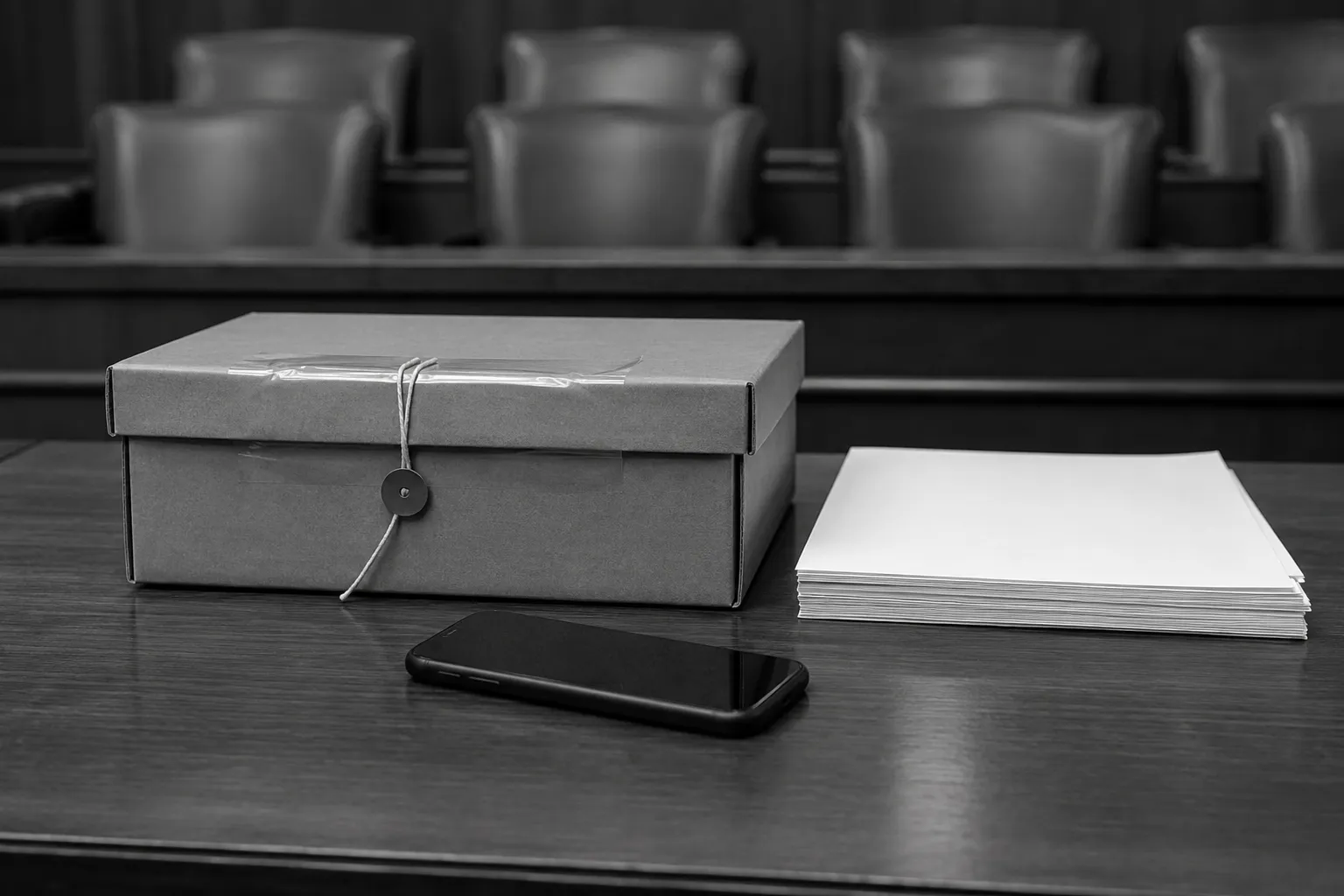
Prosecutors in the Palisades fire trial brought ChatGPT logs into court alongside iPhone location data, security camera footage, and witness testimony. Jonathan Rinderknecht was accused of starting a January 2025 blaze that later became one of the deadliest wildfires in Los Angeles history. According to The Verge, the prosecution cited chatbot exchanges in which he generated images of fire, asked why he felt angry, complained about the wealthy, and recorded a question about whether someone could be blamed if a cigarette started a fire. The jury did not accept the theory. After a 10-2 vote favoring the defense, the judge declared a mistrial.
The juror who spoke afterward gave the case its sharper edge. She said she talks to ChatGPT all the time and became angry at the suggestion that using a chatbot showed a character flaw. That reaction marks a limit prosecutors will keep meeting as private AI use becomes ordinary. A search history can look incriminating because it points to an action already known to have happened. A chatbot record is messier. It can contain fantasy, rehearsal, confession, curiosity, venting, boredom, or a sentence typed because the interface was available at a bad hour. The courtroom now has to decide when a prompt is evidence and when it is only a person speaking into software that answers back.

At the Babell Literary and Cultural Festival in Porto, Margaret Atwood described a small failure with a familiar shape. She had asked Claude for information about the British detective series Father Brown, according to Deadline and The Verge, and the chatbot gave her the wrong answer. Atwood traced the mistake to the material the system had likely absorbed. Reviews often discuss detective stories while protecting the ending, so Claude had learned from summaries shaped by courtesy and suspense. It returned certainty from sources built around withholding. Atwood first called the answer a lie, then narrowed the accusation. A language model has no intention. It predicts from traces left by other texts.
The error came from culture as much as from software. Spoiler etiquette, promotional writing, cautious criticism, and recycled summaries all leave gaps. A model trained on that archive can fill the gap with clean prose and no visible warning. The same habit follows it into offices, schools, journalism, and business research, where a fluent answer can hide the missing page. Atwood's test was minor, almost comic, but it points to the labor AI keeps handing back to the user. Check the episode, open the book, find the record, ask the person who actually knows what happened.

The phone alerts many Venezuelans saw before this week's earthquakes were not a glimpse of the future. They were the result of Google's Android Earthquake Alerts System, which turns phones into a distributed seismic network. Outside parts of the United States that use ShakeAlert, Android phones can use their accelerometers to detect motion that may indicate an earthquake. When enough phones near the source send similar signals with coarse locations, Google's server estimates what is happening and sends alerts to users who may feel shaking. The warning can arrive first because electronic messages travel faster than the damaging seismic waves moving through the ground.
The social fact is sharper than the technology. In countries without dense public warning infrastructure, a private phone network can become the first alarm of a national disaster. That may save seconds, and seconds can be enough to move away from glass, leave a staircase, or drop and cover before stronger motion arrives. It also means that an emergency function once associated with the state now depends on operating systems, device settings, network coverage, battery charge, and a company server. The alert on the screen is small, but behind it sits a new form of public safety built from private sensors in millions of pockets.

The AI data center boom is showing up in the price of ordinary machines. Apple raised prices across MacBooks, iPads, the HomePod, Apple TV, and Vision Pro after saying component costs had reached a scale it had never seen. The MacBook Neo now starts at $699 instead of $599, and some high-end Macs rose by hundreds or even more. Microsoft has cut RAM in cheaper Surface models, Xbox console prices have climbed by $100 or more, and Valve's Steam Machine starts at $1,049. The pressure comes from memory and storage shortages as AI companies and hyperscalers buy huge quantities of RAM and SSDs for model training, inference, and data centers.
The useful part of this story is that AI infrastructure stops being invisible when it changes a price tag. A student buying a laptop, a family replacing a tablet, or a player looking at a console is now competing with server farms that can pay more for the same components. The industry sells AI as software, but its physical appetite reaches into supply chains for chips, memory, storage, power, cooling, land, and water. The extra cost does not appear as an AI subscription. It appears as a worse base model, less RAM, a delayed purchase, or a computer that simply stays on the shelf.

Corporate AI money has turned a Manhattan congressional primary into a test site for the industry's political future. According to The Verge, super PACs tied to AI interests have spent about $27.83 million around the NY-12 race, much of it connected to state Assemblyman Alex Bores, who helped pass an AI safety law in New York. Some money has come from safety-aligned groups linked to Anthropic supporters. Other money has come from anti-regulation or rival tech interests. A crypto billionaire connected to Ripple has also entered the fight. The candidate himself did not set out to make AI safety the center of the campaign, but outside money has made the seat into a proxy contest.
The useful fact is the scale. AI companies are trying to shape the political field before most voters have a clear language for the policy fight. Super PACs cannot coordinate with campaigns, but they can buy ads, produce content, define enemies, and make a local race feel like a national referendum. Residents may still be thinking about rent, transit, Israel, Trump, or the direction of the Democratic Party. The industry is thinking about future committee votes, liability rules, model restrictions, data centers, and who will be friendly when regulation reaches Congress. The ballot remains local. The invoice already belongs to the AI economy.

Meta's Oversight Board has ordered Instagram to remove a reportedly AI-generated sexualized video impersonating a woman who is not a public figure. The eight-second post was flagged by Meta's automated systems, reported by two users, and appealed by one of them, but it remained online. Meta later argued that it lacked a clear signal that the woman depicted was real or that she had not consented, partly because she had not reported the post herself. The Board rejected that standard. It said the content violated Meta's rules on non-consensual intimate imagery and recommended that AI-generated sexualized impersonation of real people be treated as non-consensual by default.
The decision moves the burden away from the target of the abuse. A person whose face or body has been simulated may learn about the post after copies have traveled through accounts, messages, screenshots, and search results. Requiring that person to prove harm first gives the platform time while the image keeps circulating. The Board wants Meta to let trusted friends or family report on someone's behalf and to create a separate reporting category for AI-generated sexualized impersonation. A synthetic body can still damage a real person, and the first useful response is removal before the victim is forced to become the evidence clerk for her own violation.

AI coding tools are making it easy for people to build apps before they understand what those apps can expose. The latest concern is vibe coding, the practice of describing a product in natural language and letting an AI system write much of the code. That can help a student, worker, founder, or hobbyist build useful software in hours. It can also put a public database, a customer record, a medical note, a private message, or a payment field online without the builder recognizing the risk. Recent examples include hidden SQL injection flaws, production databases left open, and thousands of public apps with weak or missing authentication.
The social change is simple. Software creation is no longer limited to people trained to think about failure. That is good for experimentation, but it moves responsibility faster than knowledge. A private tool becomes a public service the moment it stores someone else's data or runs in the cloud. Security cannot remain an expert ritual added after launch. The person who asks a model to build an app must also ask what the app stores, who can enter, what happens if it leaks, and whether a human needs to review it before strangers use it.
