
Google introduced Gemini Omni as a model family that can create video from mixed inputs, beginning with Gemini Omni Flash in the Gemini app, Flow, and YouTube Shorts. The company says users can combine text, images, audio, and video, then edit clips through conversation. The Verge tested the tool with a stuffed animal and with selfie footage, producing clips where a familiar face appeared to eat pasta, sit on a plane, or stand near the Eiffel Tower. Each attempt also burns paid credits, so the fantasy arrives with a meter attached.
The cultural shift is smaller than cinema and closer to a phone gesture. A person can feed the model a private clip, ask for a scene that never happened, and get an image of the self placed inside it. The glitches still matter. Bottles change shape, bodies move oddly, and hair gives away the trick. Yet the labor has changed. Faking presence no longer begins in a studio. It begins with a prompt, a payment plan, and a face already sitting in the camera roll.

Anthropic says Project Glasswing has used Claude Mythos Preview and roughly 50 partners to identify over ten thousand high- or critical-severity software vulnerabilities in its first month. Cloudflare reported 2,000 bugs across critical-path systems. Mozilla tested the model on Firefox and fixed 271 vulnerabilities. Anthropic also says its own scans of open-source projects have surfaced thousands of likely severe flaws, with outside security firms confirming a high share of the inspected cases. The public numbers read like an inventory of debt hidden in routine code.
The strange lesson sits in the queue after discovery. Finding flaws used to be the hard part. Anthropic now describes a different bottleneck, where humans must reproduce findings, contact maintainers, write reports, build fixes, and wait for users to install them. Each ticket needs judgment before it becomes a patch. The machine has made weak code visible at a speed the software world cannot yet absorb. Security becomes a race between exposure and repair, with maintainers standing in the narrow space between a discovered hole and an exploited one.

Google used I/O 2026 to describe the largest change to Search in decades. AI Mode now has Gemini 3.5 Flash as its default model, and Google says the feature has passed one billion monthly users. The search box itself is being rebuilt around AI, with space for longer prompts, suggestions that help shape questions, and inputs that can include text, images, files, videos, and Chrome tabs.
The change moves Search away from the old rhythm of typing keywords, scanning blue links, and opening pages one by one. Users can ask follow-up questions from AI Overviews, keep context across a conversation, and let Search build custom responses in real time. Google also announced information agents that monitor the web for changes, booking agents for local services, and mini-app style tools generated inside Search.
The practical effect is simple. Search is becoming a place where answers, summaries, comparisons, monitoring, and actions happen before the open web gets a visit. For publishers, stores, and services that depend on human clicks, the change hits the entry point. If Google handles the task inside Search, the page becomes background infrastructure.

OpenAI says an internal reasoning model has disproved a long-running conjecture in discrete geometry, the planar unit distance problem first posed by Paul Erdos in 1946. The question asks how many pairs of points in a plane can sit exactly one unit apart. For decades, square-grid constructions were treated as close to optimal. OpenAI's model found an infinite family of arrangements that beats that expectation.
The announcement lands after a damaging 2025 episode, when OpenAI overstated Erdos-related results that were already known. This time, the company published the proof and companion remarks from outside mathematicians, including Noga Alon, Tim Gowers, Arul Shankar, Jacob Tsimerman, and Thomas Bloom. Their responses give the claim real weight while formal peer review continues, shifting the story from company boast to scrutinized mathematical claim by experts.
The signal is in the technical route. The model linked a planar geometry question to algebraic number theory, using tools far from the original picture of dots and distances. If the proof survives review, it will be a concrete example of AI doing original work inside mathematical research.
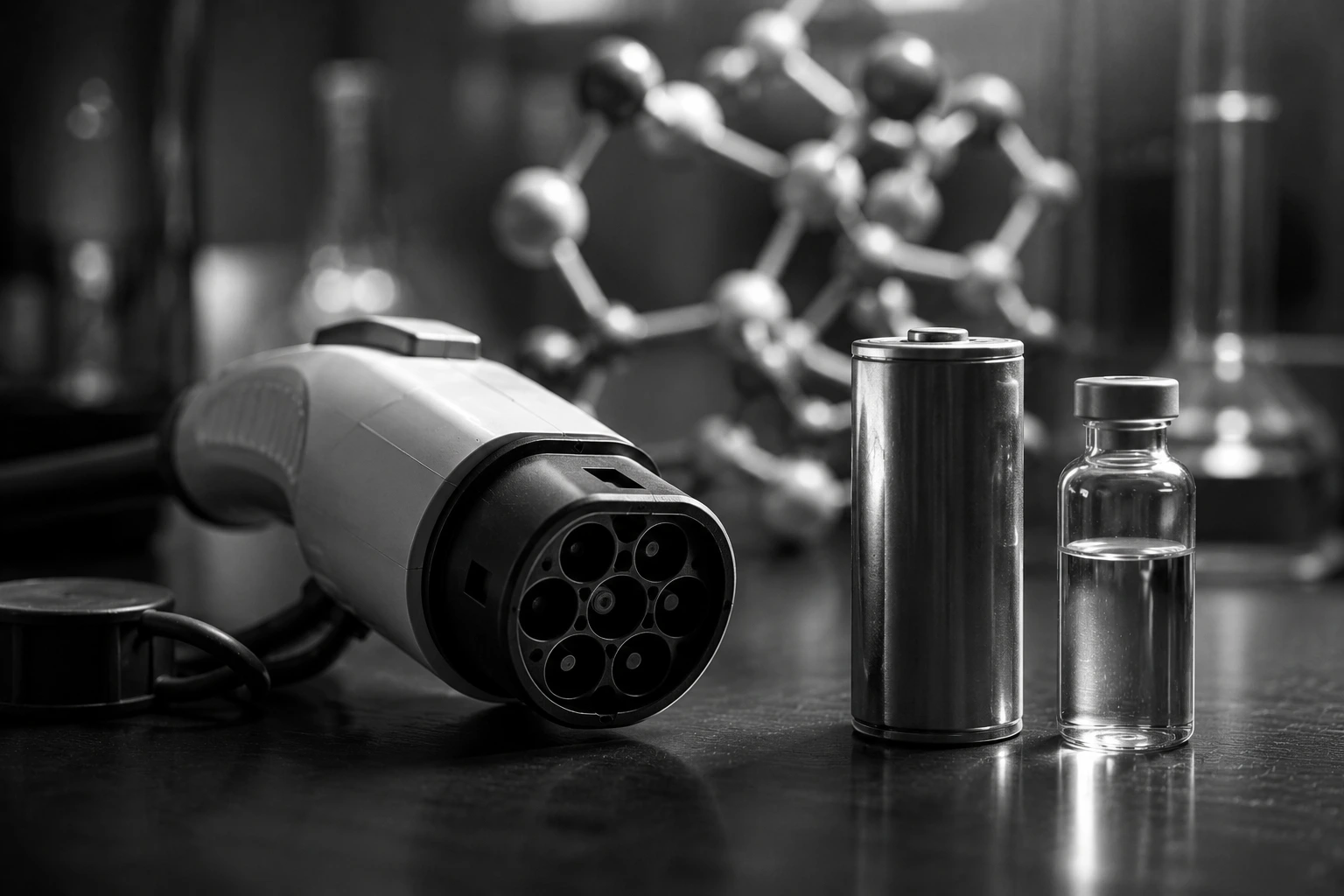
BYD says its Blade Battery 2.0 and FLASH Charging system can bring an electric car from 10 percent to 70 percent in five minutes, and from 10 percent to 97 percent in nine. The company's March technical release describes a 1,500 kW charger, a new ion-transport system, and an electrolyte layer optimized for higher ionic conductivity and faster mobility. Interesting Engineering reported on May 18 that BYD has moved flash charging from laboratory benchmark toward mass-market competition in China, where CATL, Chery, and Tesla are now being pushed to make electric refueling feel as routine as filling a fuel tank.
The decisive detail sits inside the battery, not at the charging station. BYD says the Flash-Flow electrolyte uses AI-driven precision optimization, while earlier reporting on BYD's work with ByteDance Seed described models that screen electrolyte formulations by predicting density, viscosity, and ionic conductivity. Artificial intelligence is entering chemistry as a tool for searching material combinations at speeds conventional trial-and-error cannot match. The singularity debate usually imagines a dramatic break, but this case points to a slower threshold. Machines help discover better materials, those materials improve machines, and the loop shortens the time between scientific search, industrial design, and public infrastructure.

Senator Adam Schiff announced the Energy Cost Fairness and Reliability Act on May 18, a bill aimed at preventing ordinary electricity customers from absorbing the grid costs of AI data center expansion. The proposal would require large energy-intensive facilities to bring their own power, pay for network upgrades needed to serve them, accept demand flexibility during peak periods, and avoid siphoning electricity from plants already serving the public. It would also direct federal energy officials and national laboratories to study data center demand and reliability risks.
The proposal focuses on who pays when data centers need more electricity and grid capacity. AI services require buildings, cooling systems, transmission lines, backup power, and permission to draw large loads from public infrastructure. Utilities can recover those costs through rate plans, even from customers who never use the service that created the demand. Schiff's bill tries to move those costs back onto the companies requesting the connection. It also treats demand flexibility as a condition of access, so grid operators can reduce power to data centers during peak periods instead of pushing the burden onto households.

Former Google CEO Eric Schmidt was repeatedly booed during a University of Arizona commencement address when his speech turned to artificial intelligence, The Verge reported on May 17. Schmidt acknowledged graduate anxiety about machines, jobs, climate, politics, and a damaged inheritance, then asked the crowd to let him make his point. He later told students that when someone offers a seat on the rocketship, they should get on. The line came from a familiar Silicon Valley script, but the room did not receive it as inspiration.
The setting made the reaction sharper. A commencement speaker is expected to offer graduates a usable picture of the future, and Schmidt offered the language of acceleration to students entering a labor market already shaped by automation, layoffs, and corporate promises about productivity. The boos answered the mismatch between the stage and the pitch. The same industry asking young workers to accept disruption also asks them to treat that disruption as opportunity. In that room, the rocketship line sounded like a demand to applaud a future designed elsewhere.

Sony tried to clarify how the AI Camera Assistant in its Xperia 1 XIII works after examples of the feature drew ridicule online. The Verge reported on May 16 that Sony says the assistant does not edit photos directly. It reads lighting, depth, and subject, then offers four suggestions for exposure, color, and background blur. Sony also claims the tool can suggest a photogenic angle, though the product video mainly shows advice to zoom in. The newer examples looked cleaner than the first batch, but still produced saturated, flat, overprocessed, or awkward results.
Sony's explanation keeps the feature inside the language of assistance, but the examples show a camera making visible choices about taste. Autofocus, exposure, and stabilization already decide parts of an image before the photographer acts. This tool moves further into composition and preference; it tells the user which version should look better. In the samples Sony released, the recommendations damaged color, contrast, texture, or framing. The feature promises guidance at the exact point where the photographer needs judgment, and the current evidence shows software replacing that judgment with a narrow template.

YouTube is expanding its AI likeness detection program to all users over 18, The Verge reported on May 15. The tool asks a person to submit a selfie-style scan, then searches YouTube for videos that appear to use that person's face. If it finds a match, the user can request removal under YouTube's privacy policy. The company began with creators, then expanded to politicians, journalists, and entertainment figures. The new step gives ordinary adults access to a system once reserved for public identity.
The change treats the face as something that now requires routine maintenance. A private citizen can become searchable as an image, even without fame, because cheap synthetic video has made imitation easier to produce and harder to notice. The protection also creates a new dependency. To defend a likeness, the user must first give the platform a reference scan and let it watch for copies. YouTube is offering a shield against deepfakes, but the shield works by turning identity into a monitored file. The face enters the database in order to stay itself.
