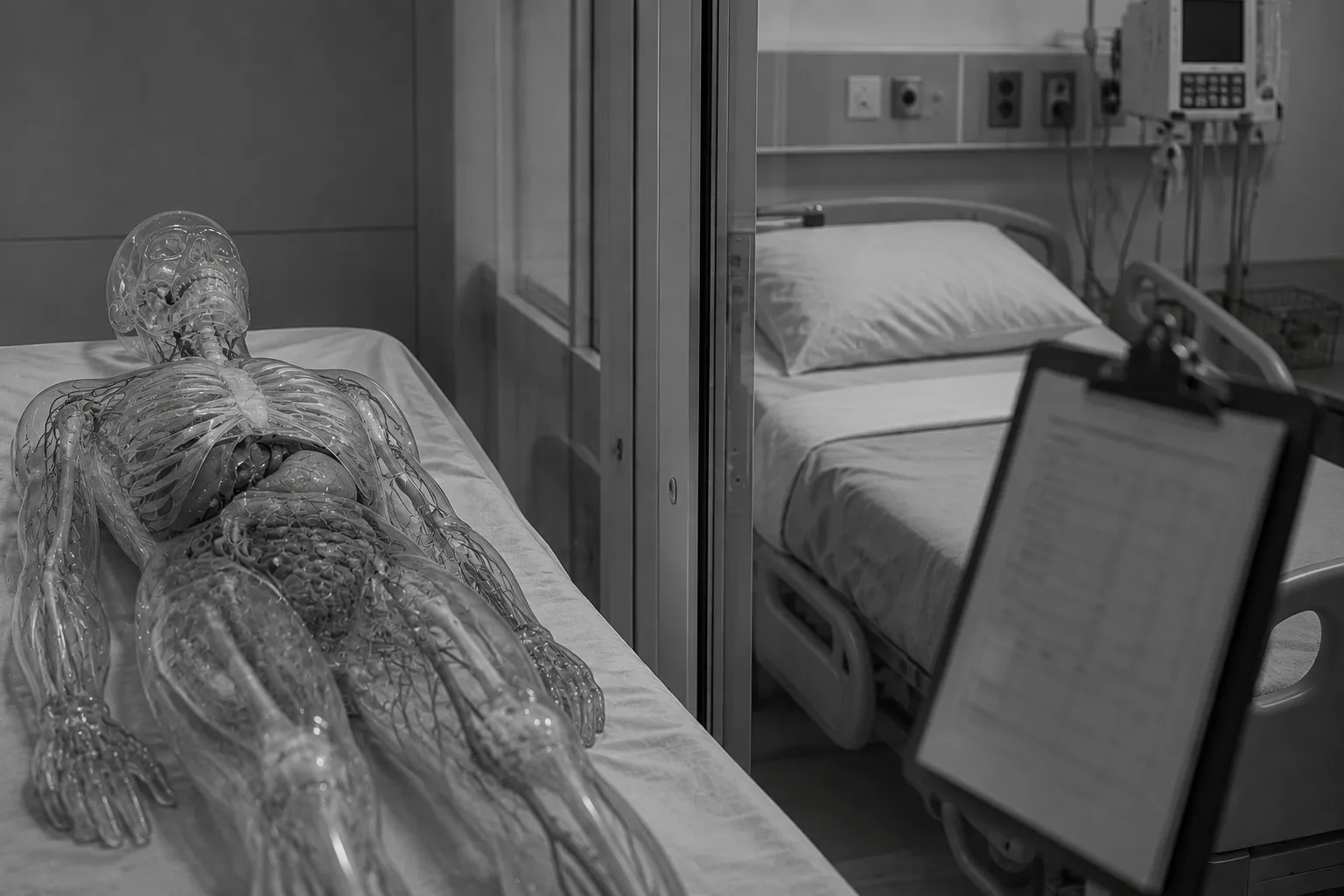
Mantis Biotech is building digital twins of human bodies from medical images, motion capture, biometric sensors, textbooks, training records, and other fragmented sources. Its system uses language models to route and validate the information, then a physics engine to produce synthetic datasets grounded in anatomy and movement. The company says these virtual bodies could help study rare conditions, train surgical robots, predict injuries, and test procedures where real patient data is scarce or ethically difficult to obtain.
A digital twin promises a second patient who can be measured, injured, reset, and observed without pain. That freedom is valuable precisely because medicine cannot experiment casually on a person. It also changes what counts as evidence. The synthetic body is not a neutral copy; it is an argument encoded in assumptions about physics, anatomy, behavior, and the datasets selected to build it. When information is missing, the model must invent a plausible bridge, and rare patients may be represented by the very generalizations the technology is supposed to overcome. Mantis proposes that virtual humans can protect privacy while widening research. The responsibility is to preserve the boundary between simulation and testimony. A digital twin can reveal a possibility, but the living patient remains the one whose body can contradict the model.






