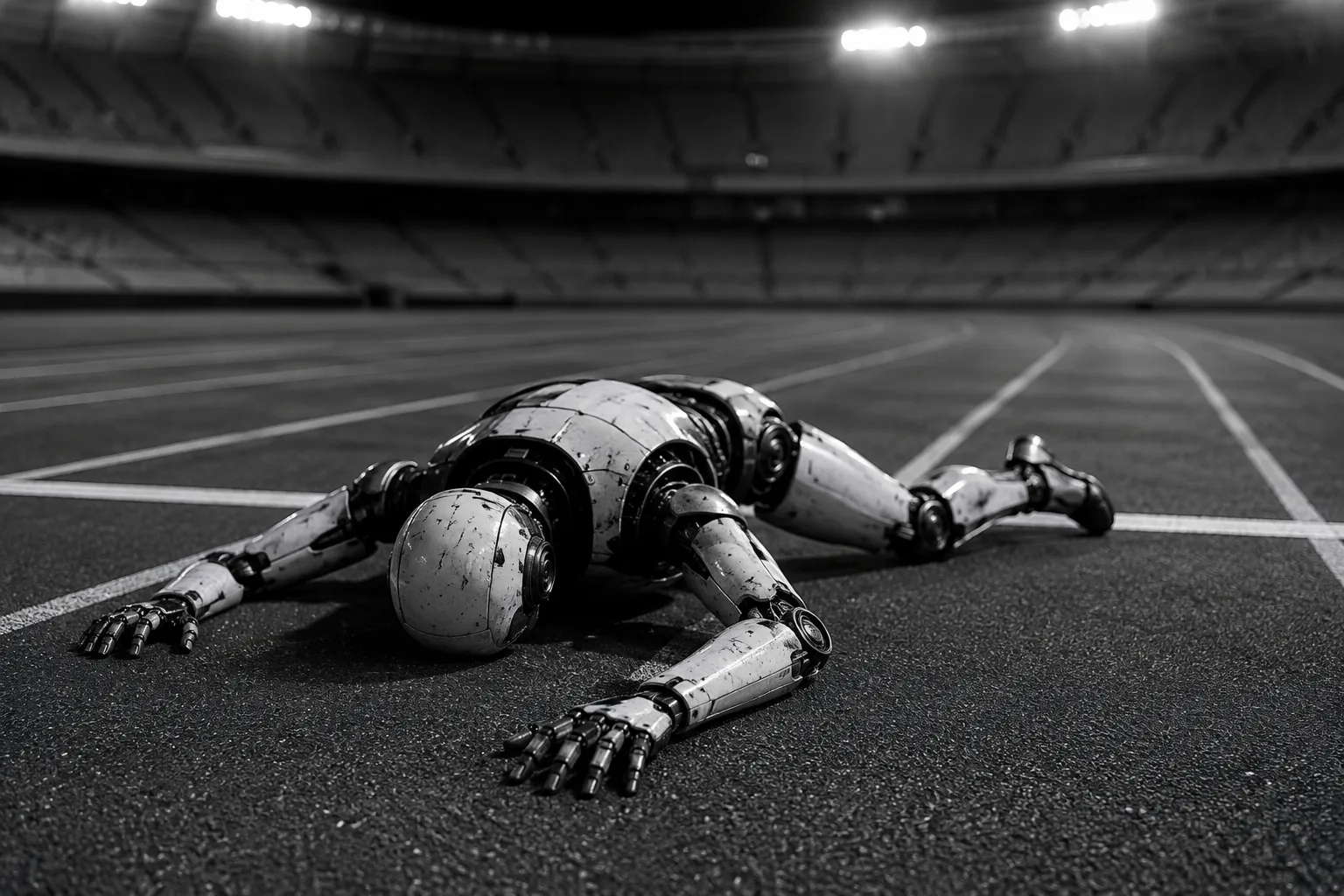
A humanoid robot named Lightning, built by the smartphone manufacturer Honor, ran 100 meters in 9.32 seconds during a preparatory test at the Second World Humanoid Robot Games in Beijing. The time beats Usain Bolt’s 2009 world record of 9.58 seconds. In the official preliminary heat, Lightning clocked 9.47. Another robot, Tiangong Ultra from the Beijing Humanoid Robot Innovation Center, finished in 9.39. Both times are faster than any human has ever run. The robots reached peak speeds above 14 meters per second. None of them could stop. After crossing the finish line, Lightning lost balance and crashed into the safety mats. Several other robots fell or collided in the same way. The first edition of these games, held in 2025, was won in 21.50 seconds. One year later, the machines have halved that time and removed the human body from the front of the race.
The record changes the conversation from intelligence to flesh. AI had already surpassed humans at chess, language, diagnosis, and image generation. The 100 meters was the last territory where the body still held an advantage. Bolt’s record ran on speed, tendons, lungs, reaction time, and a nervous system refined over millions of years. A robot does not breathe, does not tire, does not hesitate at the starting block. It accelerates without narrative. The problem is stopping. A sprinter decelerates using proprioception, balance, and learned motor control refined from infancy. The robot that beats Bolt’s time does not yet know how to stop being fast.






