
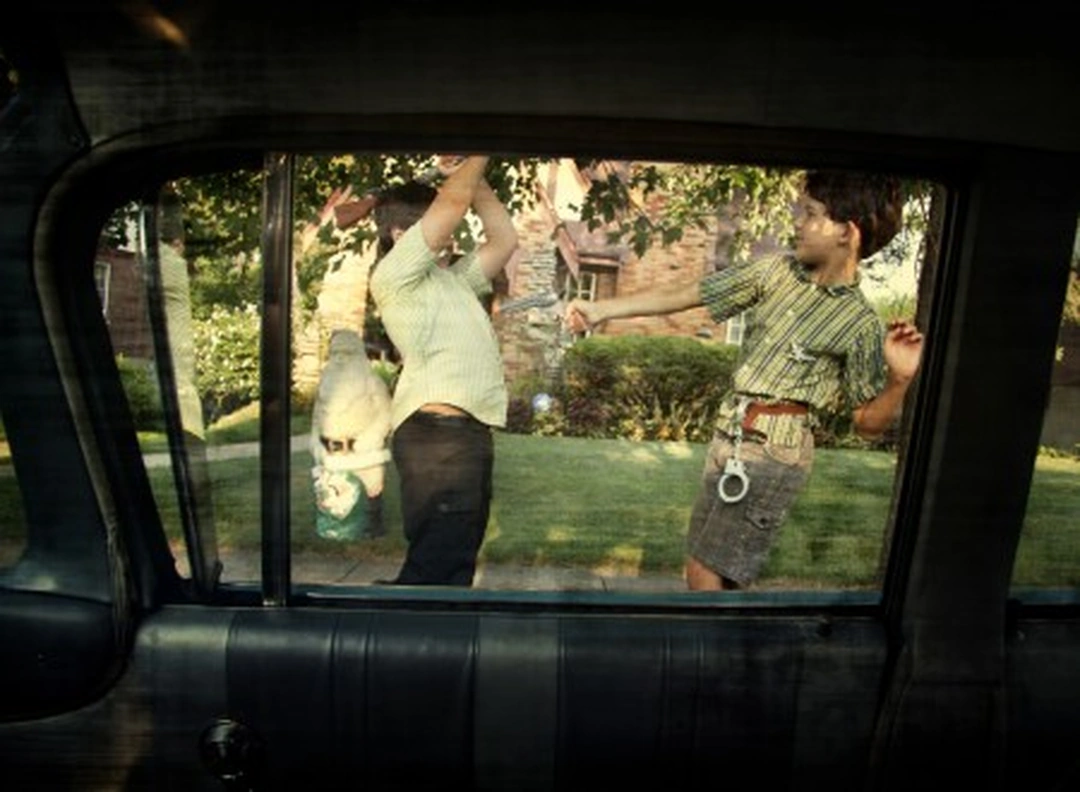
A vivid group of photographs by Brad Austin Smith are on display at the Alice F. and Harris K. Weston Art Gallery through June 3, 2012. At the heart of this exhibition is a raw look at the Queen City, its suburbs and American culture. Playful and striking photographs coalesce around a common viewpoint of the American visual lexicon, the gaze from the automobile. All the images have been shot from the interior of a classic car looking out at both urban and suburban Cincinnati. Each image is appropriately titled with the name of the street where it was captured. The world caught on film engages us with haunting and playful images of everyday life. Enright Avenue with a blurred shot of a cemetery picks up the same texture and shapes from the adjacent image of an industrial refinery in/on River Road. Smith is able to blend these diverse images into a narrative structure that evokes a social study of Cincinnati.
The reality and context of the images is reinforced by the frame of a 1960 Buick Le Sabre from which they were shot. In essence Smith takes us on a journey to experience the world as he sees it. We are looking through the front windshield or a side window of his car and see outlines of the car frame in the captured images. On occasion the image is captured directly behind the wheel, exposing the steering wheel and windshield wipers. Other images include the side-view mirror, which cleverly frames an additional image for us to reflect on. Bits of the turquoise blue car body let us know the images were all photographed from the same vehicle as we take our journey with Smith.
Hot dog stands, classic cars, airstream trailers and weathered signage summarize the architectural landscape that Smith has captured. However about a third of the twenty-eight images in the exhibition do capture people in the act of repairing cars, begging for money or making out. It seems as if the subjects photographed are all engaged in their daily lives without notice of Smith in his Buick, with one exception. The expertly composed shots reveal multiple layers for the viewer to peel away. The images all have a strong sense of nostalgia and are warmly saturated with color. Although the images were captured in the past two years, they look as if they could have been from 30 or 40 years ago.
One of the most powerful Images, Meyer Place, captures two children in the path of each other’s toy guns. On the one hand this is a simple depiction of two kids playing cops and robbers, but in keeping with the show’s title, Drive-By and present day violence of our culture it depicts the larger threat of the American psyche. Combined with ominous landscapes of flooding, shredded trees from recent tornadoes and suburban sprawl the exhibition has a foreboding presence. The images ask us to look more closely at the world around us.
Overpowering decaying vehicular structures show an ironic backdrop to a lone cyclist who rides beneath the rusting iron framework on English Avenue. This haunting vision is created by a strong juxtaposition of a singular human form against the ominous built environment. I get the sense that Smith wants us to pay more attention to our surroundings. His photographs make me want to do just that: to write down the name of the street from which they were captured and to go explore this place for myself. Despite the ominous presence of the decay the bicyclist is focused and in the process of escaping. Although many of the works depicted here show the residue and character of a decaying city, they also offer hope through various devices, such as the movement of the bicyclist. Another persuasive technique is the use of alternate reflections from side-view mirrors. They let us see multiple viewpoints into the scene. We are given the ability to look both forwards and backwards. Some examples of this juxtaposition are the reflected sunset in a larger field of traffic or a humorous vision of Frisch’s Big Boy set against a suburban strip mall or the hand of the photographer holding the camera.











Comments powered by Talkyard.