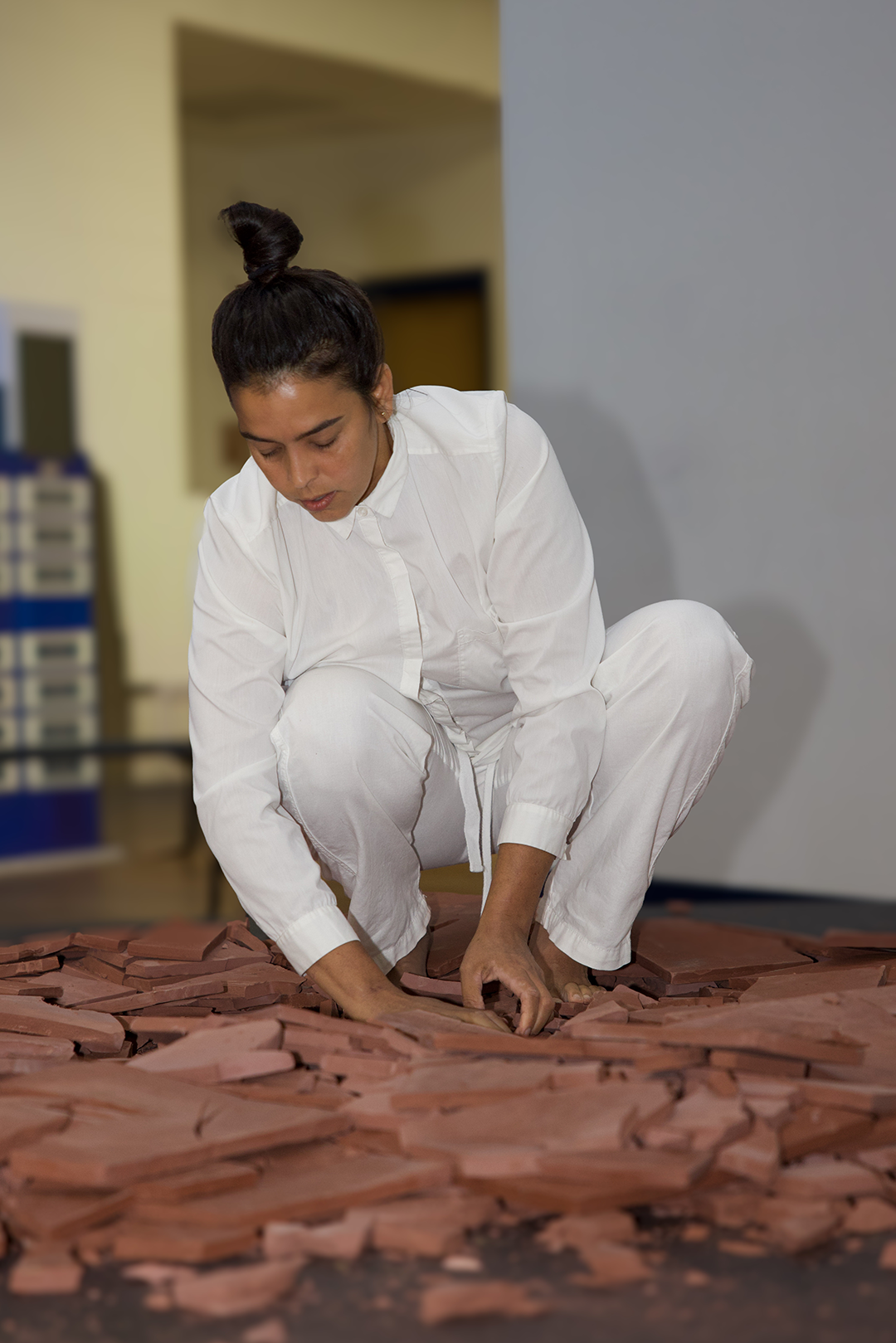
Onomatopoeia or the Moans of a Prayer, 2017–2026
Site-specific performance. Clay | Variable dimensions
Photography by Lazaro Kuang
In encounters with certain works of contemporary visual art, perception activates modes of association that situate aesthetic experience in territories where matter, gesture, and time intertwine. Elizabet Cerviño’s (Manzanillo, Cuba, 1986) exhibition The Rhythm of Resilience, recently presented at Gallery 114 in Ybor City, Florida, unfolds within this horizon.¹ Each work proceeds from a state of transformation that accompanies the life of its materials, whether through their interaction with the surroundings or through the process of their creation. This dynamic takes shape through two aspects of migration. On the one hand, matter migrates from one state to another—it evaporates, hangs suspended, breaks, stretches—or appears in forms in which the material remains stable, while its arrangement suggests processes—of falling, accumulation, erosion—that take place in the viewer’s perception. On the other, in the course of her own life, the artist moves from the island of Cuba to the Florida peninsula, and that experience becomes a path to knowledge that guides her practice.
Cerviño’s relationship with nature—a bond rooted in her rural childhood and reestablished in the course of her life in the southern United States—offers one possible route into this exhibition. That sustained contact with the organic and the natural world manifests itself in her handling of materials and in the structures that constitute her works, without imposing itself as the sole interpretive key; it opens, rather, another perspective from which to understand how the artist places her work in dialogue with the processes that move through matter.
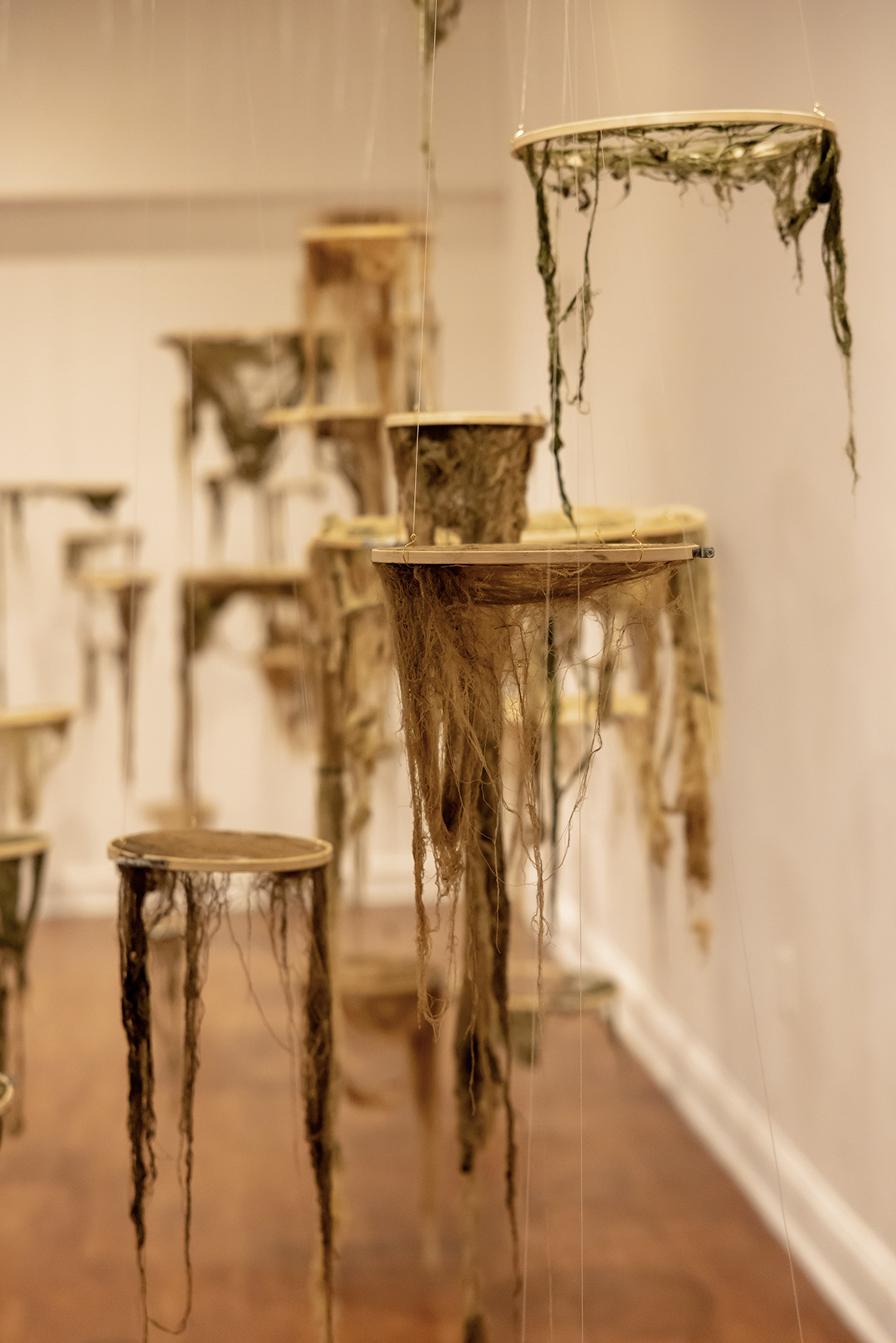
Goteras sobre un pantano (Leaks over a Swamp), 2026
Installation. Embroidery hoops, seaweed, fishing line, audio | Variable dimensions
Photography by Lazaro Kuang
Her sensitivity to these processes gives rise to Leaks over a Swamp. In this installation, suspended algae and the vibration of sound create an atmosphere in continuous transformation. Spread across embroidery hoops hanging from the ceiling, the algae behave like membranes that filter light and air. The work holds itself in an equilibrium that is never fixed: changes in ambient conditions subtly alter the landscape, and the piece is perceived as an organism responsive to its surroundings. Within that space, atmosphere becomes a way of inhabiting, and the installation takes on the character of a breathing body. Woven into this fabric is the sound recording, whose vibration eludes the visible and is perceived as a modulation of the surroundings that links the sounds of the flowing river to the gathering of algae by hand, reinforcing the installation’s presence as a living space where nature and human labor intertwine.
The artist continues her work with matter through a tactile and visual experience that she develops both in her contact with organic materials and on canvas. By opening, stretching, and unfolding fibrous networks, she brings to the algae a working logic derived from her relationship with painting: the fibers behave like surfaces that filter light and air, and in that condition acquire the quality of a support on which ideas take form. The embroidery hoops reinforce this reading by stretching the material as though it were suspended canvas, positioning the installation as an extension of a pictorial exercise in which matter becomes thought.
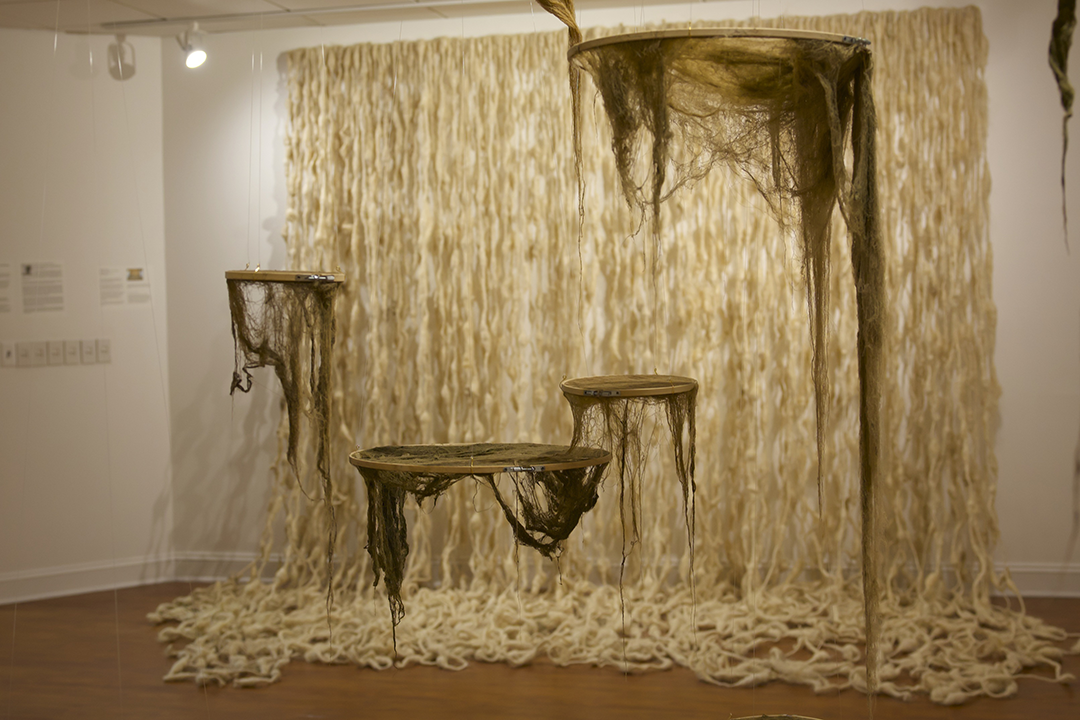
In the background, from the Resiliencia (Resilience) Series: Taking Stock, 2022
Installation. Hand-woven sisal fiber | Variable dimensions
Photography by Lazaro Kuang
Taking Stock proposes a different way of thinking about transformation, associated here with the suspension of change within matter. The fiber extends toward the floor, alluding to the “waterfall” Cerviño mentions in her project text. The image, more poetic than literal, makes perceptible the tension between the flow it evokes and the stillness of the matter that seems to arrest it. The artist speaks of a “splintered, illegible, and serene writing” and of “knots that hold secrets.” Through these words, the skein can be read as a silent presence, closer to memory than to narrative. Within the exhibition, Taking Stock constitutes a moment of pause. The stability of the fiber invites us to consider resilience also through what is preserved.
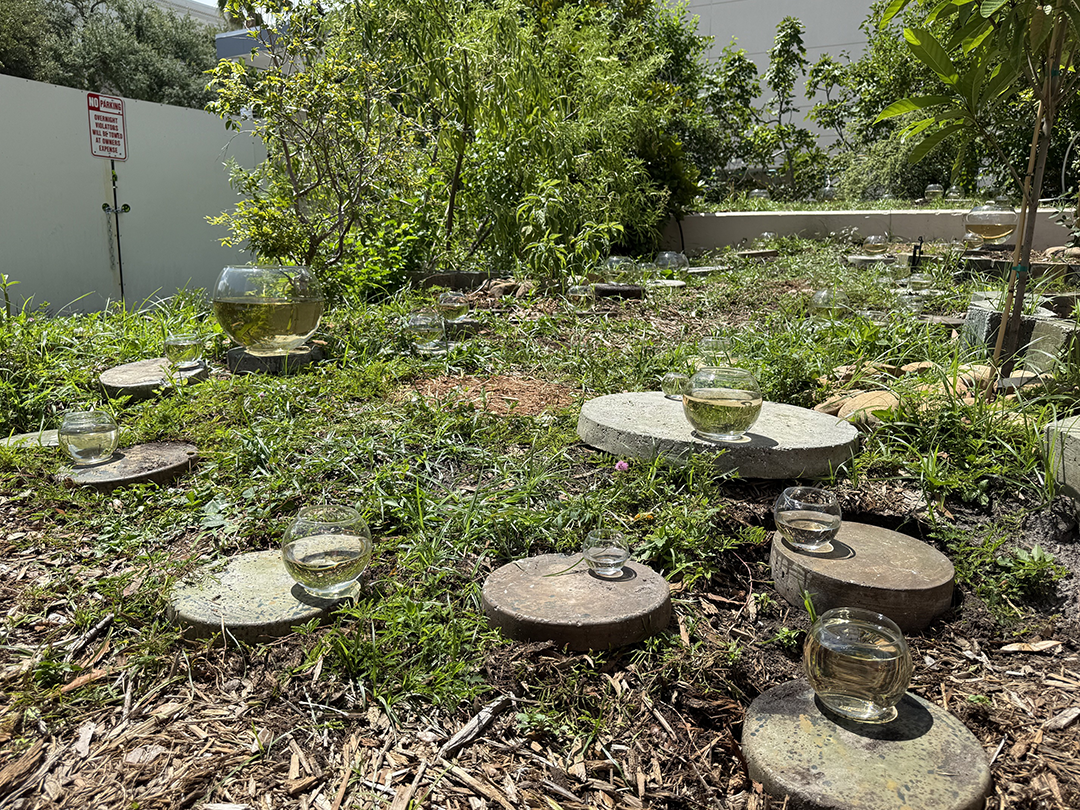
Consumación (Consummation), 2026
Installation. Glass spheres, water | Variable dimensions
Photography by Lilliam Cedeño
Consummation, for its part, brings together small glass spheres containing rainwater. As the days pass, the water evaporates, leaving traces on the walls of the glass: marks that function as geographies of time, records of a process no longer present. The piece rests on a dynamic of withdrawal: matter migrates from one state to another and, in that passage, produces a minimal, almost imperceptible form of writing. Evaporation acts as a silent transformation that turns each sphere into a small archive of absence. The serial arrangement of the spheres—fifty-nine in all—also introduces a pattern of repetition that subtly evokes ritual structures of counting, without allowing this dimension to dominate the material reading of the work. The installation reveals a form of resilience articulated through matter’s capacity to migrate from one state to another, to undergo a process of loss and, despite it, persist as a trace. That minimal, almost secret continuity enters into dialogue with the artist’s own life, for whom transformation—in her passage to a new country and a new environment—becomes, in turn, a way of remaining.
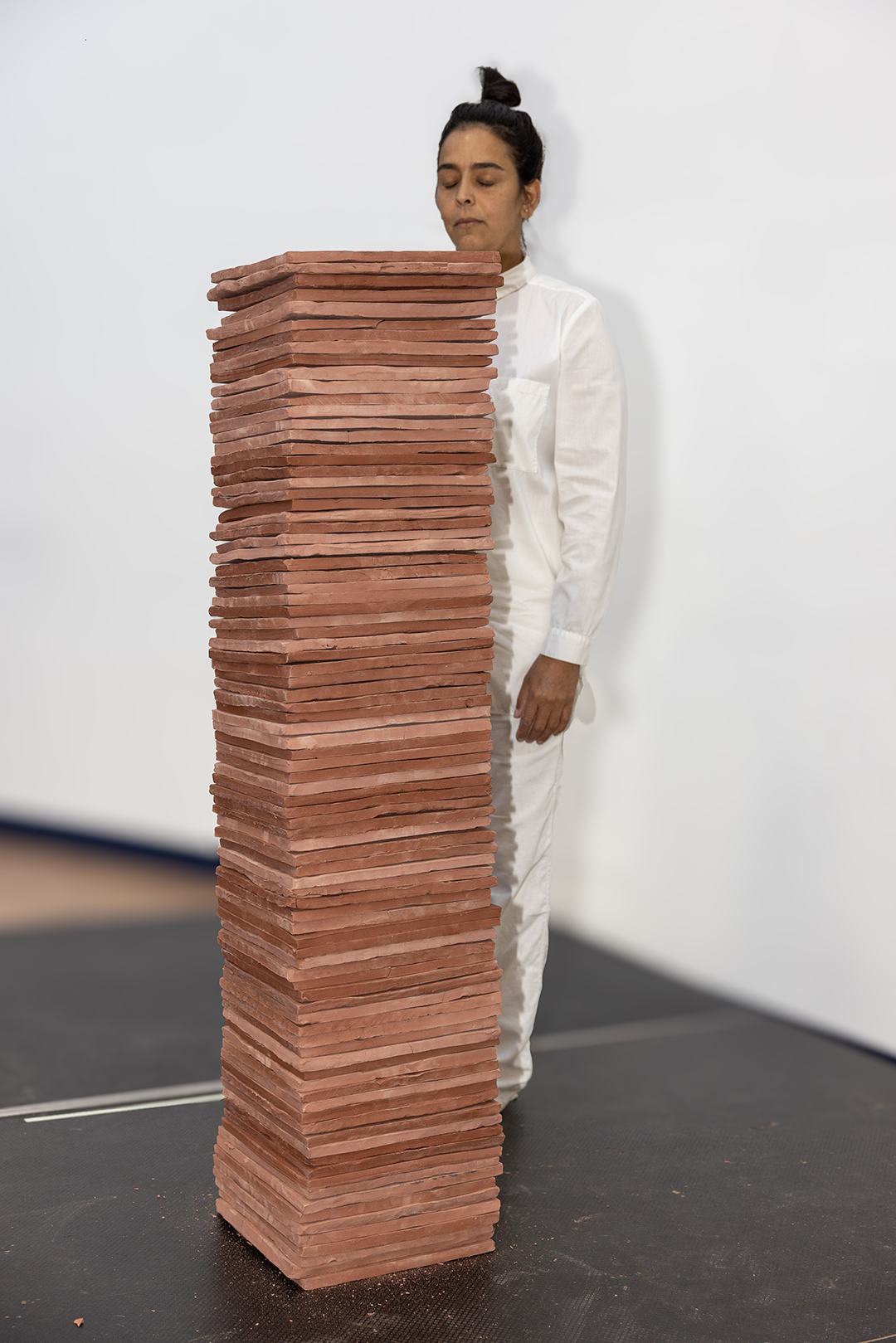
Onomatopeya o gemidos de una oración (Onomatopoeia or the Moans of a Prayer), 2017-2026
Performance, Site-Specific. Clay | Variable dimensions
Photography by Lazaro Kuang
Onomatopoeia or the Moans of a Prayer takes shape as an object-based and performative work built from a series of clay tablets, each marked with a letter that the artist identifies and vocalizes before smashing the tablet against the floor. That sequence—inscription, sound, fragment—forms the conceptual core of the work, where temporality manifests itself as a process of linguistic decomposition and, simultaneously, as a reflection on communication in contexts of migration. The artist has noted that emigrating confronted her with the difficulty of inhabiting a language still foreign to her; in this work, she gathers that experience and transforms it into gesture. A drift takes place that carries the letter from sign to manipulable matter; the word from meaning to physical gesture; and language from structure to action upon clay, all of which produces a vibration that unsettles the stability of the linguistic order, giving rise to a minimal form of invocation. The work materializes language, turns it into surface, weight, and ruin, generating a landscape of fragments that retains the memory of the gesture.
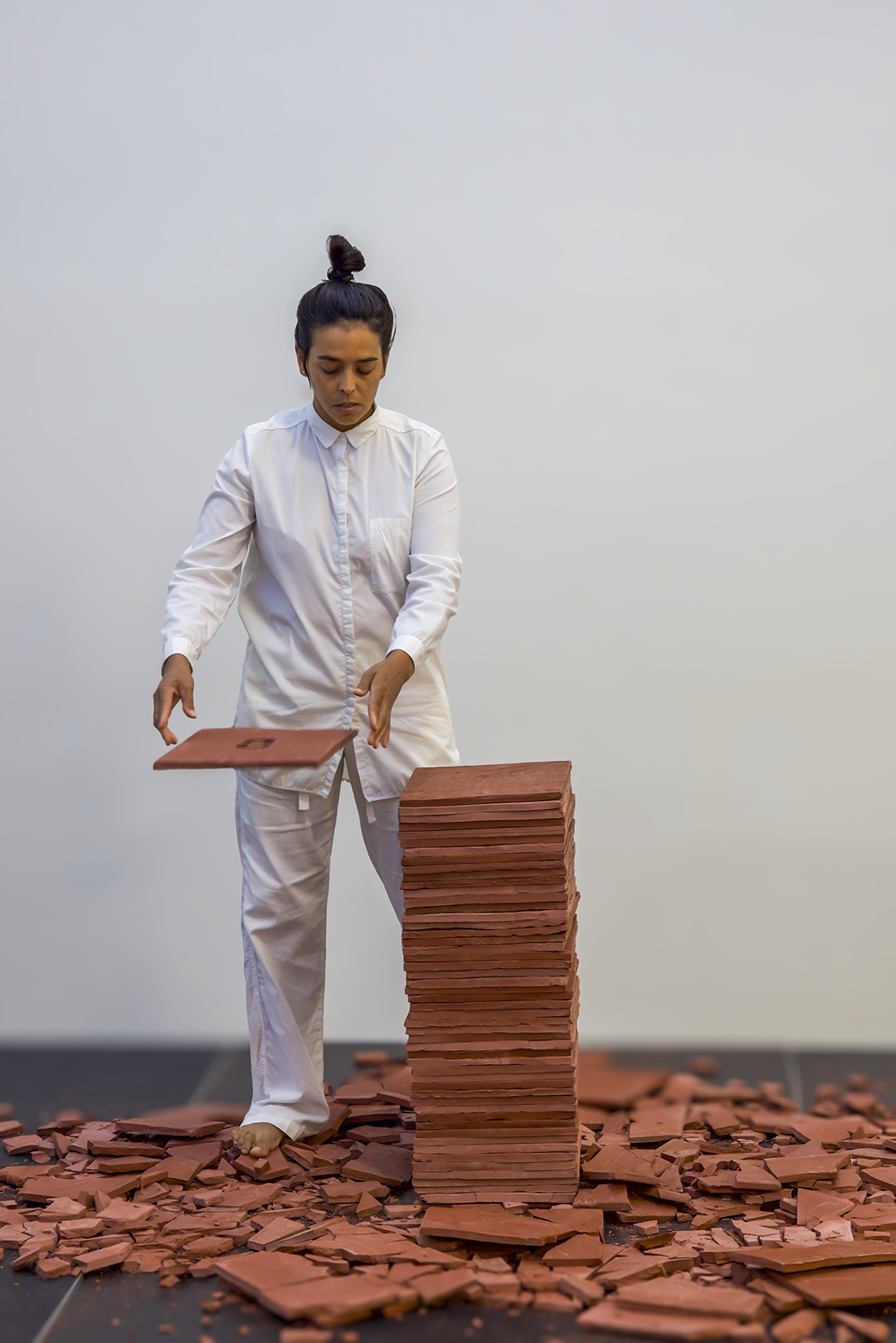
Onomatopeya o gemidos de una oración (Onomatopoeia or the Moans of a Prayer), 2017-2026
Performance, Site-Specific. Clay | Variable dimensions
Photography by Lazaro Kuang
The vertical stacking of the tablets acquires a symbolic dimension that expands the work’s interpretive horizon. This arrangement functions as a set of signs held in semantic suspension, a body of potential narratives revealed only at the moment of its destruction. Two images thus emerge that open further possibilities of meaning: “from dust we come and to dust we return,” whose materiality becomes literal in the clay when, upon breaking, it returns to its condition as earth. Another possible image would be that of the Tower of Babel, where the failure of communication brought about by the fracture of shared intelligibility could serve as a metaphor for migratory passage. In the performance, Cerviño dismantles the tower blow by blow, returning each letter to dust and fragment; in that sequence, change also reaches the structure that makes the word possible. The work thus expands the temporal sensibility that runs through the exhibition by translating metamorphosis into a series of irreversible actions—from inscription to dissolution—in which matter, language, and displacement converge in a single form of becoming.
Ibis Hernández Abascal is an independent curator and art critic
¹ The Rhythm of Resilience was curated by Gabriela Azcuy, Amanda Posse, and Elizabet Cerviño. The exhibition was open to the public from July 30 to September 24 and concluded with a performance and an artist talk.









Comments powered by Talkyard.