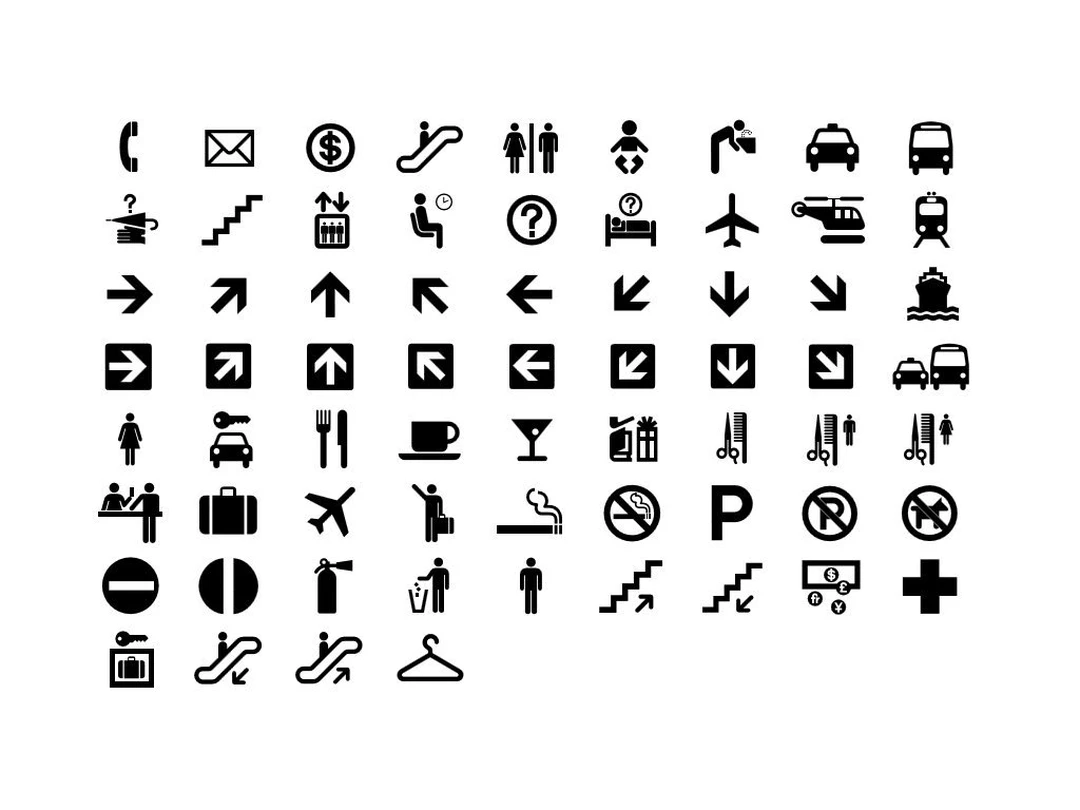
A sampling of the symbols created by the U.S. Department of Transportation in collaboration with AIGA.
In 1930, Beatrice Warde gave a speech entitled “Printing Should Be Invisible.” Later printed under the name “The Crystal Goblet,” she explores concepts that graphic designers will invariably encounter at some point during their careers. Warde begins by asking whether you would rather be served your favorite vino in a solid gold vessel or a crystal clear goblet. Your answer, she says, will reveal you to be a connoisseur of wine …or not.
The crystal goblet is preferable for one with an interest in the wine itself, “because everything about it is calculated to reveal rather than to hide the beautiful thing which it was meant to contain.”
Graphic design frames, shapes and informs many of our experiences and yet often goes unnoticed by the casual observer. Rarely, it will leap into the public spotlight, most often out of dislike. The London Olympics logo, The Gap’ s new (and later retracted) logo, and the University of California’ s new (also later retracted) identity system all come to mind. Comic sans is regularly joked about by designers and non-designers alike, but how many of us can name not only “bad” but also “good” fonts? Great design is the crystal goblet: we hardly notice it, because it accomplishes what it was intended to do with little fuss.
It is nearly impossible to spend a day in our contemporary world without encountering graphic design. Have you ever stopped to notice the symbols used for airport signage? You were likely focused on your travel plans rather than considering that a team of designers carefully developed those icons which have become universal in airports, malls, casinos, and convention centers; the average viewer absorbs the message and continues on his or her journey with little thought as to how that message was delivered.
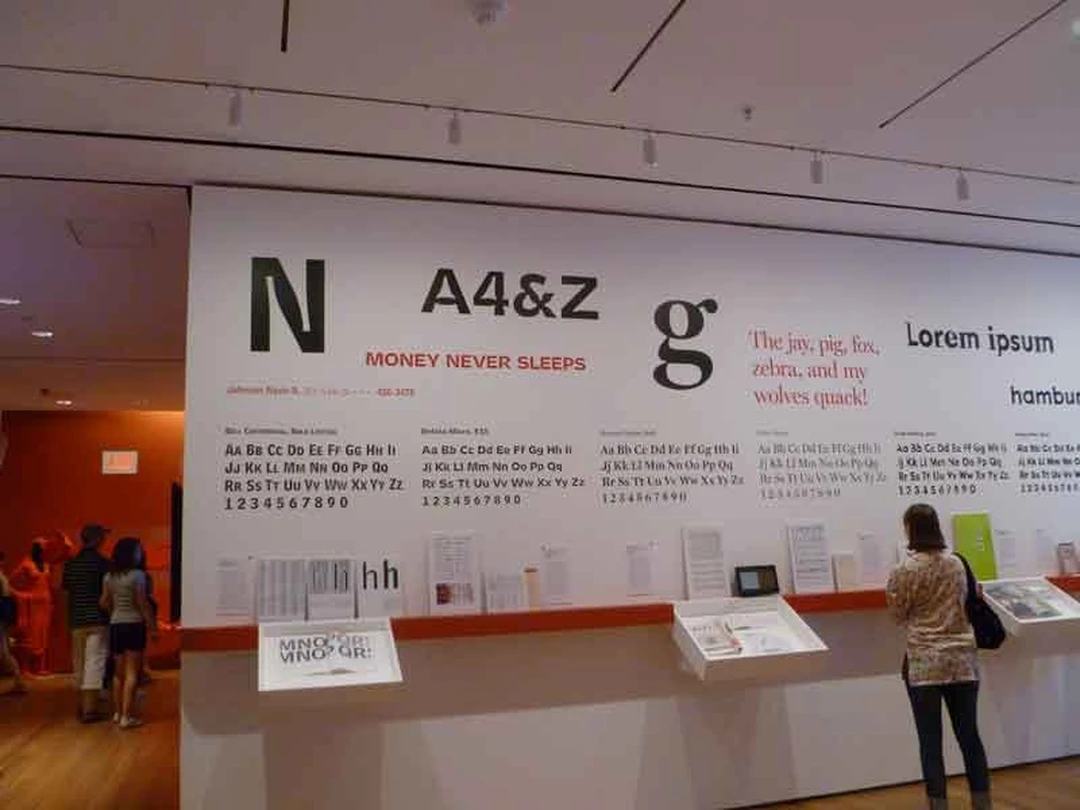
MoMA’s digital font installation, courtesy of Simple Splendid Things.
A bit of a blurry space exists which both graphic design and art inhabit. The Museum of Modern Art established their collection of Architecture and Design as early as 1932 and has begun to acquire digital fonts as part of that collection. Like many other objects–for example, the Eames Lounge Chair–these digital fonts are commercial products that continue to be available through the manufacturer.
Other museums also include iconic pieces of graphic design in their collections. The Cooper-Hewitt National Design Museum has a curatorial department specifically named Drawing, Prints and Graphic Design, which includes 88 objects by the Modernist graphic designer Paul Rand, including letterheads, memo pads, and envelopes he designed for IBM (along with their now iconic logo). The Design Museum in London has posters, books, catalogues and brochures by Saul Bass, Stefan Sagmeister and Experimental Jetset (the latter two are still practicing graphic designers today).
In these opposing contexts, graphic design is a nebulous thing, moving seamlessly between your everyday experiences and the hallowed halls of a museum. It can exist within a museum as the art object, and at the same time provide context for said object (as an object label or exhibition brochure). Perhaps its fluid nature is why I find the discipline to be endlessly fascinating, and why many graphic designers–including myself–struggle to define what exactly their job is when questioned. Graphic design is surely a creative discipline, but even graphic designers can’ t come to a consensus when asked if their discipline is art.
One could point to the intentions of the creator. Art may be defined as such because the creator intended it to be art, as a personal expression in the purest form, to serve themselves and not their audience. Artists are generally the authors of their own content, while graphic designers are traditionally the framers of another’ s message. Graphic design may be commercially motivated, intended to distinguish a product from the competition or to instill trust in a customer; conversely, it may also be motivated by the “greater good,” and many designers feel compelled to deliver environmentally responsible and socially conscious work. In instances like this, the designer is often the author of content as well as messenger.
One could also point to the perception of the audience. Are soup cans art only when painted by Warhol, or also when sitting on a grocery store shelf? Are urinals art only once Duchamp has scrawled a name on it? Do we make something art merely by declaring we find it visually appealing? An audience can, and will, place both graphic design and art in different contexts than the creator intended, and formulate new conclusions about the nature of the work based upon those contexts.
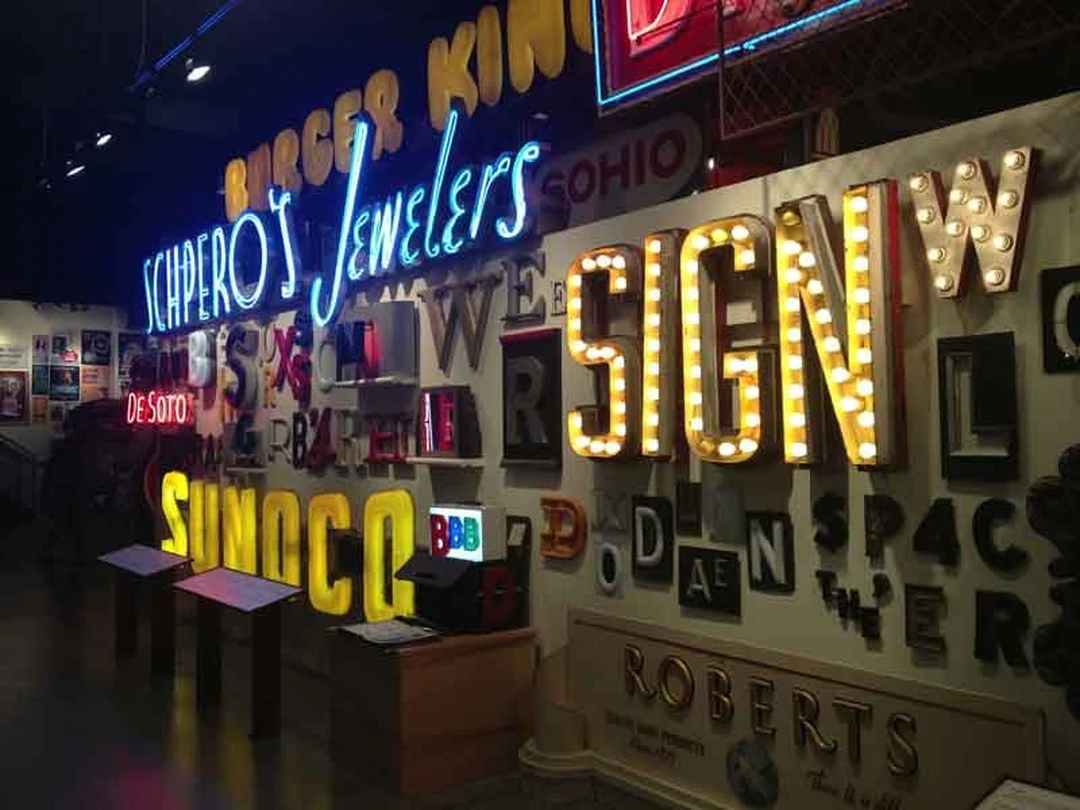
The American Sign Museum located in the Camp Washington neighborhood of Cincinnati.
It’ s not so hard for me to imagine a future in which some of our best contemporary signage systems (again, only one small example of graphic design in our contemporary world) are on display in a museum. Many of the artists whose work is now on display in the newly-opened American Sign Museum here in Cincinnati surely never intended their work to be found years later in a museum setting; yet, here it is, and very rightfully so. The American Sign Museum has an impressive display of signs spanning the history of the craft, most of which were originally commercial designs that we now appreciate for their ingenious use of the technology of the times, such as a sign for Kelly Springfield Tires with a system of cast glass screw-in plugs, or their beautiful shapes and forms, such as the large collection of proposals by the Beverly Sign company featuring incredible custom lettering.
I also imagine the same future museum displaying websites, graphical user interfaces, books and magazines: contemporary non-art objects we touch every day that will someday be valued for their aesthetic beauty and innovative use of technology. We may not know what the wine of the future will be, but I have no doubt there will be designers making crystal goblets to serve it.
Danelle Cheney is a graphic designer living and working in Cincinnati, Ohio. She specializes in typography, publications of all kinds, and photography. Her hobbies include traveling, hiking, playing with cute puppies, and taking photos of beautiful old signs.







Comments powered by Talkyard.