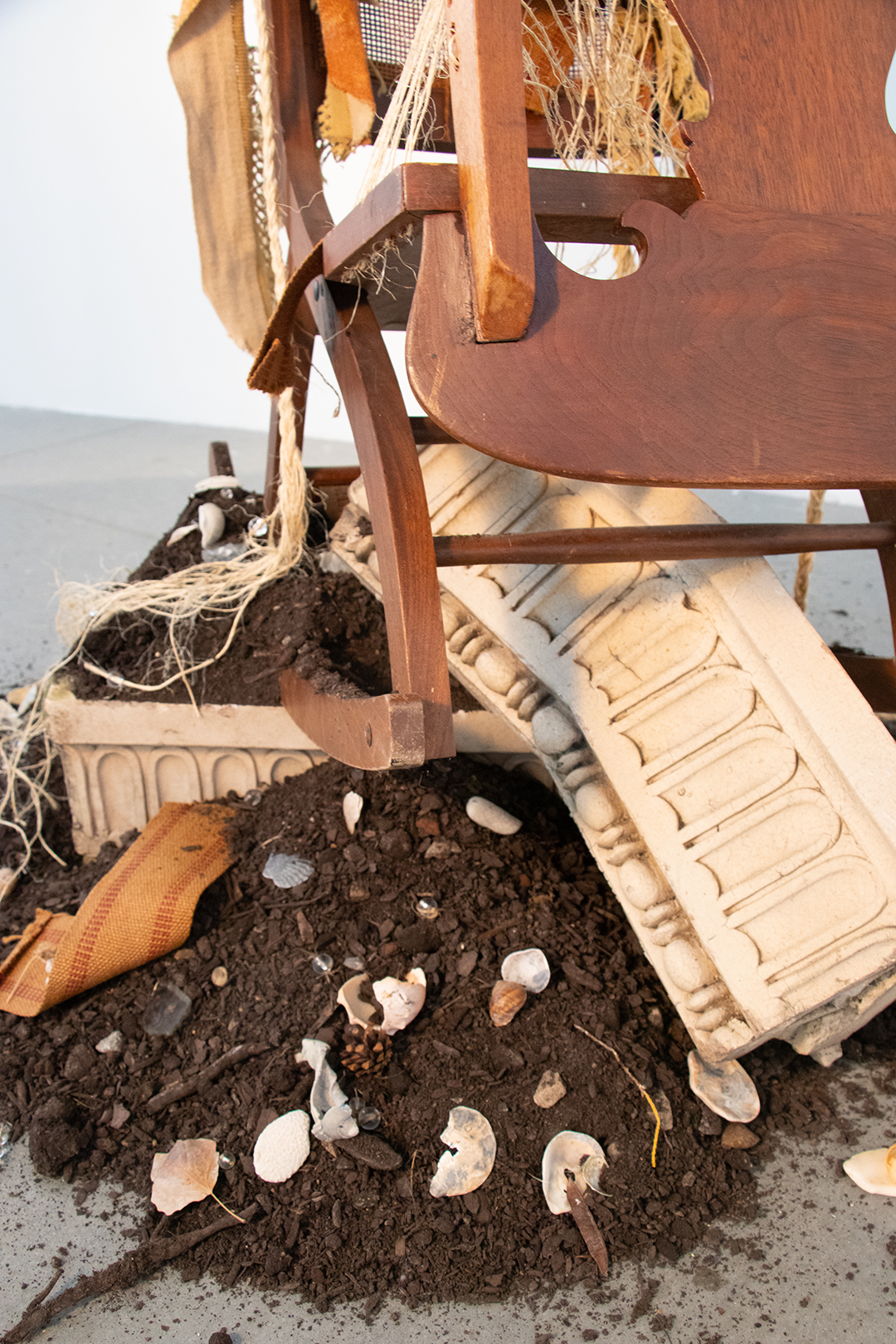
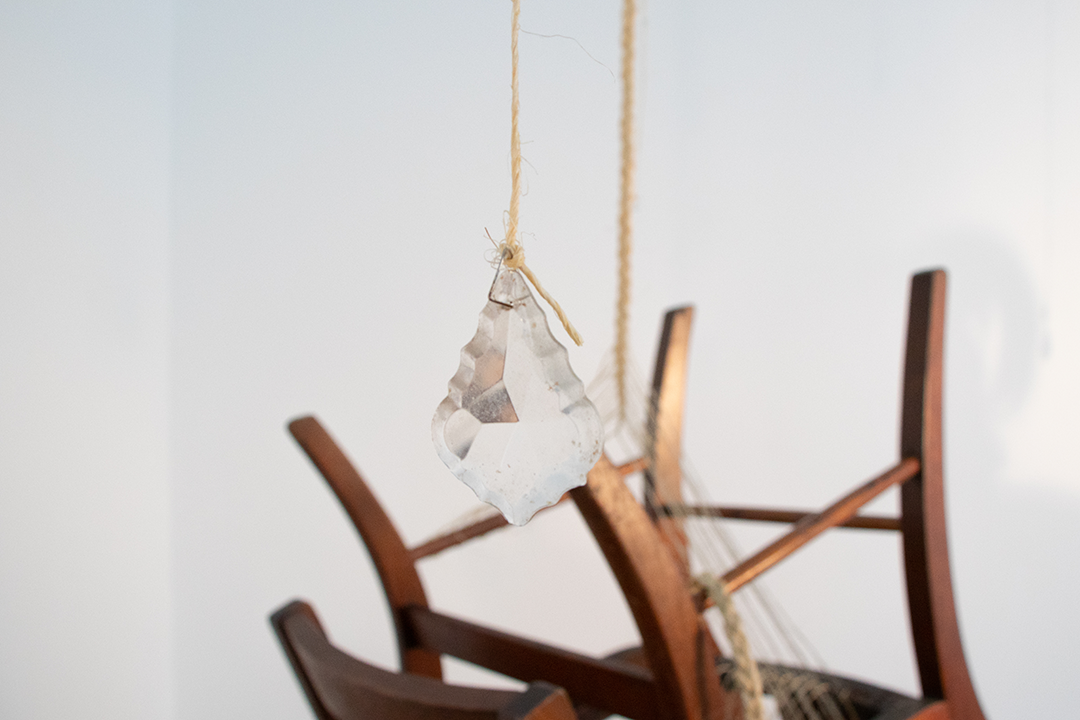
Installation, 2017–2024
Repurposed chairs, twine, repurposed architectural debris, soil, shells, organic and inorganic matter
Dimensions variable
In the Middle of the Endless Water, a solo exhibition by Julia Orquera Bianco curated by Carolina Cuervo at the Philip M. Meyers Jr. Memorial Gallery at the University of Cincinnati, brings together more than a decade of work by an artist whose practice has gradually moved from the personal experience of migration toward an inquiry into territory, memory, ecology, and alternative forms of knowledge.
This shift in register should be read as one of the keys to the exhibition. Bianco was born in Argentina, initially trained in Buenos Aires, later earned an MFA from the University of Southern California, and now lives in Cincinnati. To this artistic trajectory she has added studies and experiences connected with sustainability, permaculture, medicinal-plant conservation and, since 2024, regular journeys to the Peruvian Amazon to study medicinal plants with Shipibo teacher Estela Pangoza.
For all these reasons, a reading of the exhibition centered on a narrative of immigration would be limited. The migratory experience functions as the point from which Bianco begins to question the stability of concepts such as origin, home, or identity. The curatorial text speaks of the “hybridization” between what she carries with her and what she encounters in each new territory.
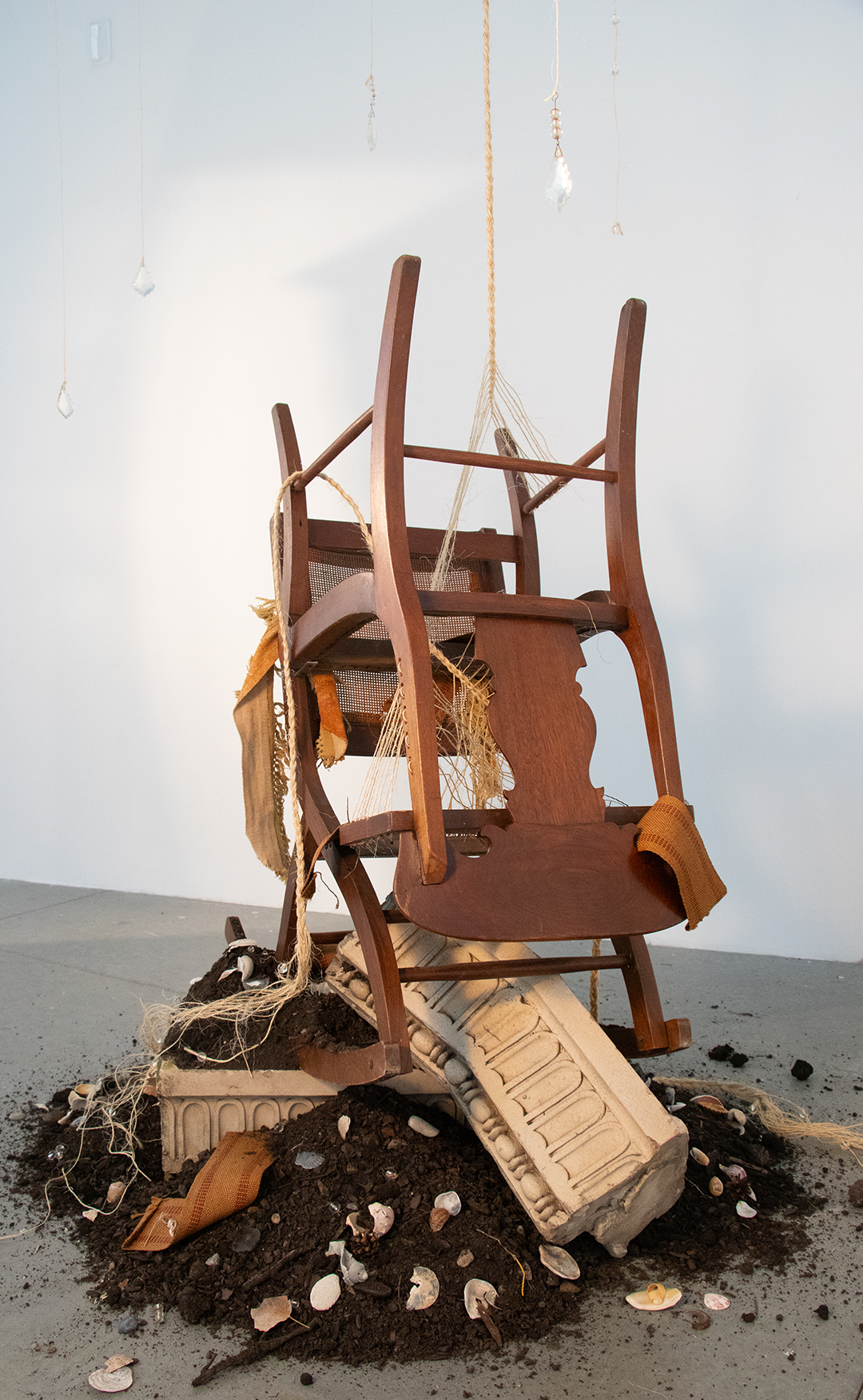
Installation, 2017–2024
Repurposed chairs, twine, repurposed architectural remnants, soil, shells, organic and inorganic matter
Dimensions variable
Doesn’t the exhibition truly begin when that migratory experience becomes an inquiry into belonging, territory, and knowledge?
Within that shift, the place occupied by inherited practices becomes important. Work, craft, music, and storytelling appear as mechanisms through which a person sustains a certain continuity after displacement. Bianco defines these family traditions as strategies for rebuilding a home, connecting present experience with memory.
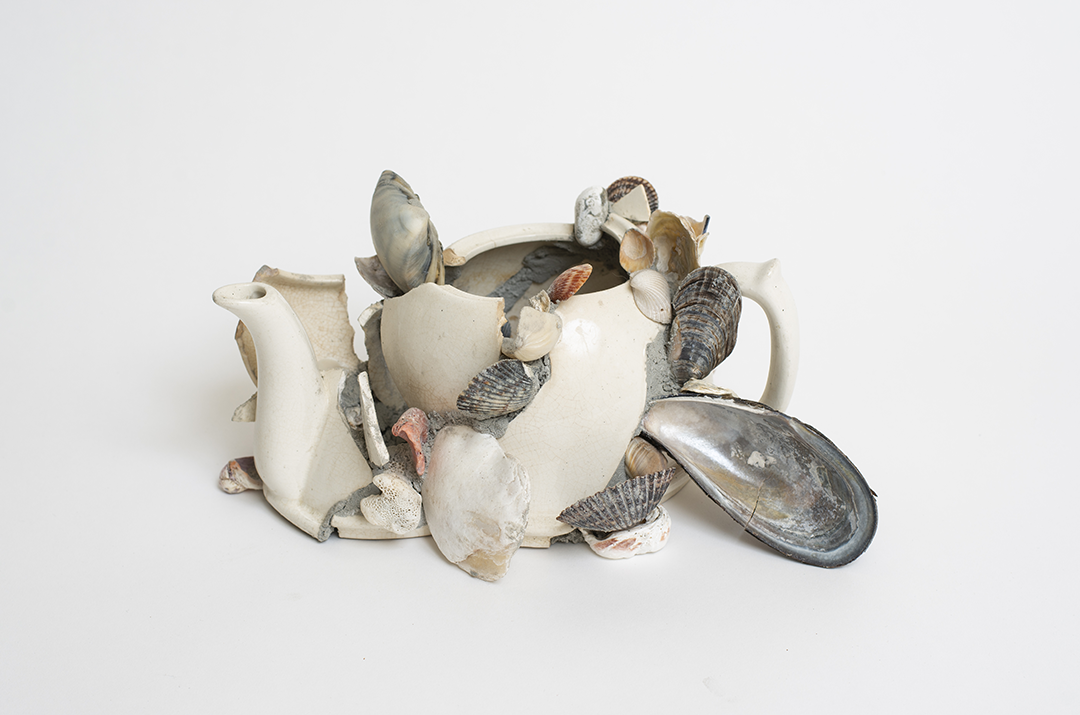
Home Artifact, 2013–2015
Repurposed teapot found in L.A., shells collected in Mexico between 2013 and 2015, cement
12 x 20 x 12 in.
Home then ceases to be understood exclusively as a geographical site and begins to function as a mobile structure composed of habits, objects, memories, and relationships. Curator Carolina Cuervo reinforces this interpretation. Her own research has for years considered travel as a method of artistic production. In an earlier text, Cuervo noted that her research on contemporary Argentine art led her to examine how travel could become a working methodology for artists. It is therefore hardly accidental that she organizes the exhibition as a passage through territories and stages rather than as a chronological retrospective. It is a significant curatorial decision. Travel ceases to be the isolated event that precedes a series of works and becomes a source of knowledge and a working methodology. The artist moves, observes, gathers materials, establishes relationships, learns techniques, and comes into contact with other systems of knowledge. The relationship with territory participates directly in the production of the work.
This idea is perceptible in Bianco’s recent works involving plants and her research into Andean-Amazonian cosmologies. The exhibition press release defines fieldwork as a narrative device and points to the way process, laboratory, and experimentation displace the traditional centrality of the finished work. It is probably the most significant and interesting aspect of her current practice.
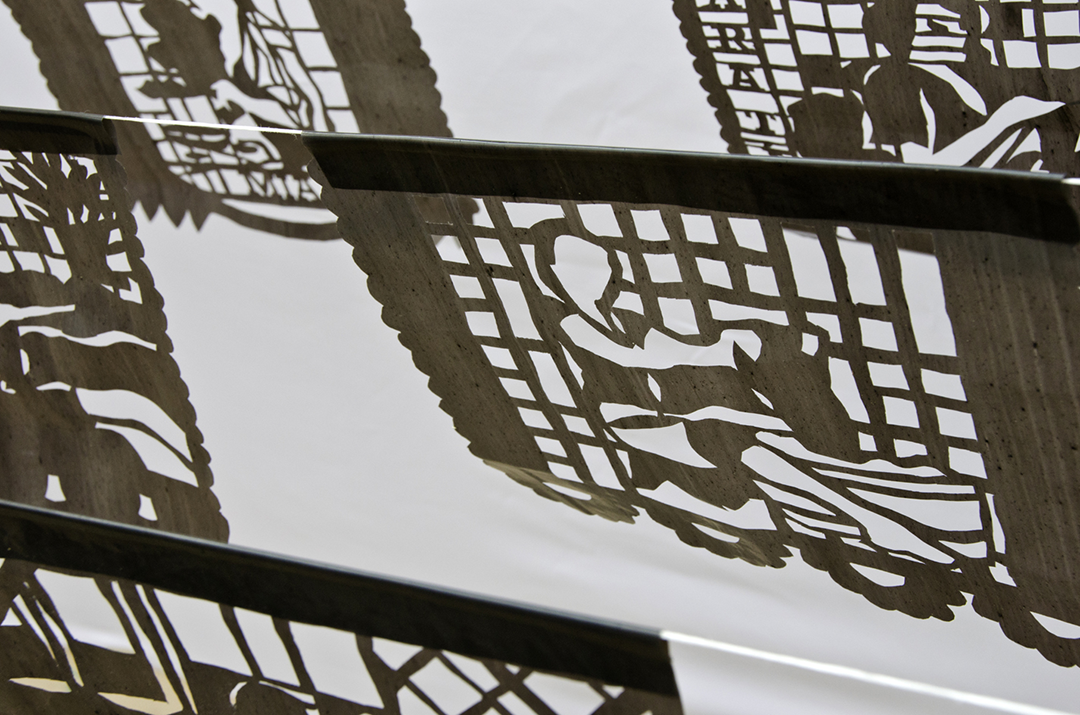
Trapitos al sol, 2015
Installation – Cut-out trash bags, twine. Banner designs by the artist.
Dimensions variable
Bianco insists on remaining in an intermediate zone between artist and field researcher. Her recent training makes it difficult to regard her references to plants, ecology, or sustainability merely as iconographic resources. She has deliberately sought to acquire concrete knowledge in these fields. Nor does she appear intent on becoming a scientist in the conventional sense. Her work occupies, rather, a space of exchange among personal experience, family memory, artistic research, botanical knowledge, and cultural forms of knowledge connected with plants. That intersection deserves attention because it belongs to a phenomenon that has become quite visible in contemporary art over the past several decades. Many artists have moved away from the autonomous production of objects to develop practices based on research, archives, ecology, collaboration, or fieldwork. In the Middle of the Endless Water makes clear that it places greater importance on processes, the laboratory, and the relationships established during research than on a closed body of works.
The risk involved in this kind of practice is evident. When an artist chooses to work with Indigenous cosmologies, traditional medicine, or ecological knowledge, there is always the risk of reducing these complex cultural systems to symbolic repertoires available for appropriation. Bianco, however, unquestionably attempts to establish a systematic relationship with these forms of knowledge. Since 2024, she has studied regularly in the Peruvian Amazon with Estela Pangoza and connects that learning with earlier preparation in conservation, sustainability, and permaculture. This may not make the familiar questions concerning the reinterpretation of such knowledge within another cultural context, or its direct appropriation, disappear, but it considerably alters the context in which those questions are formulated.
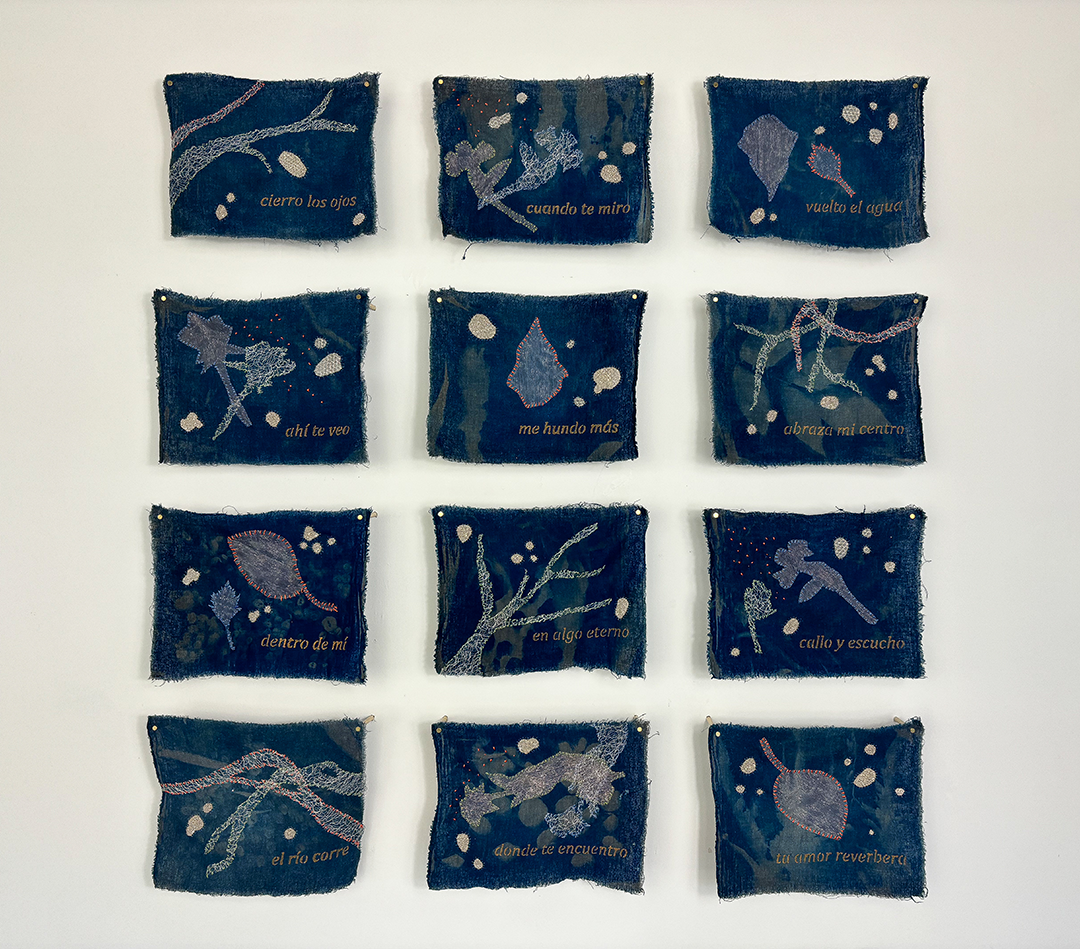
Rainsong, 2024
Installation – cyanotype-printed linen banners, tulle, embroidery thread, watercolor
Dimensions variable
Water provides Cuervo with the conciliatory element, appearing as a material continuity between territories and as a cyclical structure connecting present and past. It is a metaphor, of course, but it is useful to observe that water also makes it possible to relate several of the project’s foundational dimensions: migration, circulation, transformation, ecology, and memory. It constantly changes position and state without losing continuity. It functions as a model for the idea of identity that sustains the exhibition.
The place in which the project is presented is also significant. The Philip M. Meyers Jr. Memorial Gallery forms part of DAAP Galleries, whose program explicitly states its intention to use visual practices to foster the exchange of ideas within the university and to present exhibitions capable of connecting different disciplines. The gallery, in particular, includes among its goals the visual presentation of complex ideas drawn as well from historical and scientific fields. In the Middle of the Endless Water fits that institutional orientation with considerable precision. It crosses art, ecology, cultural anthropology, human displacement, and botanical knowledge.
It becomes clear, then, that the exhibition is attempting something beyond documenting the trajectory of a Hispanic artist. Bianco, Cuervo, and the institution arrive at a common point: shifting the discussion from identity understood as origin toward identity understood as process.
In a few words, migration provides an initial experience. Travel becomes methodology. Fieldwork expands the repertoire of knowledge. Plants introduce concrete ecological relationships. And water provides a structure capable of connecting all these operations. These premises attempt to answer a distinctly contemporary question: how can a sense of belonging be constructed when territory, culture, and one’s own experience cease to coincide within the same physical space?
In this sense, Bianco ventures an answer grounded in direct experience. It is difficult to preserve intact an identity that has been shaped by experiences rooted in and generated within entirely foreign contexts. More likely is the articulation of new relationships — or connections — among the places where that identity has been confirmed or confronted, the knowledge incorporated along the way, and what we decide to preserve from the contexts from which we came. There is magic everywhere, and limits to it everywhere as well, and when it rains, flowers bloom on every side.
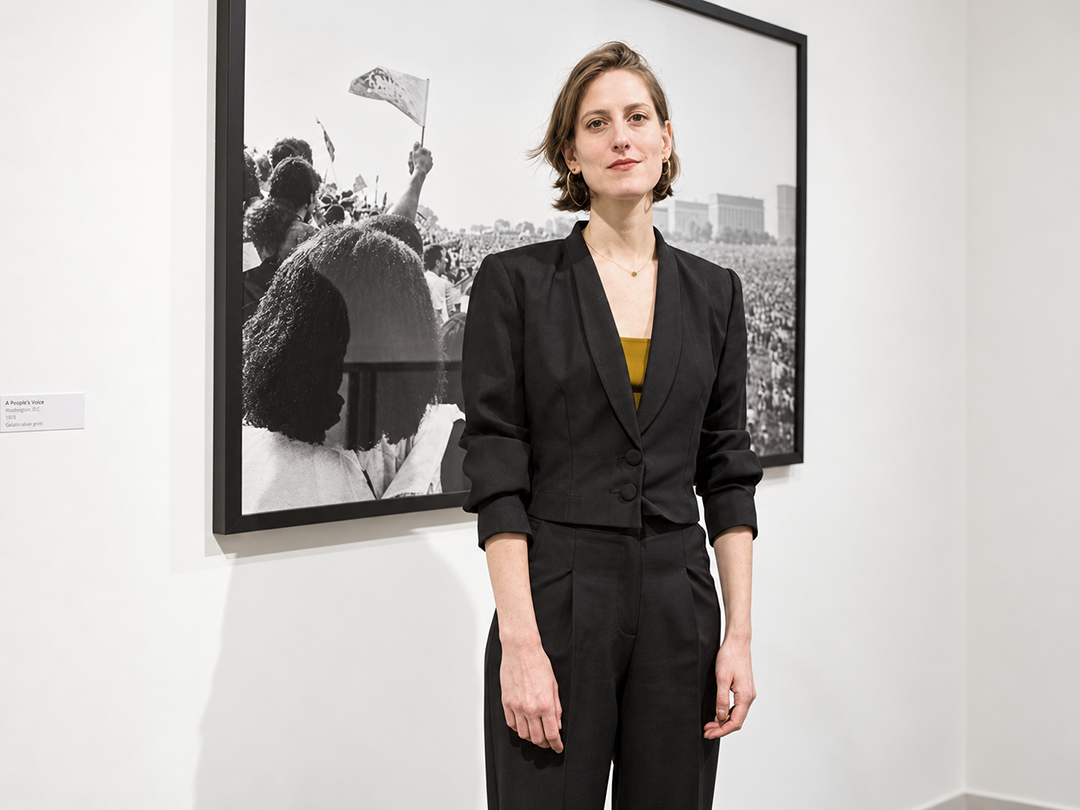
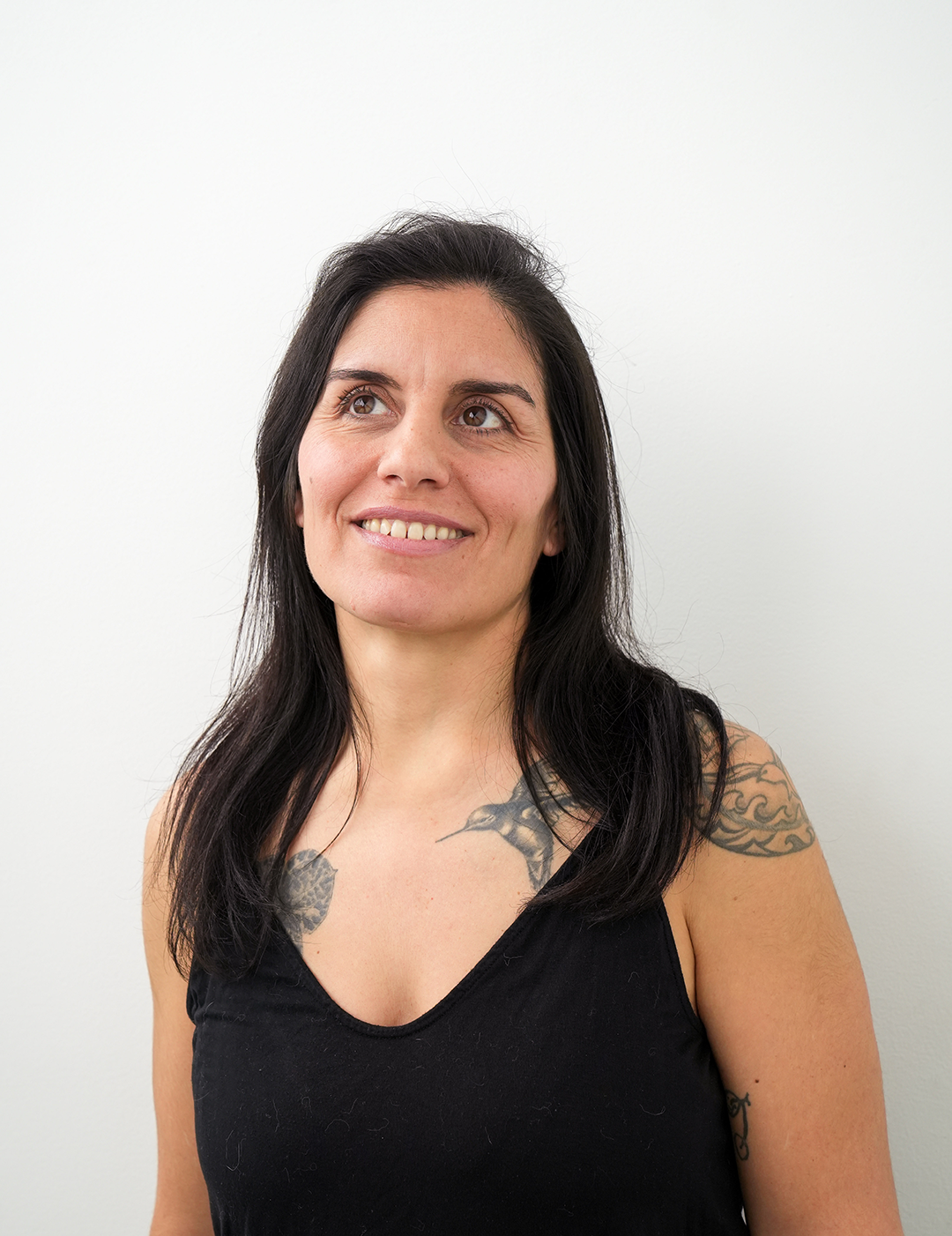
Carolina Cuervo, Godoy Cruz, Mendoza, 1986. Holds a degree in Painting and a postgraduate qualification in Cultural Management from the National University of Córdoba (UNC), as well as a Master’s degree in Visual Arts Curating from the National University of Tres de Febrero (UNTREF). Since 2012, she has worked at Fundación OSDE’s Espacio de Arte in curating, exhibition management, and production. She also works as an independent curator. As an artist, she trained in the studios of Dante Montich in Córdoba and Agustina Núñez and Magdalena Rantica in Buenos Aires, and participated in an artist workshop with Tulio de Sagastizábal. She lives and works in Buenos Aires. @carocuervobudd @yerua_taller PH @boscology
The Philip M. Meyers Jr. Memorial Gallery, part of DAAP Galleries at the University of Cincinnati, is located in the Steger Student Life Center, along the central axis of the university campus. Its program combines exhibitions connected with DAAP disciplines with projects emerging from other areas of the university, including historical and scientific approaches. The gallery conceives exhibition practice as a means of presenting complex ideas through visual languages and encouraging exchange among students, faculty, and the Cincinnati community.
A few months ago, The Annex Gallery presented another solo exhibition by Julia O. Bianco, Amazonia.
Rainsong, 2024
Installation – cyanotype-printed linen banners, tulle, embroidery thread, watercolor
Dimensions variable










Comments powered by Talkyard.