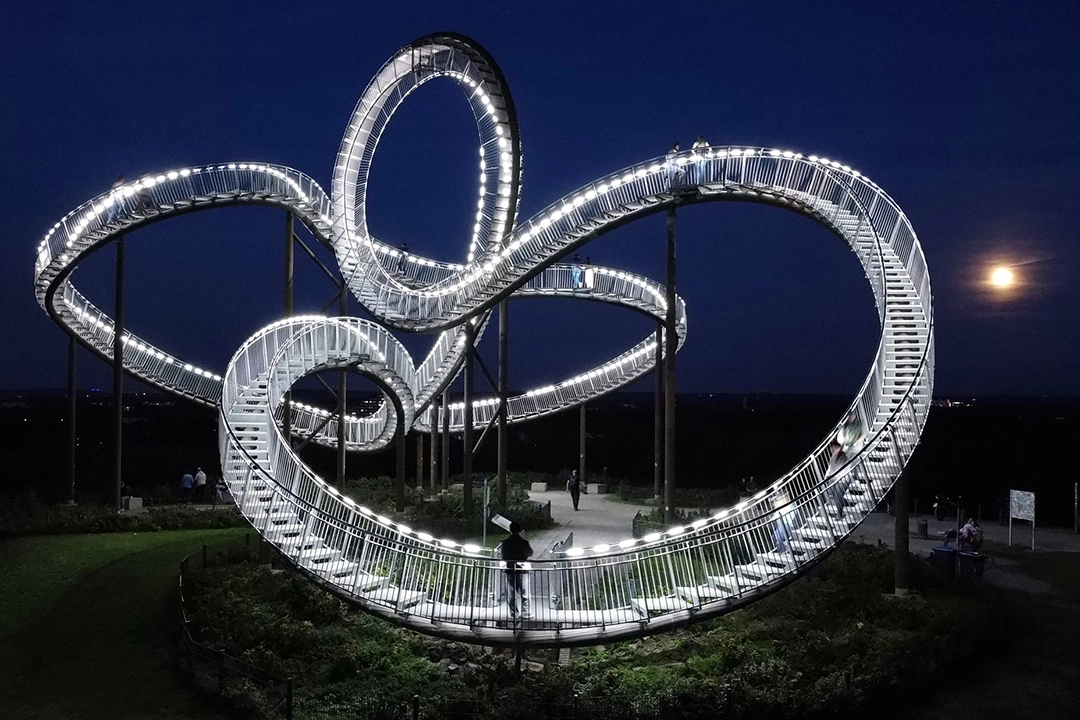
Michael Sohn / AP
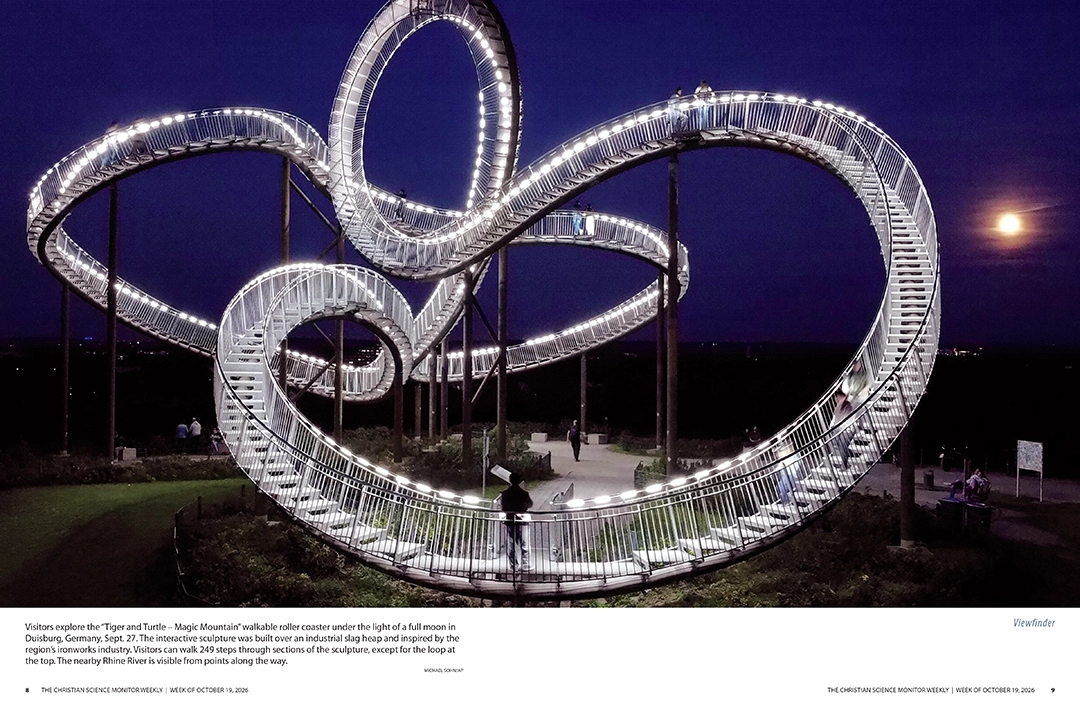
People visit the Tiger and Turtle—Magic Mountain walkable roller-coaster sculpture in Duisburg, Germany, on September 27, 2026.
In its October 19, 2026 edition, The Christian Science Monitor Weekly devotes a double-page spread to an interactive sculptural installation. I mention it for its photograph, which is hardly anything special in itself, though it has something striking about it. The contrast between the abyssal blue of the background and the gentle lines of light is lovely.
The photograph was taken by Michael Sohn of AP on the night of September 27 in Duisburg, Germany, beneath a round, murky moon, as if a cat had run its tongue over it.
It shows a kind of roller coaster made of galvanized steel, edged with 880 LED bulbs sewn along the handrails. I immediately thought of the photographs Gjon Mili took of Picasso for LIFE magazine in August 1949, in which Picasso, in a darkened room, drew bulls and centaurs with a small electric bulb.
A handful of people move along the steel ribbons as they climb, dip, and twist like a roller coaster, absorbed in the peaceful pleasure of taking in the landscape from different heights. Unlike on a real roller coaster, they need no restraints to enjoy the experience.
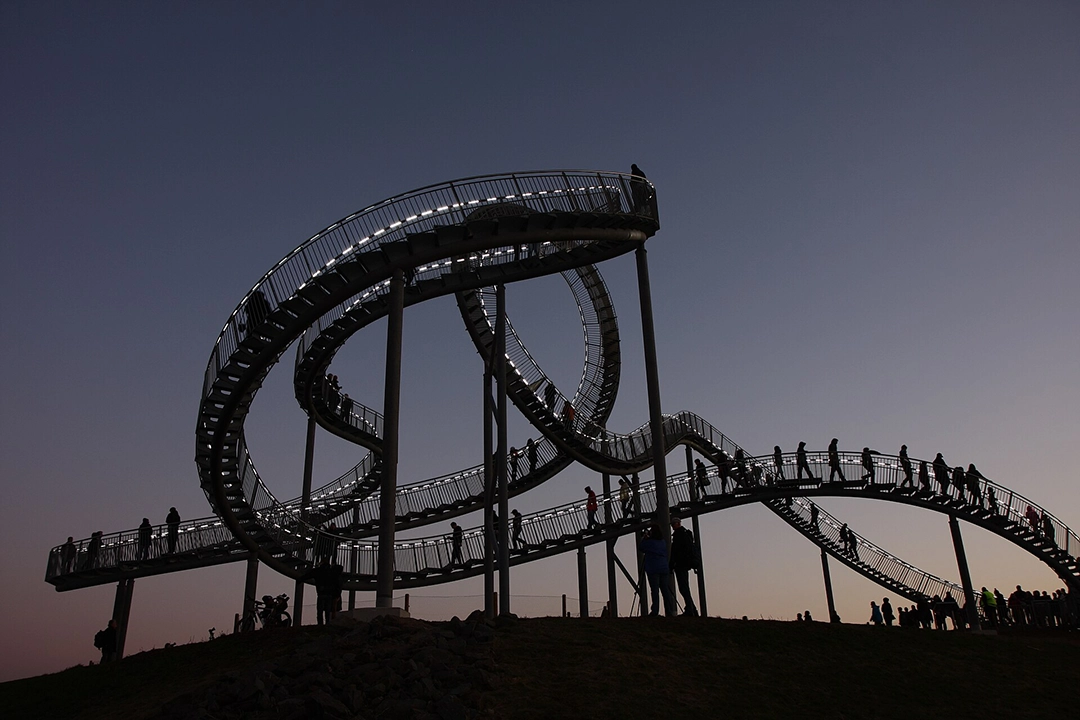
Heike Mutter and Ulrich Genth, Tiger and Turtle – Magic Mountain, Angerpark, Duisburg, 2011. Galvanized steel, 20 m high. Photo: FotoDirk, Wikimedia Commons, CC BY-SA 4.0.
It is called Tiger and Turtle – Magic Mountain, and its creators are Heike Mutter and Ulrich Genth, an artist couple from Hamburg. It opened in November 2011 on an artificial hill in the south of the city, built largely from slag left by a zinc smelter that closed decades ago. The Germans have considerable experience erecting magnificent structures on ruins or devastated sites, then giving them new, profound, humanist meanings. This one stands twenty meters high and has some 249 steps, according to the caption. From the top, you can see the Rhine. There is no charge to walk through it.
It cannot be traversed in its entirety. Of course not. Gravity makes it impossible to walk upside down. At night, art lovers will inevitably share the structure with young couples just out of the nearby bars, ready to discover uses for it its creators could hardly have imagined, challenging both the laws of gravity and the effects of alcohol along the way. The designers seem to have taken care to keep any fun from ending in disaster.
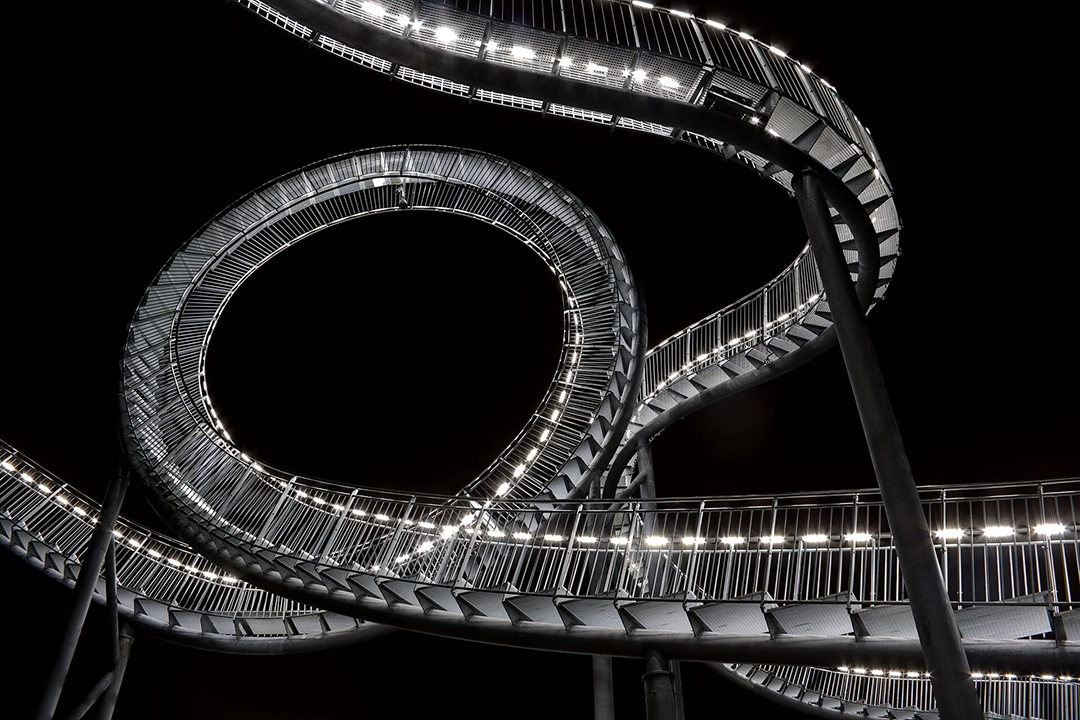
The loop, the week of the opening, November 2011. The staircase is still inside; the barrier can’t be seen. Photo: Kleunam, Wikimedia Commons, CC BY-SA 3.0.
They explained the title through a metaphorical antithesis that strikes me as apt enough: the track has the acceleration and speed of a tiger, while visitors make their way along it step by step, like a tortoise. True, the work proposes a visual acceleration that is impossible and pointless, since one of its attractions is the chance to climb up and take in the river and the surrounding landscape. No one climbs anywhere just to look at something for half a minute. Besides, contemporary art, like art of any other kind, takes time to understand and to complete the artistic experience.
I return to the moon because it makes me uneasy, and seems unnecessary. Why would the photographer need to include it in the picture? If the aim was to document the installation, it makes no sense. If he wanted to make a pretty picture in which the moon “takes part” in a dialogue with it, fine. If he was trying to create what might be called visual poetry, a counterpoint between two luminous whispers, all right. I could do without it, because I am a graphic designer and not very tolerant of distractions.
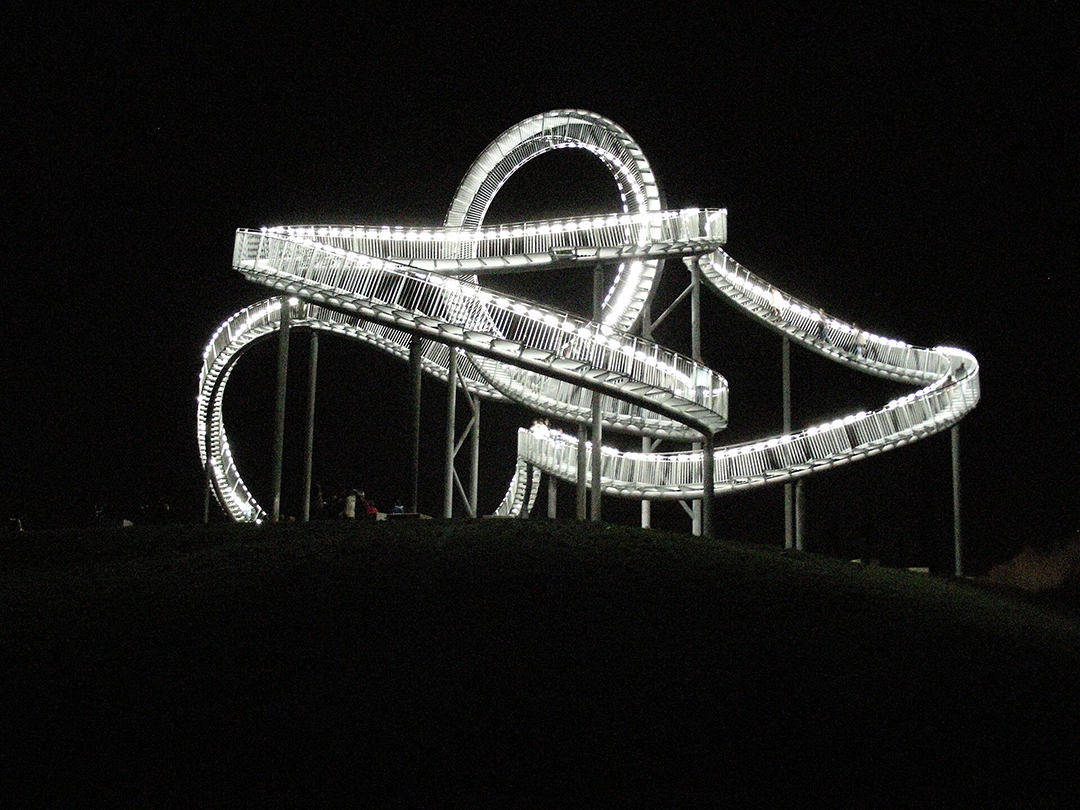
The 880 LED lights on the handrails, no moon. Photo: Spanjokel, Wikimedia Commons, CC0.
The photographer, and probably the author of the caption that singles out the image, Michael Sohn of AP, tells us in the opening line—as if it really mattered—that the scene is bathed in the light of a full moon. Perhaps it is a blessing that, for now, print magazines remain silent. I can easily imagine that one day before long this same sculpture will be photographed again from the same angle, and we will see it beneath its moon and hear the notes of Sinatra’s “Fly Me to the Moon” or Pink Floyd’s The Dark Side of the Moon. At the summit, beyond human reach, several werewolves will howl at the exorbitant price of meat.
Some boys, protesting everything that accelerates climate change, will attack it, cover it in scars, and leave it in darkness. Even so, the rails and handrails will go on shining in the light of an obstinate moon.









Comments powered by Talkyard.