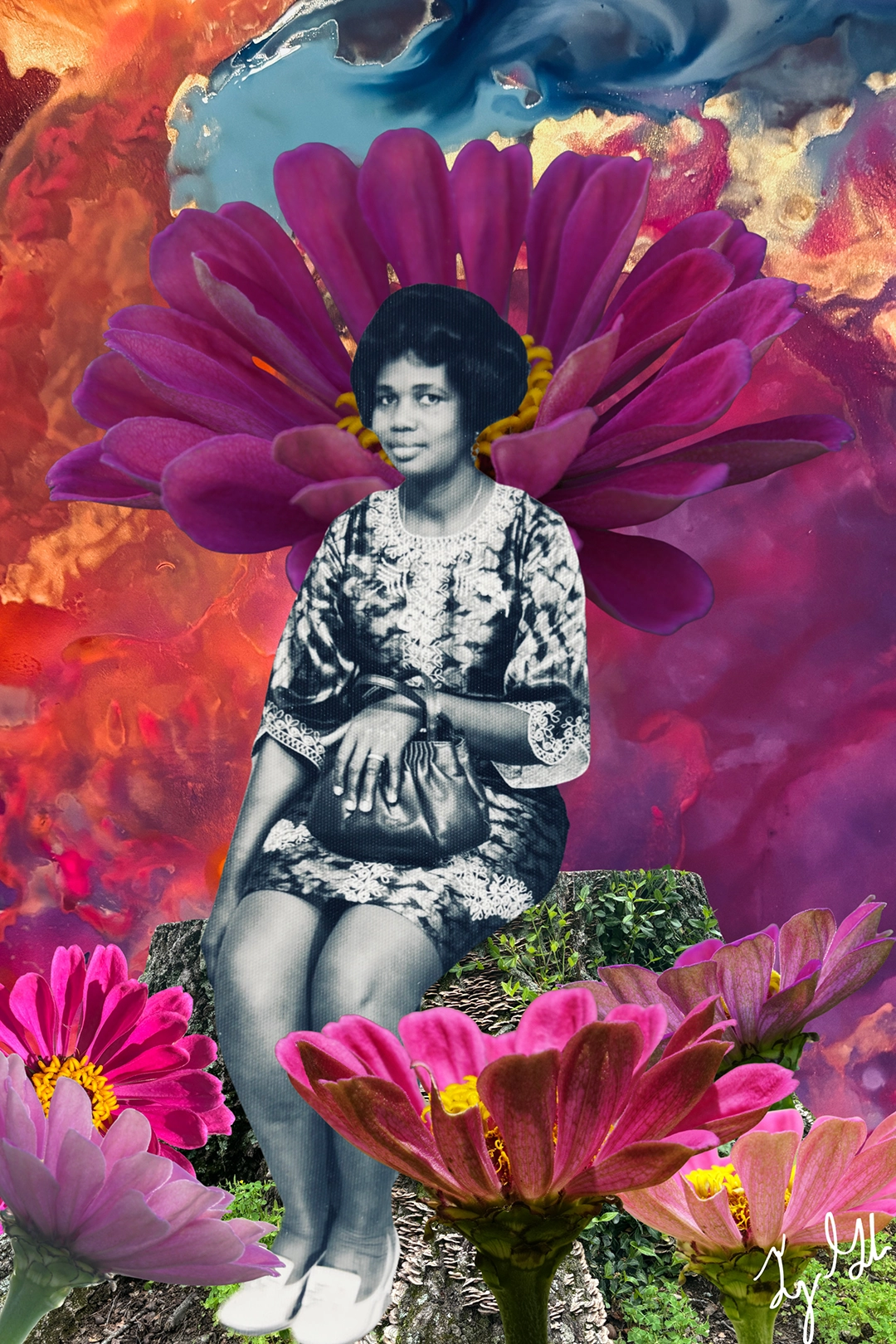
My Grandmother, Viola Kebbah Gaba, 2026
Ink on paper
I have sometimes thought about what, for once, I might call “the oneiric substance,” if only to steer the question into less sinister territory: do dreams arise from experiences not fully processed, or are they autonomous energetic structures, detached from various material or temporal sources, that pass through the mind in search of the lost warmth of emotions? The question has its beauty. In asking it, I also recognize how nearly certain it is that we have no control over dreams whatsoever, asleep or awake. I understand that the pleasure of a pleasant experience carries the burden of its brevity. And along these lines, it seems logical to me that the debt—that is, whatever remains to be processed—should become a recurring dream. Some are so enjoyable that we try to give them structure, to articulate them in a way that lets us relive them, feel them again, tell others—or ourselves—how good they made us feel.
But we cannot make them. We cannot demand that they come to us. They arrive or they don’t, and when they do, they bring their own order, colors no one asked for, and a logic that seems a little absurd in daylight but shone with perfection at night.
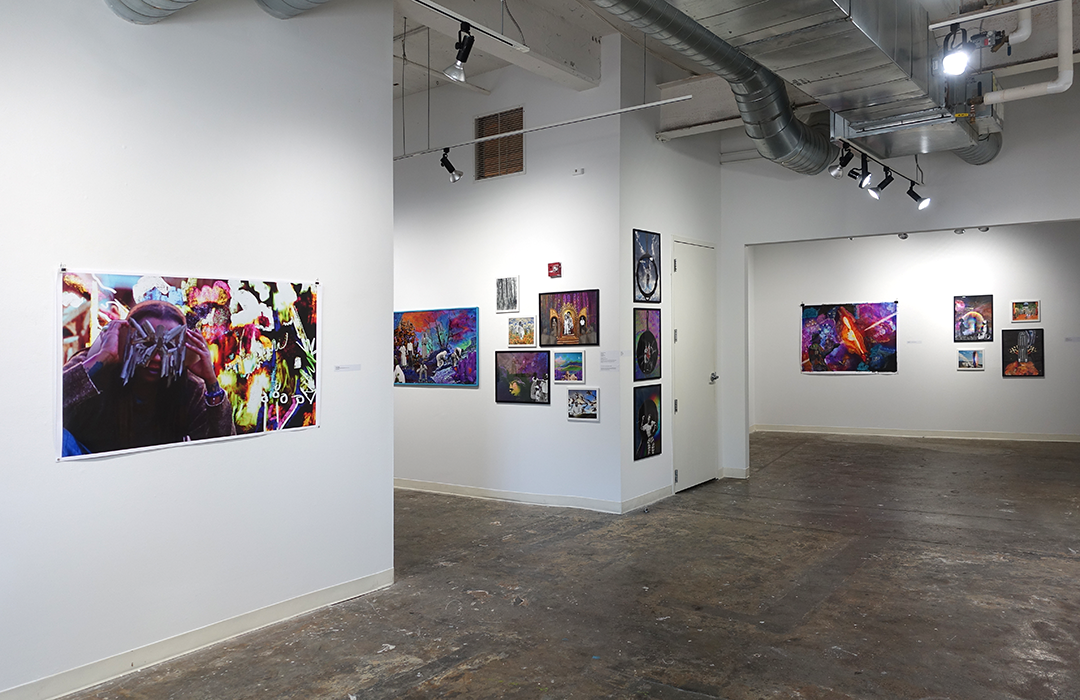
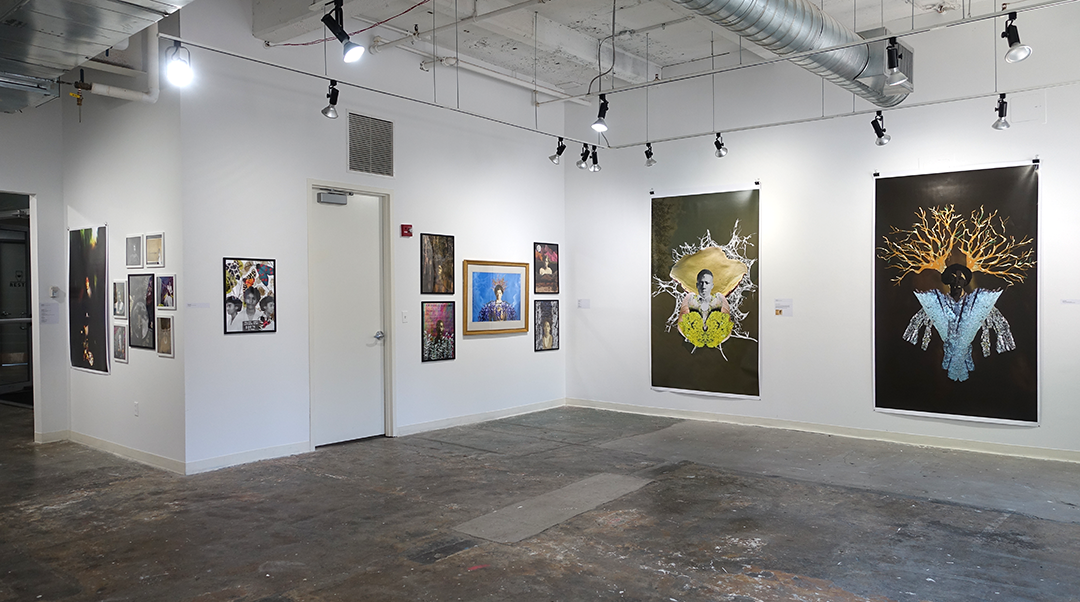
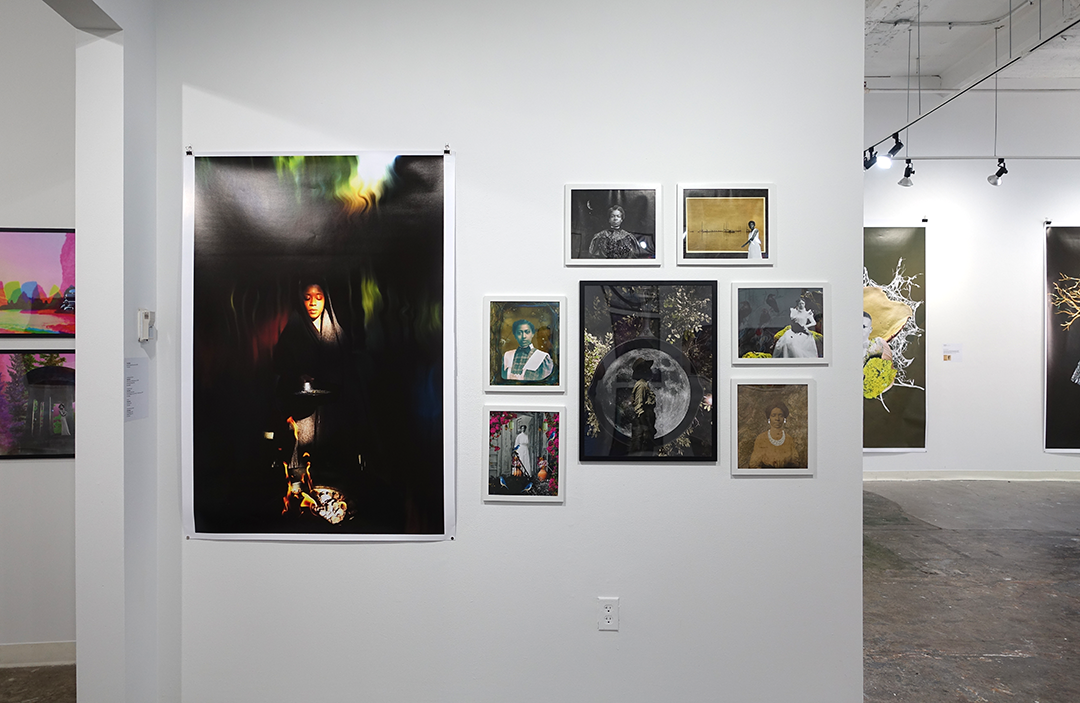
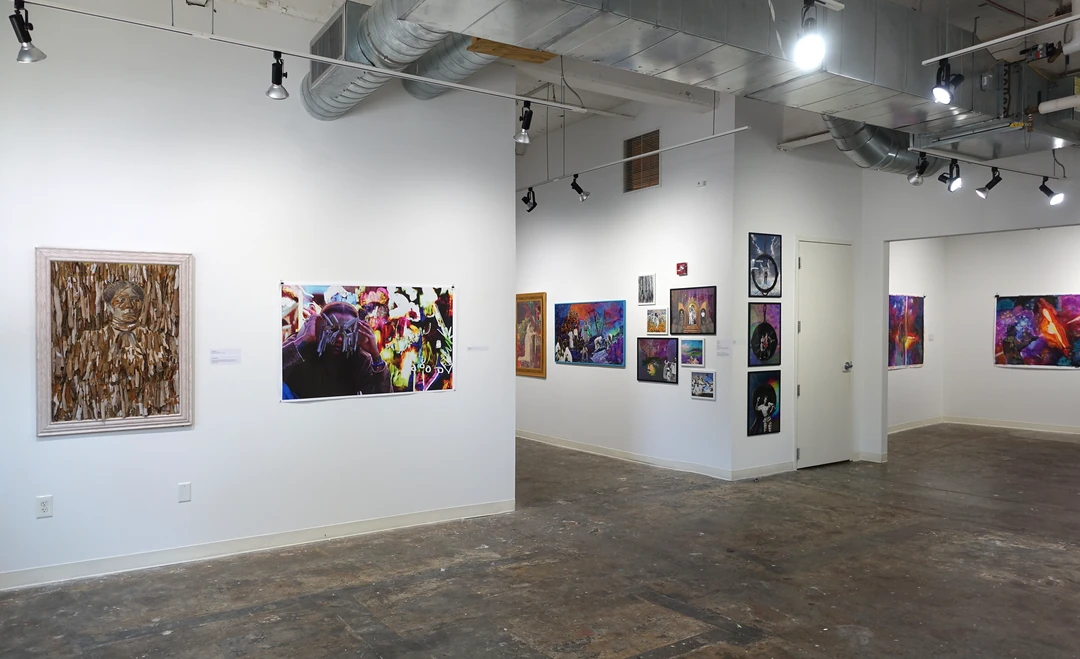
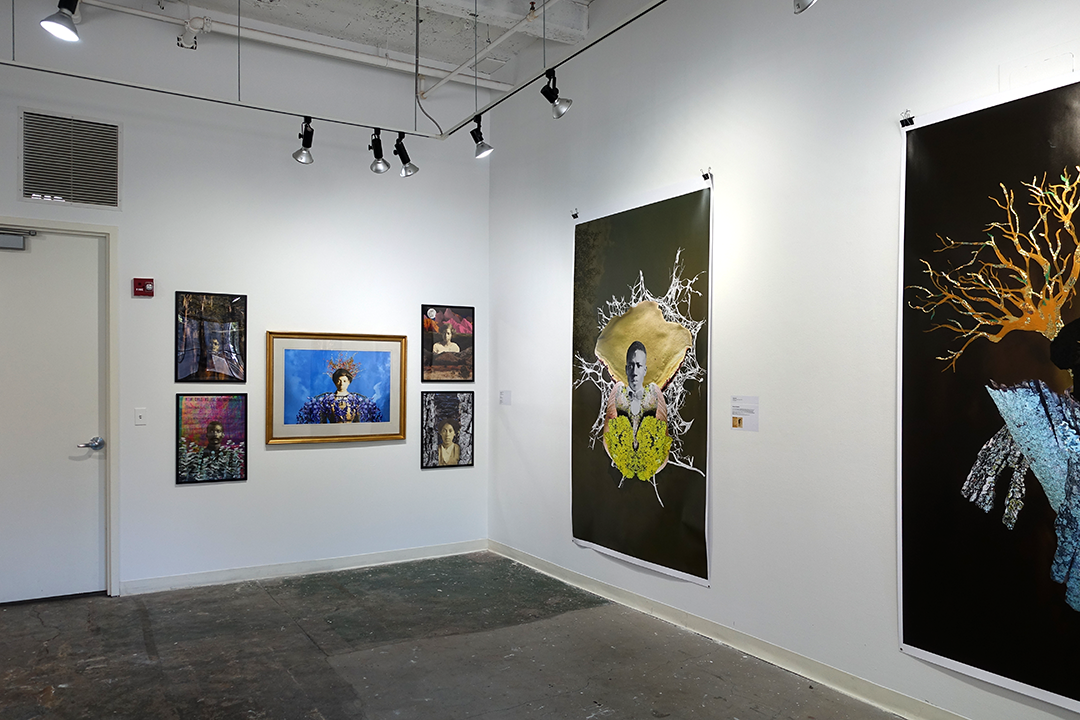
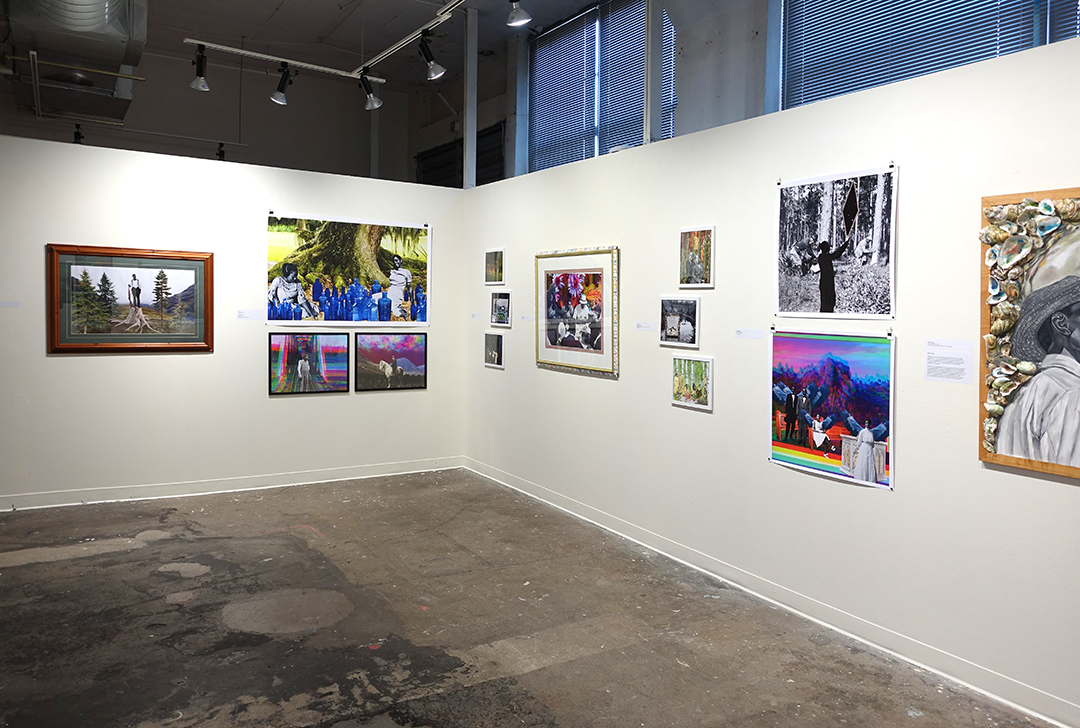
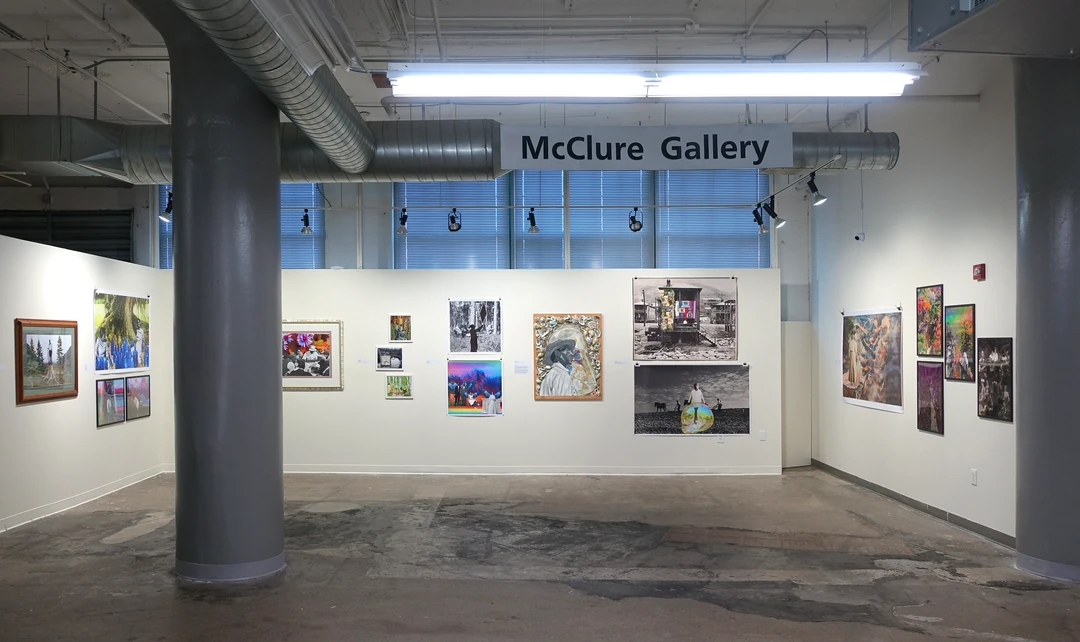
In mid-September 2026, I had the opportunity to meet Trudy Gaba when Portals of Remembrance had been on view for nearly three weeks in the Pearlman and McClure Galleries at the Art Academy of Cincinnati. By the time she arrived, I had already walked through the entire exhibition, chosen the works I wanted to explore more deeply, formed an initial idea of who Trudy was as an artist within a clearly defined contextual ecosystem. But Trudy did not fit any of the categories I had devised for her. Our conversation, as it concerned the works on view, exceeded almost all my expectations and completely transformed the map I had imagined.
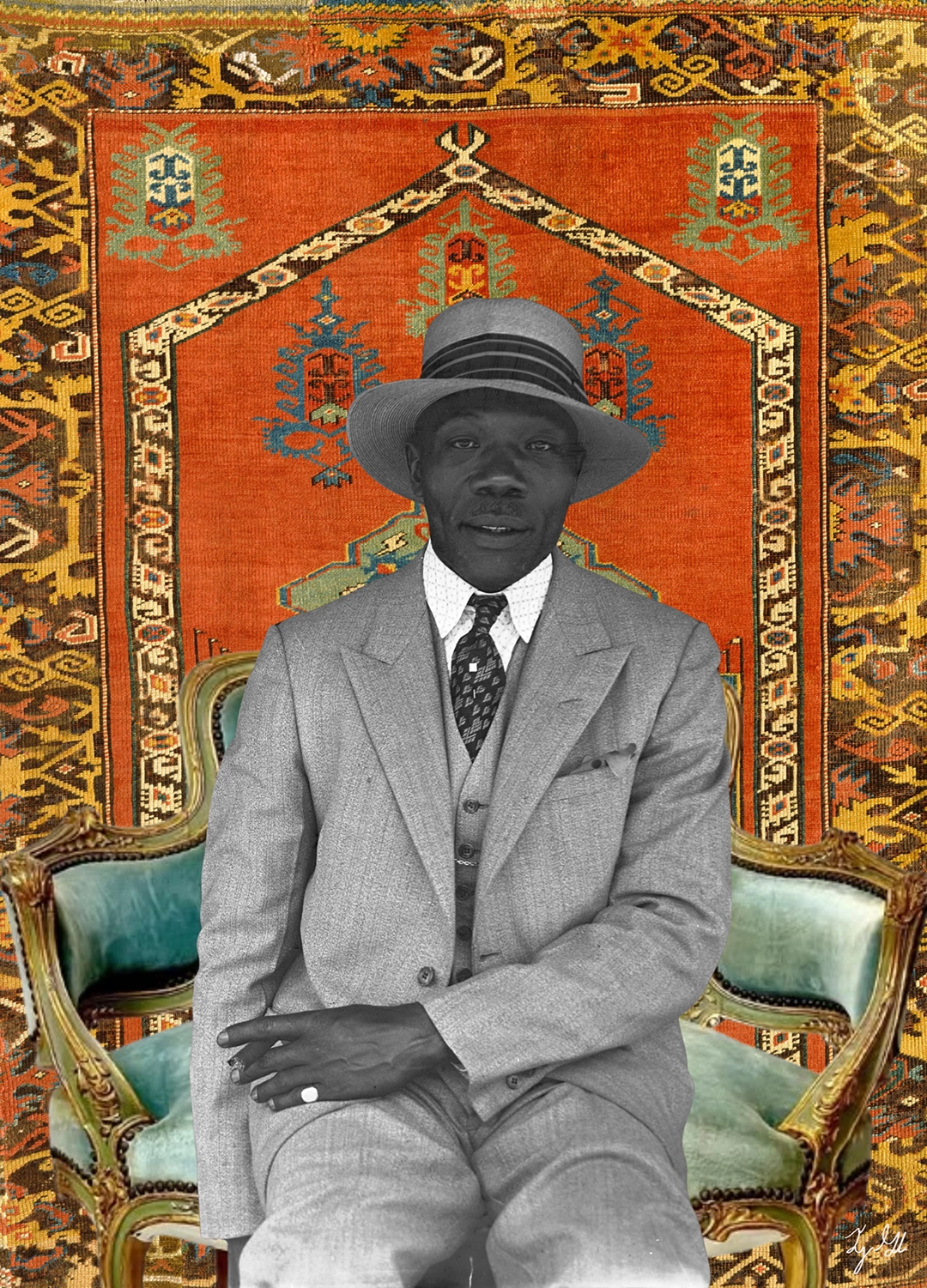
From the series Portals of Remembrance
Trudy was born in Atlanta in 1988, the daughter of a Liberian pastor who received his first pastoral appointment in Virginia. When he took his family with him, Trudy grew up practically inside a church, in a setting where she first learned to recognize or identify images and much later—if we have even reached that point—to interpret them according to the demands of a culturally sanctioned reading. She earned a master’s degree in Edinburgh, spent five years at the Cincinnati Art Museum as assistant curator of South Asian and Islamic art, and since 2023 has been Social Justice Curator at the National Underground Railroad Freedom Center. Today she works as a historian and curator for much of the day, and as an artist for the rest of it. She has been in Cincinnati for eight years now, she says, a city that has been winning her over little by little, without her realizing it.
Her artistic practice begins on the banks of the Ohio. As a historian, she needed to understand what Little Africa and Little Bucktown had been, and how they had come to be: the first Black settlements in the Cincinnati basin, where those escaping slavery settled after crossing the river. At Cairo, Illinois, the Ohio flows into the Mississippi. Trudy followed its current. From Mississippi to Arkansas, she crossed the sharecropper communities of the southeastern lowlands. She found archives overlooked by formal education, whose digitization had only just begun. Many of the stories she finds there are violent. The stories from the years after emancipation and Reconstruction, of people making their way through a thicket of prejudice and misunderstanding. It was hard for her to accommodate, to reconcile herself to a drama she could not see ending. The anguish made her need, in her own words, “a space of my own in which to dream new possibilities and return to those people the grace and dignity that belonged to them.”
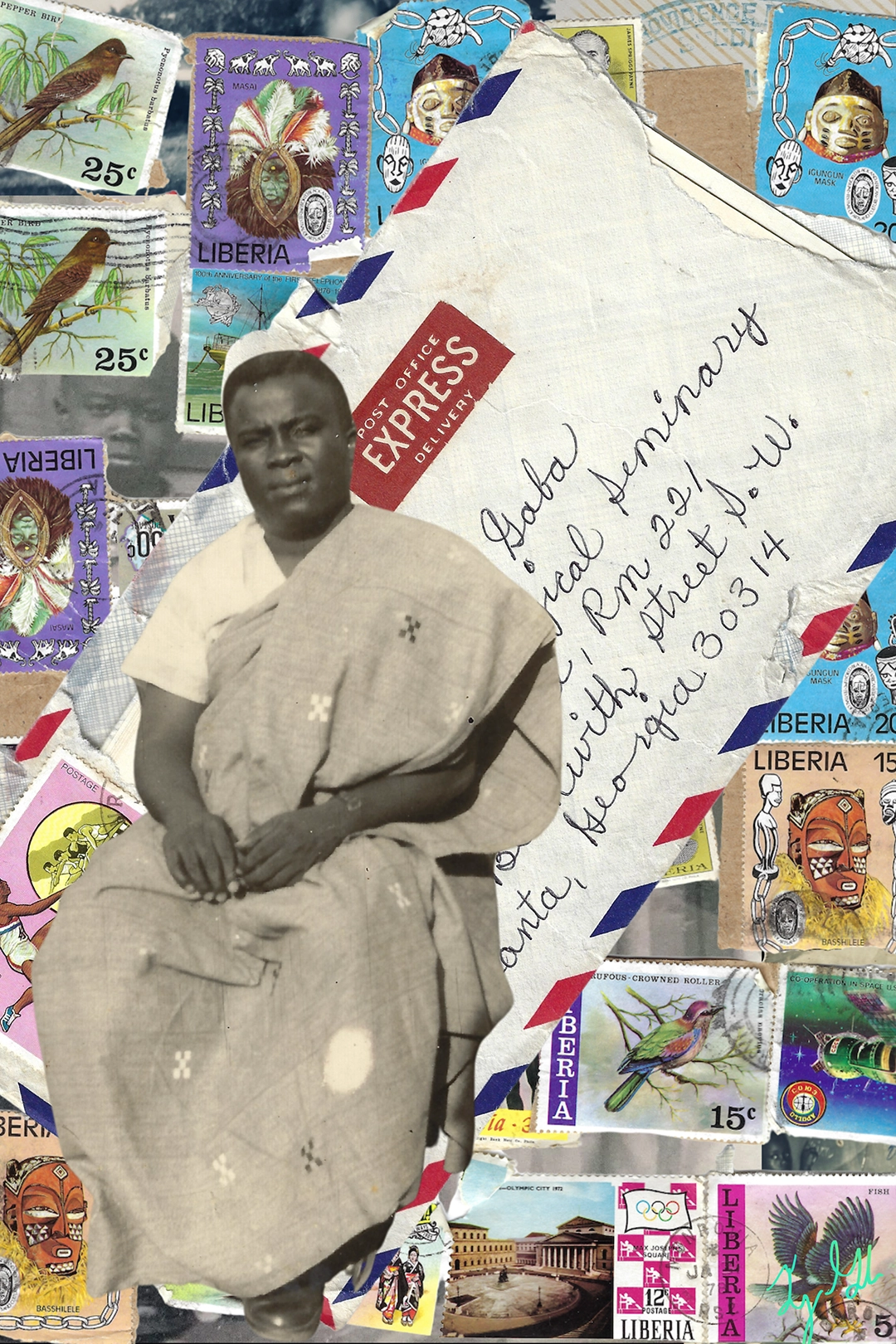
Letters from Klaus, 2024
Ink on paper
In April of this year, 2026, her father died. His death added another layer of pain and anguish to a project that had already emerged from the family archive. She began asking the elementary questions that arise from her research. What does it mean for her to be Liberian? Where does her surname come from? The colorful stamps of Liberia—masks, birds, Maasai warriors—remain on the letters her grandfather and father exchanged over several decades. Some are stuck to an envelope addressed to a theological seminary in Atlanta.
I should also mention that Gaba was gallery curator for Kara Walker: Cut to the Quick at the Cincinnati Art Museum, from November 5, 2021, to January 16, 2022, with the poet Ciona Rouse as guest curator. Walker’s work always holds in view a history of subjugation, violence, and exclusion, partly lived and partly inherited, and tells it with a severity that allows no reply. Entirely understandable. The passing decades, the civil rights struggles, and the efforts of thousands of exemplary citizens have changed that bitter circumstance, but its consequences endure. That makes it necessary to turn the page back, to return to the scene and attempt a reparation more than a century overdue. And that weight reaches artistic creation, too.
Walker makes reparation through denunciation. Trudy, who knows all of this, shapes hers through sweetness and warmth. I also found her an absolute delight. An artist of uncommon sweetness, happy in her demiurgic capacity to build universes to her own measure. Probably because her family history is quite singular, and because the traditions she has drawn directly from have led her there. Even an inherited grievance, worked through with extraordinary subtlety, can come to find an exceptional and profound artistic expression. She enters the art world with a disarming smile. She retraces history to bring us closer to a world saturated with harmony and color, almost an amusement park where joy and curiosity float in the air and the enchantment of the supernatural can be felt. She reminds me of Latin American magical realism.
I was as sweetly surprised as the look on her face when she told me that her great-grandmother Gertrude made candy.
She appears in one of the photographs, a young woman dressed in white down to her feet, wearing gloves to the elbows, seated sideways in a bentwood chair. The candy maker’s brass thermometer, its scale reaching six hundred degrees, hangs from her gloved hand. Above her is the letterhead of her business. Nanette Home-Made Candies, “For Discriminating Tastes,” 508 North Eleventh Avenue, Birmingham 4, Alabama. That 4 is a postal zone, and postal zones were in use from 1943 to 1963. A Black candy maker with printed stationery and a motto in cursive, in Birmingham during those twenty years. For discriminating tastes.
Candy belongs to that universe of tiny things in which we rarely look for the traces of history. And yet Trudy grew up with the peppermints churchgoers kept in their pockets to help the pastor’s children sit through the sermon. Is sweetness, like a dream, another fleeting category? Most likely. Is it also possible for sweetness to leave the candy, escape the sugar glass, cross a century, and become part of a contemporary artist as a quality of character, one that also shapes her artistic expression?
Almost all the material Trudy began with in the work she developed for Portals of Remembrance consists of black-and-white photographs from the late nineteenth and early twentieth centuries. Many come from public archives, one or two from her family. But waves of color overlap the gray scales and cover them. I cannot remember seeing white or black candies, gray confections. Some of the joy we can send back to those difficult times is the color that the technology of the day withheld from them. The color of candy today. Strawberry or cherry reds, lemon yellows, mint or apple greens, citrus oranges, grape purples; chromatic conventions learned in childhood that let us taste candy with our eyes. In hard candy especially, light passes through the sugary substance and produces glints, transparencies, and iridescence that shift with movement, like little pieces of colored glass. Their polished surfaces return flashes of light and multiply the shades. Fill the past with candy, with color? There is something deliberately festive in the chromatic exuberance, a promise of immediate pleasure that makes color an essential part of the experience.
Gaba adds color, flavor, sweetness. She works in layers, in Canva, Photoshop, Procreate, whatever she needs. She knows watercolor and gouache. Whatever the piece asks for. She gives her subjects, or their families, a gentler setting.
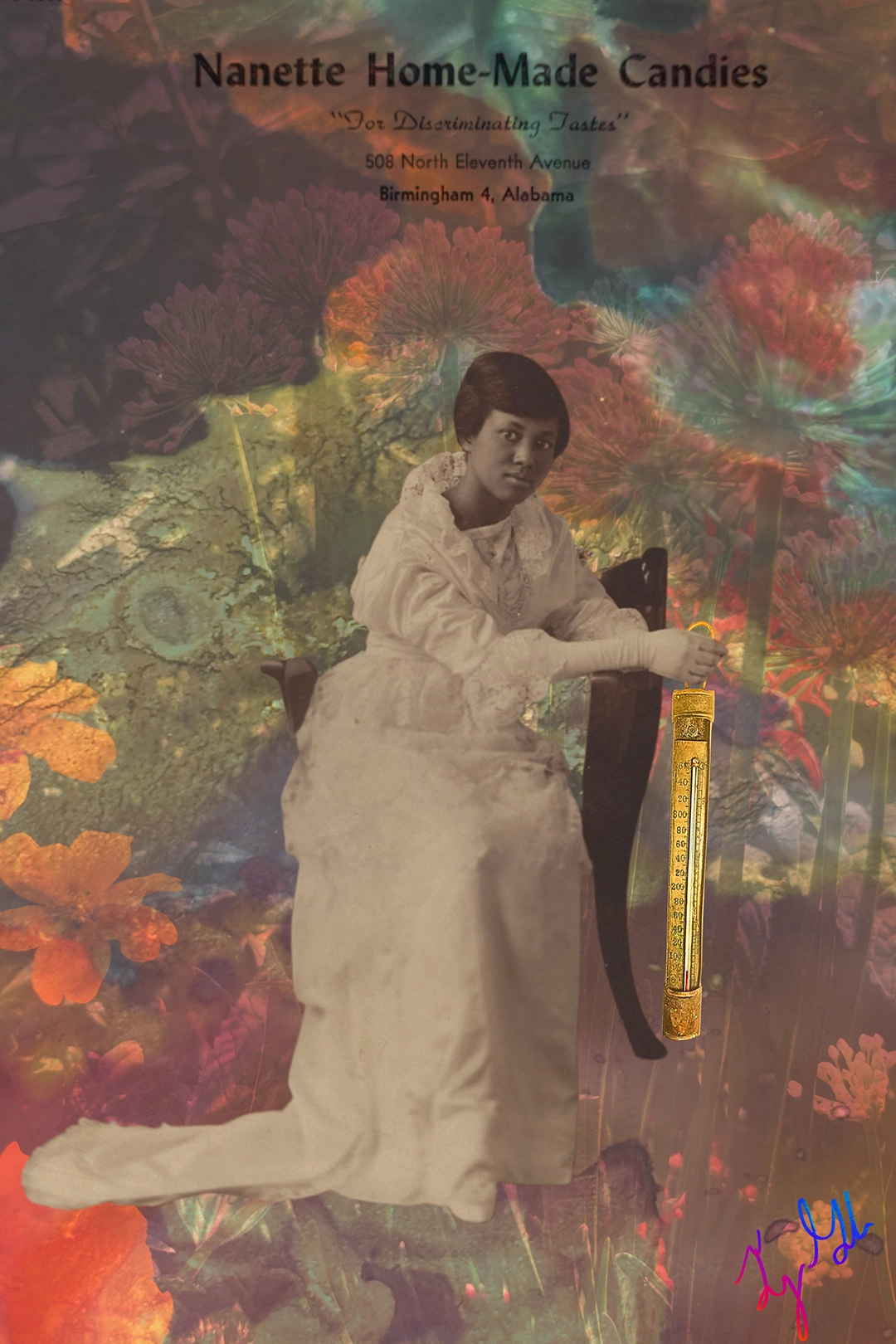
Nanette Home-Made Candies, 2024
Ink on paper
In the artist’s words:
My great-grandmother, Mrs. Gertrude Fisher Anderson (January 9, 1894–August 22, 1984)
Gertrude Fisher Anderson was the eldest of the nine children of the Reverend Charles Lewis Fisher, who served for many years as pastor of the Sixteenth Street Baptist Church in Birmingham, Alabama. It was at that church that four little girls were murdered by white supremacists. My grandfather, Benjamin Anderson, had preached there the Sunday before the tragedy.
When she was widowed in 1935, with four children to support, Gertrude turned her hobby of candy making into a thriving business of considerable size called Nanette Home-Made Candies. During World War II, she supplied candy to three military camps. This print incorporates her company letterhead. The business was located at 508 North Eleventh Avenue in Birmingham. The brass thermometer she holds in her right hand is the instrument she used to monitor the temperature while making candy. My mother, Gertrude, who was named in her honor, still has her candy-making tools.
In Nanette Home-Made Candies, for example, she shows us a dark-skinned girl, very young, sixteen or eighteen, seated sideways in an old dark-wood chair with a curved back. She wears a white dress down to her ankles, with sleeves, like the dresses still worn in the early years of the last century; white gloves to the elbows. Her hair is short and pinned back, her head turned toward us, her expression serious, like a studio portrait, too alert, without the trace of a smile.
The original, in the sepia imparted by time, has been carefully cropped. Trudy places a long brass candy thermometer, with its scale printed on it, beneath the hand resting on the chair arm. As though the girl were holding it. The proportions are somewhat forced; the thermometer is larger than it would be in her hand, which makes me think it was added as a hagiographic attribute, like the emblems of saints. I think this is her great-grandmother Gertrude. In any case, it represents her. Of that I have no doubt. Against a very colorful background, she adds context through typography.
This may be the basic procedure behind almost all the pictorial language we see in this exhibition. In no case is it sustained by painting, but by collage. She preserves her protagonists and gives them the spatial or social circumstances they might have chosen for themselves. Once every variable has been cleared away, this is what ends up defining art. To reformulate a reality. To adjust it to our measure.
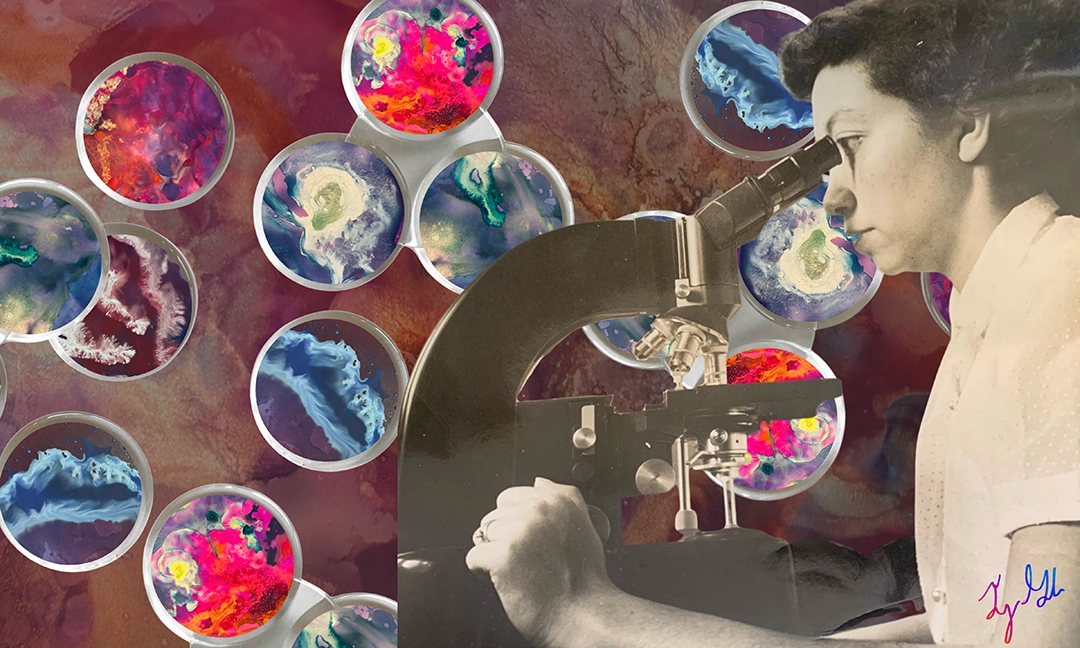
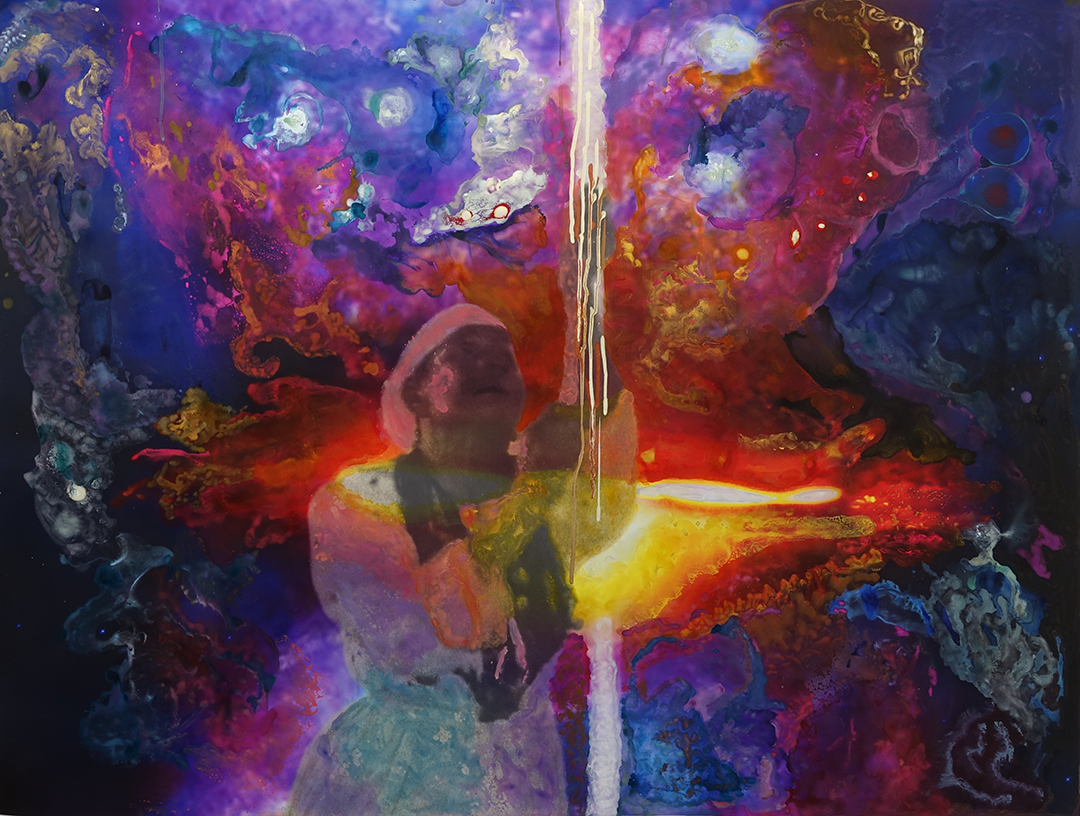
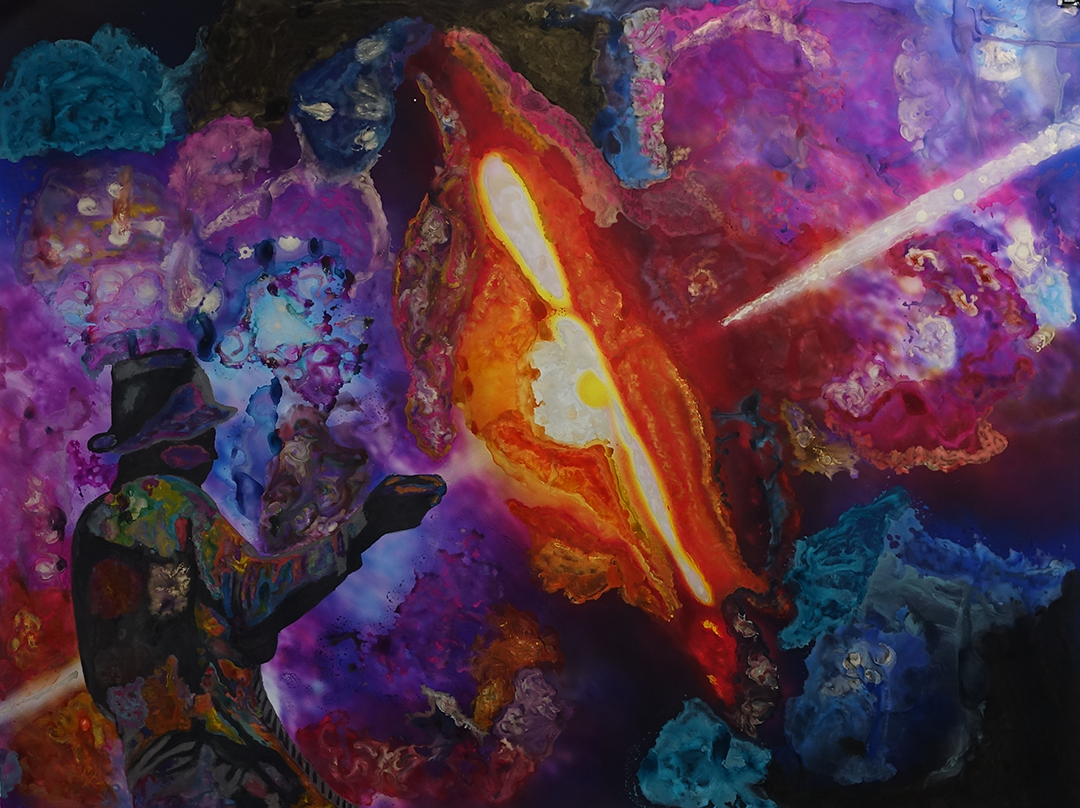
Cosmic Microscopist.
Ink on paper
Cosmic Microscopist. On the right, a young woman in profile, in sepia, wearing a short-sleeved white blouse, her dark hair pinned up in waves. She leans over a large monocular microscope, with a curved black arm, the kind used in laboratories in the 1940s. She looks through the eyepiece. Her left hand rests on the focusing knob; she wears a ring. She looks concentrated, gives no impression of posing for a photograph. The image is well preserved and has no abrupt cropping; you can tell it comes from the family archive.
This is Louise Gaillard Anderson, her grandmother, born in Birmingham in 1919 and raised at Sixteenth Street Baptist Church, the same church a Klan bomb would blow up forty-four years later. She studied at Spelman, completed graduate work in bacteriology at the University of Michigan, and helped refine the Wassermann test there, the one that detects syphilis in the blood. From there she went to Princeton as the university’s first Black professional, in the physics department at Palmer Laboratory. The photograph is surely from those years in Michigan or Princeton—the microscope, blouse, and hairstyle fit the 1940s—and the woman would have been in her twenties. She was looking at bacteria. What the photograph does not say directly is that she liked astronomy more than bacteriology. In the 1960s she wrote a book about Benjamin Banneker, the Black astronomer, the son of enslaved people, who learned the sky by looking at it all the time. She died in February 1980. Trudy was born in 1988. They never met; everything she knows about her comes from what she was told and what the documents tell. Trudy’s label says, “we share a fascination with the cosmos.” The two of them together, beyond dimensions.
Around her float some fifteen Petri dishes, their glass rims silvered, each holding a different liquid. They are fluid inks or paints photographed, and each dish is a galaxy. The dishes overlap the woman and the microscope without order, like bubbles at a fair. Where the microscope focuses, on the stage, there is a magenta dish. She is looking at the universe. This is the correction her granddaughter makes to her grandmother’s profession. She replaces the bacteria with what Louise truly wanted to see, and leaves her looking forever. Hence the title, Cosmic Microscopist, a position Louise never held at Princeton, which Trudy gives her sixty years later.
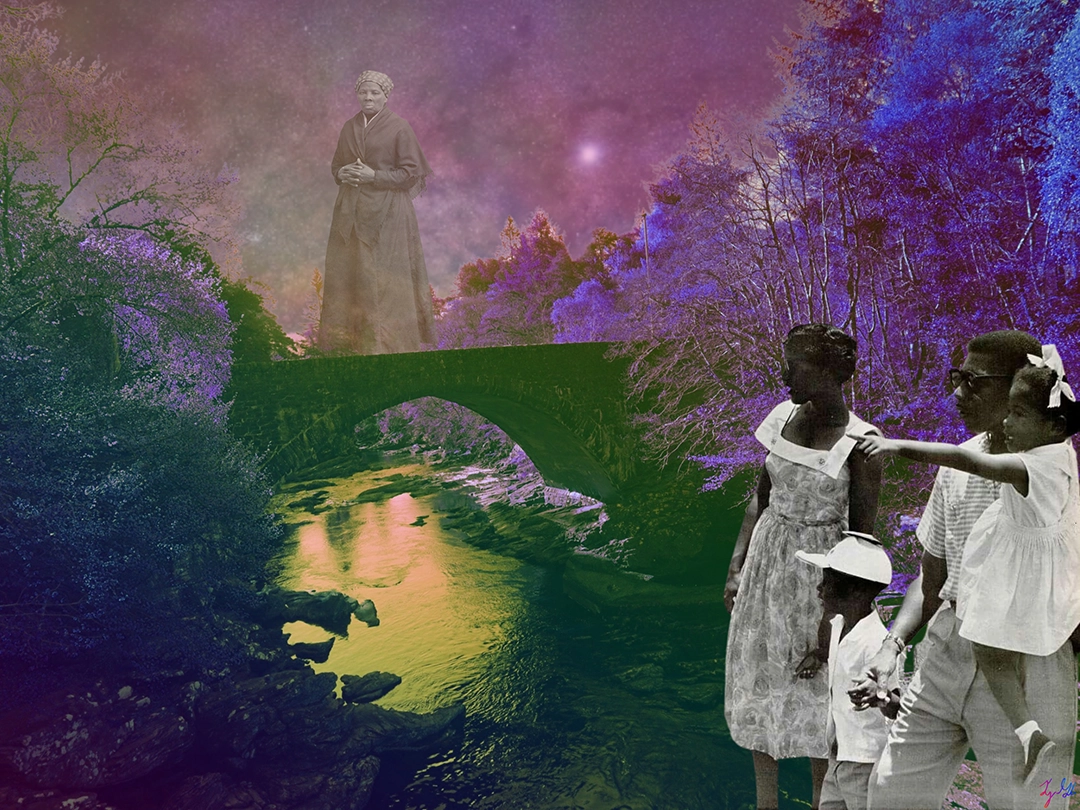
Apparition of the Ancestor
Ink on paper
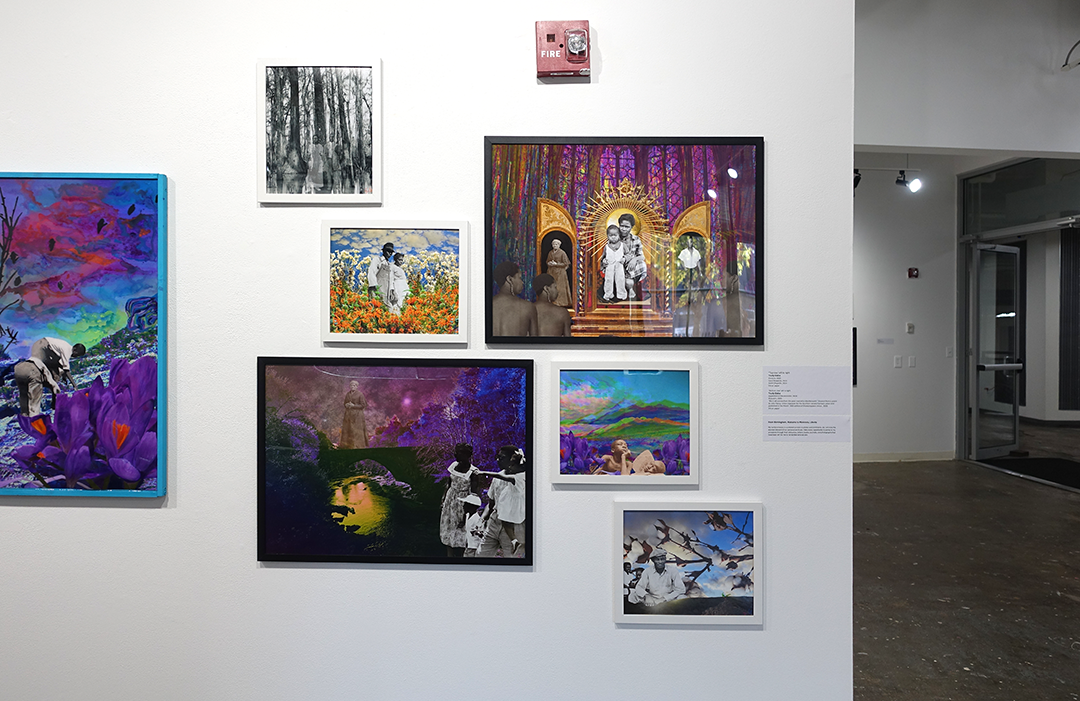
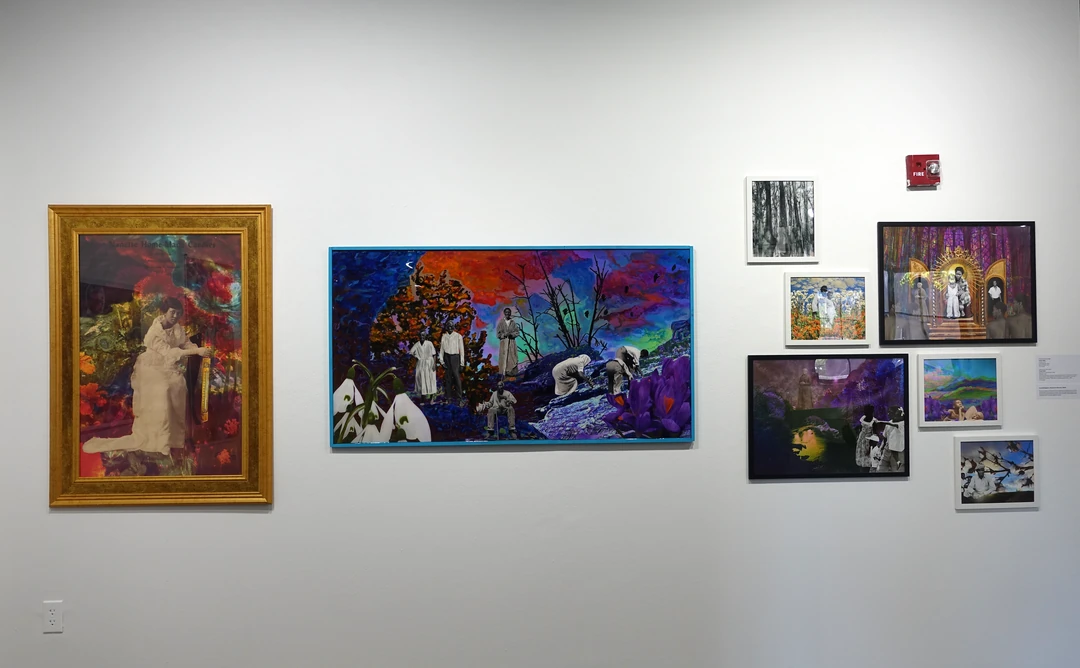
Apparition of the Ancestor shows a river crossed by an old, moss-covered stone bridge with a single arch. The whole landscape takes on the chromatic strangeness of an infrared photograph. The trees along the banks are electric blue, lilac, and violet; the sky is pink and mauve, with a pale moon and pinpoints of stars. The river runs toward us between stones, carrying a bright yellow and golden reflection that corresponds to nothing in the sky. This reflection is the brightest point in the work, and it has no source.
Standing on the bridge, in the center, is Harriet Tubman in her best-known photograph, a light-colored headscarf on her head, a dark dress down to the ground, her hands crossed in front of her. She looks straight ahead. She is somewhat larger than the bridge would allow, which makes her seem like an apparition rather than someone crossing it.
On the right, in the foreground and in black and white, a family from the 1950s or ’60s is seen in profile. They are dressed in their Sunday clothes. They, too, come from the family archive. They are on the other side of the river. The girl is the only one pointing; the others are looking.
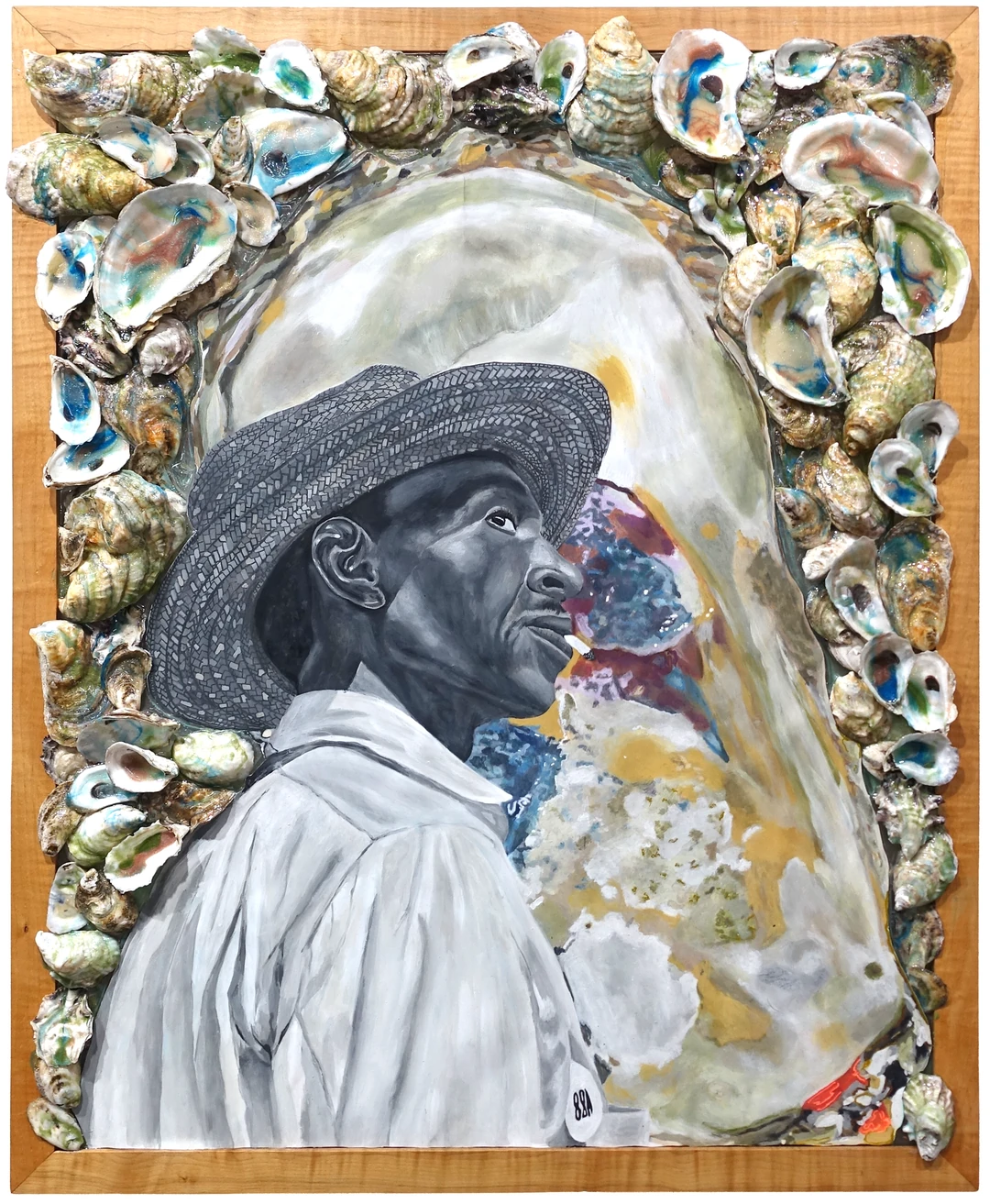
We Are the Pearls, 2026
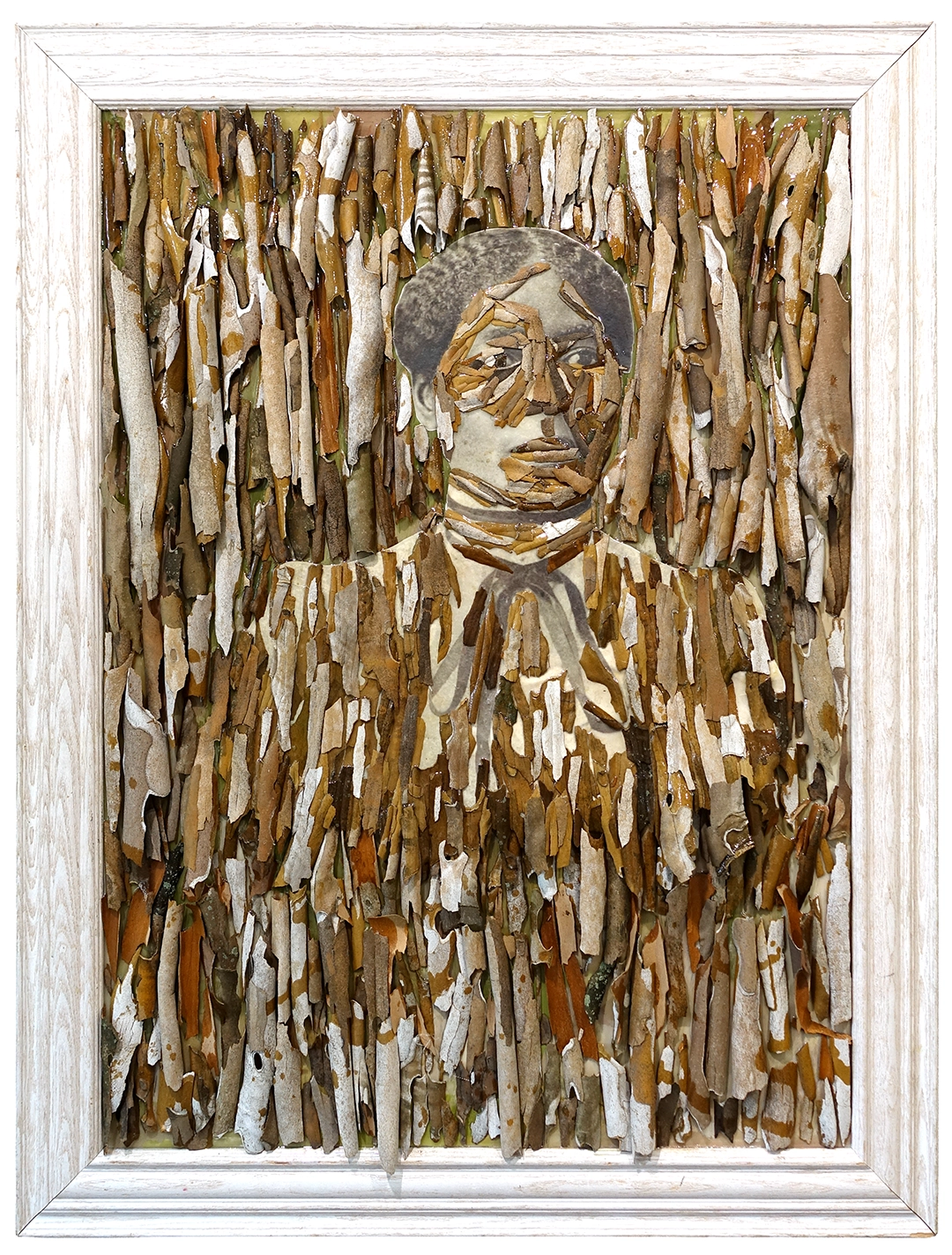
Acrylic, gouache, oyster shells, and resin on cardstock
Black Basins
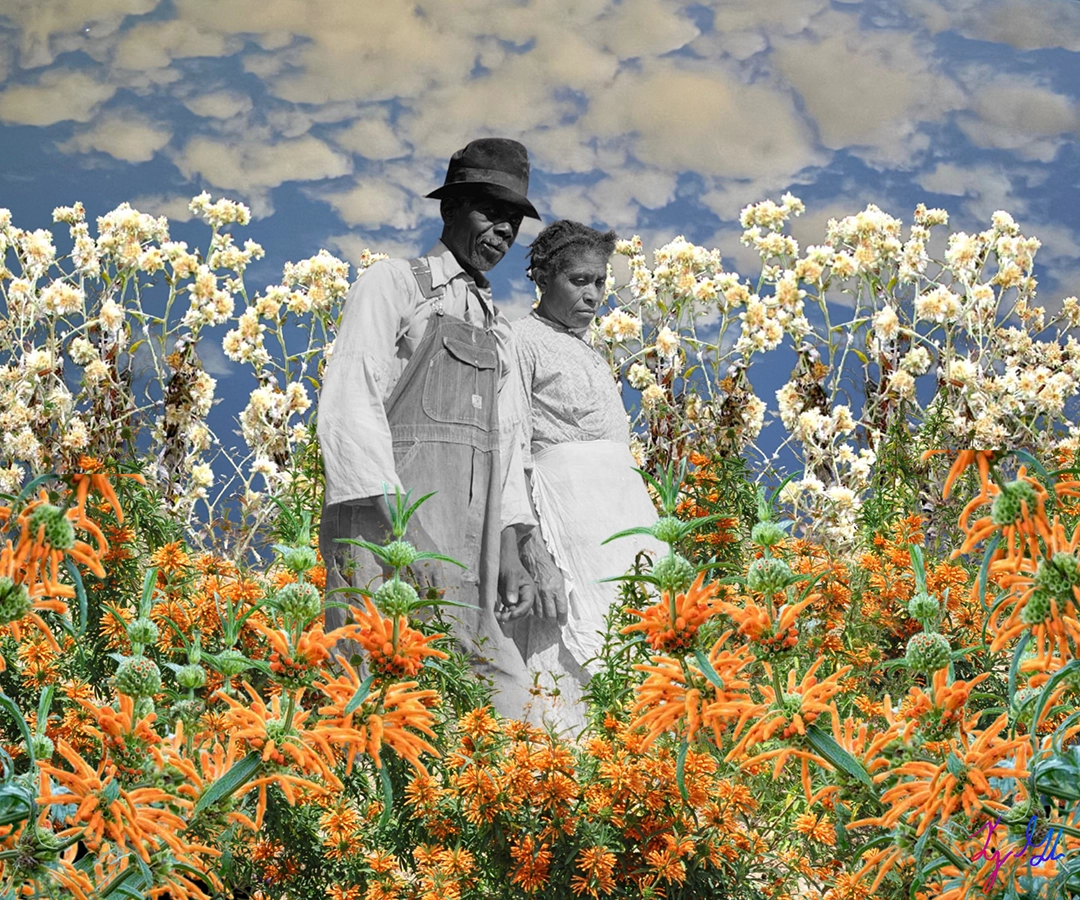
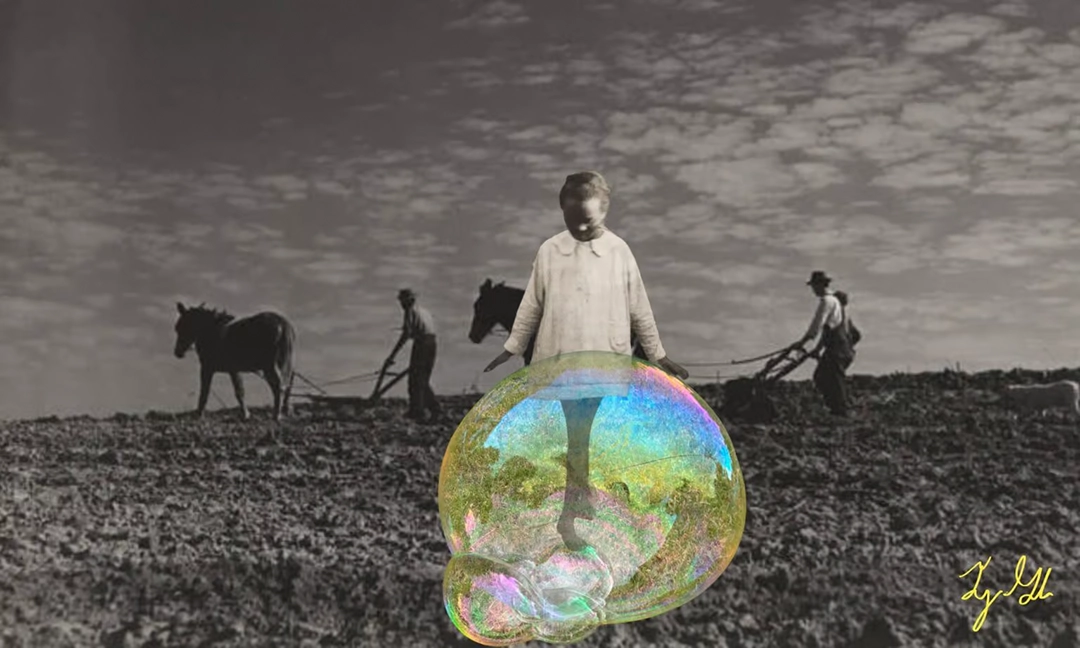
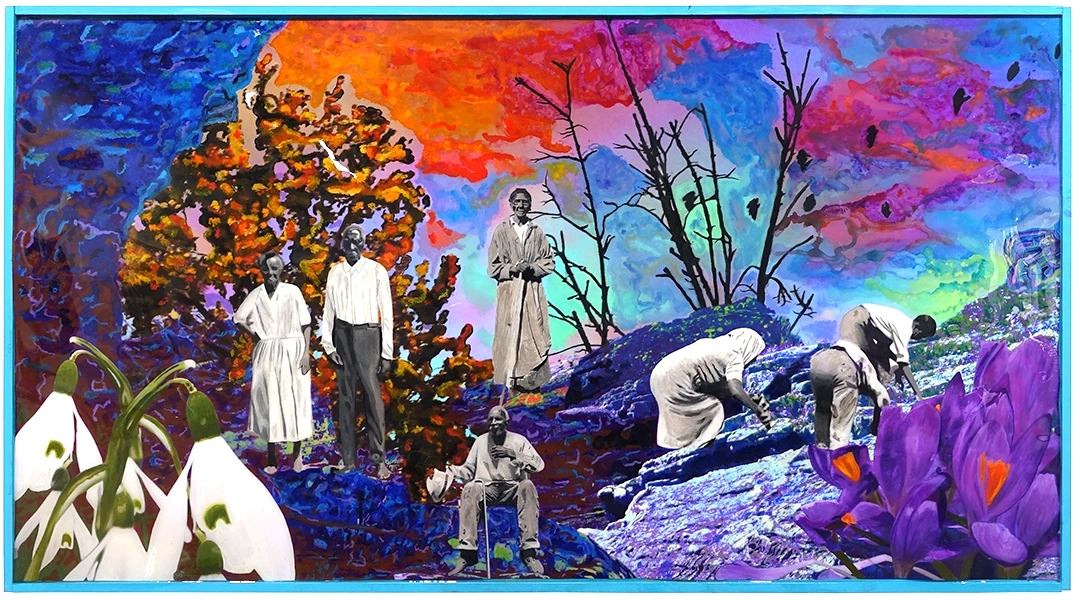
Wherever rivers have crossed this country, Black life has continued on its course. The works gathered here pay tribute to the children of the Delta and the dust, to the women whose skin, hair, nose, smile, and way of walking look so much like mine. As a world-maker working through Afrofuturism, returning to archival images of sharecroppers subjected to hard days of labor and their families, from Jerome, Arkansas, to the Mississippi Delta, offers me infinite possibilities for reinventing their stories.
We Are the Pearls is a testament to the lived experiences of the first African American communities settled in river basins, where they put down roots and prospered in territories considered undesirable because of the rivers’ unpredictable floods. This is the home of the majestic great blue heron, capable of gliding effortlessly over those turbulent waters. To live in this country with Black skin means making the uninhabitable habitable. Oysters, organisms that live in river mud, share something essential with the African American experience. They are also purifiers, able to absorb and process the harshest sediments and produce pearls from them. Our culture is a river made of pearls.
Another collage, made with a different technique, is We Are the Pearls, one of the few works in the exhibition with a frame, light maple in this case. Trudy embeds or glues several dozen real oyster shells onto the surface, opened, mother-of-pearl side out, varnished with resin until they shine like porcelain, in search of the iridescence of a freshwater pearl. She tells me she is trying to return to the materiality of the river, that Black experience in the United States has had to absorb the harshest sediments of white supremacy and colonialism, and that from this friction comes the capacity to create culture. For her, “that is the pearl.”
I asked if the protagonist was her grandfather. No, he is an unnamed Arkansas sharecropper who appeared in a photograph. She thought he had a very warm, charming face; she felt as if he could have been her grandfather. He appears in profile, looking to the right and a little upward. He was painted by hand in shades of gray, in acrylic and gouache, from a photograph. He wears a broad-brimmed straw hat, its weave drawn strand by strand, and a white work shirt with the collar open. His features are strong, his mouth closed, his gaze wary. His face is set against the interior of an enormous oyster. At least, it is an oval shape that looks pearlescent, despite its uncertain gleams. At the level of his mouth, a splash of color stands out, with red and blue predominating. Is the oyster bleeding? Could it be his wounded testimony, his bleeding experience? I asked no more.
Like him, many of the people in her works are unknown. But she manages to recognize herself in their features, in their eyes, cheekbones, noses. When so many lost their surnames, they all became uncles, aunts, grandmothers. The Art Academy says Gaba “queers” the archive. It means she takes photographs history has deemed catalogued and returns them to circulation with the record left open.
If she were also conscious of every element she introduces into her narrative—the stamp, the shell, the zinnia she grew at home to photograph it—nothing would seem like a living dream, but rather a historical thesis. That is why her works contain considerably more than she herself believes.
I am sure that when she dreams, her eyes weep inward, in threads of a thousand colors, weaving the stories she will strive to paint before she forgets them. They are dream images, without a doubt. Anyone could have dreamed them, but not everyone can put them on canvas exactly as they appear in the dream. She sees them, enjoys them, hangs them; she arranged them in the gallery herself—without a curator or designer in between. Her dreams, having outlasted the night, will outlast it in those who dream them, too.
I return once more to the great-grandmother’s candies. Since I know that nothing escapes the planet, I know that the sweetness of every candy the world has eaten has accumulated from one generation to the next. And, exceptionally, it sometimes ends up concentrated in a single person, an artist. Who, like Gertrude, has made the universe sweeter.
Note
Portals of Remembrance, Trudy Gaba. Art Academy of Cincinnati, 1212 Jackson Street, Pearlman and McClure Galleries, August 28–September 20, 2026. The exhibition was taken down to make room for the FotoFocus exhibitions. The family pieces have returned to the walls of her home. They are not for sale. They are her family. Images of the artworks are courtesy of the artist; gallery images are mine.
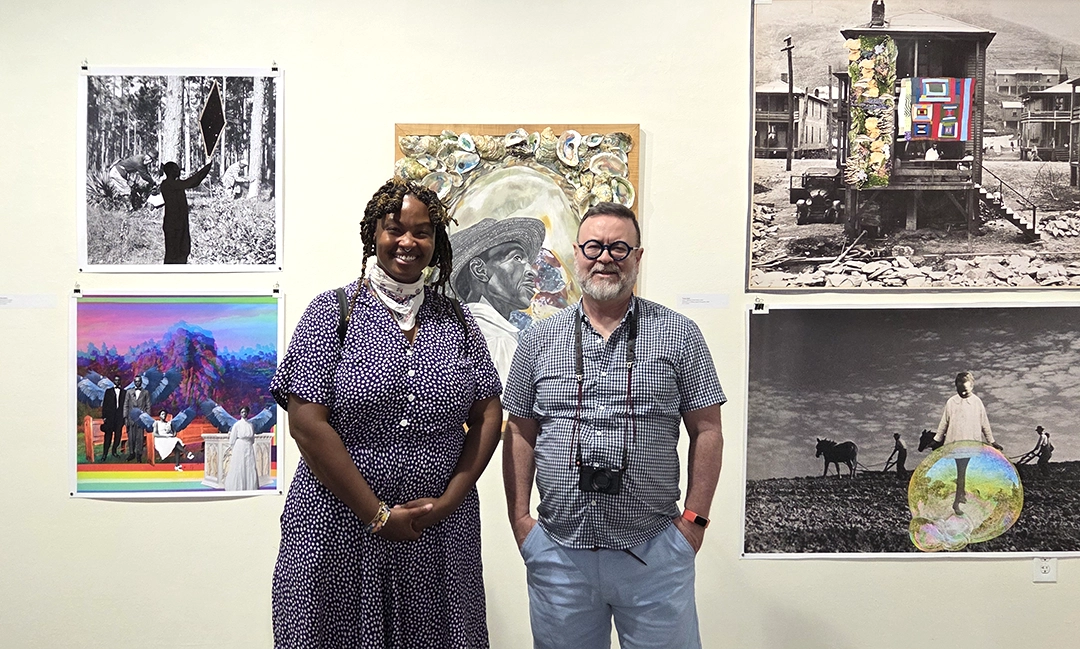
The AAC describes the exhibition this way:
Portals of Remembrance is a body of work conceived in a black hole, in the depths of the cosmos. A place where infinite possibilities coexist and timelines are threads woven together like a patchwork quilt. Nikki Giovanni once said that the Middle Passage was like traveling to Mars, when her ancestors were transported in rocket-like ships from familiar lands to utterly strange, unfamiliar, alien shores. But when they disembarked, they made the uninhabitable habitable. Portals of Remembrance is a black-eyed pea quilt.
This body of work pays tribute to the ancestral archives scattered across this country and the world, from nineteenth- and twentieth-century photographs, census data, newspaper articles, mug shots, and letters to images rescued from the artist’s family archives, from Monrovia, Liberia, to Birmingham, Alabama. Portals of Remembrance is an inquiry into the archive understood as something born of abundance rather than scarcity. Here, time, history, place, and people remain interconnected and simultaneous, without fixed forms and in constant transformation.










Comments powered by Talkyard.