

In the city we call Cincinnati, there lies nestled a hidden gem of a library founded by three brothers, John Uri, Nelson Ashley, and Curtis Gates Lloyd. They ventured here first and foremost, to further their knowledge and practice of pharmaceuticals, and as it turned out they were quite successful. Their combined eclectic attitudes towards their field of pursuit, coupled with their extensive private, and rare, collection of literature formed the basis of what is now the Lloyd Library and Museum which has stood its ground since the early 1900’s.
Their current art exhibition entitled ‘The Emerald Tablet’ displays the visual workings and research of Ken Henson, who, among other titles, is a professor at the Art Academy of Cincinnati. His work seems to focus on a multitude of different subject areas which include philosophical and chemical alchemy, meditation, astral projection, and the system of the Tarot. The esoteric nature of his paintings and illustrations is immediately apparent, and often borders on the mysterious. One gets the sense that there exists a beautiful and complex hierarchy hidden just beneath the surface of the paint, if only our eyes were so sensitive. Such is the nature of all work that stems from the mystical. I was given the chance to speak one-on-one with Henson about his show, which sprawls the first floor of the library. When asked about the use of occult symbology in his work he replied, “Don’t look for decoding the system, it’s about organic and manipulative play. There is no finite or concrete system, because symbols tend to reveal meaning over time rather than all at once.”
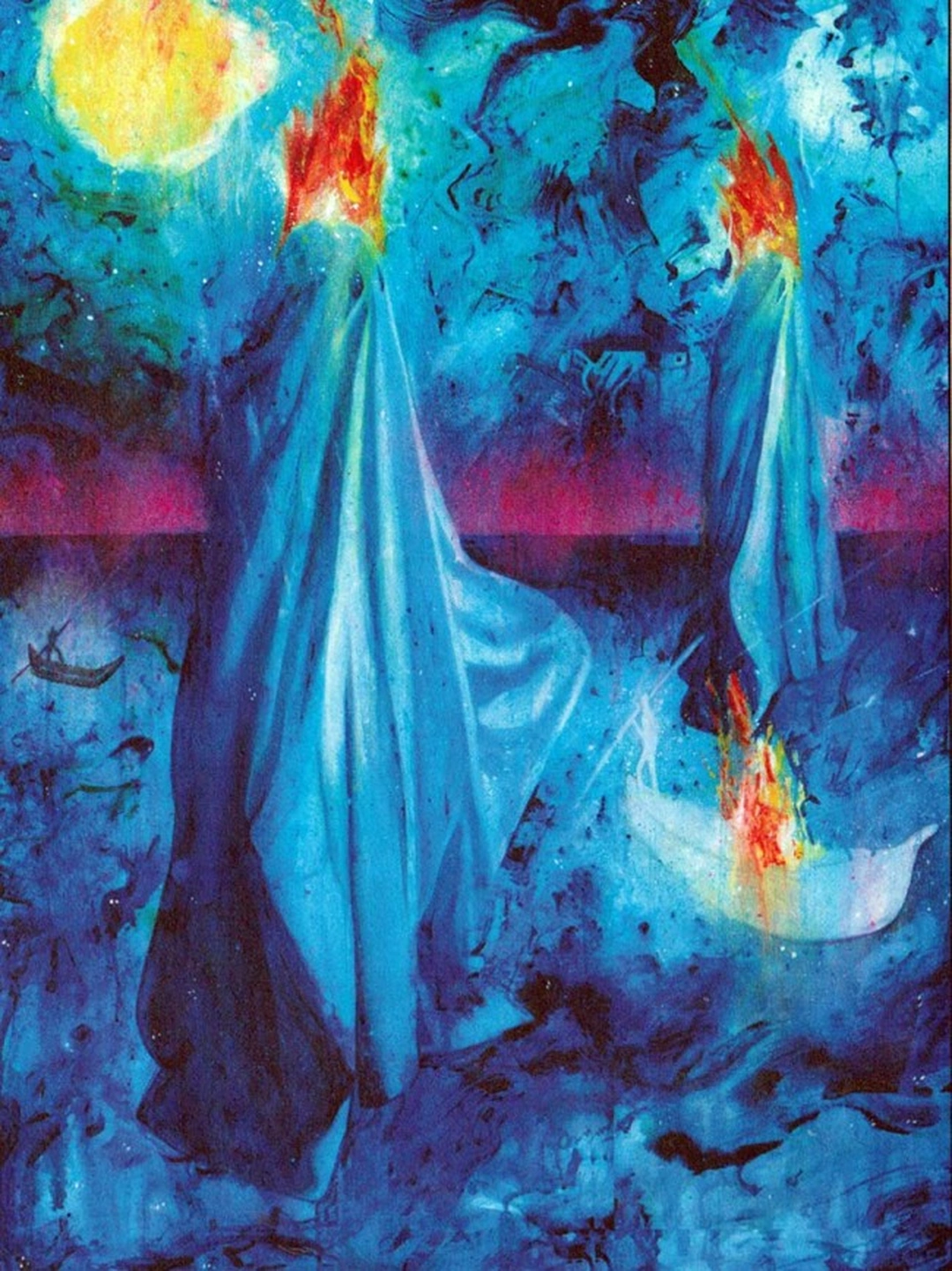
Particular attention is given to the so-called ‘seven gates of alchemical transmutation’ (Calcinatio, Solutio, Separatio, Conjunctio, Mortifactio, Sublimatio, and Coaglatio) which are expressed as large and vibrant paintings, riddled with symbological correspondence. Henson stated that the personal exploration of these ideas are regarded as “keys of initiation”, through which the soul must pass on its way toward spiritual enlightenment. For example, Henson’s interpretation of ‘Solutio’, which I felt to be my personal favorite of the series, consisted of two large cloaked beings, heads aflame, standing as gatekeepers upon a calm body of water. The hue of twilight is upon the horizon, and a solitary boatmen seeks to breach the threshold of their guard. In philosophical terms, it appears to be a certain kind of baptism and implies dispersion or separation. In chemistry this can be seen as the dissolving of a dry substance in a liquid.











Comments powered by Talkyard.