
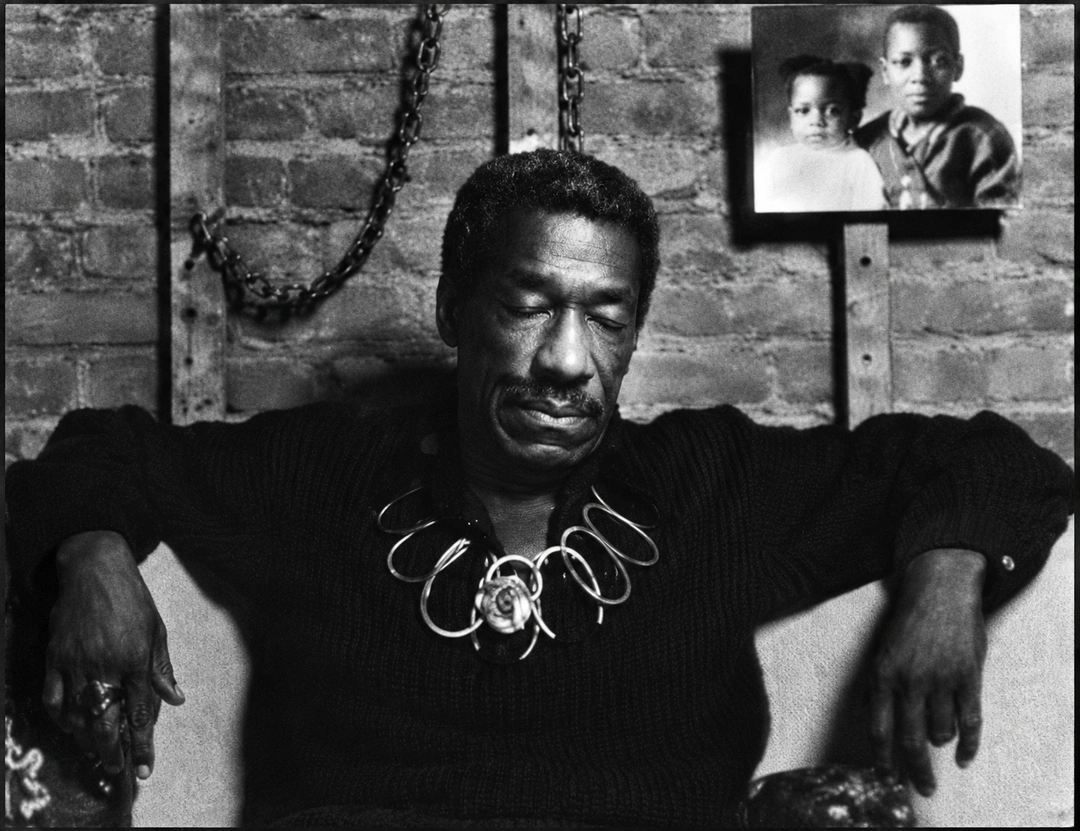
From the Village to Vogue: The Modernist Jewelry of Art Smith
February 14, 2014 – May 11, 2014
Cincinnati Art Museum
“Bespoke” was hardly an often-used description of jewelry during the ’60’s when Art Smith created the highly original pieces seen in his current display at CAM, but it now seems to refer to the rather funky, hand-made, individualistic pieces currently taking the high road in fashion. Crossing gender boundaries in personal adornment, it appeals to everyone with the brash statement so prized by those who take pride in a personal sense of style.
One piece, any piece, of the neck decorations, bracelets and rings displayed here would stand alone as miniature sculptures were they not so infinitely wearable. Most impressive were those involving cold connections: the links between elements that require no soldering or welding. These are the pieces which speak most clearly of design as portions move with the wearer. Smith’s ability to accomplish elegance with basic shapes, while implying a wealth of importance, places this work beyond mere jewelry, firmly ensconcing it in the category of fine art.
Curved heavy wire plays the most important part in the majority of these twenty-one items. Most are flattened through forging, echoing Alexander Calder’s classic wire jewelry. Both artists adopted concern with space as their inspiration, the same idea behind sculpture. Smith acknowledged the “spaces in between” as a necessary component of jewelry, adding both solidity and delicacy with its negative presence.
Smith was not so much interested in producing jewelry for shock or aesthetic qualities, as much as a part of the human form. He envisioned them as sometimes unable to exist on their own if not worn on the warm surface for which it was produced. Around the neck he made forms that undulated sensually. Or, as in the case of “Half & Half”, he mixed the solid scimitar-shaped portion on one side with surprisingly gentle wave motion in wire on the other.
Other neck designs tax the realm of wearability with protruding wires, taking wire into dimensions not ordinarily associated with necklaces. “Last”, actually the last work finished before the artist’s death, pushes outward, fending off closeness, sending a message of preferred solitude. Once again, much of an artist’s actual existence can be wordlessly comprehended through the work of his lifetime of growth, change and acceptance.
Materials used in his work were common metals, copper, silver, brass, etc., the same used by today’s jewelers of this genre. Such imaginative shapes are precious in their own right without expensive components. Tonality was introduced via patinas resulting from the welding process, or artificial application. Degrees of the patinas yield a more intriguing variation than an application of color could do, without interfering with the vitality of the design. “Lava”, a 1945 bracelet, moves from shine to a spectrum of grays as it wraps and re-wraps into a partially open fold encasing the wrist. Since the fold is doubled, the recesses are darkened naturally, then dimensionally exacerbated by patina. An effect of foreboding and mystery comes with the addition of semi-precious jewels embraced by the oddly manipulated circles, evoking possible powers for the wearer.











Comments powered by Talkyard.