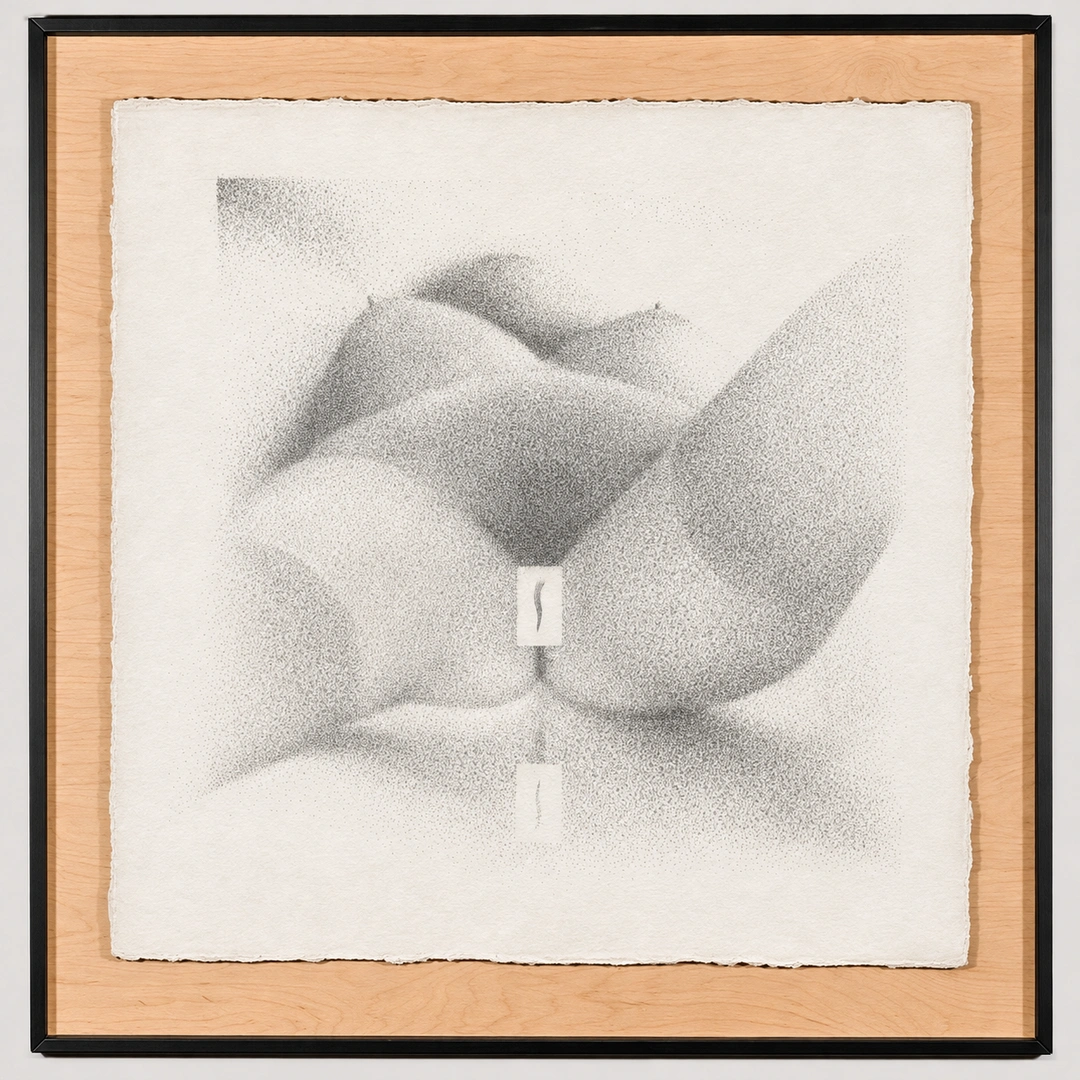
How are we to understand the intentions of a conceptual artist like Tom Marioni when he mounts an exhibition of objects using traditional mediums like fresco, drawing and bronze sculpture? It’s true that with conceptual art the medium is dictated by the idea (as Marioni has said with typical humor, a conceptual artist is “free to work in any medium except painting”). But this exhibition’s title, Dry Fresco, Drawings and Bronze, draws attention to these classical and decidedly non-conceptual mediums. And many of the drawings are female nudes. So it’s fair to posit that Marioni is making a point in his usual intelligently wry manner. To understand what that point might be we need to consider the work in this exhibit (obviously), but also a bit of Marioni’s large body of past work.
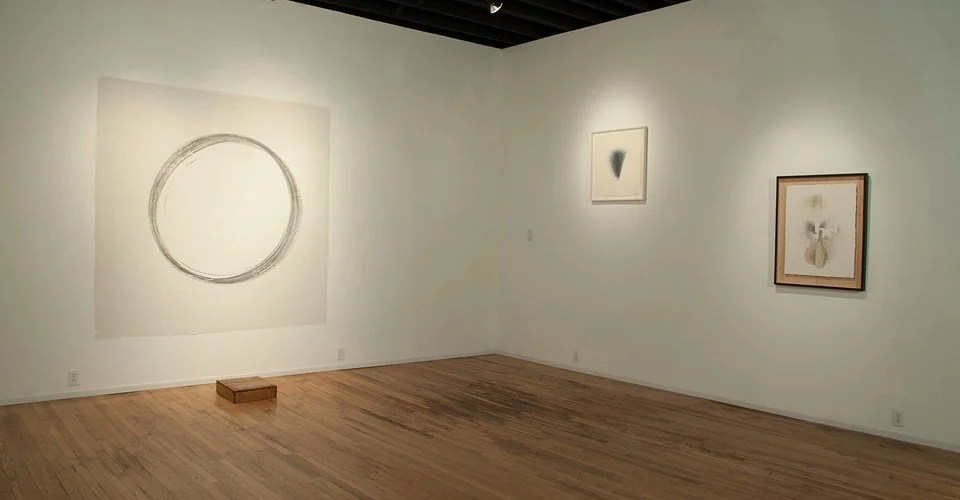
Dry Fresco, Drawings and Bronze consists mostly of just that: new graphite drawings of female nudes on plaster (ie dry fresco), his drum brush drawings on plaster and sand paper, bronze sculptures made between 1990 and 1999, and his circle drawings (in honor of the 100th anniversary of cubism, Marioni dubbed 2007 the “year of the circle”, and made only circle drawings that year).
The figurative dry fresco drawings are the most recent pieces, never shown before to my knowledge, and also his biggest departure. Marioni’s work has always related to the body, as in his Out of Body Free Hand Circle On Prepared Wall, Cincinnati B, a performative piece in which his arm is used as a sort of compass to draw a circle, over and over. But never until now has his work been of the body. Landscape with Finger Line and Life for M.D.(perhaps a nod to Marcel Duchamp and his female alter ego, Rrose Sélavy) are both drawings of a nude female, the former from the same vantage point as Courbet’s Origin of Life, with the woman’s breasts and faint outline of a head resembling hills that, along with Marioni’s title, invoke a pastoral landscape.
The relationship of Marioni’s past work to the body is a complex one that implicates pretty much the entire history of conceptual art. The most convenient place to start is Joseph Beuys’ concept of social sculpture as a way for an artist to use actions and objects to, in a nutshell, improve society. For Beuys, everybody is an artist – something as mundane as peeling a potato “can be a work of art as long as it is a conscious act.” Marioni certainly had Beuys in mind when he created his signature work, The Act of Drinking Beer with Friends is the Highest Form of Art, perhaps poking a bit of fun at Beuy’s German severity and seriousness. In the piece, Marioni simply drank beer with friends in an exhibition space, and left the cans as proof of the act. The act, and therefore the body, was the medium. In this way, Marioni’s art is grounded in sculpture and the body, and it is why Marioni calls himself a sculptor.