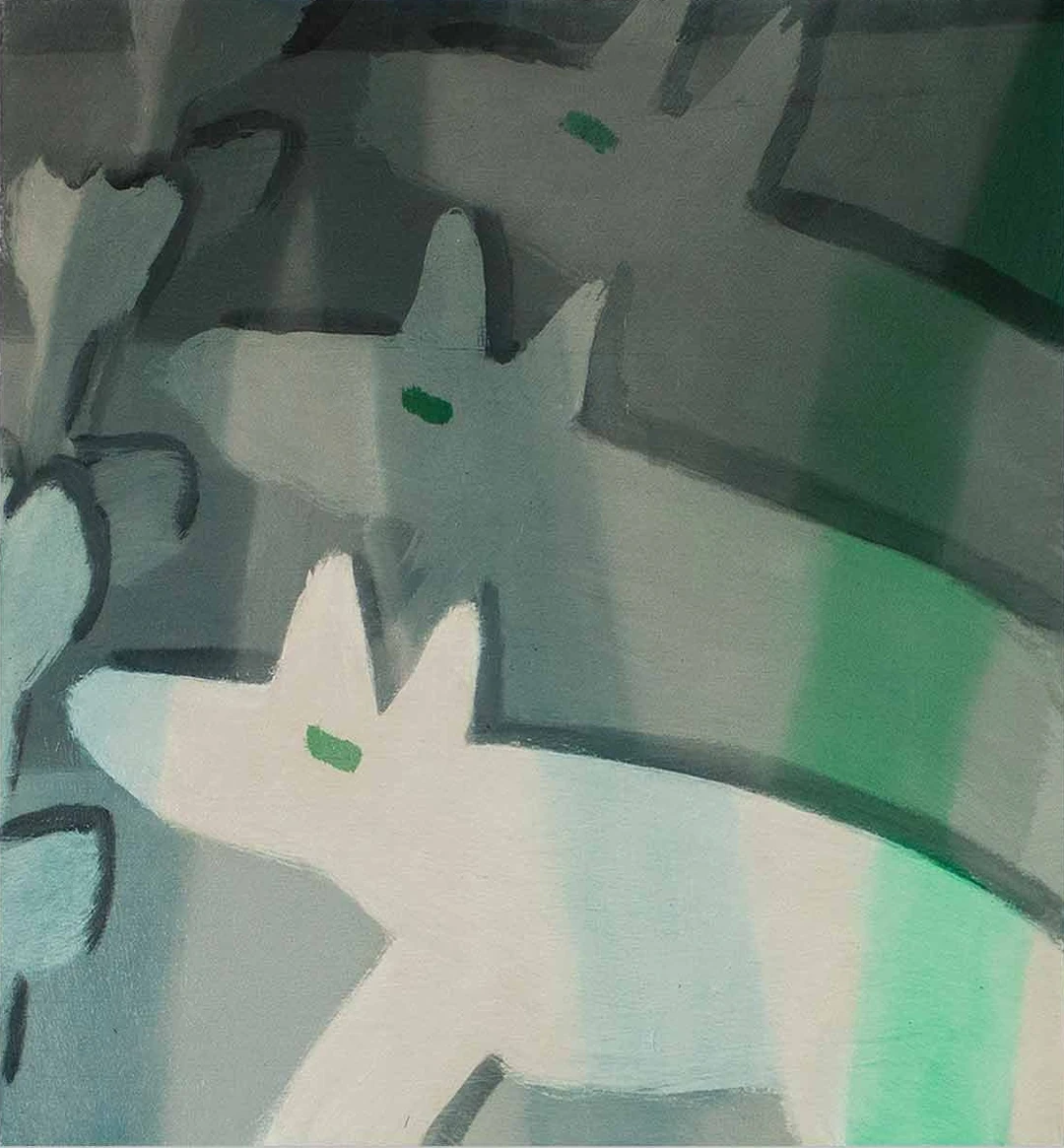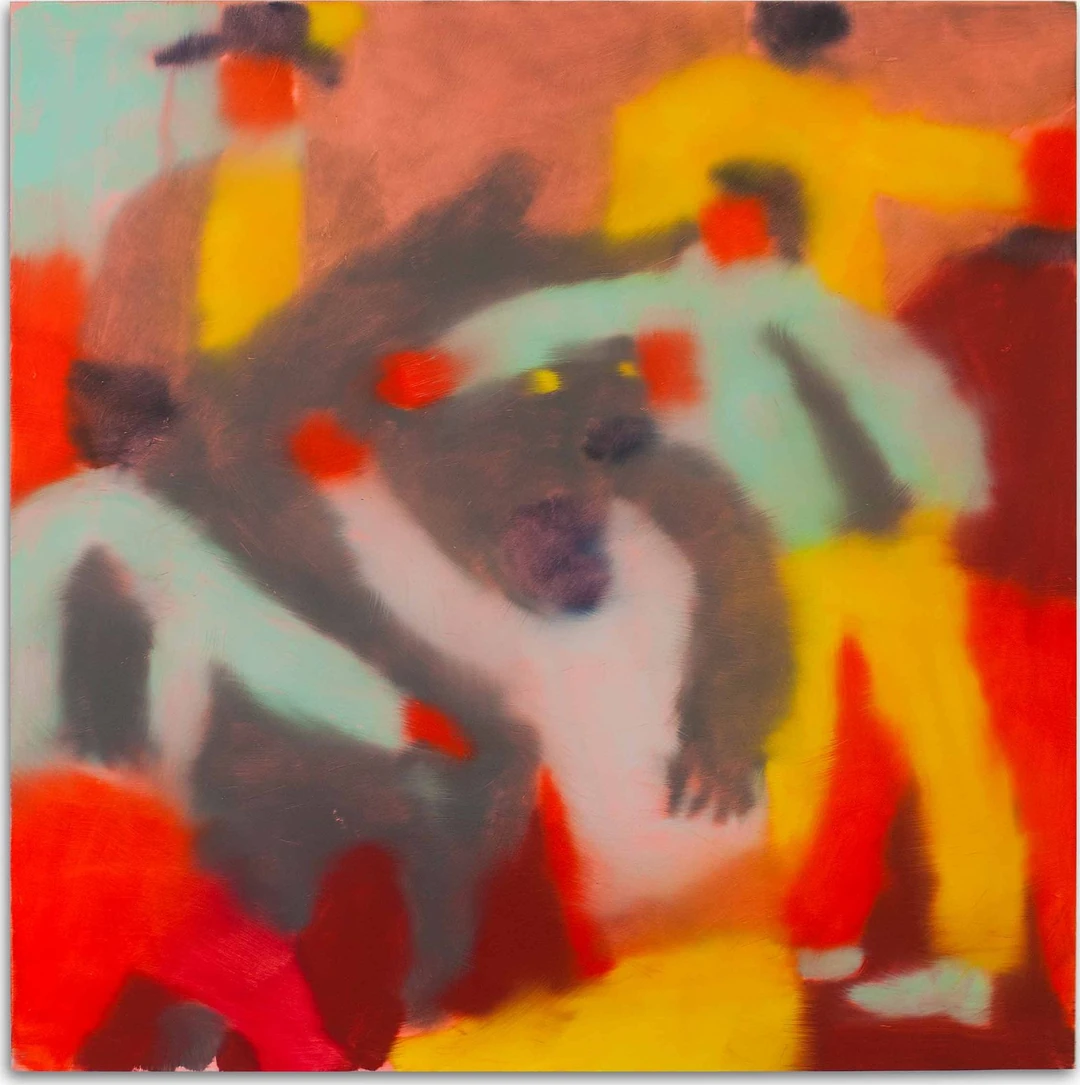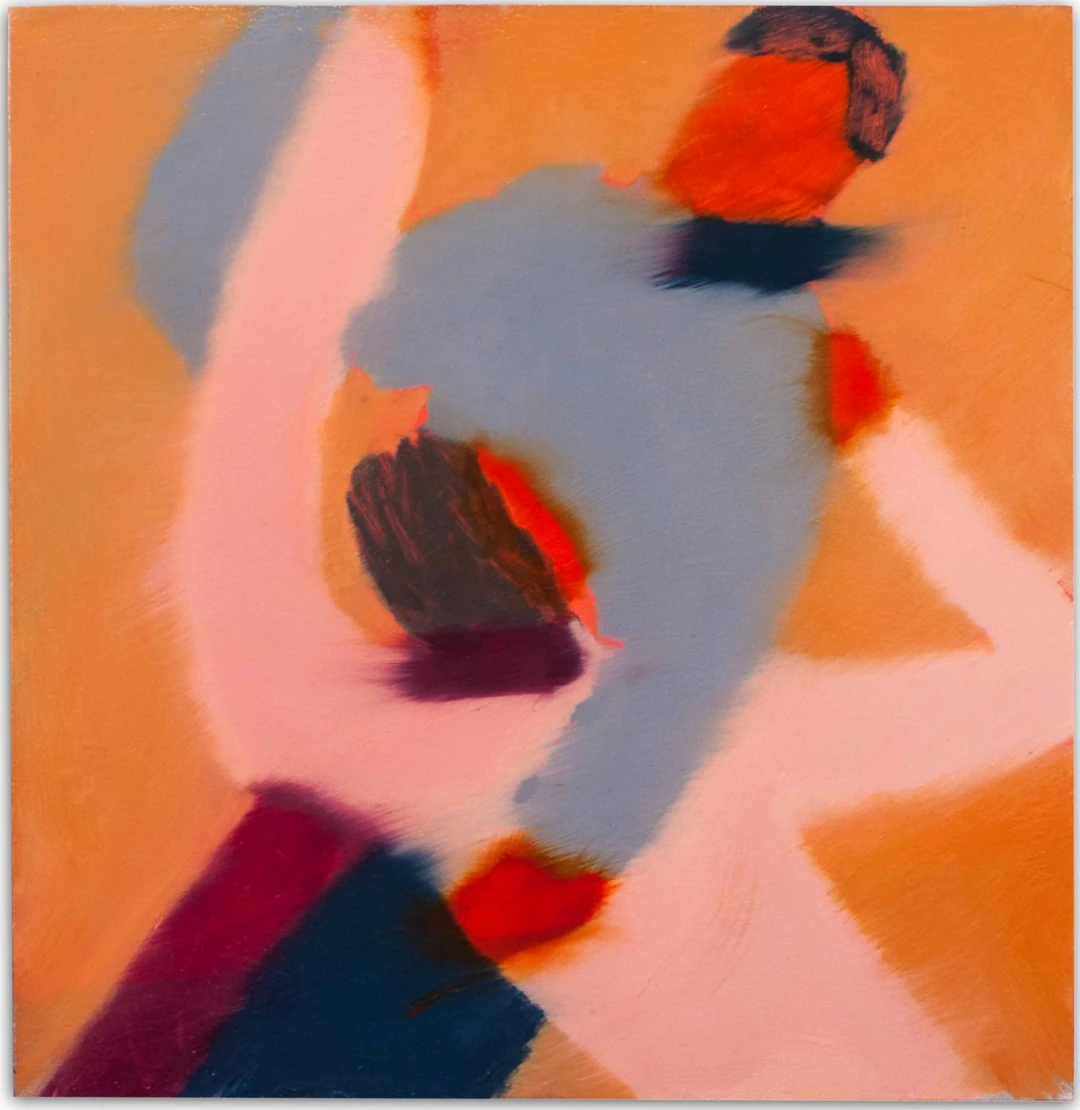
My first thought, looking at Patrick Shoemaker’s “Hindrance” is that it looks as much like dance as hindrance. Then I wonder who is hindering whom—and from doing what. And why. Then I wonder why two things opposite seem, so often, on the verge of one another.
And now I’m still looking at the painting, but I am also in the middle of remembering a question. (Questioning a memory.) The memory is of an afternoon in the courtyard of the Boston Public Library. I am watching a girl, four or five years old, with each of her arms in her father’s hands. He shakes them up and down in a way that looks alternately playful and violent. The girl squints or winces. From this distance, she could be either laughing or crying. I tend to think when two possibilities present themselves, the bad one is the truth. But on the other hand, we are in a mostly public space—
I equivocate like this because I know, in reality, only one of these scenarios happened, and I know that I don’t know which. But in memory, punishment and play can occur continuously in tandem—can continue to exist by virtue of their opposition, like the corridor produced when two mirrors face one another.
Shoemaker’s work, currently on view at Anna Zorina Gallery, thrives on this reflectivity. There is not so much an opacity or ambivalence in the paintings as there is a careful simultaneity. Everything is happening or could be. Pain flickers against pleasure, struggle against embrace—the friction of bodies on the brink of combustion.
But these paintings are also already in the middle of fire—Fire on Fire, as in the exhibition’s title, eyes and hands burning at the moments of visual, physical contact. Or: fire ignited to its superlative form.
In that state, in these paintings, intimacy breeds panic. Panic, likewise, tightens the grip the figures have on one another. The exhibition guide articulates Shoemaker’s union of forces through the Greek notion of the pharmakon, a substance Plato describes in Phaedrus as both a remedy and a poison. In Plato’s account, Thoth, the Egyptian scribe of the gods and judge of the dead, provides King Thamus writing as a pharmakon to memory. It is Thoth’s intention that writing tame the wildness of memory—but writing, Thamus refuses, can also become its own intoxicant.
Drug, cure, filter, light source, spell. Pharmakon becomes exponentially variable the more deeply we engage it. Derrida, for example, excavates the word from its status as a substance to something that resembles more of a medium or matrix—an atmosphere of disorientation, indeterminacy, and constant transformation. Because it is unstable, because it both rejects and enkindles all previously conceived possibilities, Derrida writes that the pharmakon becomes itself “the movement, the locus, and the play: (the production of) difference.”