
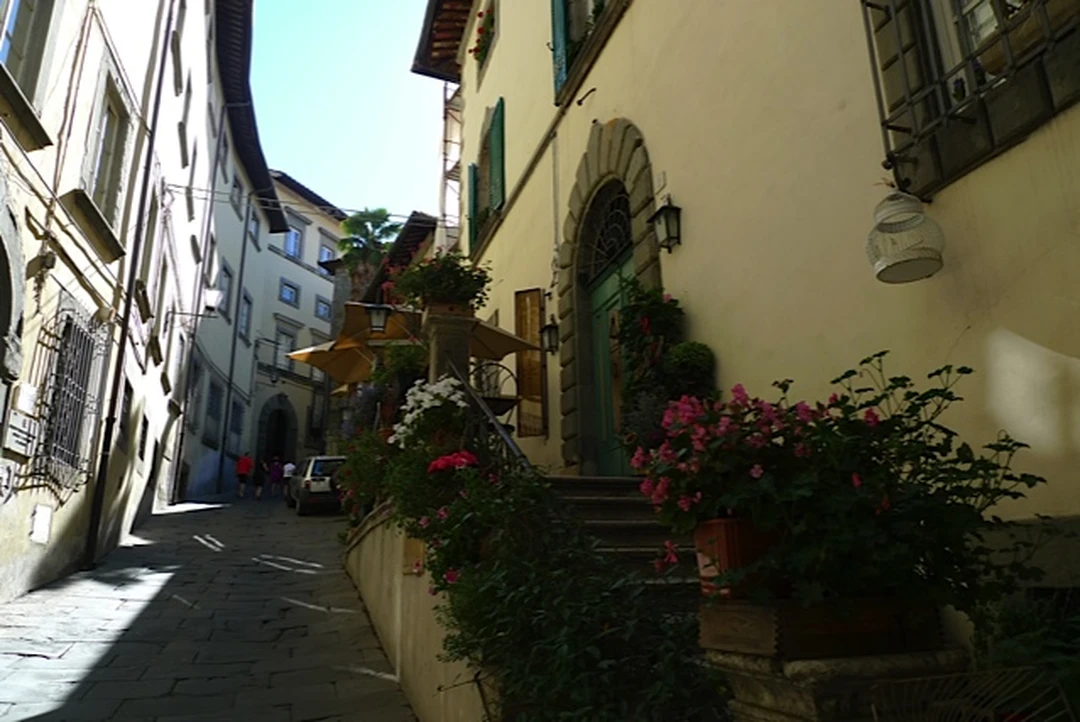
Cortona is a walled Etruscan hill town 1 ½ hours southeast of Florence by auto, mostly via the white-knuckling auto-strada. A bit less of a tourist destination than some other Tuscan towns—smaller than Siena, maybe less charming and trampled than San Gimignano—its nearly carless, cobbled steep and narrow streets meander the hillside. Our home for two days, a picture perfect villa rented by old friends just outside of town, overlooking the hills, groves of olive trees and grape vines.
I expected the camaraderie of old college friends and our wives, too much drink, beautiful vistas, dinners on a postcard perfect veranda and afternoons by the pool. We got that. But, I did not expect one of the finest exhibitions of contemporary photography I have seen. “Cortona on the Move: fotgrafia in viaggio” takes place in six venues scattered around the village, with the work of 13 photographers. Think Foto Focus, the Cincinnati event, but cohesively curated to a singular, though broad, theme and taking place during a defined period. Then picture the art hanging on walls of a centuries’ old fortress, an ancient former hospital or a church, the work taking on new meaning and beauty on seven hundred year old stone walls.
“On the Move”, the title and, in essence, the theme or thread that ties together the various exhibits—movement and its many manifestations. Antonio Carloni, Festival Director, describes the work as “photography in travel, as a dream, as magic…the images open the doors of time, past and present merge. The logical thread that connects all the exhibitions shares the travel and drifts to various experiences.”
Our first day, we wound our way up the steep alleys and paths to the top of Cortona and the fortress, where we took in Jergen Toirkens “Nomad”. Since 1999, Toirkens, of the Netherlands, has documented the last living nomads of the Northern Hemisphere. The photos depict the brief, harsh lives of various Mongolians, Alaska’s Inupiat, Russian Sami and Nanets. Climate change, globalization and oil exploration have disrupted the migratory patterns of the animals these Nomads often follow and use to survive. Their population is in steep decline. The photos of these weathered people in their often brutally cold and barren surroundings are soulful and full of loneliness. Survival is their goal, comfort an unknown.
Also in the Fortress, the excellent American photographer, Joel Meyerowitz’ “Taking My Time”. Photos from the mid-sixties up to his iconic picture of The World Trade Center site days after the 9/11 attack, show Meyerowitz’ nearly peerless ability to capture everyday scenes of movement that evoke emotions of nostalgia and wonder, or in the case of the 9/11 photos, awe and loss. These, in particular, are somehow beautiful in their depiction of horror and loss, and paired with the work from the ‘60s and ‘70s convey the overall feeling of the mystery of the movement of time. A gorgeous show.










Comments powered by Talkyard.