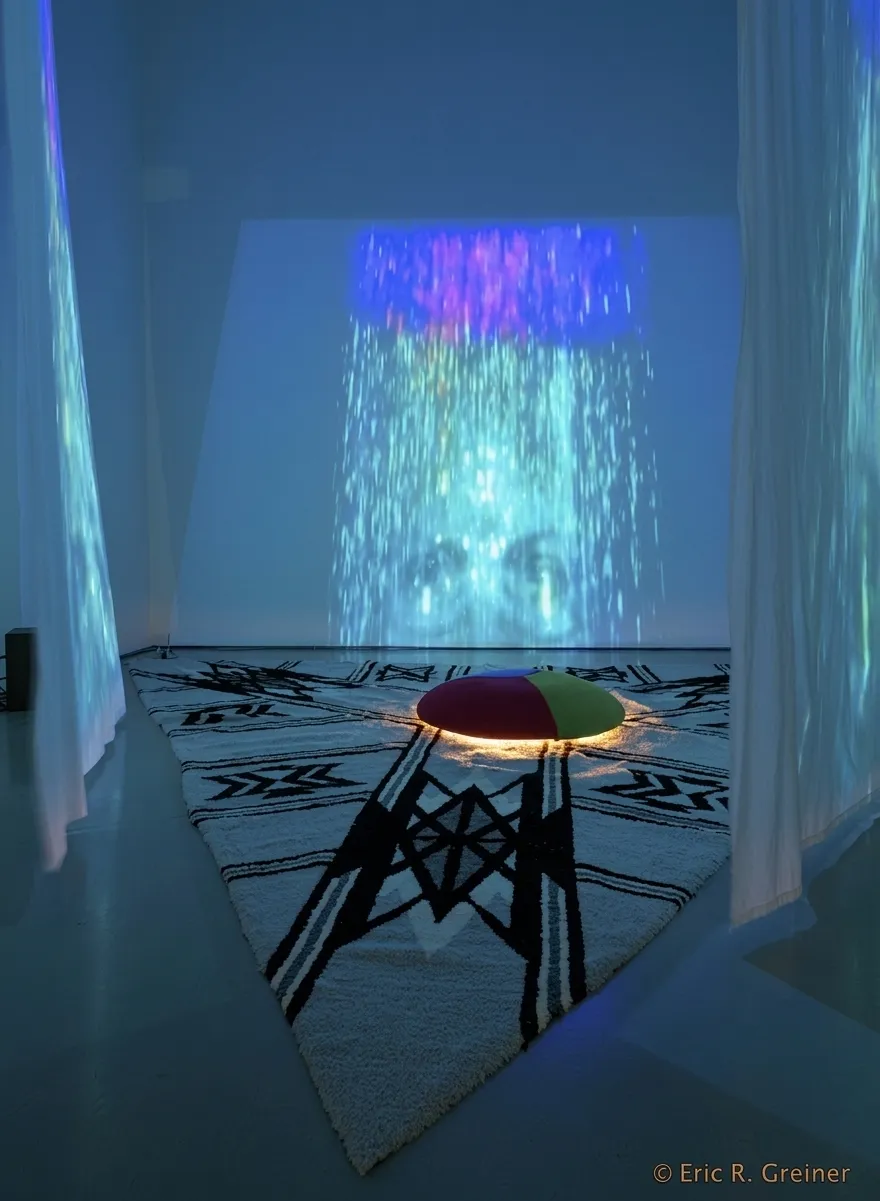
Maidens of the Cosmic Body Running, Majr Gazr, 2011, installation view, Contemporary Arts Center, Cincinnati; video, wood furniture, wall drawings, prints, and handmade fiber elements; photo: Eric R. Greiner.
“Maidens of the Cosmic Body Running: Majr Gazr” is a collective exhibition featuring the work of area artists Denise Burge, Lisa Siders, and Jenny Ustick at the Lois & Richard Rosenthal Center for Contemporary Art. The installation is an intensely immersive experience in which the group employs color, video, geometric abstraction, wall-drawings, fiber art, and various other media to create a kind of psychological space for introspection and encourage “utopian” relaxation in the viewer. It is at turns dark, psychedelic, and contemplative, and the viewer is left with an emphatic impression of self-reflection that gets stronger, the farther down the rabbit hole (and into the exhibition) one goes.
According to the introductory wall text, the Maidens’ “concept of the female community” employs “rural endeavors and integration of craft to conjure up references to some ‘communes’ from modern art”. A few issues in that lofty sentence behoove clarification: to my mind, “rural endeavors” refers to the Maiden’s use of weaving, quilting, and various fiber arts throughout the exhibition. Indeed, both Burge and Siders are fiber artists who teach at the University of Cincinnati.
Additionally, they specifically identify such groups as the Bauhaus and the Soviet Constructivists when referring to modernist “communes”, and in doing so they employ the word metaphorically. Although American author Tom Wolfe called the Bauhaus “a commune, a spiritual movement, a radical approach to art in all its forms,” in his book “From Bauhaus to Our House” (1981); and the Russian Futurists’ (who begat the Soviet Constructivists) published the art journal The Art of the Commune (1918-19), the Maidens’ use of the term is—like so much of this exhibition—highly allegorical.
By connecting themselves to such groups, and reclaiming the ideology of their artistic endeavors, the Maidens highlight their own romantic, all-encompassing, and collaborative approach to art making. Neither The Bauhaus nor the Soviet Constructivists were “communes” in our contemporary understanding of the word, so much as they were educational settings for communal living based on romantic notions of earthly transcendence through artistic methods. The Maidens, likewise, are all arts educators (Ustick likewise teaches art at the University level) who create art-saturated environments for ostensibly idealistic ends. And like their modernist precursors, these artists are explicit in their “desire to ignite social revolution through art.” Whether Art is capable of such a romantic ideal remains in the realm of the utopian, but the journey into self on which the Maidens take their viewer, is well worth the ride.
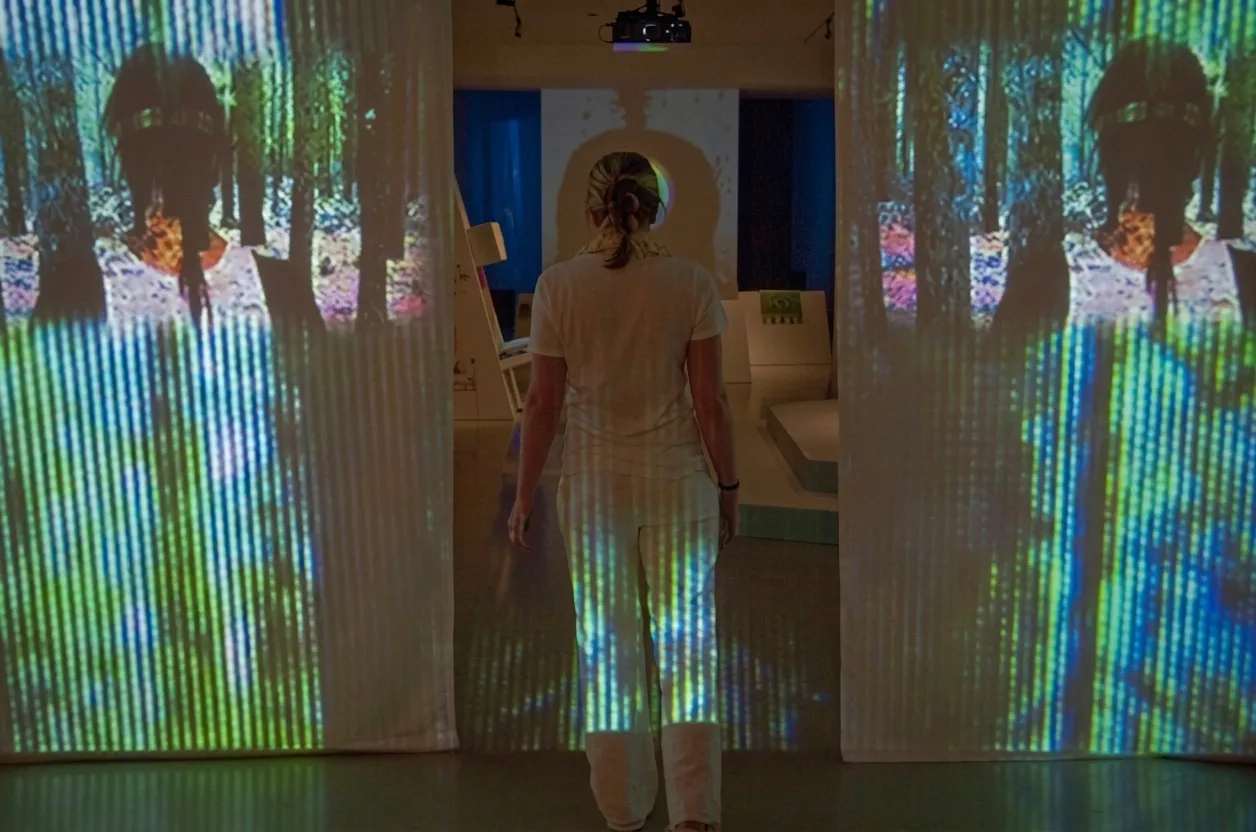
Maidens of the Cosmic Body Running, Majr Gazr, 2011, installation view, Contemporary Arts Center, Cincinnati; video, wood furniture, wall drawings, prints, and handmade fiber elements.
Located on the second floor of the CAC, “Maidens” is situated in the far gallery several steps down and feels (appropriately) significantly removed from the lofty ceiling and bright lights of the main gallery area. We were told downstairs at the ticket desk to remove our shoes for this exhibition and, once upstairs found a simple low black triangular shelf with rows of white felt slippers along all three sides for visitors to wear inside.
I was immediately reminded of Judy Chicago’s iconic feminist installation, The Dinner Party (1974-79), which also features a triangular table of equilateral sides. While Chicago’s plate-centered Dinner Party was an invitation for women to eat at the proverbial table of history, the Maidens’ shelf of white slippers could be interpreted as an invitation to take off ones’ shoes and submit to their proffered modes of relaxation, into transcendent states of unconscious.
Subdued lighting in the intimate space requires ones’ eyes to adjust, and the exhibition gets darker as one delves in farther. Posted on the right wall is a box with laminated guides describing “THE BASIC RELAXATION STATIONS and their relation to cooperating bodies,” replete with how-to drawings of people demonstrating each interactive “station,” and the words “the Clearing properties of R.G.B. [Red, Green, Blue] on cooperating bodies” written in black marker on the wall. One might say then, that “cooperation” was not only important to the collaborating artists’ process, but also something that they wanted to impress upon their audience.
When facing the long glowing gallery from the first room, a projected video of one of the artists (pictured from the shoulders up within a forest scene) is visible in the adjoining exhibition space. Wearing an eye mask that extends over the figure’s head, the eyes become a space for other rapidly-moving images. Viewing this projected image from the entry point, another video—doubled on two nearer white sheets and separating the first two exhibition areas—creates a resulting simulacral effect. The nearer two projected images appear to be the same person facing the interior video with back to the viewer, and this visual metaphor for self-reflection is repeated throughout the exhibition.
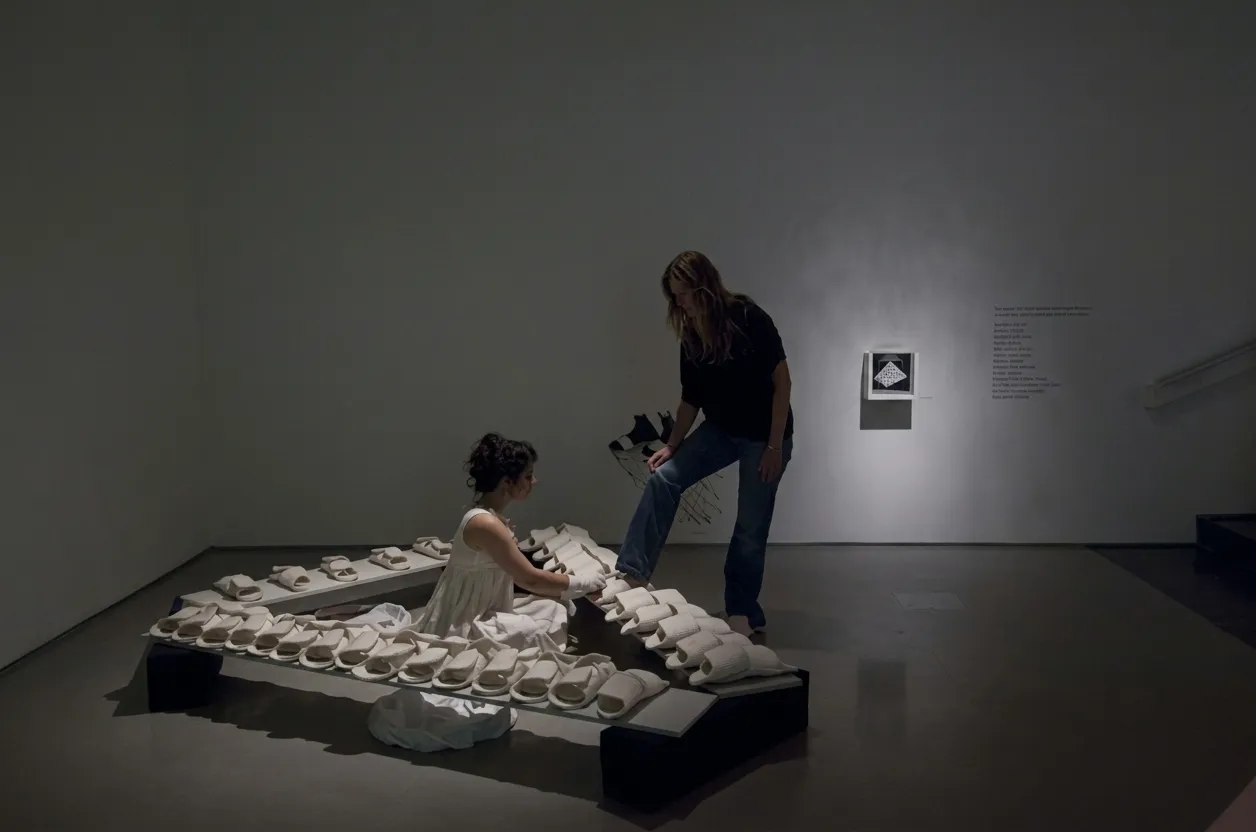
Denise Burge, Lisa Siders, Jenny Ustick / Maidens of the Cosmic Body Running, Majr Gazr, installation view, Contemporary Arts Center Cincinnati, 2011.
Entering between the two projected screens into the second of three major exhibition spaces, one finds the first of five Relaxation Stations, closest to the viewer on the right. “Station 1 mirror stage (prime focus)” consists of a white platform with an embedded triangular television screen, three surrounding triangular seating pads (one of each: red, green, and blue), and corresponding white headphones that play varying ambient noises. On the platform are several drawings of three faces with empty eyes, projecting fields of vision at each other and a triangular sign, wearing the same masks as in the previously-mentioned videos.
Unfinished graffiti-like drawings and text in pencil, black pen, and marker on the walls, platforms, and various installation components retain the feeling of half-baked doodles—the visible results of fleeting flights of whimsy or personal reminders in the margins of a larger narrative. Block letters are not filled-in, pencil is rubbed-off, and composition & alignment are rejected—contrasting sharply with the geometric precision elsewhere in the exhibition and therein underscoring their importance.
Farther in and to the left is Relaxation Station 2: “encounter with the extra self.” Here, detailed instructions on how to interact with the exhibition component are given. “For full experience of relaxation” one stands within a tall triangular module across from a mirror and a places a quilted blanket over their person, (held up by two pegs on either wall,) and a digital image of hands pulling up fabric is projected onto the white quilt, which one sees reflected in the facing mirror—the shape of which is echoed in the aforementioned projected imagery as well as in woven materials throughout the exhibition. This pervasive use of repetitive signs (red, green, & blue, triangles, wall-drawings, etc.) reinforces the Maidens’ triumvirate of collaborating artists, references to the self, and their overarching abstract geometric aesthetic.
There are two more Relaxation Stations within the larger middle exhibition space, and one final in the farthest reaches of the exhibition hall. If one ventures past the second and largest partitioned room—which, despite my own familiarity with that specific CAC gallery space, it was (perhaps purposely) unclear whether there was anything beyond—they will find the most immersive component of “Majr Gazr”, Station 5: “Ethr (energy threshold)”.
This adjoining space is quite dark, elicits a rhythmic pulse, and would be the kind of place one would want to be if under the influence of hallucinogens or some other deep state of consciousness. I was reminded of where one’s mind might wander if enclosed in a sensory-deprivation tank or the feeling of seeing migrating spots in one’s eyes after being in a dark room for a significant amount of time.
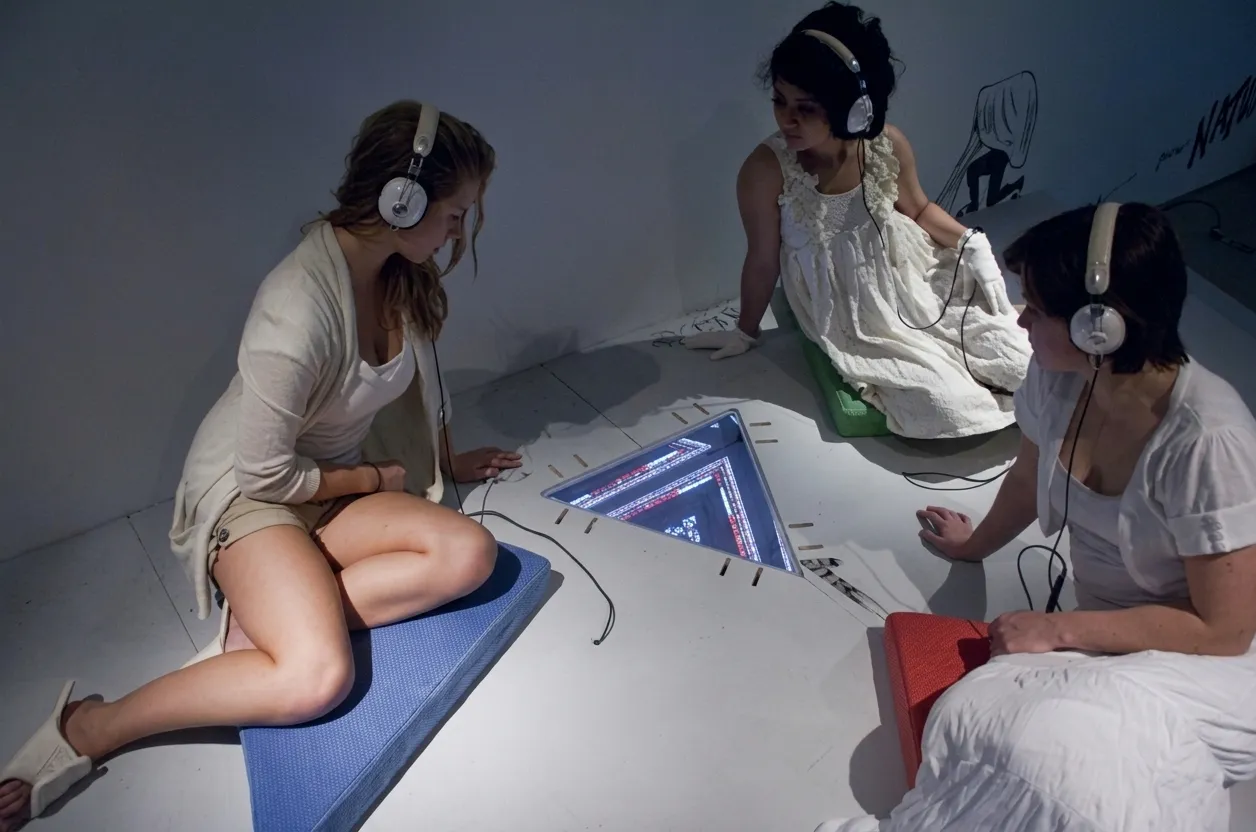
Denise Burge, Lisa Siders, Jenny Ustick / Maidens of the Cosmic Body Running, Majr Gazr, Relaxion Station 1, installation view, 2011.
Consisting of three white sheets, arranged (you guessed it) in triangular formation, the image projected on all three is even more abstracted than earlier video components and contains only a close up of the masked-face, which permeates the video components in the exhibition. Pixilated raindrops of red, blue, and green course down the long screens, with merely a hint at horizon to allow the viewer to become the ‘self’ so oft referred to throughout “Majr Gazr”. In the middle of this three-sided space is a likewise-shaped plush white woven rug with black geometric elements, and a circular cushion of red, blue, and green lit from underneath so as to almost appear floating atop.
It is here that the viewer experiences the most profound reference to the Maidens’ professed desire to provoke societal change, and I suggest that their implied method for social improvement involves working individually within groups, cooperatively (as in communes). This is alluded to in their how-to guide for the various Relaxation Stations, as well as the ubiquitous doodling of personal aphorisms and references to being a “cooperative” body. The communal transformation to which the work aspires, comes from necessarily looking within to start with the “[wo]man in the mirror.”
On the wall into the final exhibition area, the phrase “I am under…” is written repeatedly in black oil stick, the largest and most emphatic of all previous wall drawings. One might conclude that the artists were referring to being “under” a hypnotic state, “under” the influence, or perhaps merely rejecting the state of being “above” it all. This may be a transcendental exhibition, but it is grounded in the artists’ use of “rural” media and utilitarian craft.
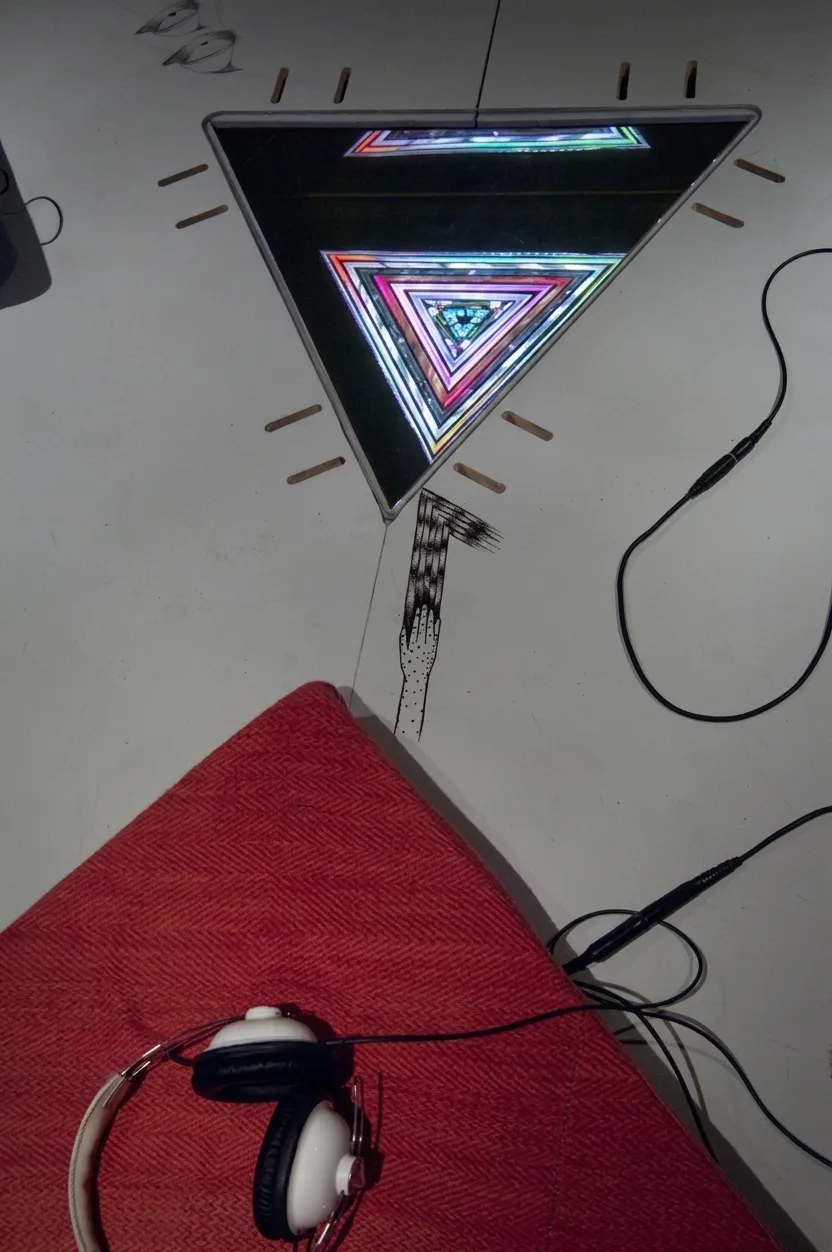
Denise Burge, Lisa Siders, Jenny Ustick / Maidens of the Cosmic Body Running, Majr Gazr, Relaxion Station 1, detail, 2011
Just as Jean Baudrillard came to see the idea of the simulacrum as the ultimate collapse of the distinction between art and the world, the immersive environment of “Majr Gazr” employs simple aesthetic elements and technology to idealistic ends. Thus, the Maidens are “under” it all—not above it. They employ any and all media without fear of being associated with the artistic implications of craft, technology, or self-referential artwork. They own it; they use it. Why not, if the aesthetic processes are for utopian ends?
Like their predominantly European male forerunners, Burge, Siders, and Ustick seek to erase the distinctions between art, craft, and technology through their work, but (thanks to the third phase of feminist art that came before them,) the “Maidens of the Cosmic Body Running” demonstrate no need to reclaim craft for their aesthetic purposes. Thus, they can address larger issues of universal commonality in their work: aspirations for self-improvement, transcendent states of un/consciousness, and how we are affected by the aesthetics of our environment. And despite their purported employment of the “female community” in their collaboration, this is a gender-neutral installation—one that concerns a Universal Self, devoid of issues of sexual identity, but rife with matters of introspection and self-reflection.
-Maria Seda-Reeder
“Maidens of the Cosmic Body Running: Majr Gazr” is on view until July 17th, 2011 at the Contemporary Arts Center










Comments powered by Talkyard.