
There are moments of alignment, when it seems as if the universe is sending us a sign. Vain hope. One could say the same of crossing a disciplined line of ants at work, each keeping perfect distance from the other—and all it would mean is that they are carrying organic matter back to the nest.
For professional reasons, I am often required to write in an orthopedic language. That’s how things are. When I have a few empty minutes—while three tortured potatoes boil for Friday’s mash—I try to write without restraint or self-censorship.
One of the most endearing scenes in Tarantino’s Inglourious Basterds is when Hans Landa, in the Le Gamaar cinema, questions Enzo Gorlomi (Lt. Aldo Raine), Antonio Margheriti (Sgt. Donny Donowitz), and Dominick Decocco (Pfc. Omar Ulmer) about their Italian names. When he turns to Donowitz, Landa asks him to repeat his name once more, purely for the pleasure of hearing it in Dante’s tongue. Well then—like Landa—Anch’io vorrei sentire, ancora una volta, la musica delle parole. I too want to savor the music of the word.
Not as often as I’d wish, I’m visited by what José Prats Sariol, in his Lezamian studies, called el azar concurrente—the concurrent chance—related to the phases of the Curso Délfico (palatal opening, transmutative furnace, aporetic gallery): symbolic structures of reception, transformation, and uncertainty that mediate between creator and reader. To simplify, I leave it at the casual concurrence of multiple factors bearing equal symbolic weight.
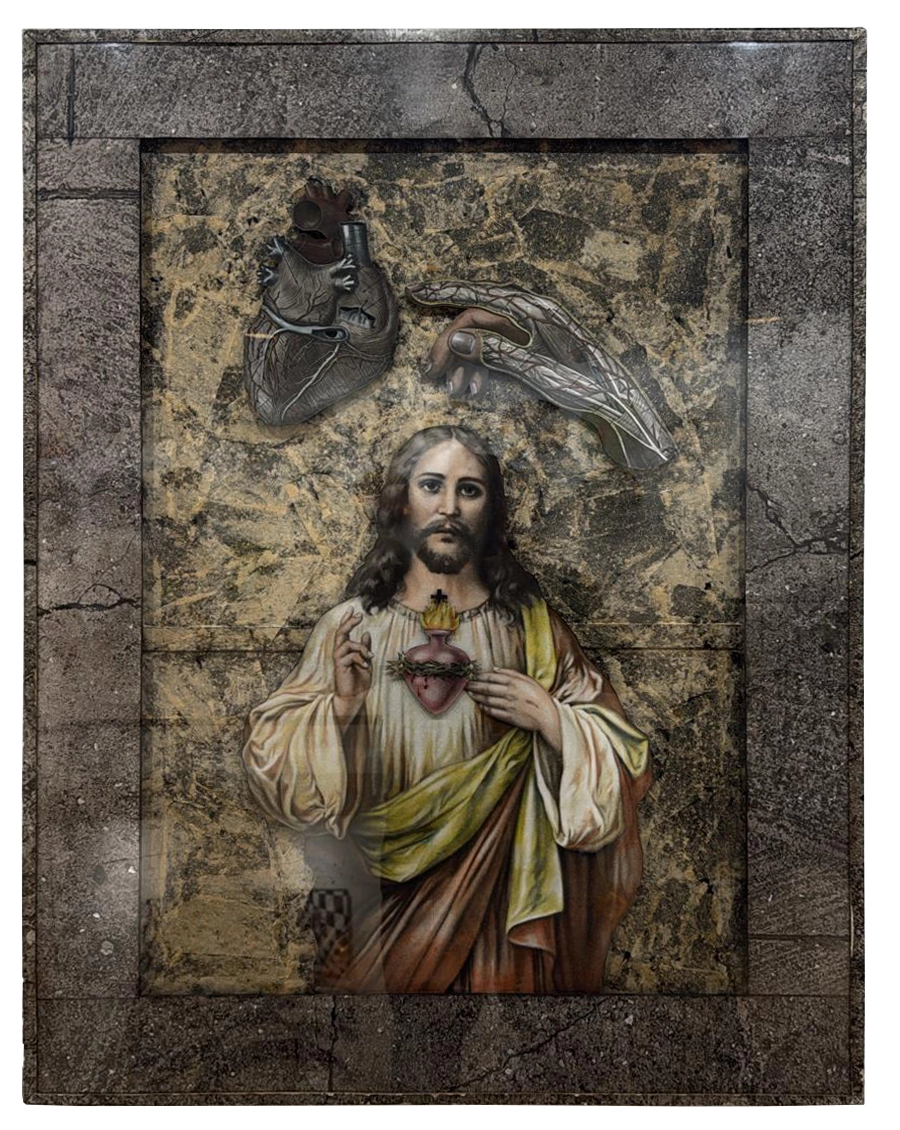
Yesterday morning I wrote a note for the Museum of Contemporary Art of the Americas about the acquisition of a piece by Rubén Torres Llorca. It is titled Here It Come That Heavy Love and was created in 2015. It depicts the Sacred Heart of Jesus. In the text I briefly discussed its origin as a symbol: its representation has roots in seventeenth-century Christian spirituality, though its meaning reaches much further back, to the medieval devotion to Christ’s suffering humanity. The heart came to be conceived as the center of Jesus’s divine and human love, a symbol of his total self-giving and infinite compassion toward humankind. Encircled by a crown of thorns, crowned with a cross, and burning with flames, it expresses both redemptive pain and loving passion. Its iconography was consolidated through the visions of Saint Margaret Mary Alacoque, who spread the devotion to this Heart as a sign of reparation and consolation for the sins of the world.











Comments powered by Talkyard.