 Go to English Version
In a couple of weeks, The Annex Gallery will receive an exhibition by Juan-Sí González. There are several generations of Cuban artists —the younger ones especially— with only a very blurred idea of who Juan-Sí is and what his role has been in Cuban visual arts during the second half of the twentieth century. Some do not know him at all. This does not surprise me. The revolutionary cultural bulldozer and State Security treated him much as the Soviet authorities treated Reactor 4 at the Chernobyl nuclear power plant. They did not dare then, and do not dare today, even to disparage him.
And so, one day, I see a fellow countryman walk into the gallery wearing a little hat, and at that moment I am completely unable to gauge his commitment to the highest civic values, his character and, above all, his enormous talent.
Getting to know him has taken me months, and I neither intend nor wish to compress the knowledge that has accumulated into a single article. Something simpler would be to share a few reflections on his extensive and magnificent career, his conceptual projection, his legendary performances and his competence as an artist. I will not do that today either. This career, irregular because of context rather than any lack of clarity, has been accompanied by a long rosary of dissidences. Above them all stands his ferocious antagonism toward the Cuban communist dictatorship. A dissidence he put into artistic and political practice from the 1980s onward, when very few people understood that the entire enterprise of international communism, together with its tropical Latin American variants, was already in free fall.
The exhibition is titled I.T.I.N.E.R.A.T.I.O.N.S. It opens on September 16 at 11:30 in the morning, within the context of the FotoFocus Biennial.
Juan-Sí has sidestepped the temptation of a linear succession of photographs. The exhibition comes closer to a limited number of imaginary constellations, interrelating objects, words and minimal visual episodes distributed throughout the space according to a predetermined logic. Some of these works will rest against the wall and maintain a conventional relationship with it, retaining the autonomy proper to the photographic object. Others will be placed directly on the floor and incorporate three-dimensional letters, gathered objects or domestic structures with no artistic authority per se. We will encounter videos, reflections, suspended papers, and we will have the possibility of physically walking around the work. The route through the exhibition will, of course, be nonlinear as well.
One of the exhibition’s gravitational centers is Mental Landscape, an installation bringing together photography, video, mirror and a homemade clothesline. Images printed on partially translucent paper hang from it. The viewer can move around the installation, visually couple one image with another, and distinguish his or her own reflection, with whatever that may imply.
Around this nucleus will be placed works resulting from different moments and different displacements. Photographs taken in Ohio, images from American Playgrounds, interventions carried out between Dayton and Springfield, pieces constructed from words, treating language itself as material.
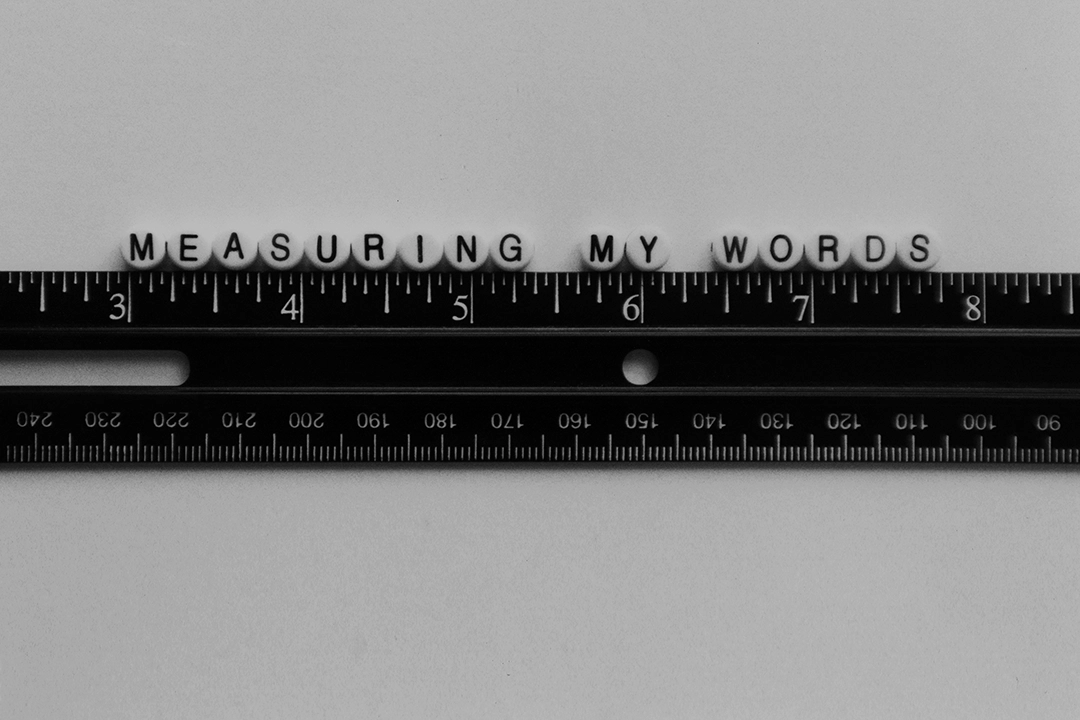
Palabra y semilla evokes the experience of circulating between languages, of using a foreign tongue while one’s own remains alive, operating and interfering beneath the dialogue. In these and other pieces, letters, stones, coffee and ordinary objects recreate that urgency, turning words into aesthetic experiences that need not be auditory.
The exhibition also incorporates works whose political dimension emerges without having to become the direct illustration of a discourse. In one of them, González turns to the names inscribed on the Vietnam Veterans Memorial to reconstruct his own name through fragments belonging to other men, Latin Americans killed in the war. In another, ABC becomes Avarice, Brutality, Control, within a piece where honey and ants construct a small scene of attraction, consumption and death. The procedure changes, while a persistent inclination remains toward observing the systems that organize human experience and the traces they leave upon objects, words and places.
For all these reasons, it makes sense that he did not conceive this exhibition according to a predictable formal logic. It would not be particularly confusing, but it would demand a gratuitous effort of decoding first, only to reconstruct it immediately afterward. Some locations have already been defined; others will be decided inside the gallery itself. Photographs may be moved, relocated into vertical or horizontal combinations. Pieces will alter their relationship with the others depending on the wall they occupy. This seems to me a coherent way of approaching the museography of an exhibition traversed again and again by the idea of itinerancy. The installation does this too. It is tested, corrected, made to find its place. Like everything else. Like ourselves.
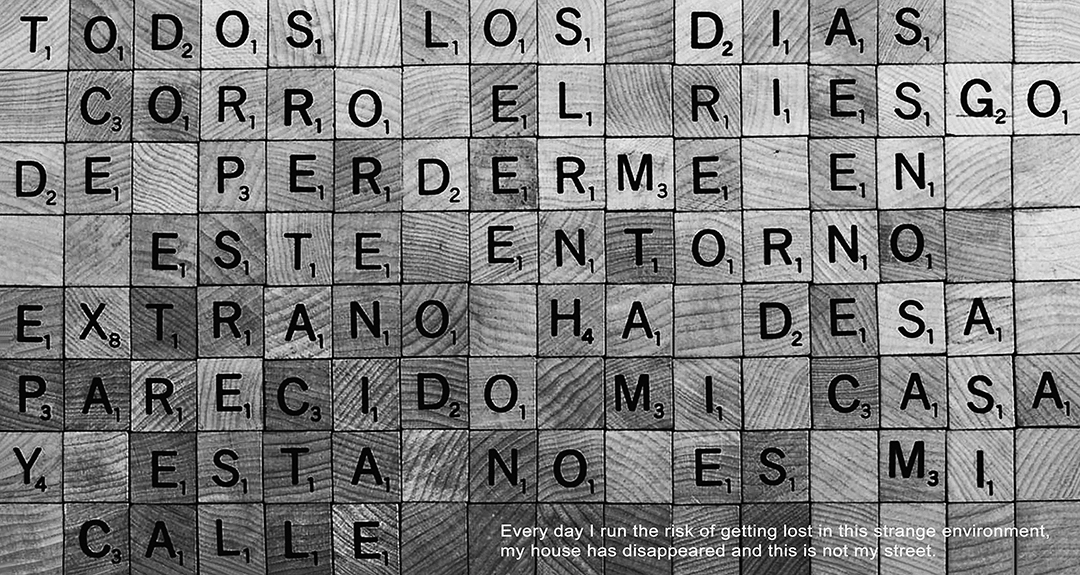
It seemed more interesting to me to begin documenting Juan-Sí González’s proposal from here, from the process of museography and installation. These are works arriving from the places where they were imagined, where they were conceived in relation to certain controlled points of reference. They reach a space that is in no way hostile, yet one in which they will have to readjust spatially and within the conceptual framework of gallerist, artist and curator. Common as this may be, it remains an itinerary and another way of emigrating. It will be a flexible system of approximations. Physical and mental landscapes, spaces traveled, feelings entrusted to words with no specific weight, a language whose strangeness redraws and reconfigures feelings and objects, some of them found, political memories, and photographs that register what stood before the camera and something beyond it.
I think this exhibition speaks to us about distance, worn-out shoes, the surprise of the “other” world, personal reconfiguration. Above all, about displacement as a synonym for development. Going from point A to point B, and seeing and recording what happens (to us) along the way.













Comments powered by Talkyard.