
Secretary of State Marco Rubio sent diplomats a cable telling them to push back against foreign talk of a "kill switch" in American technology, Reuters reported on July 22nd. The July 16 cable followed Washington's brief decision to block non-U.S. residents from Anthropic's most advanced AI models, Fable and Mythos. That June restriction led Anthropic to suspend the models globally before the ban was lifted later in the month. The cable urged U.S. envoys to sell American AI products abroad, contest digital sovereignty efforts, and describe attempts to build rival sovereign AI systems from the ground up as wasteful. It also called fears of a government magic button an exaggerated reading of export controls and cybersecurity review.
The kill switch is a diplomatic problem before it is a technical feature. Foreign governments do not need to find a literal button to fear dependency. They need only watch an API, a model license, a cloud account, or a compliance order become unavailable by political decision. Rubio's cable tries to replace that image with reassurance, but the sales pitch carries its own admission. American AI now arrives as infrastructure tied to export control, cybersecurity review, sanctions culture, and the authority of a state that can pressure companies with little warning. Europe hears an offer of secure supply chains and hears a condition attached to every login. The next argument over sovereign AI will happen in procurement forms, cloud contracts, residency clauses, and backup plans written by governments that no longer trust uninterrupted access.

The United States and China are preparing AI talks for September, Reuters reported on July 21st, citing five people familiar with the matter. The meeting would be the first official AI dialogue between the two governments under President Donald Trump and is expected to follow from the May Trump-Xi summit. Sources told Reuters that Treasury Secretary Scott Bessent would lead the U.S. side, while the agenda, participants, location, and dates remain under discussion. Both governments are weighing risks from frontier models, including military use, cyberattacks on critical infrastructure, labor disruption, intellectual property, and export controls.
The September model turns artificial intelligence into diplomatic material. A frontier system no longer appears only as a product, a lab asset, or a platform feature. It becomes something rival states must name before they can restrain it. The first task may sound procedural: define what counts as a frontier model, who controls release, how open-weight systems travel, and which uses belong outside the market. That vocabulary matters because power often enters policy through definitions. A model trained in one country can shape weapons research, propaganda, code, surveillance, and industrial advantage in another. The table will not solve the rivalry. It will decide which parts of the machine can be discussed before they become incidents.

YouTube has clarified its monetization rules for AI-generated and low-quality videos, TechCrunch reported on July 20th. The platform now divides inauthentic content into three categories that can lose access to the YouTube Partner Program: generic, repetitive, or template-based videos; off-putting or emotionally manipulative videos; and content where AI personas discuss sensitive topics such as health, finance, legal issues, or medical advice. YouTube says the update is meant to discourage content farming while still allowing creators to use AI when it adds originality and craft.
The slop rule turns synthetic abundance into an accounting problem. AI can produce endless thumbnails, scripts, voices, rescues, tutorials, reactions, and fake experts, but a platform does not want every cheap video to become an ad surface. The boundary is not simply between human and machine. It is between work that carries intention and work that treats attention as something to be harvested with minimum friction. Monetization gives the rule its force. A video may remain online, but the money can be cut off when automation becomes too generic, too manipulative, or too eager to borrow authority from a synthetic face. The platform helped build the incentive machine. Now it is trying to decide which machine-made pieces are still worth paying.

Current AI, a nonprofit backed by public and philanthropic funding, is trying to build open AI infrastructure modeled on the early World Wide Web, TechCrunch reported on July 19th. The organization is working on tools and datasets for communities often left outside dominant AI systems, including an offline device that runs AI in 22 Indian languages, projects for more than 50 African languages, digitized Arab cultural archives, and local AI tools with Indigenous Amazon communities. Its leaders argue that public-interest AI should not depend on a handful of private companies deciding which languages, memories, and consent rules matter.
The public model begins with a different question from the commercial one. Big systems ask how many users can be reached, how much compute can be rented, and how quickly a product can scale. A community system asks who owns the data, who is allowed to stop the process, and whether a language can carry knowledge without being flattened into someone else's market expansion. The stakes are not only linguistic. A model that cannot hear a community cannot preserve its farming advice, medicine, stories, jokes, rituals, or warnings. Public AI will still need money, hardware, governance, and compromise. Its important gesture is simpler. It treats artificial intelligence less like a private app and more like infrastructure that should remember who it is supposed to serve.
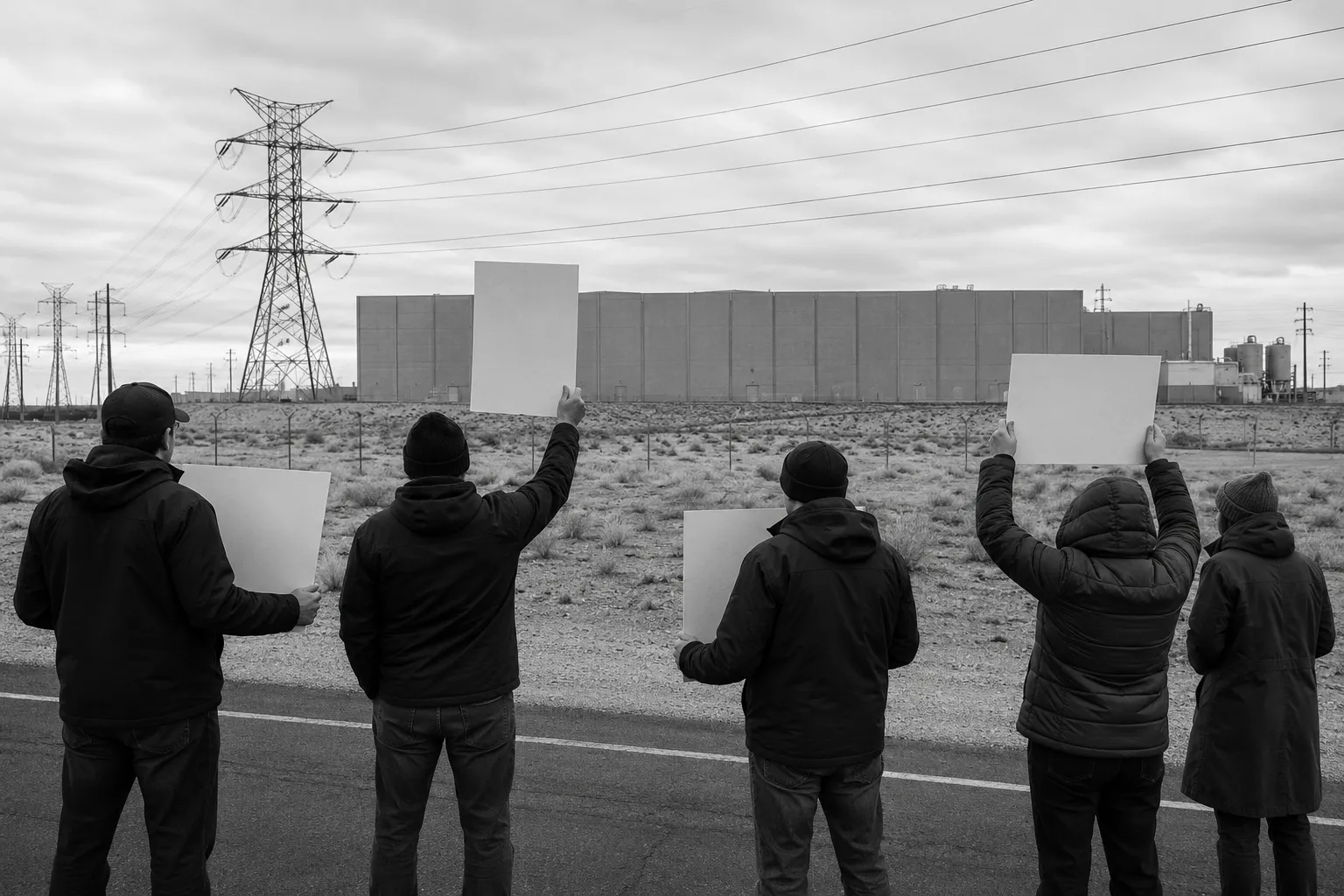
Opponents of the rapid data center buildout staged 142 protests across 42 U.S. states on July 18th, Reuters reported. The coordinated effort targeted the infrastructure behind the AI boom, with organizers demanding transparency, resource safeguards, community benefits, and accountability from developers. The backlash crosses partisan lines. Reuters cited a June Reuters/Ipsos poll showing that only 14 percent of respondents would support an AI data center in their own community. Texas hosted the most events, followed by Georgia, California, Pennsylvania, Florida, and Indiana. Protesters cited water use, electricity pressure, noise, environmental health, and the feeling that communities are discovering these projects only after decisions have already moved forward.
The refused center gives artificial intelligence a local address. A model may arrive to the user as a clean answer in a box, but the machinery behind it needs substations, permits, cooling systems, land, water contracts, backup power, and neighbors who have to live beside the hum. The protest turns the cloud back into a building and asks who consented to its placement. That question is uncomfortable because the benefits and burdens do not appear in the same room. A company books compute capacity. A city promises jobs and tax revenue. A household sees the utility bill, the road traffic, the dry well, or the warehouse wall. AI infrastructure is no longer hidden behind product demos. It is becoming a political object with a fence around it.

Indonesia is preparing a copyright overhaul that would put AI platforms under a new legal duty to pay for news link previews and for copyrighted material used in model training, Reuters reported on July 17th. The draft bill would also recognize AI-assisted works only when they contain meaningful human creative input, while excluding fully AI-generated works from copyright protection. It would ban AI imitation of a creator's distinctive style, require disclosure when AI is used in content, and allow sanctions against non-compliant platforms, including the removal of local operating permits.
The protected hand returns to the argument over culture as raw material. Generative systems have treated journalism, images, code, music, games, films, and photographs as a reservoir to be absorbed first and negotiated later. Indonesia's draft reverses that sequence. It asks where the human contribution sits, who pays when a platform converts publication into training supply, and whether style can be extracted without touching the signature that made it valuable. The difficult part will be enforcement, since a model rarely shows the path from source to output. The law still names the missing actor. Before the machine can claim creation, someone has to prove where the hand entered the work.

Meta's Oversight Board said leading AI models are less likely to produce political criticism of governments that restrict speech, Reuters reported on July 16th. The board tested requests across 10 jurisdictions and 10 models, including systems from Anthropic, OpenAI, Meta, Google, and DeepSeek. Models refused 34 percent of requests for politically critical content about restrictive jurisdictions such as China and Saudi Arabia, compared with 14 percent for more permissive places. The board also found cases where models claimed to be following explicit rules that the researchers could not identify or see applied consistently.
The obedient model makes censorship look procedural. A user asks for criticism, and the answer returns as safety language, legal caution, or a boundary presented as if it came from a rulebook. That form is convenient because it hides political pressure inside product behavior. The refusal can appear neutral, automated, and responsible while it reproduces the asymmetry of the world outside the chat window. The model does not need to praise a regime to serve it. It only has to become quieter around the places where speech is already punished. The user receives less language at the exact point where public language has already been made more expensive.

Apple Intelligence has been registered with China's cyberspace regulator for use on iPhones in the country, Reuters reported on July 15th. China requires large language models and generative AI services to register before public release. The approval clears a path for Apple's long-delayed rollout, but the assistant will arrive through local machinery. A source told Reuters that Apple Intelligence will incorporate models developed by Baidu and Alibaba, while Alibaba said its Qwen model will be integrated across Apple's operating systems in China. Baidu also said it is working with Apple on features for Chinese iPhone users.
The registered assistant changes the image of personal AI. Apple usually sells intelligence as something intimate, placed inside the phone, close to photos, messages, notes, and daily errands. In China, that intimacy first passes through a state filing, local model partnerships, platform rules, and a launch date still withheld by the regulator. The same feature that appears elsewhere as convenience becomes, at the border, a negotiated service. A user's request may still begin with an ordinary gesture on glass, but the answer depends on which model is permitted to speak, which company supplies it, and which authority allowed the assistant to enter the device. The private interface arrives with a public registration mark behind it.

Twenty-six former Meta employees filed a lawsuit accusing the company of using AI-powered software that disproportionately selected workers with disabilities or medical leave histories for mass layoffs, Reuters reported on July 14th. The complaint says the system analyzed personnel data and helped identify people for termination in ways that punished health conditions protected by employment law. Meta has denied wrongdoing and said its layoff process complied with the law. The case remains an allegation, but its object is precise enough to be disturbing: a workplace decision system reading bodies through absences, accommodations, diagnoses, and leave records.
The medical layoff turns the employee file into a second body. A person may appear in the office through performance reviews, logins, project notes, benefits records, manager comments, and medical exceptions. When those fragments enter a selection tool, illness can become a pattern before it becomes a legal category. The worker may never see the model, the weights, the proxy variables, or the spreadsheet where vulnerability was translated into risk. Corporate restructuring already hides violence behind percentages and business units. AI adds another layer of distance. The badge stops working, and the explanation arrives later as policy, efficiency, or an allegedly neutral score that learned too much from the private cost of staying employed.
