Fanfiction readers are building ways to hunt for AI inside stories that were supposed to belong to the intimacy of fandom. The Verge reports that an anonymous X account released an AO3 skin that turns a work page red when it detects a Claude-related code artifact pasted directly into Archive of Our Own. The method can catch one specific trace, and The Verge's own testing found that the red screen appeared when Claude text was copied straight into AO3. It can also miss generated work that passes through another editor, and it cannot tell whether Claude wrote an entire story, corrected a paragraph, translated a line, or touched a draft through someone else's editing.
The tool changes the reading posture. A fanfic community built from pseudonyms, gifts, borrowed characters, private obsession, and volunteer labor starts treating style as evidence. Readers inspect punctuation, sentence rhythm, purple prose, and hidden code, then some name and shame writers in public. The fear is understandable. Generative AI feeds on the same open web where fanworks live, and many writers see undisclosed use as a violation of the human exchange that keeps fandom alive. The damage comes when suspicion becomes the main interface. A strange sentence stops being clumsy, excessive, young, translated, or simply personal. It becomes a possible confession.
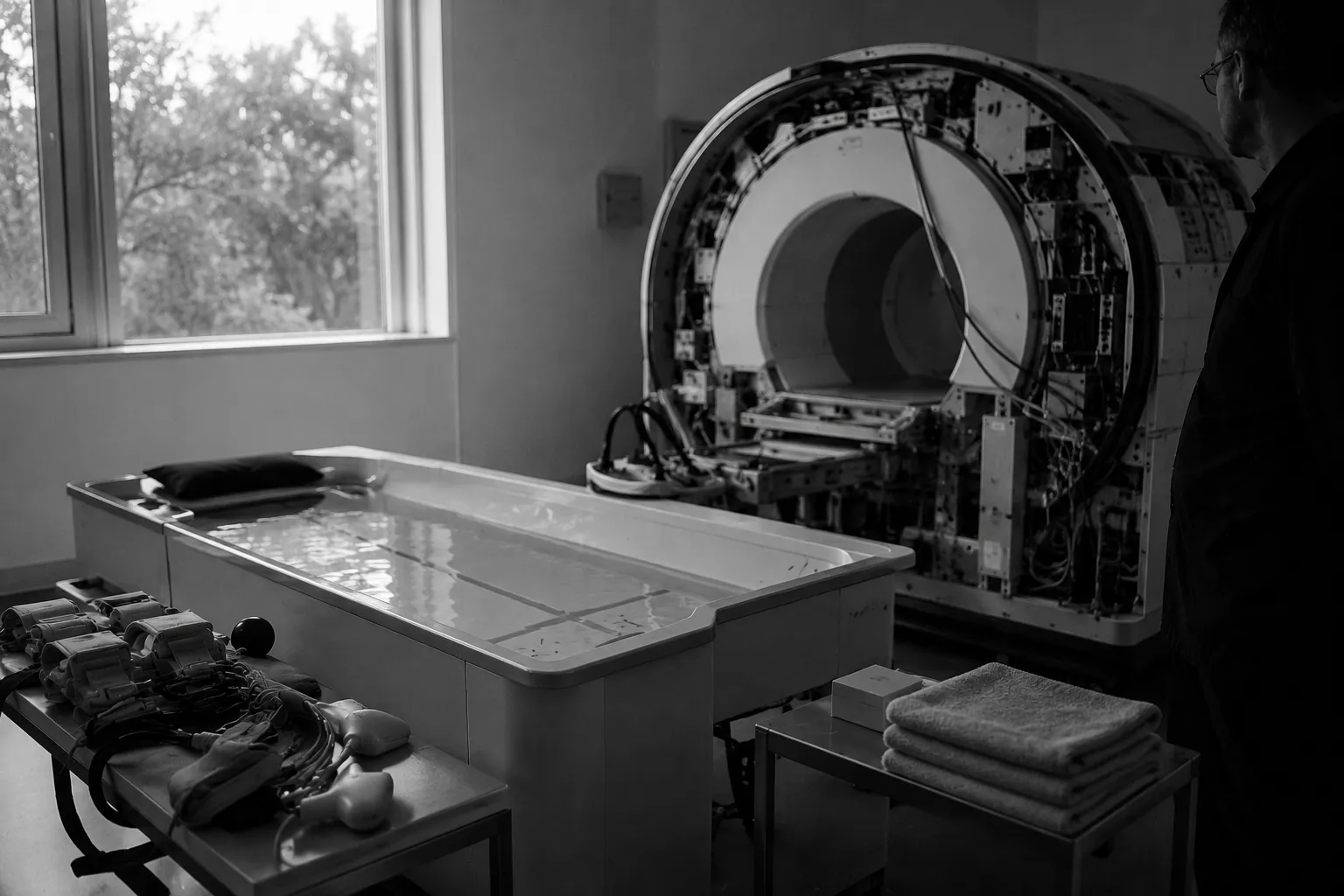
Midjourney released a behind-the-scenes video of its ultrasound body scanner, and the new look at the hardware did little to settle the older doubts. The company is known for making images from prompts. Its medical project now shows a dunk-tank-like device assembled from scores of ultrasound probes, off-the-shelf computers, Raspberry Pis, and an elevator mechanism that lowers the body through water. The Verge reports that engineers and experts still have not seen evidence that the system can overcome the physics and imaging limits that make ultrasound difficult at whole-body scale. Midjourney says the first launch will be framed as wellness and body composition, which keeps it away from the heavier demands of diagnostic medicine.
That distinction carries a lot of weight inside a spa room. A visitor may not receive a diagnosis, but the setting borrows medical authority through probes, scans, images, and the promise of frequent bodily measurement. The device does not have to claim disease detection to change how a person looks at their own flesh. It can produce a recurring internal picture and invite the user to compare it over time. Evidence then becomes part of the product experience rather than a condition that clearly arrives before it. The scanner can open as wellness while speaking in the visual grammar of medicine.
Meta has begun putting a meter on one of the most intimate functions in its smart glasses. According to WIRED, users of Ray-Ban, Oakley, and Meta-branded AI glasses will get limited access to Conversation Focus, a feature that boosts the voice of the person in front of them in noisy places. Without the Meta One Premium Plan, the feature runs for three hours a month. Paying subscribers get expanded use, though even that is capped at 15 hours. Meta says the feature works on-device and that the subscription supports continued development and premium device support. A company spokesperson also said this is not an AI rate limit.
The distinction may be technically true and socially thin. The glasses sit on the face, the microphones collect the room, and the software decides which voice should come forward. A user at a restaurant, station, bar, classroom, or family table receives hearing as a counted allowance. The old subscription bought storage, entertainment, or cloud software. This one reaches closer to the body. It turns assistance into a monthly plan and makes a crowded conversation depend on a cap, a notification, and a customer-support tier. The device still looks like ordinary eyewear, but one of its promises is now measured in hours beside the ear.
A security researcher used Claude to find a flaw in Front Gate Tickets, the Live Nation-owned platform that handles ticketing for many major US music festivals. According to WIRED, Ian Carroll found a vulnerability that let him reach internal systems, access customer and staff data, take over a super-administrator account, and add high-value festival passes to a cart. He did not use the access to attend events or issue himself tickets. He reported the problem, and Front Gate says it patched the flaw within 24 hours. The company also said it found no evidence of ticket impact or compromised customer information.
The case is memorable because the prize was not a bank transfer or a stolen password sitting in a dark file. It was a backstage pass, a festival wristband, a seat inside the ritual of sold-out access. Claude helped turn a hidden weakness into a working path through the gate. That does not make the model a criminal, but it changes the scale of ordinary curiosity. A researcher can ask for help, receive a technique, read the code afterward, and understand the door only after it has opened. The festival ticket becomes a small lesson in modern trust. The crowd sees barriers, scanners, accounts, prices, and badges. Behind them, the system may still be held together by a password reset, an exposed table, and a machine patient enough to test the seam.
