

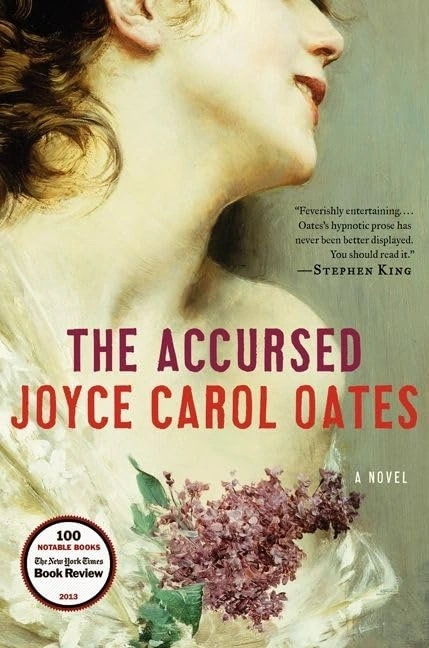
The acclaim surrounding Joyce Carol Oates‘ newest novel, The Accursed, is much deserved: it is the best novel of 2013 to date and replete with complexities yet utterly readable–it is actually a keep-you-up-at-night page-turner, and at nearly 675 pages, that’s a lot of pages to turn.
Oates is probably the most paradoxical of American fiction writers: she is notoriously prolific–she writes about a novel a year, as well as short stories and mysteries under a pseudonym. Long considered a “gothic” novelist, a trait very much in evidence in Accursed, she tended to be underrated and undervalued by top tier readers, critics and academics, in spite of the many honors she has been awarded. Part of the problem , over the years, was a chronic miscalculation of her books, her intentions, her worlds. I am among the many who rather ignored her work over many years, until The Falls, and then The Gravedigger’s Daughter, and I became an Oates convert.
She has been reassessed by the literary elite, quite correctly, as it turns out, as one of American’s finest realist writers; I have always found her to be a realist, if a touch HyperRealist. Oates grew up near Buffalo/Niagara Falls, and the world in which she matured is a part of America that was already fading economically and sociologically as early as l962. Industries were closing left and right all through Upstate New York, an area of contrasts between great natural beauty and economic deprivation, much like West Virginia but with more of an original middle class. Nearly every mill town in Upstate New York and Northern New England was facing an end during the sixties. (When I drove to college my freshman year, which is in Vermont, my family and I stopped for dinner in Utica, New York, in this very area, where we learned that a friend of my parent’s was about to close the tannery he owned. Water pollution, a new idea at that time, had been discovered to be partially caused by chemicals tanneries had been dumping in rivers for decades, and The State of New York had decided to dump the entire clean-up onto the tannery owners, who would have been bankrupted, so they all began to shut down: same with many a textile mill in many a New England town: they were all located on rivers partly for this very ease of elimination of wastes, including dyes and the like. Thus Upstate New York was one of the first generally downwardly mobile parts of America–giant swaths of the Mohawk Valley were in the beginings of ruins. This is Oates’ world.
Her fascination in her novels has been with the survivors, with those who stay, and whose worlds became replete with drugs, alcoholism, petty thievery, and commonly, a lot of family abuse: these phenomenon are rife with the undertows of violence: thus her realism, often written off as exaggerated romantic gothicism. However, out of this very environment sprung and grew and nourished a young woman, Joyce Carol Oates, whose own blue-collar, working class family she occasionally alludes to in her books and stories; she now teaches at Princeton University, but she has long seen and looks for the underbellies of the worlds she inhabits, much like Joan Didion does.
The Accursed may well be Oates’ tour-de-force, although I have admittedly not read all her work. Postmodern in structure and ideation, she posits the idea that the Devil, in what will become three different guises, appears in the upper classes of Princeton, New Jersey in l905-6, when Woodrow Wilson really was President of the University, a school which the rich families barely notice, care about , or take very seriously.
Oates has an alleged surviving son of the era as the narrator, immediately taking a swipe at historiography and biography; in explaining his methodologies, we understand that much of it is lingering gossip of the era left in notebooks or diaries kept by rich , sheltered wives, whose lives consist of teas, gossip, and fascination with “the unspeakable”, which, of course, is sex (Freud’s theories on sexuality and hysteria were still very new in America). Throughout this novel, Oates will use the tropes of race, gender and class as her structuring devices (the class parts are particularly fascinating, as most of the art and literary worlds have mined race and gender, but have avoided class, as the worlds of the upper classes are difficult to penetrate. Oates will also play with, toy with, various other methodologies of postmodernism, making the novel a delight for smarties as well as for those looking for a great morality play of sorts.
She structures the novel a lot around the occasional party, meeting between friends, random encounters on the street, the snooping realities of any small town (which Princeton is). The role of women cannot be overemphasized, limited thought their worlds were. It’s an environment wherein husbands who work in banks or in corporate law in New York never discuss their work at home, houses of immense grandeur staffed by blacks, survivors of early slavery, and who are living marginally in or around Witherspoon St. in Princeton (all these facts are real; I was a graduate student at Princeton in the early seventies). The women’s gossipy lives are the main structuring device, though Oates revels in secret meetings, hidden incidents from the pasts of the rich (which will, inevitably, come to haunt them). She also takes quite a few swipes at Presbyterianism, the dominant religion of the New Jersey of this era; the more the demonic appears, the more the Princetonians affirm that “we do not believe in demons” (who are virtually pounding on their doors and windows and invade their dreams, etc.). Wilson is presented as a prissy hypochondriacal man, replete with hypocrisy but a Presbyterian sense of “destiny”. The subthemes and subplots in this novel are rolling over each other; some of Oates’ most astute writing is on the petty politics of academia, which I am certain she well understands–and these subplots are often just fun and funny.
So even when Oates decides that one or two men should be vampires, and their victims are found with their necks drained of blood, she makes the vampires gay and the victims pretty young men–you have to appreciate the satire in doing this. Snakes appear in a women’s private school, causing massing hysteria–a Freudian delight, and we the readers are appalled and frightened, too, although we cannot help a small smirk–and Oates succeeds on every level with every literary trope she decides to include.
She also introduces Upton Sinclair and his wife, living on the periphery of Princeton while he writes his masterpiece The Jungle (he cares about all the poor and deprived yet totally ignores his falling-apart wife and is blissfully unconcerned about his new baby: here Oates presents the liberal who cares about everyone in despair but his own family. Novelist Jack London makes an appearance as titular head of a new Socialists League in New York, and ends up appearing to be a complete bigot: here, Oates wants us to differentiate between the public and the private man, with overlays of hints on the worlds of celebrities yet to come (although I have always considered the Bloomsbury group in England to be the first marketers of “lifestyle” in The West).
Oates will even offer different endings to her novel–how postmodern can you get?– and even though one of them is really foolish, it is, after all, her novel. But there is a sermon of sorts at the very end of the book, which I don’t want to spoil, but suffice it to say that Joyce Carol Oates is nearly at the level of one of the greatest chapters in literature, Dostoyevsky’s The Grand Inquisitor, in The Brothers Karamozov, in her ending to The Accursed–you will want to reread this ending several times and its ideas on The Old and New Testaments.
Suffice it to say that this is a truly great novel, entertaining and brilliant and often funny; she doesn’t get the reader to care terribly about any of the characters with one exception, a grand idea as many of them are at the mercy of the Devil so we don’t quite care what happens to them.
The Accursed is a must read and its enormous strengths remind us not to rush off to the newest young author when writers like Joyce Carol Oates are still very much at their peak, their most brilliant.
—Daniel Brown











Comments powered by Talkyard.