Charles Woodman is a multifaceted new media artist, whose work spans the semblance of public art forums, temporal installations, documentary modes, and multi-channel projections. As an educator, curator, and creator whose work occupies multiple disciplines, Mr. Woodman has crafted a diverse aesthetic, motivated by an amalgamation of experimental and avant-garde video artists, sculptors/installation artists, and sound designers. Charles Woodman has been on the faculty of the DAAP School of Art at the University of Cincinnati since 1999.
Through his collective viDEO savAVnt, comprised of a changing set of free-form jazz musicians and experimental electronica musicians who accompany him and, at times, other video artists, Mr. Woodman has pioneered aleatory live video and cinema performances that accompany the sound-art therewith. The viDEO savAVnt performances display structured live audio-visual improvisation built from a wide range of cinematic fragments, such as detritus from a shared motion picture past, found footage, or nature videos. Woodman’s fragmentary loops, both with his collective and in his individual artistic undertakings, are collected from new media materials juxtaposed, re-ordered, and recombined to create new narrative threads. Accompanying musicians react to the flow of projected images with the music evolving in response to the visual score.
When Woodman works independently, he often utilizes ambient and droning local-sounds and found-sounds, while the images, in turn, are composed and manipulated in response to the moods and changes in the sound. The dynamic evolution of the material—as sound and image lead each other back and forth in intermix—results in unique and meditative new media experiences. While the entire oeuvre of Charles Woodman’s work regards the physical and temporal place and community that it occupies – often forwarding environmental and ethical concerns – the University Hospital Family Waiting Room permanent installation Table of Elements perhaps best embodies the artist’s critical concern with public affect and social change.
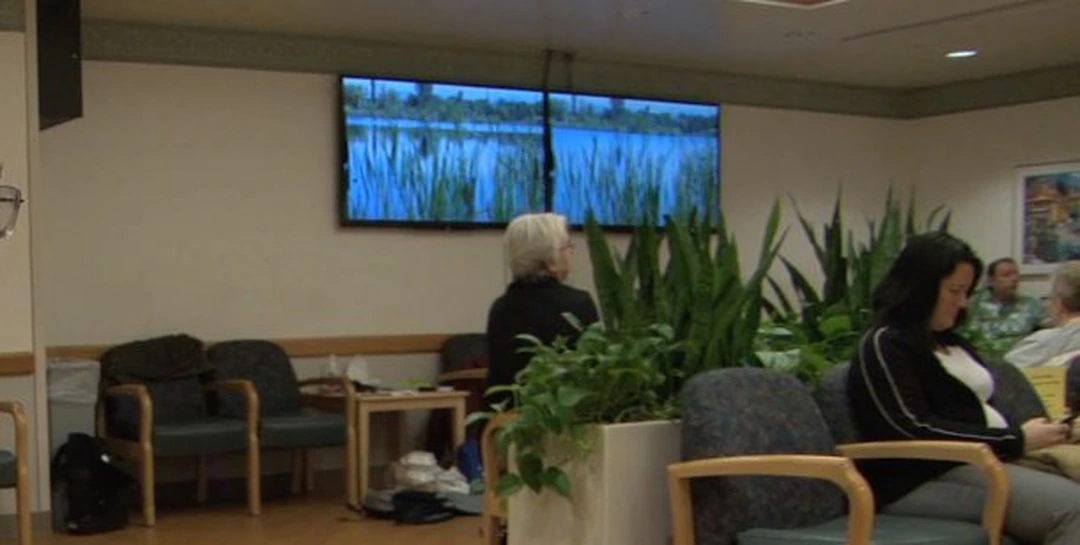
Mr. Woodman worked with the UC Public Relations and Communications office, the branch of University of Cincinnati’s UC Academic Health Center that deals with “keeping the public informed about scientific and medical progress at the UC Academic Health Center…” while serving as a “link between UC faculty and staff and local and national news media” (“UC Health: Reinventing the Waiting Room”). Consequently, by collaborating with the Aronoff Center’s Weston Art Gallery, Mr. Woodman was able to situate his multi-channel video art piece as a permanent installation within the public space that is the highly used public surgery waiting area at the UC Medical Center.
Charles Woodman originally spent three years collecting the material comprising Table of Elements. In order to properly elucidate the nature of Charles Woodman’s work, it is important to explicate upon the aesthetic inspiration sources that frame the artist’s body of video art and installation work. Experimental video artists such as Bill Viola, Henry Hills, Stan Brakhage, and Peter Rose exemplify a few of his predecessors. This collection of avant-garde figureheads in the history of video art occupy perennial positions due to their visual usage of memory, emotion, and affect, often occupying themselves with public arenas and utilizing heavily processed and edited videos to emotively engage their audiences. Charles Woodman often cites Bill Viola’s early work, in particular, as inspirational. Viola’s The Reflecting Pool (1877-1979) is a source of technical and thematic inspiration, with the ambient video serving as Woodman’s go-to piece when teaching his course The History of Experimental Video Art (a UC DAAP undergraduate art history course). Notions of reflection, time and human connection persist as themes for Viola, who often transcends the traditional nature documentary mode by utilizing editing techniques that blend natural forms into inorganic and mechanical ones, while visually mending the human subjects depicted.
Other selected pieces such as Viola’s Passions series (2000-2002) focus on the extreme expressions and detailed emotional transformations of people at the thresholds between life and death. Thus, this temporal and existential ethos frames much of what “Table of Elements” critically considers, both in its imagery and public-forum installation space. When interviewed by Asian literary journalist Camille Xin, who wrote a feature on Bill Viola for the journal “Art In America” in a February, 2015 publication, Bill Viola described his work “Transfigurations”, part of his Ocean Without a Shore 2007 Venice Biennale series. The on-site video installation occupied a deconsecrated chapel called San Gallo in Piazza San Marco. The three large altars presumed a symbolic role in Judeo-Christian tradition, and invited the Venetian public to engage with an invisible threshold in the form of water, which has historically transformed society in many ways. Site-specifity has occupied an integral element within the genealogical development of Bill Viola’s video art and Charles Woodman most certainly took heed of this when conceiving of his Table of Elements project.
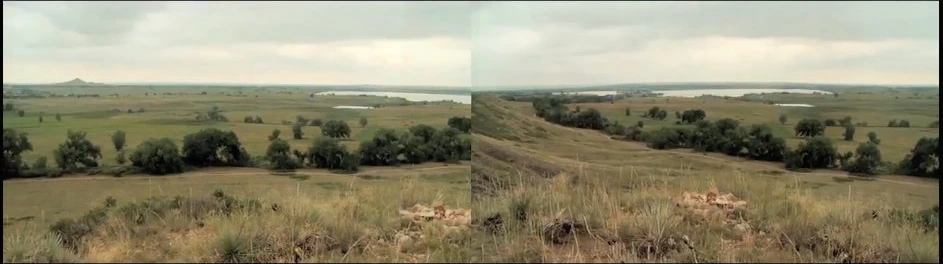
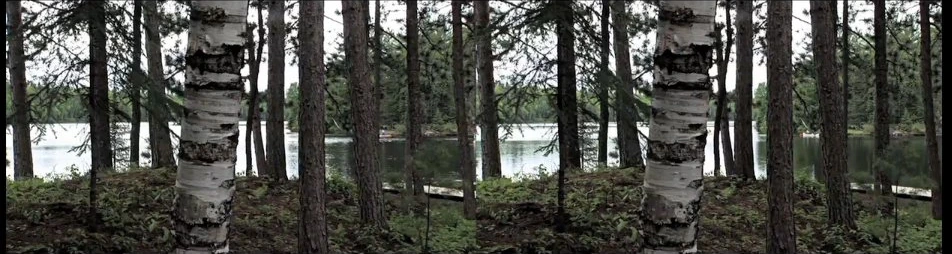
Charles Woodman describes Table of Elements as, similarly, a project specifically conceived and designed for use in a particular environment – the health care setting. With the ideal situation for the work being a hospital waiting room, the project shifts viewers’ experience away from typical modes of watching moving images into observation and meditation, formatting a painterly experience. Table of Elements consists of a series of nature videos displayed on two screens, shifting between tree canopies and skylines swaying in the wind. The camera moves to relay a sunset below a heavily cloud-bedaubed scenery, with purple and gray hues drifting together and apart. There are macro and micro shots of water and reflecting greenery, concentric water movements accompanied by local sound collages. The sounds are collected from field recording equipment, with distant and close audio of human voices layered upon the ambient drone of river-water. Purple petunias, dandelions, roses, birches, and wide-spanning flaxen plains construct the painterly foreground that Charles Woodman has so adeptly constructed, while loops of bird chirps and songs, buzzing bees, and animal cries create a meditative experience. Charles Woodman contends that the work is slow-moving, and that initially Table of Elements may appear to be an unchanging work. However, it is never static, and small movements are constantly captured alongside repeated aural chance encounters, balancing the poles of randomization/chance operation with an intentionally constructed spectatorship experience. The work is multi-channel, consisting of two adjacent screens that function as the “diptych,” a familiar nod to the work of Bill Viola, which often regards religious iconography and methodologies. The two adjacent monitors play unique synchronized video loops, each one hundred and fifty minutes long.