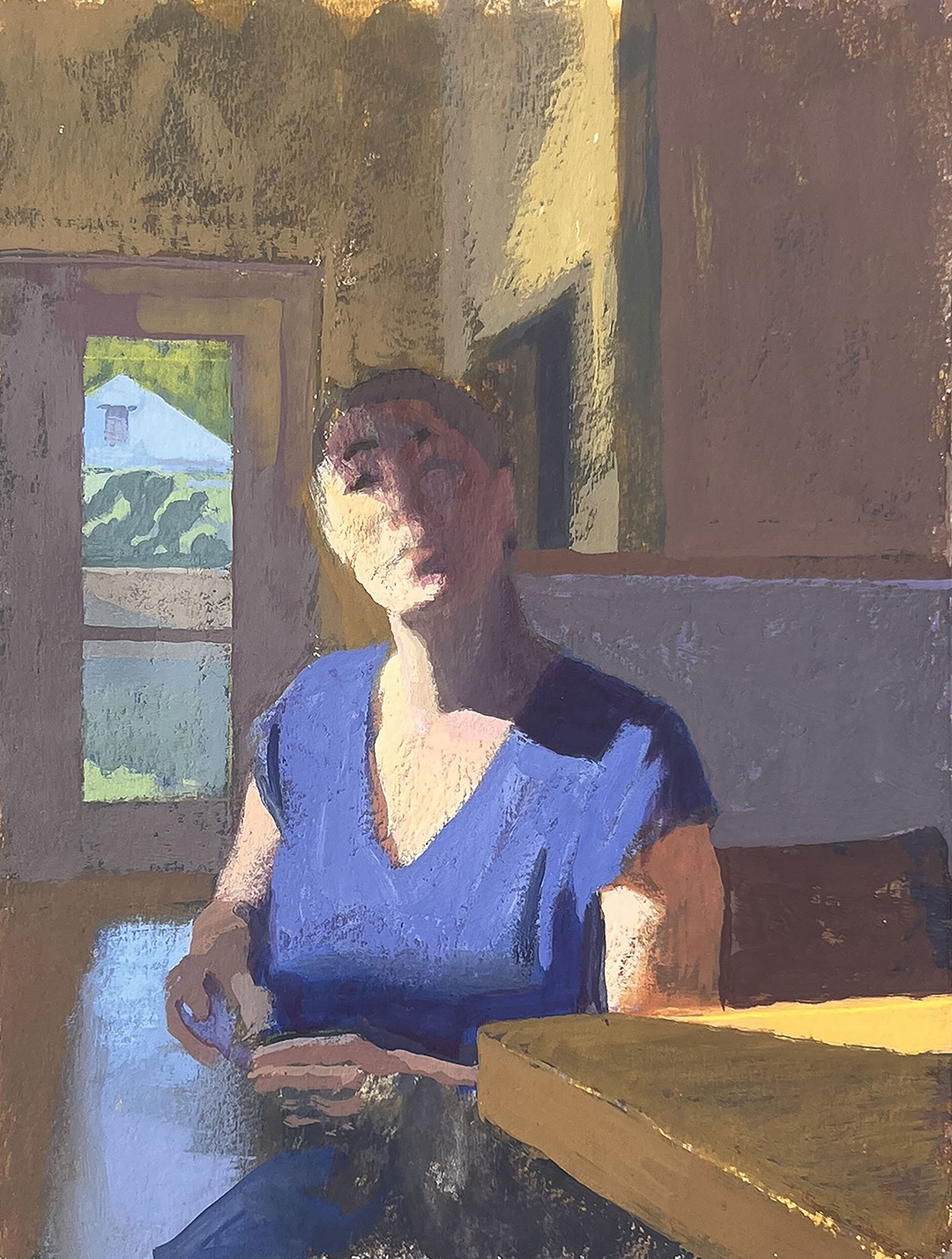
Late Afternoon
Casein on canvas | 11 × 9 in.
Emil Robinson teaches art and design at the University of Cincinnati. He lives and paints here. But above all, he is an excellent painter. In recent years, the public has become familiar with his paintings of interiors. I easily find images on social media of half-open doors, hallways, windows, and corners. Everyday motifs, though not for that reason devoid of interest. In his exhibition at Gallery Jenseits, we have the privilege of seeing several of his portraits. It might seem like a shift in his gaze, but I don’t think it is. For some twenty-five years, Robinson has drawn and painted people every week in a life-drawing group. Before the interiors, his reputation was established through his work with the human figure. And I think they find a particularly apt presence here.
As with so many artists, his childhood offers clues to how Robinson’s way of seeing took shape. He grew up in Maineville, north of Cincinnati, in a house in the middle of the woods. His family had little money. He didn’t have many store bought toys and watched very little television. The house was heated by a wood stove, his mother sewed their clothes, and his father sometimes hunted for food. It was a home where culture had a place at the table. His parents were artists; they had books on modern art, reproductions of Matisse, and classical music. They sang, and many things were done together. Robinson remembers it as a very happy childhood. It was in that context, materially austere yet spiritually abundant, that he learned to be curious about what was at hand, without needing to look far away.
It is precisely this impulse to look attentively at what surrounds him that remains present in his work. Robinson wants his work to be extraordinary, basically because we live alongside the extraordinary all the time. Almost everything possesses the singularity supposedly demanded by the exceptional.
This desire for immediacy and closeness does not keep him from traveling to study, both within the United States and in Europe; he does so often. In his painting, however, he returns to direct experience. Although he can use photographs—as so many contemporary artists do—he prefers to paint from life, with the person in front of him. When he paints someone, he does not limit himself to recording the light and atmosphere. He also tries to apprehend an elusive emotional experience, what escapes the most immediate senses. In each person, he seeks the light that emanates from within and that, passing through the sensibility of the painter, finds its place on the canvas.
Skylinn Poses with a Carafe and Stage Lighting
Oil on canvas | 12 × 13¾ in.
We usually think of light as a physical reality outside us and of feeling as a private experience, sheltered within. For Emil, perhaps the distinction is not so clear. To be someone is always to be in a particular place at a particular moment, under a certain light, breathing a particular air. What we feel does not originate within us and then project itself onto a room; it takes shape in the bond we establish with it.
A cold winter afternoon is not melancholy because we are; it is the way that moment presents itself to us. The phenomenological tradition, to which Robinson feels close, has insisted that light is not one object among others, but that which allows things to appear. To paint light, then, is not to paint a thing. It is to paint the way the world reveals itself to someone.
This also influences the way a work of art is apprehended. From the perspective of semiotics—where I feel more at ease—we understand an image by deciphering its signs. A medal indicates recognition within the military, and a scar reveals the direct consequence of a confrontation. But it takes several layers of signification to arrive at the heroic or the patriotic.
I think Robinson would decline to take that path. He is not interested in having his works “read” or “decoded”; he wants them to be lived. To take in a knowledge that precedes words and cannot be translated in full. Like a haiku, which falls apart when explained. It is read, period. And it settles—sometimes lodges—in the memory.
That is why he tends to leave out details that are too “informative.” He carefully chooses what can be discarded so the viewer cannot accumulate unnecessary tools and is left standing, almost naked, before the experience itself. He recognizes the person he paints in front of him, not through that person’s history. As the viewer should recognize the work. In an austere span of time. His ideal is for a painting to offer something one could not live without it.
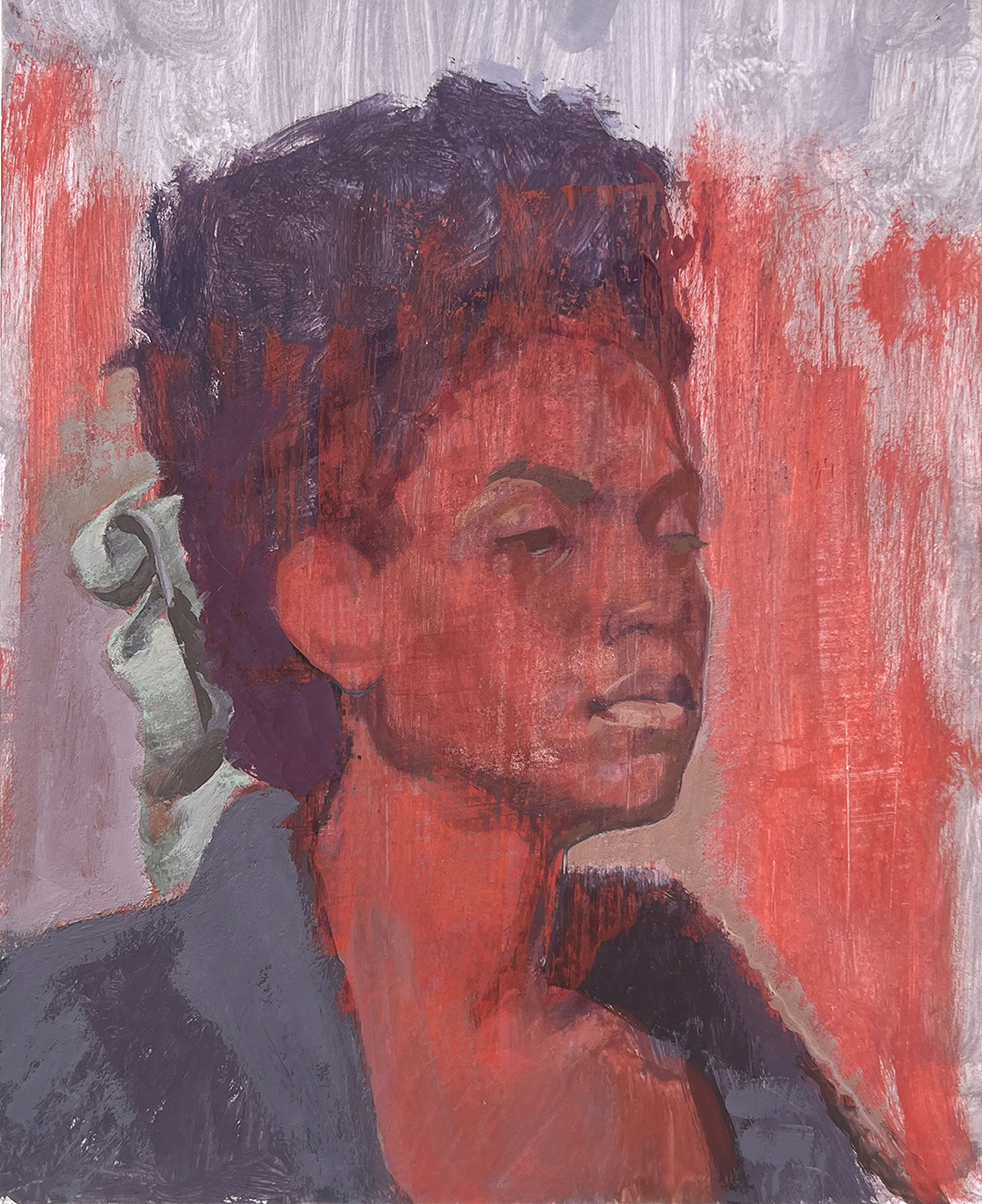
Portrait of Skylinn
Oil on canvas | 14 × 11½ in.
He knows that if he included everything, the painting would be boring. For him, leaving too little out turns the experience into tedium. Even his palette is restrained, without pure or emphatic tones. Simplicity leaves room for mystery.
On the other hand, his portraits do not seek to certify a person’s beauty or fix their sadness in legible states. Perhaps they seek to distill the elusive substance stirring in the amalgam of feelings, the substance no word can fully contain. He says himself that he rarely succeeds. He knows that many portraits are painted every day, and that very few manage to convey emotional or affective complexity. Nor does he want to tell his models’ lives through symbols or biographical details. He believes that a person’s life—I would use the word imprint—is already present in a single gesture and the expression that accompanies it.
Although Robinson studies art history with the passion it deserves, his paintings do not rely on its authority. What matters to him is direct atmospheric and object-based experience. As a teenager, he worked as a janitor at a school and was struck by the empty spaces, by how they looked or breathed after everyone had left. Absence slowed perception, and details began to emerge. Noise and light conceal that whole universe. You cannot see the stars by day, nor the Milky Way at night near cities. His paintings ask for attentiveness and time, and no reproduction can replace the direct encounter.
Robinson teaches his students that making art is a responsibility, a way of standing up for what one believes. Curiosity and simplicity are at the heart of his vision.
Emil Robinson’s figurative paintings will be on view at Jenseits Gallery in Mount Adams, Cincinnati, from December 4, 2026, through February 28, 2027. The opening reception will take place Friday, December 4, from 5 to 8 p.m.
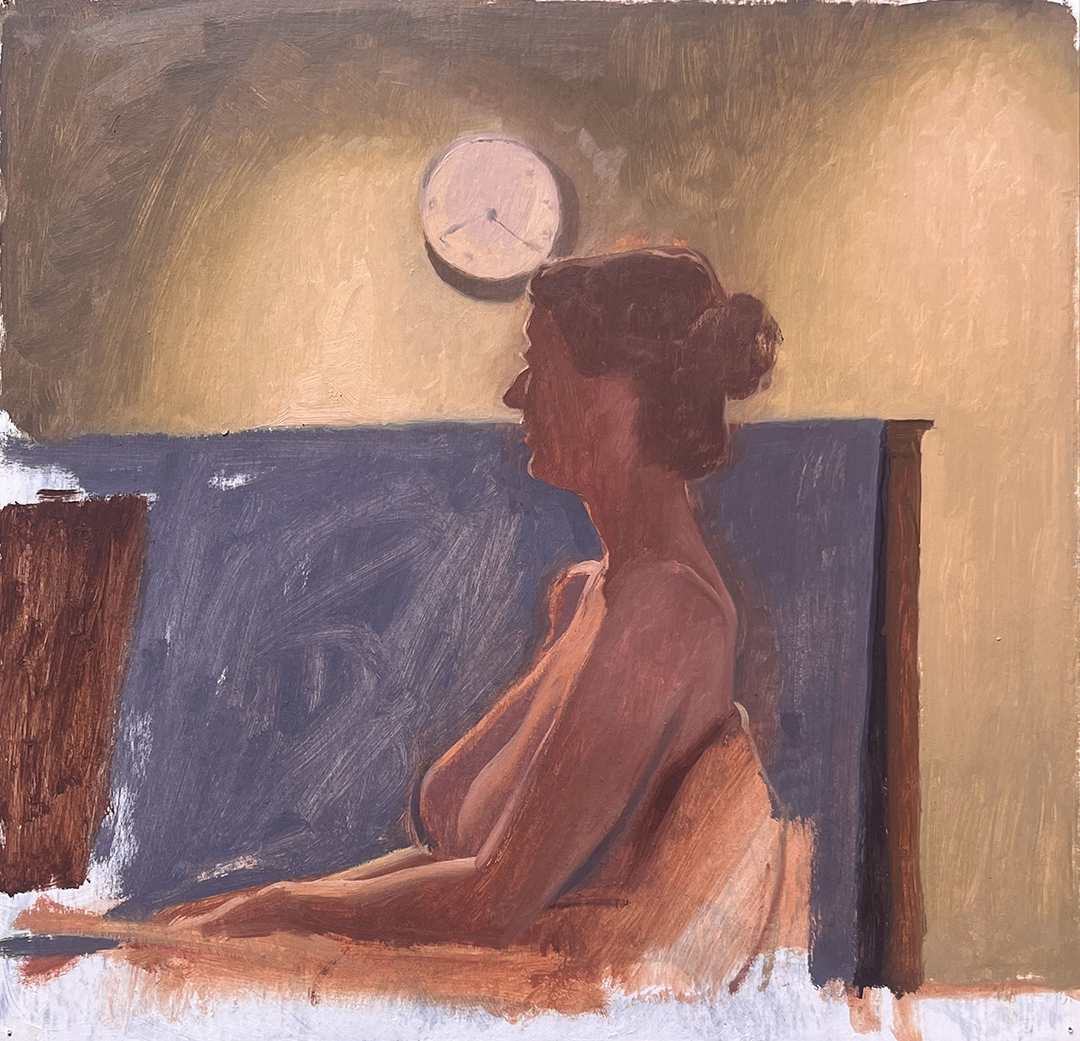
A Woman Posing Around 8:25 p.m.
Oil on canvas | 18 × 18 in.