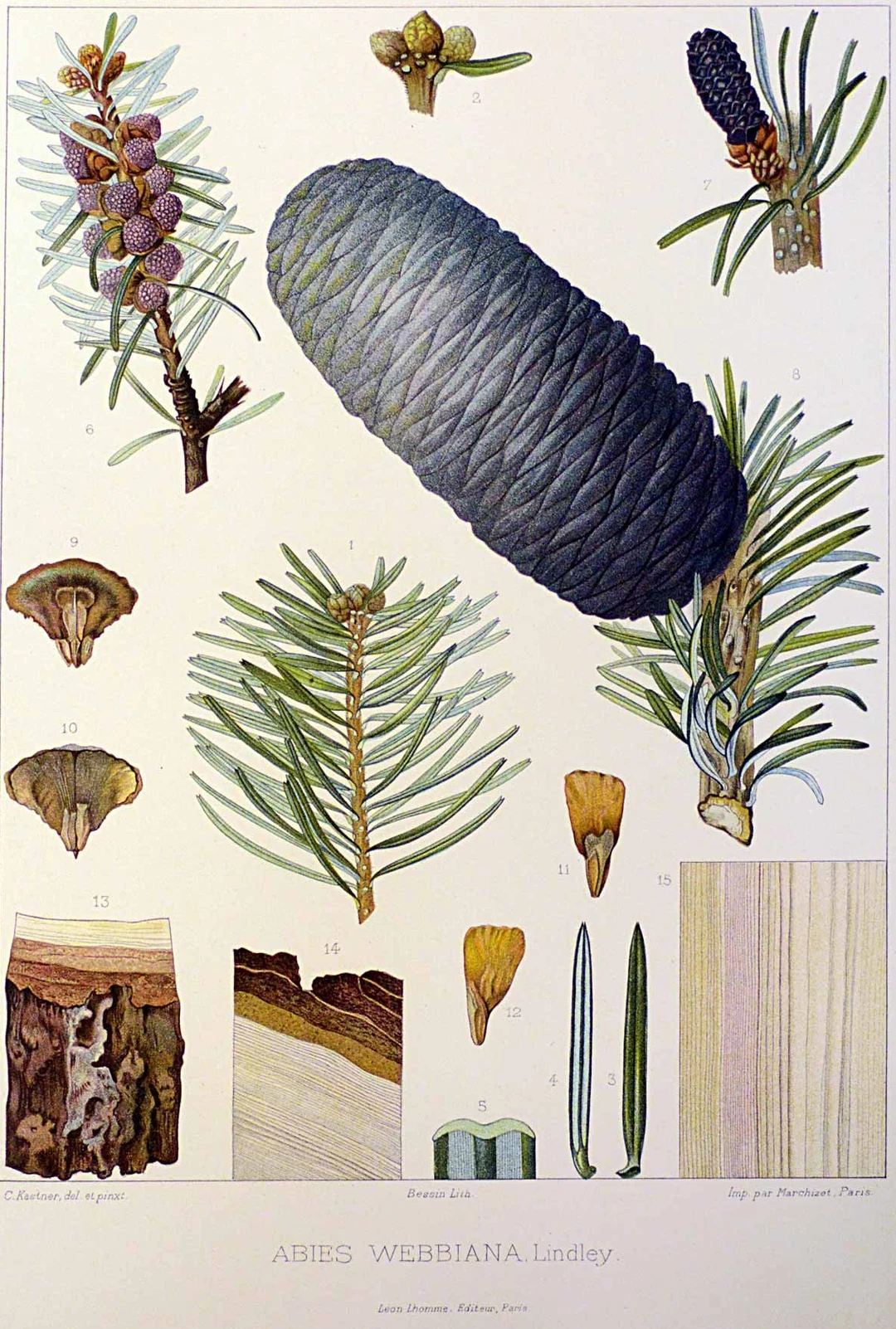
Perhaps the most seasonal exhibition in town right now is “Winter Greens: Seasonal Illustrations from the Lloyd Library.” The Library, at 917 Plum Street in downtown Cincinnati, is both a library and museum with rare books, botanical drawings and manuscripts that provide, for this exhibition, a long look back at our pleasure in the natural world in exactly the months when access to it is most restricted.
The key to the exhibition is in one of the interesting and informative labels that accompany individual groupings of materials, this one headed “Evergreens in Cultural Traditions.” We learn from it that Christmas trees are only one of the later manifestations of added meaning to these persistent examples of continuing life in the dark months. “Evergreens have been part of seasonal celebrations for centuries,” the label points out, and goes on to say “its use as a symbol can be traced back to the winter rites of pre-Christian Vikings and Saxons and to the medieval plays given on December 24 to commemorate Adam and Eve.” It’s warming – I use that verb deliberately, in this season – to think that our comforting pleasures link to those of people so long gone.
The “Cultural Traditions” label also tells us other things about evergreens: fir trees, flourishing at high altitudes, symbolize elevation; to ward off evil spirits one should burn juniper berries; ancient Romans considered cypress a symbol of the permanence of death.
The labels here are almost as interesting as the objects themselves, but the illustrations in these old and older books are beautifully delineated and worth looking at carefully. One particular example is The Botanist’s Repository for New and Rare Plants, published in London, apparently in sections from 1797 to 1811. It is shown open to a fold-out illustration of a gorgeous Magnolia Grandifloria produced by the author, who was also the publisher, and is identified as a botanist and artist who “drew and engraved” the illustrations.
Exotic evergreens would become only more fashionable as the 19th century took shape. Very large books were produced – Queen Victoria is listed as a subscriber to one of them, which looked to be perhaps two feet high and each page perhaps 18 inches across. She asked that it be dedicated to her late husband, a request that was no doubt gratified. Another spectacular illustration in one of these large books shows a rhododendron in a blaze of greens and pinks.
One display case is dedicated to herbals, an early reason that these plants were valued and a continuing reason for their popularity today. Still another old habit: kissing under the mistletoe’s long, long history may go back to the Druids, I learned from this exhibition. Think about that, the next time someone catches you under it.