
“A world without rules and controls, without borders and boundaries. A world where anything is possible where, we go from there is a choice I leave to you.”
Keanu Reeves as Neo, The Matrix, Warner Brothers 1999
Art Beyond Boundaries is a gallery on Main Street in Over-the-Rhine whose mission is to provide exhibition space for artists with disabilities. Two weeks ago, having no knowledge of this fact, I went to attend the “Changing Perceptions: Birds of a Feather” show, and as the title suggests, after reviewing the work and learning more about both the artists and the gallery, my perception has been changed.
The show itself is the latest addition in the “Changing Perceptions” series: a rubric, under which each show’s distinction, has been defined around a morphing sub theme dealing with duality. Thus far “Changing Perceptions” has yielded “Side by Side,” “Two of a Mind,” “Siamese Twins,” “Parallels,” and “It Takes Two.”
“Birds of a Feather,” the gallery’s seventh installment, seeks to push this elastic thread by not just showing both abled and disabled artists concurrently, a hallmark to all in the series, but to move past the notion of singularity vs. duality to address the greater ideal of community. The community of the disabled includes those with physical, cognitive, mental, sensory, emotional and developmental challenges, either present at birth or through injury or affliction. Art Beyond Boundaries is the arts programming arm of the Center for Independent Living Options (CILO), a not for profit advocacy organization serving people with disabilities in the Greater Cincinnati/Northern Kentucky region. More elusive, on the other hand, would be to categorize those in the show who are not disabled, who include everyone from artists, trained and untrained, former gang members and teachers to those both renowned and emerging. Together this pool of artists, this flock, if you will, that Director and Head Curator James Jymi Bolden selected, serves to stretch the bounds of the show’s serial theme, and through the representation of the work and the artists themselves, presents a new way of understanding what community could be.
The first piece to realign one’s preconception of the theme is Thomas R. Phelps’, “The Westernization of the African Mask.” Phelps’ mixed media presentation, acrylic on stretched canvas, hung on a silk drape back, with two American flags, an African iron spear, a wooden cane with a small candle shrine in front and wooden African mask atop, collages iconic artifacts and images from both Anglo and African cultures to delineate a figure that is influenced by and influential to the collection of disparate items that comprise the context of the scene. The tension between the things in the piece, including the masks themselves, and the figure begs the question of how significant are the cultural artifacts we appropriate in the construction of our own identity. With the race of the figure unclear, priority is given to the African mask by its repetition, rendering every other non-African cultural artifact subordinate as a result. Phelps’ “The Westernization of the African Mask,” a piece that could have just as easily have been titled “The Africanization of the Western Artifact,” establishes a baseline for engaging the work and made me realize that regardless of the stated goal of the institution or even the theme of the show, there’s way more here than meets the eye.
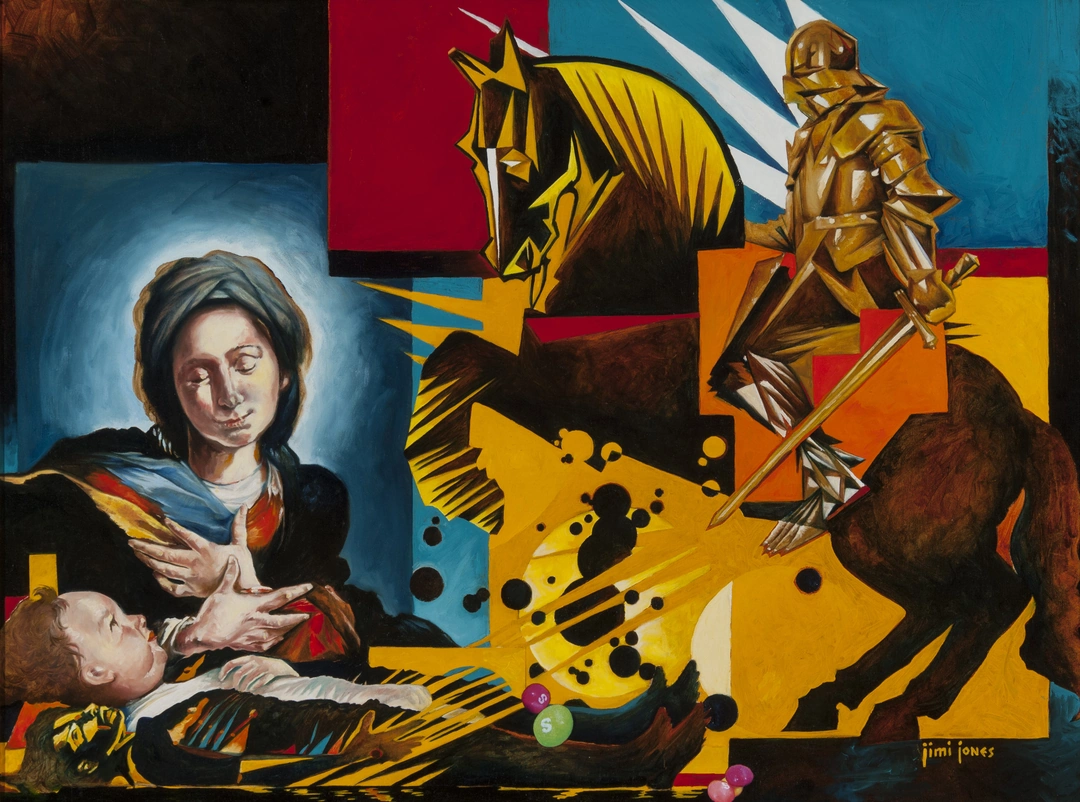
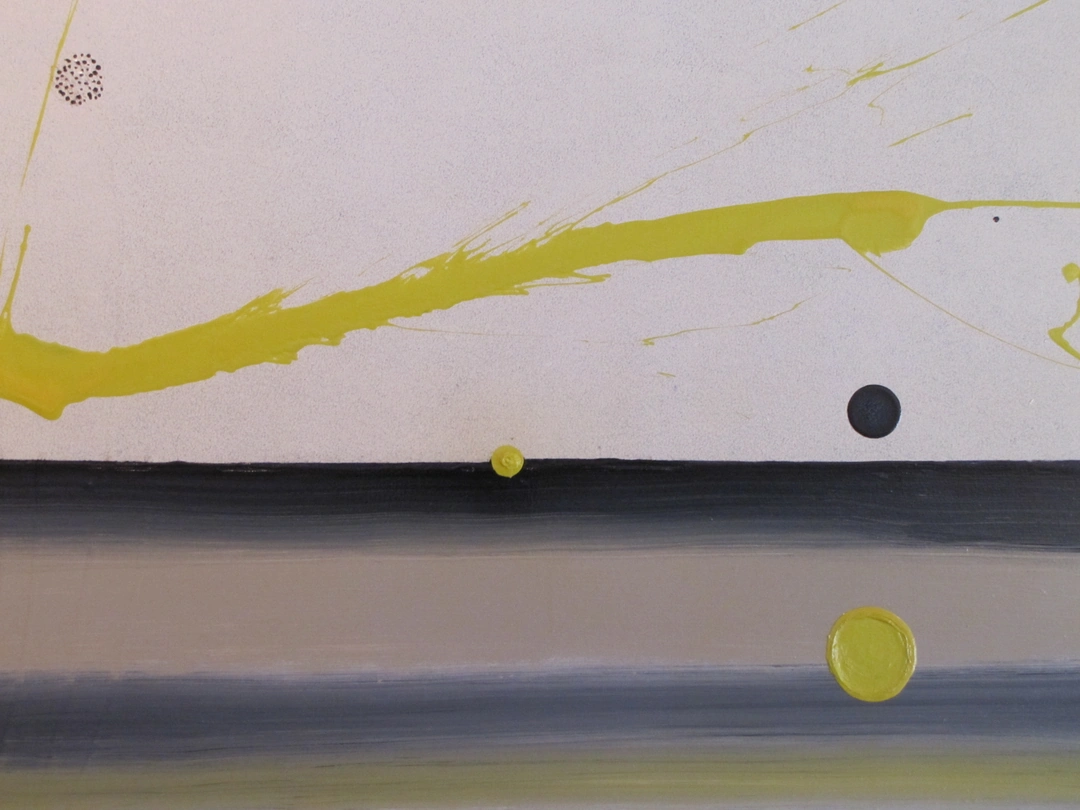
Another piece that had a similar effect on me is Jimi Jones’ “The Death of Innocents Innocence,” a painting I was initially attracted to because of its compelling composition and fine craft, but in the course of speaking with the artist, learned to appreciate because of its deeper, more subdued meaning. The painting is a disposition of two scenes: one, a Madonna and child with the abstracted corpse of a boy depicted just under the image of the Divine Infant, and the other a knight/beast in full armor, sword drawn, atop a rearing steed. What ties the two images together is a compendium of comic inspired explosion graphics, abstracted circles and floating Skittles that, compositionally, connects the mounted knight to the corpse across the somewhat immaculate image of the Virgin and Child. Visually provocative, the subtle meaning of the piece, only hinted at in its title, shifts once it is understood that the painting portrays the story of Trayvon Martin’s death. Like Phelps’ installation, the underlying depth of the work defies cursory examination; it must be parsed out to be fully understood and appreciated. It should be clear, however exemplary both artists and both pieces are, the challenge of the work is not what epitomizes the theme of the show or defines community, for the work of Wil Wiley happily accommodates both without relying on symbols or narrative for entrée.








Comments powered by Talkyard.