
“WHEEL AND—WHOA!
The Great Wheel of Samsara.
The Wheel of the Law. (Dhamma.)
The Wheel of the Taro.
The Wheel of the Heavens.
The Wheel of Life.
All these Wheels be one; yet of all these the Wheel of the TARO alone avails thee consciously.
Meditate long and broad and deep, O man, upon this Wheel, revolving it in thy mind!
Be this thy task, to see how each card springs necessarily from each other card, even in due order from The Fool unto The Ten of Coins.
Then, when thou know’st the Wheel of Destiny complete, may’st thou perceive THAT Will which moved it first. [There is no first or last.]
And lo! thou art past through the Abyss.”
-The Book of Lies, Chapter 78
Throughout the long history of artistic expression, ideas have manifested themselves as metaphor and as symbol. humankind, acknowledging itself to be but the conduit or transmitter of these ideas, knew there to be a certain dilution of these root ideas once created. In a sense, the simple act of expression masked the purity of the idea with a veil, or ‘maya’ (illusion in the Hindu and Buddhist sense). Future generations would see this veiled idea and, thinking it to be the original, cast upon it yet another veil. One can easily assume that after a given amount of time, the idea becomes completely hidden and unintelligible. The language of the ancients, although perfectly clear to them, is utterly confusing to modern man. Luckily, there were those who possessed enough wisdom and foresight to keep record during periods of translation, and were able to pierce through the many veils. Through their great works and effort, a single language is shown to have spawned all others through permutation, and it is the language of numbers.
Early engineers of language knew well that the waves of time would eventually crash upon them, so they attempted to create systems which were more universal. This universal language system would ideally have an in-depth system of correspondence in relation to man’s awareness. Thus, the number becomes a color, and also a shape, and a feeling, and a sound. In this manner, things like music, dancing, science, philosophy, and even natural phenomena could be respectably linked.
The idea of the Taro, or more commonly spelled, Tarot is introduced somewhere along the human lineage in history. Although it is thought that Tarot cards themselves are only a mere 600 years old, it is obvious that their ‘message’ is far older. The story actually begins with simple playing cards in the 14th Century (which is where our four-suited playing cards today originate), and blossoms into a method of divination a bit later. The roots of this transition remain vague, so I won’t bore you with speculative nonsense, although the ideas inherent are at least as old as ancient Egypt.
The main crop to be gathered here is that a system of 78 playing cards laid the eventual framework for the universal language system, and it was based on the rigidity of mathematics and the fluidity of creative intuition; two systems which are thought to be at ends with each other. The system also happened to be mirroring the Kabbalah of Judaism, which utilizes the Hebrew language. For anyone who doesn’t know, this language is just over 2000 years old and employs 22 letter-forms, each with their own unique numerical value. In fact, our English alphabet is but a debauched version of this much older language. Even the word ‘alphabet’ is derived from the Hebrew א and ב, or Aleph and Beth.
The basic structure of the Tarot pack is divided into two large groupings, as if to align with the Hermetic maxim of “as above, so below”:
The Major Arcana, or Trumps (Major Mysteries)
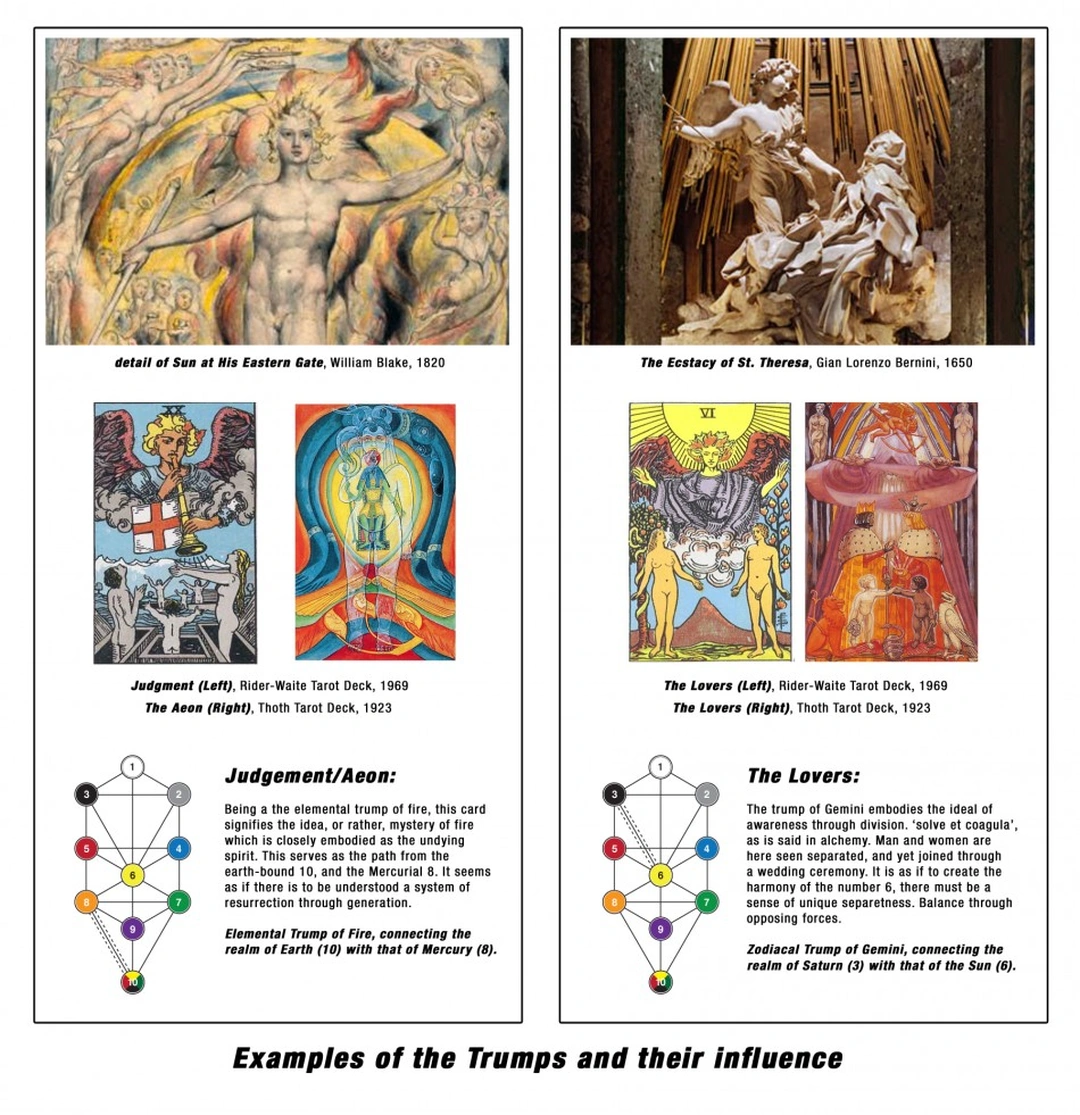
-These consist of 22 purposefully titled cards, each with a significant illustration. Their symbolism is tied with ‘paths of initiation’ or paths of life, and can be laid comfortably upon what is know as the Tree of Life (See Tree of Life diagram). Since there are 10 emanations, the Trumps can be seen to signify the communication and linkage between them.
Minor Arcana (Minor Mysteries)
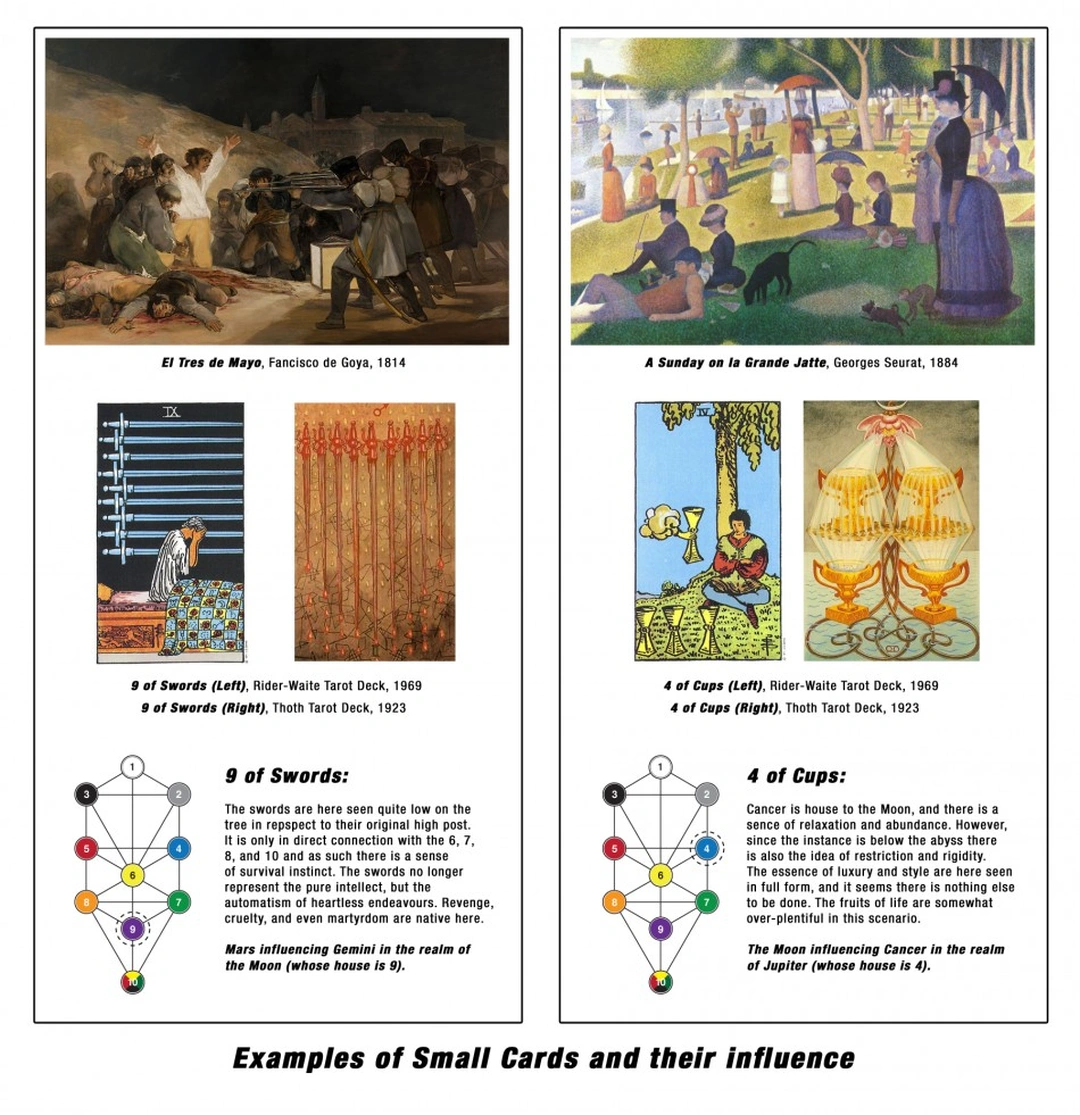
-These consist of 56 cards divided into 4 suits, just as in modern playing cards, but in this system there are 4 court cards per suit, instead of the 3. The reason for this lies in the ancients’ knack for dividing the universe into 4 modes or ‘elements’ (the all-to-familiar Fire, Water, Air, and Earth symbolized in the Tarot as Wand, Cup, Sword, and Disc).
Both the Major and Minor Arcana find their respective places upon what is know to the Kabbalists as the Tree of Life, which is a graphic diagram depicting 10 sephirot (emanations) connected by 22 paths. Each of these sephirot are identified by their separate names, and are an embodiment of certain ideals of both individual and universal significance. The connection between the inner man and the ‘forces of nature’ are here seen conceived by the ancients according to a convenient form of symbolism. The choice of this type of diagrammatic approach, along with the unusual connections between its points, has been a profound source of debate among many scholars. With the space provided here I shall not even touch upon the subject. It would help to know that the shape and form are quite correct, and only through due study are they understood in accordance with their truth.
A list of the Major Acrana or Trumps, which serve to bridge the gap between the Sephirot, are as follows (See Tree of Life diagram):
0. The Fool (Air)
I. The Magician (Mercury)
II. The High Priestess (Moon)
III. The Empress (Venus)
IV. The Emperor (Aries)
V. The Heirophant (Taurus)
VI. The Lovers (Gemini)
VII. The Chariot (Cancer)
VIII. Adjustment (Libra)
IX. The Hermit (Virgo)
X. Fortune (Jupiter)
XI. Lust (Leo)
XII. The Hanged Man (Water)
XIII. Death (Scorpio)
XIV. Art (Sagittarius)
XV. The Devil (Capricorn)
XVI. The Tower (Mars)
XVII. The Star (Aquarius)
XVIII. The Moon (Pisces)
XIX. The Sun (Sun)
XX. The Aeon (Fire/Spirit)
XXI. The Universe (Saturn/Earth)








Comments powered by Talkyard.