It’s been nearly a decade since Kehinde Wiley graced the cover of Art in America (2005) and since, he has become one of the most collected contemporary painters in America. This high profile artist made his mark re-imagining the African American figure in grand/large scale paintings. Using classical poses from Western art historical references, Wiley’s paintings of contemporary figures explore African American identity and individuality. The artist also fits neatly into both the contemporary art conversation and the historical context of figuration in the African American diaspora, as defined by curator and collector David C. Driskell.
The Taft Museum of Art reunites a collection of eight works that were first organized by the Phoenix Art Museum in 2013. The relatively new series of works focuses Wiley’s scope to a group of portraits now on exhibit in the Sinton Gallery at The Taft. Wiley appropriates an intimate series of paintings that investigate the work of the influential Flemish portrait painter Hans Memling, as each of the eight paintings is based on a corresponding Memling Artwork. In contrast to Wiley’s other paintings, he downsizes his work to a more intimate scale and mimics Memling’s work by painting on panel held in the traditional triptych style typical of the Northern Renaissance. Rather than upon aristocrats and church leaders of the era, Wiley focuses upon Memling’s less grandiose subjects.
The eight portraits of African American men sit inside the intimate Sinton Gallery. Each figure’s eyes are in line with the viewer’s, as he or she gazes on the wooden gold-leafed frames on the wall that hover upon tall thin pedestals situated around the perimeter of the room. Although Wiley’s compositions are strongly informed by corresponding Memling paintings, his models’ poses, gazes, and hand placements are slightly altered. These alterations elicit new meanings from Memling’s fourteenth and fifteenth century iconography; however, each artist reflects the era within which he lived and painted.
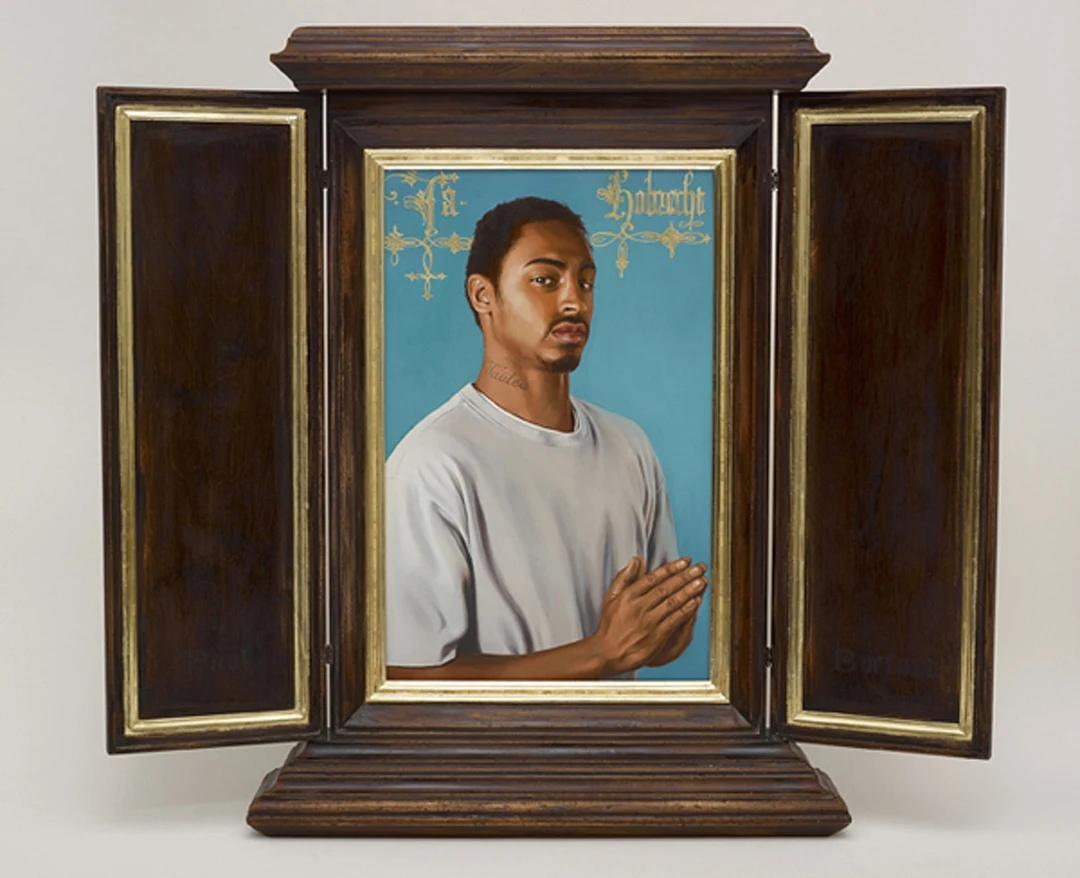
Wiley famously works with male African American models between the ages of 18-35; a process of model selection he refers to as “Street Casting.” He collaborates with his models by asking each of them to select his poses and his costume. The first and last name of the portrait’s sitter is faintly stenciled in black behind the doors of each frame. Incorporating the models’ names in the artwork is new. The individuality of the model is highlighted in the painting and as a result, the identity of the sitter is elevated.
Individuality is clearly explored in the painting entitled After Memling’s Portrait of Jacob Obrecht. Wiley uses the same flat blue background as Memling but increases the intensity of the hue to play against the coloration of the figure in the foreground. The background text, placed above the head of the portrait, is borrowed from the Memling painting. The text spells out the name of Obrecht in ornate script and is intentionally echoed by Wiley’s painted text of a tattoo that wraps around his model’s neck. Wiley has substituted young African American Paul Bueford for the famous composer Jacob Obrecht. Bueford stands at three-quarter view, hands pressed together in prayer, and looks directly at the viewer. While Wiley’s alterations are subtle, they often make his work strikingly contemporary (and occasionally ironic). The alterations prove that modifying a pose or even a simple hand gesture can reveal volumes about a model and the time within which he exists.
Behind the Obrecht painting, we see another painting entitled After Memling’s Portrait of Tommasa di Folco Portinari. The model in After Memling’s Portrait of Tommasa di Folco Portinari is posed much like the model in the Obrecht painting; however, Wiley brings to life the distinct differences in dress and ornamentation on the model’s clothes with a slightly different emphasis, and thus emotional impact. The sitter wears a button up shirt, coat (collar folded over), bow tie, and jewelry (ring, bracelet, and earring). Both paintings are the only two of the series that use a flat color field in the background and are composed in similar arrangements figuratively. The change of palette is unique for the series. Wiley uses the secondary triad by creating a dark green back drop to highlight the wonderfully modeled orange tones of the skin and the expertly painted fabric on the deep violet coat.
The Obrecht and Portinar paintings by Wiley are a clear departure from how an artist typically uses background space. The lovely color fields on the panel alter the way the modeling of the figure operates in the foreground. As a result, it refocuses all attention back to the figure, corresponding palette, and the individual stature that the model projects. Thus, Wiley’s work can be seen to integrate Memling’s painting techniques, while undermining them to render them very contemporary.
Wiley’s painting After Memling’s Portrait of A Young Man is an excellent example of what the artist calls the “fusion of period styles,” as he seems to place the contemporary figure within the style of the Northern Renaissance. The composition situates the youngest of Wiley’s well-dressed subjects with his right elbow on a table and his hands pressed together and hovering above an open book in prayer. Two marble painted columns split the composition, one in the foreground on the left and the other in the deep background on the right. A lush deep green surrounds the silhouette of the figure. The composition looks to Memling for guidance in all design and compositional decisions. Wiley deviates by replacing the youthful Caucasian European figure with an African American man whose gaze turns outwards toward the viewer: Wiley’s work thus becomes theatrical, where Memling’s is not. This painting exudes a sheer innocence that makes it different than any of his other paintings. The wonderfully oversized hands that are much too big in proportion to the figure suggest an adolescent boy who has not quite fully grown into his body, just like Michelangelo’s David. The hands cupped together in prayer coupled with the addition of the Latin laced book suggest spirituality and learning. The painting contains a remarkable piece of craftsmanship in the way the plaid shirt is depicted. The fully buttoned blue shirt modeled with red cross-contoured striped lines have given the figure the appearance of a “Sunday’s Best” outfit, reminding us of the importance of church life in African American life and culture.
Throughout the Memling series, Wiley exercises a powerful use of formalism within his palette. Value variations superbly reveal skin tones to enhance a sense of individuality. Figures still remain centered in compositions, but there is a departure for Wiley from flat, intricately painted ornamental backgrounds. In the new series of Memling inspired works, Wiley plays for the first time with the development of space and perspective inside of these background areas. Tighter cropping of the portrait and the activation of the surrounding space with both subject and emptiness (previously mentioned negative space) drive this compositional departure. Using the influence of Hans Memling, Wiley elevates the stature of the urban figures by introducing these African American men into the European painting tradition both subjectively and figuratively.
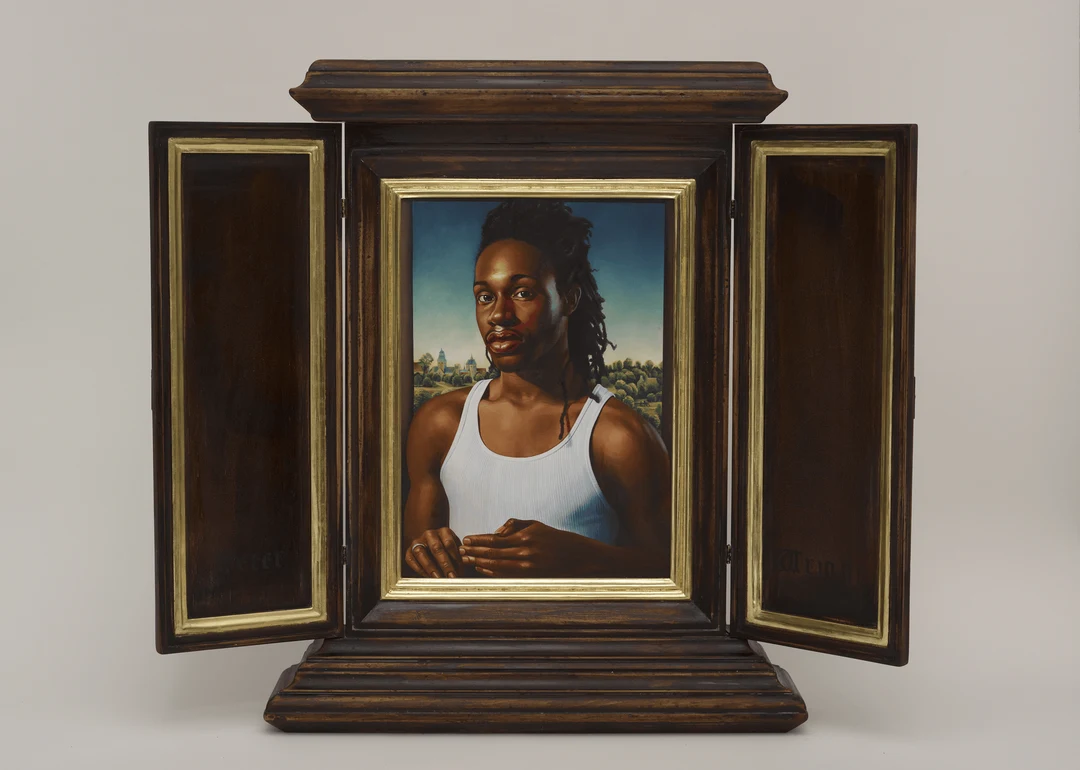
A group of three paintings by Wiley closely mimic Memling’s outdoor background spaces to a varying degree with little to no change. In these three paintings, a palette of blue and green is explored in natural landscape backgrounds that—through simultaneous contrast—shift the tones of flesh toward an orange hue. The artworks entitled After Memling’s Portrait A Man With A Letter, After Memling’s Portrait A Man with a Coin of the Emperor of Nero, and After Memling’s Portrait A Man in a Red Hat all share a similar sense of scale; each male’s clothing is mirrored but not copied, so that a figure with white shirt/tank-top, placed about shoulder height at the center of each composition, manifests these similarities and differences.
(These paintings share a similar type of figure/ground relationship with many Leonardo Da Vinci paintings, including Mona Lisa.) The three works have a cartoon styled background that is emphasized when combined with Wiley’s contemporary dressed figures. The size of the figures push against the edges of the compositions in slightly smaller rectangles to make for a heavier weight inside the borders of the format deepening the illustrative quality of the painting style.
Wiley leaves out the addition of a hat, which was included on all three Memling originals just mentioned above. In the painting entitled After Memling’s Portrait A Man in a Red Hat, the hat is replaced by the model’s dreadlocks. On the other two paintings, hats are replaced by cornrows and fade hairstyles (as a substitution for the ornamental placement of the hat as a symbol), which results in the shift of subject towards race and class within the visual dialogue.