The art historical narratives of the history of photography and the advent of modernism are often intertwined, though in some of those narratives, photography helps facilitate modernism, and in others, modernism gives photography the nudge it needs to outgrow its 19th century roots.
If part of the purpose of FotoFocus is to help contextualize photography, this is the show to see. In its arrangements of vintage photographs from the collection of Michael Mattis and Judith Hochberg, the show sets out a particularly rich and complicated version of the intersection of modernism and photography. In this narrative, it seemed to me that photography gets distracted by all the sweet things it hears about itself by modernist artists and critics, but makes tremendous progress by combining the appetite for the unmediated and the instantaneous that fed the rise of photojournalism with the desire to update the sedate painterly lyricism of late 19th century pictorialism.
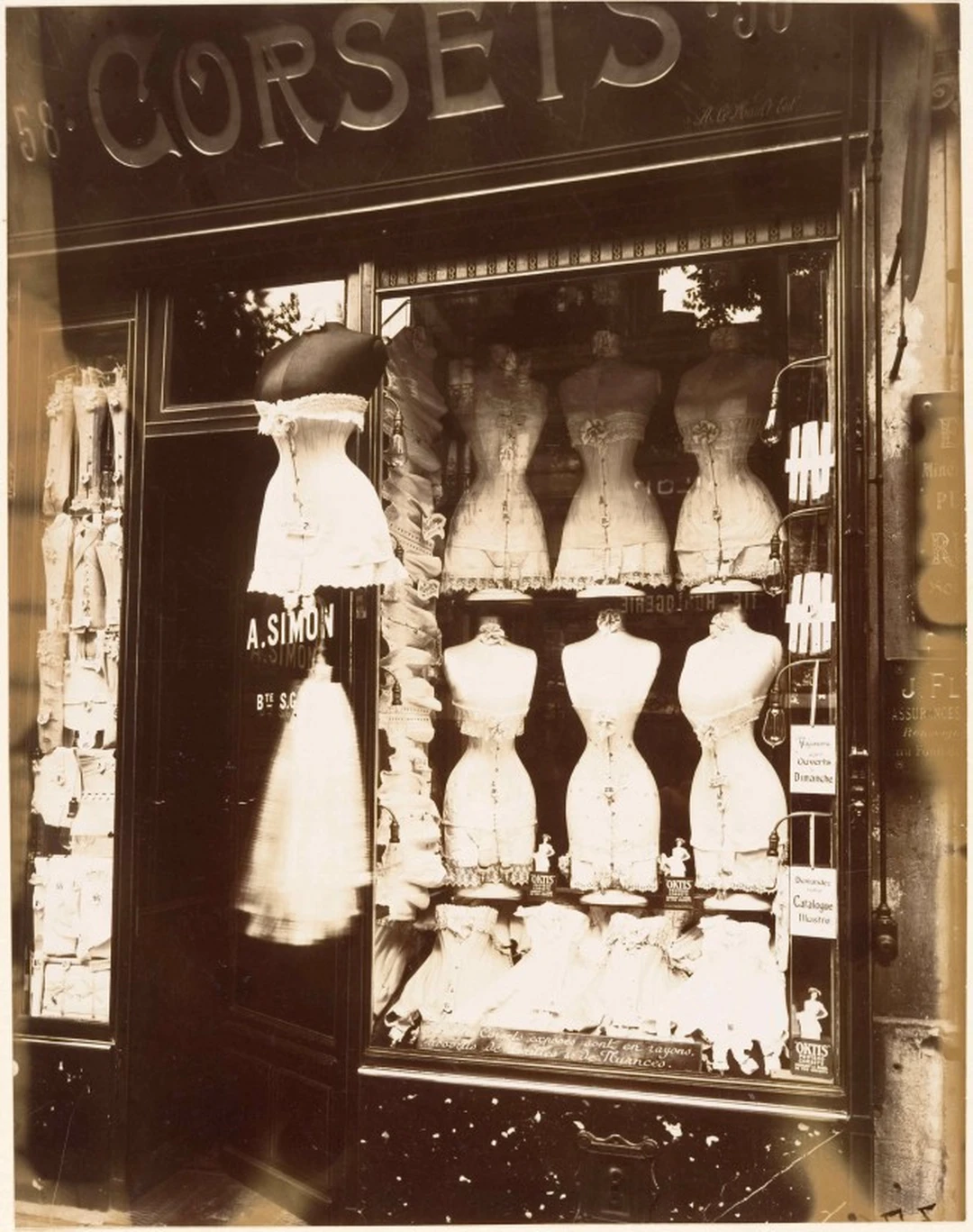
A significant part of the story can be found in the complex standing of Atget himself. A dogged documentarian, Atget saw his thousands of negatives as designed to help others—painters, scenic designers, and the like—start their work from accurate representations of the older, less bustling parts of early 20th century Paris. He had an endless appetite for making sure that the small things were captured right, as he does in his pictures of thick posts sunk deep into the streets for boats working their way up and down the Seine to tie up to in “Bassin de la Villette.” But as attractive as Atget’s visions of empty streets and silent ancient facades and corridors may have been to Man Ray and his contemporaries, his real attractiveness to them were in his photographs of modern store windows with their glass surfaces both reflective and transparent, partly revealing storefronts cluttered with the kinds of items that secured middle class identity, such as men’s suits or, in the picture at the Taft, “Corsets, Boulevard de Strasbourg.” Presented in machine-like multiples of themselves, the window-full of imitation people (or parts of people) are neither being tended to or looked at by living humans. The corsets transform the mundane into the uncanny, placing us square in the home territory of surrealism. Elsewhere in the show, Bill Brandt’s “At the Flea Market” (c. 1930) imagines a city more populated by statuesque mannequins than people, though they are individualized and personalized by the garments they are wrapped in. But in Atget’s version, modernism had hit the mother lode. Here is high modernism’s formal concerns about the nature of pictorial space combined with a vision of urban capitalism, where everything is commodified. Atget’s storefronts look more like a museum exhibit depicting a depopulated city where human beings used to be, their absences identified by handwritten labels and prices, rather than an active cavalcade of living, complexly motivated individuals.
As the show’s title suggests, the exhibit at the Taft follows the urban thread of modernism. Its bread and butter are the internal contradictions of the city, an easy thing to capture when one remembers that virtually every city we know, with the possible exception of Pompeii, is constantly reinventing itself. The city is a place that leaves signs of how to find its past like a trail of breadcrumbs. Ilse Bing’s “Greta Garbo” (1932) looks up at a peeling movie poster pasted over at least two prior posters and then onto a decaying wall, leaving only Garbo’s name and her mouth. (The Paris of the Taft show is the direct inheritor of Toulouse-Lautrec’s Paris, with posters everywhere blaring out information, though no one ever seems to be looking at them.) A gas lamp is no longer lit and across the street, all the shutters are tightly closed. The city often appears to be a palimpsest, a layering of images of itself in which we can take in various pasts simultaneously. The city is an intensely layered experience. Henri Cartier-Bresson’s “Coronation of King George VI” (1937) shows a small cross-section of the crowds of people who have come to see the royal carriage. In this picture, the mostly older spectators are sitting on a wall at whose foot are piles and piles of discarded newspapers. On top of the paper scraps lies a man in a dark suit, ignored by everyone else, who might be dead but is in fact sleeping through the event he has come to see.
In these photographs, Paris is a city waiting to be found by looking in odd places and from unfamiliar angles. At best, it can be found indirectly. Ilse Bing’s “Puddle, Rue de Valois” (1932) finds the skyline by looking at the murky rainwater left by the side of the road. It what was for me one of the most telling images of the city, Brassai captures the “Cesspool Workers, Paris” (1933) who are cleaning out the sewers (they were apparently not self-draining). They work at night, under lights, literally attending to the underside of the city while its daytime inhabitants are safely asleep. Possibly the grittiest picture in the show, it does still retain, oddly, a bit of the picturesque. In one of the most odd but most compelling aspects of the Taft’s show, pictures like this one hold onto some of 20th century photography’s roots in pictorialism. It would have been a perfectly appropriate subject for a pictorialist to have a photograph of a farmer, sitting down in his farmhouse or on his stoop or by his barn, exhausted by his daily labors. The artfulness of the photograph would have been found in its painterly rendition of him in his context, allowing us to see his character, his material culture, and his destiny. Aside of course from its urban setting and its provocative sense of what keeps the city regular, is Brassai’s remarkably well-composed picture that different? (Lewis Hine’s celebrations of American labor certainly have strong roots in the pictorialists’ works.)
Felix Thiollier’s remarkable “Tipping a Coal Bin” (c. 1900) is plainly pictorialist, paying homage to the heroic (and sculptural) qualities of men who have the apparently Sisyphean task of emptying containers of coal into what seems like a bottomless pit. Aside from noting its sympathy for the labor and the laborer, if this were a painting from around 1900, we would be likely to dismiss it; it is a curious thing that one thread of photography enabled culture to continue to admire designs and content that was, in theory, being left behind by the innovations of modernism. Ilse Bing’s “Chair, Champs-Elysees” (1931) reminds us of the absent rump of its sitter as surely as Van Gogh’s pairs of shoes and boots from the 1880s summon up for us the feet that wore them. For me, this was one of the revelations of the Taft’s show: the modernist aesthetic in photography represents an updating of the pictorialist vision rather than a rebellion against it.
It was an updating partly made possible by faster film and lighter, less obtrusive cameras. It is hard to imagine two better pictures than Brassai’s “Paris from Notre Dame” (c. 1933) and his “Avenue de l’Observatoire” (1934), both photographs of Paris at night, both showing the city obscured and enhanced by fog and mist. In the first, the story goes, Brassai trundled his camera illicitly up to the top of the great cathedral to capture the bustling city electric glowing in the distance, overlooked by the famous medieval gargoyles in the foreground. In the second, a car pauses before a park of some sort, its headlights made perfectly visible by the fog. It could be an unusually well-composed still from a film noir of its time. It is tense, because we cannot tell who is on their way to do what, and elegant, and mysterious because it substitutes a part—the long reach of the headlights extending from the car—for the whole, which we cannot know.
I would say that modernism also represents a break from the ideals of pictorialism in demanding that the photographer acknowledge his own presence in what he sees and photographs. There are plenty of strikingly-designed images where the photographer is removed at a safe distance. Ilse Bing takes pictures from the Eiffel Tower of the crowds below her, and Cartier-Bresson’s iconic “Hyeres” (1932) allows him to remain at the top of the stairs while a man on a bicycle speeds past. But I felt there was a steady movement towards the photographer acknowledging that to see also risked being seen. Lisette Model’s unpleasant “French Gambler” (1934) is enjoying the sun in his three-piece suit on the Riviera (if enjoying is the right word), while from underneath his almost-closed eyes, he is sneaking a peek at the photographer who is in danger of disturbing his rest. In Brassai’s “Le Balajo,” many of the men and women in this working-class dance hall are looking at each other or possibly at the band, but a waiter in the distance, and a woman in the middle ground, and a sinister man almost entirely in the shadows of the foreground are all looking squarely at us.
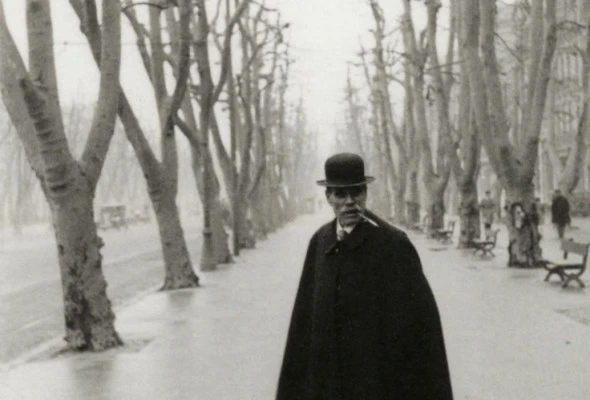
In a medium in which the question of voyeurism is particularly relevant, it matters who’s looking at whom. In Cartier-Bresson’s “Allee du Prado” (1932), a well-dressed mustachioed man in a cape and sporting a cigarette in a holder has just turned to look at us. He is not pleased to see that he is being photographed. The seer acknowledges being seen—and sometimes that acknowledgement becomes the core of the photograph. This is the story of Brassai’s “Street Toughs from Grand Albert’s Gang” (c. 1931), where the photographer was, in fact, just about to have his pocket picked, even though he’d already paid his subjects to be able to photograph them.