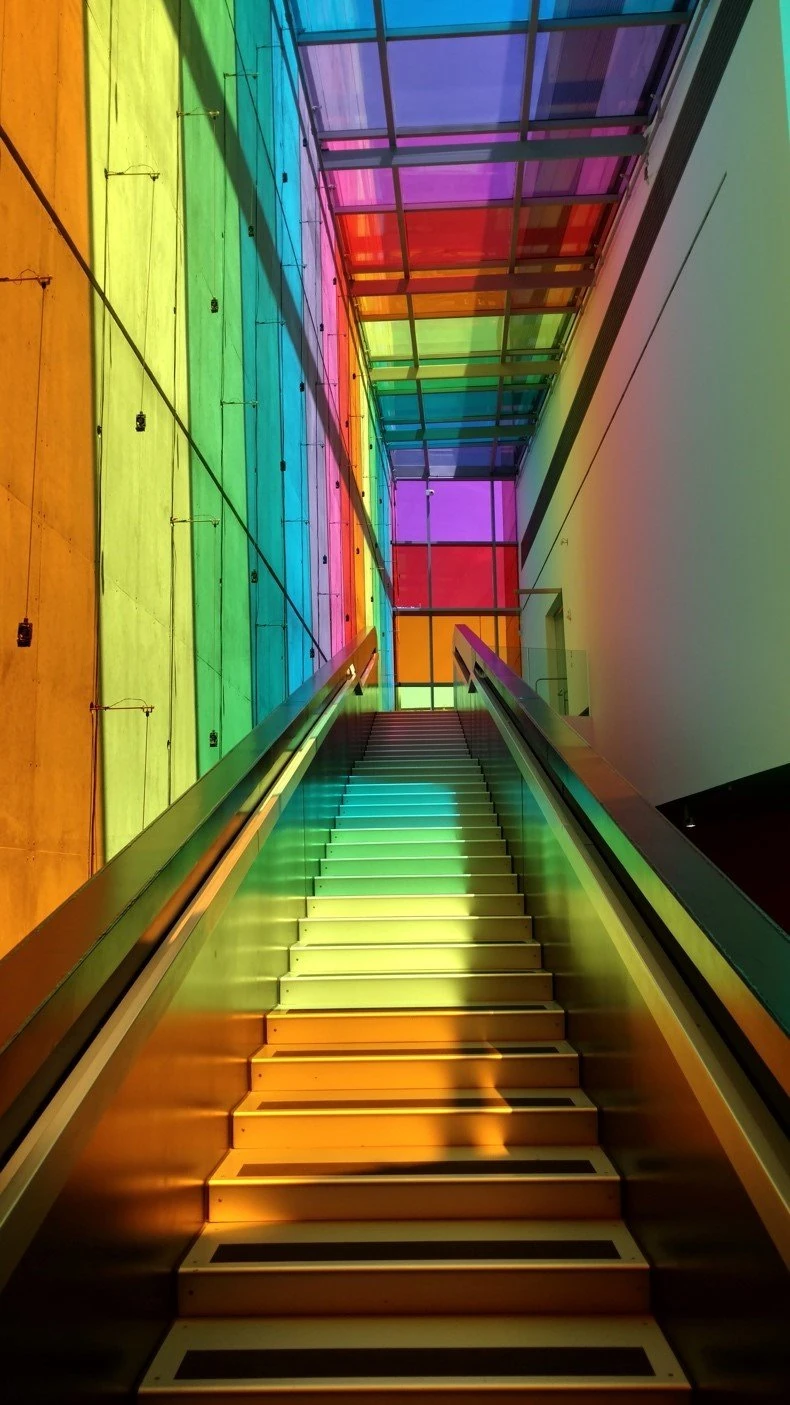
Ugo Rondinone, born and based in Switzerland, is known for sculptures and installations with alternately an absence or an overabundance of color. Referred to by the artist quite literally as “night” and “day,” one oeuvre contains mostly greys, browns, and earth tones while the other—what’s on view now at the CAC—a vibrant spectrum of bright, artificial color. Rainbows echoing the pride flag have filled the galleries and adorned the exteriors of institutions the world over, and along with last summer’s Do Ho Suh exhibition, let’s start this day again, the latest presentation of Rondinone’s multicolor oeuvre, positions the Contemporary Arts Center within an international group of institutions. Rondinone’s spectrum of color completely overtakes the top floors of Zaha Hadid’s iconic building in downtown Cincinnati, and I find the site-specific components of this exhibition to be its strengths—Hadid’s dramatic diagonals form a Constructivist composition of pure color and the rainbow-tinted skylights flood the walls and stairs. Covering the ceiling skylight and nearly every inch of the third and fourth floors with Rondinone’s signature color spectrum was no small undertaking, and CAC was the first institution that featured colored floors as well as walls. Many of the artworks housed within Rondinone’s painted rooms, however, were underwhelming, sparse, and unable to compete with their funhouse surroundings.
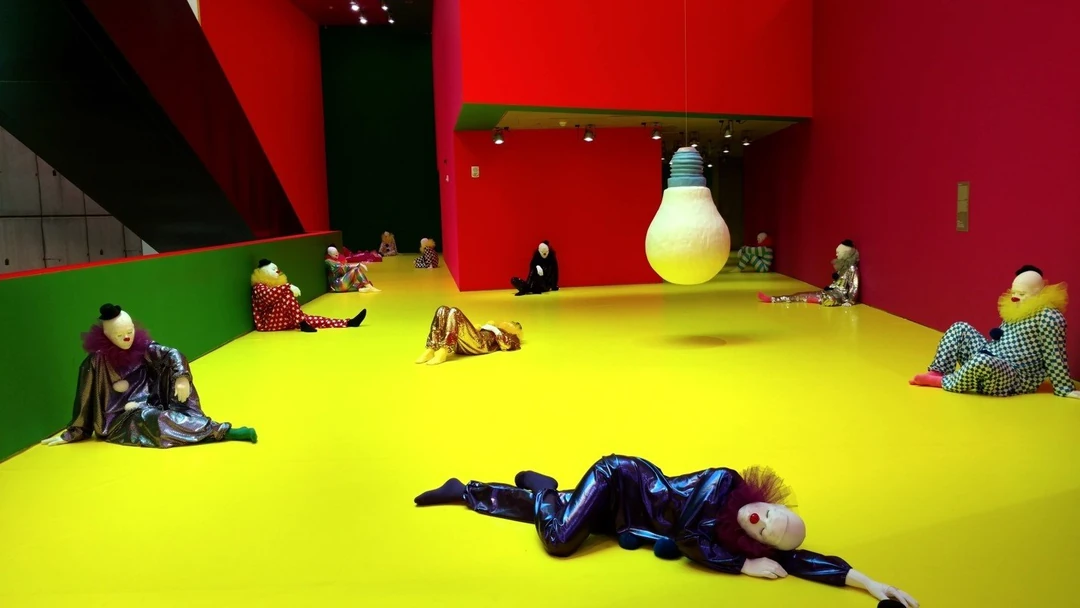
On the first floor are the most photographed members of the exhibition—life-sized casts of clowns strewn about like revelers at the end of an orgy. Together the forty-five clowns form the work vocabulary of solitude (2014). Each sculpture is life-cast from a real person and subtitled with daily activities ranging from the physical (Pee, Shit, Eat) to the psychological and spiritual (Love, Lie, Hope). Despite the unique individual cast to make each work, they initially appear uniform and lacking individual identity. The figure of the clown seems almost incapable of evoking the happiness and joy he ostensibly represents—many people report being afraid of clowns, and they have long signified sadness and hidden identities in art history. Picasso returned repeatedly to the character of the harlequin, for example, and since the 1990s Rondinone has used the clown as a surrogate for himself and the artist’s inner and outer life.
Placed in a variety of positions and group arrangements throughout the CAC’s third floor, one anticipates new interactions and discursive spaces to pop up between the clowns, and indeed each one appears as if it could start moving at any moment (a creepy effect, to say the least). The closed eyes of the masks and introspective poses keep them from interacting, however, and it is hard to discern how each titled action corresponds to each clown—they all just look tired. The clown masks intentionally show signs of wear, and the painted floor similarly bears the skids from shoes of gallery visitors, despite the CAC’s placement of a sticky mat at the entrance to prevent visitors from marking the floor. Far from prompting my own sense of introspection, the figures instead evoked a sense of dread, hinting at but not revealing any details of what catastrophic event occurred just before the hangover I walked into. The headache-inducing colors furthered this sense of discomfort, and the contrast between the clowns’ joyful clothing and somber comportment rendered the work unsettling.