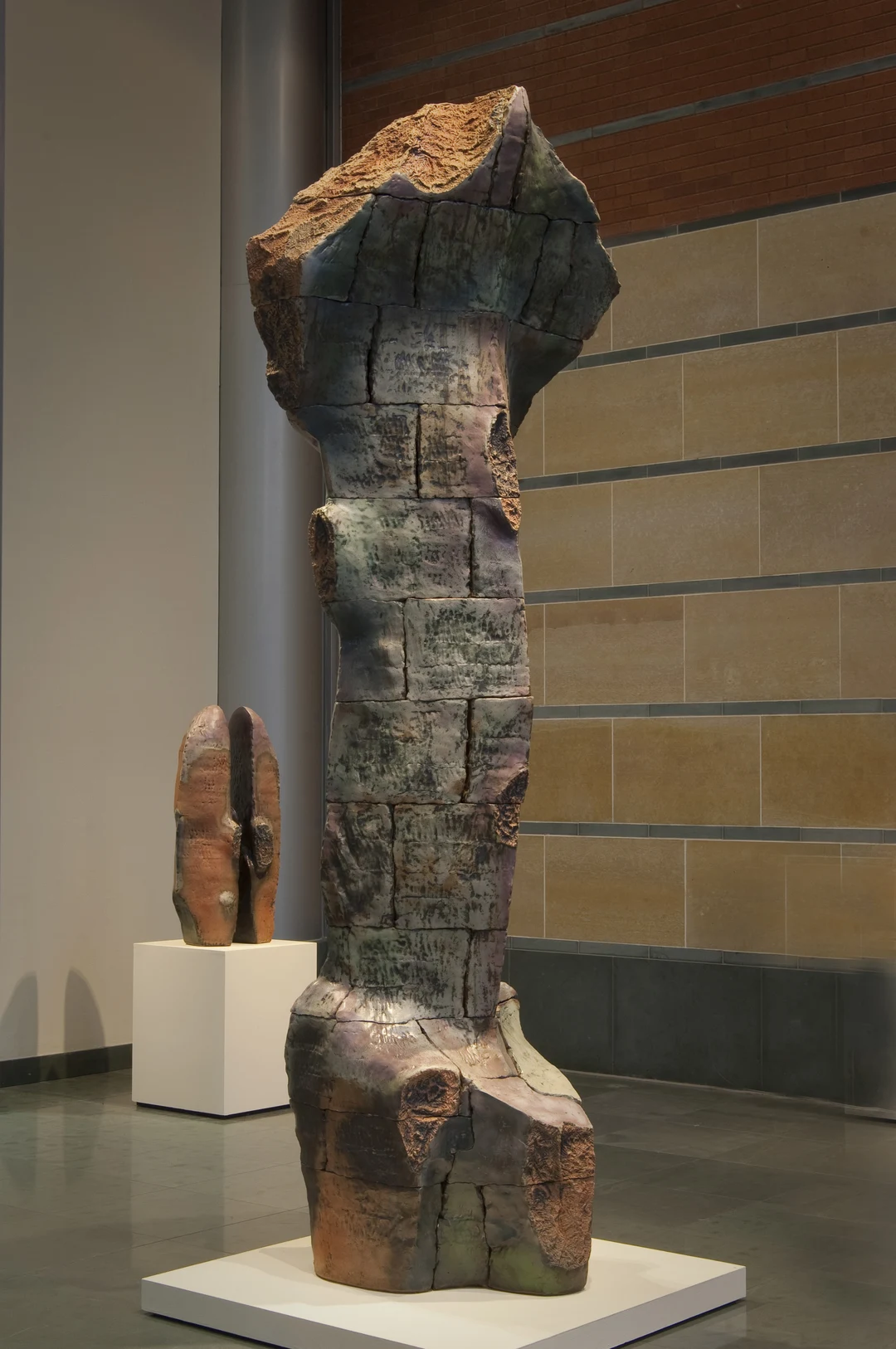
Robert Pulley, Serpent, 2011, ceramic, 136 x 36 x 30 in. Image from the artist's website.
Alice F. and Harris K. Weston Art Gallery
Robert Pulley has found the perfect medium for his sculptures with their allusions to the earth’s geological history: clay, which is just mud, and perhaps symbolic of the primordial ooze of the beginnings of life. The results can be seen in “Standing in Time’s Flow” exhibition on view at the Alice F. and Harris K. Weston Art Gallery through February 17, 2013.
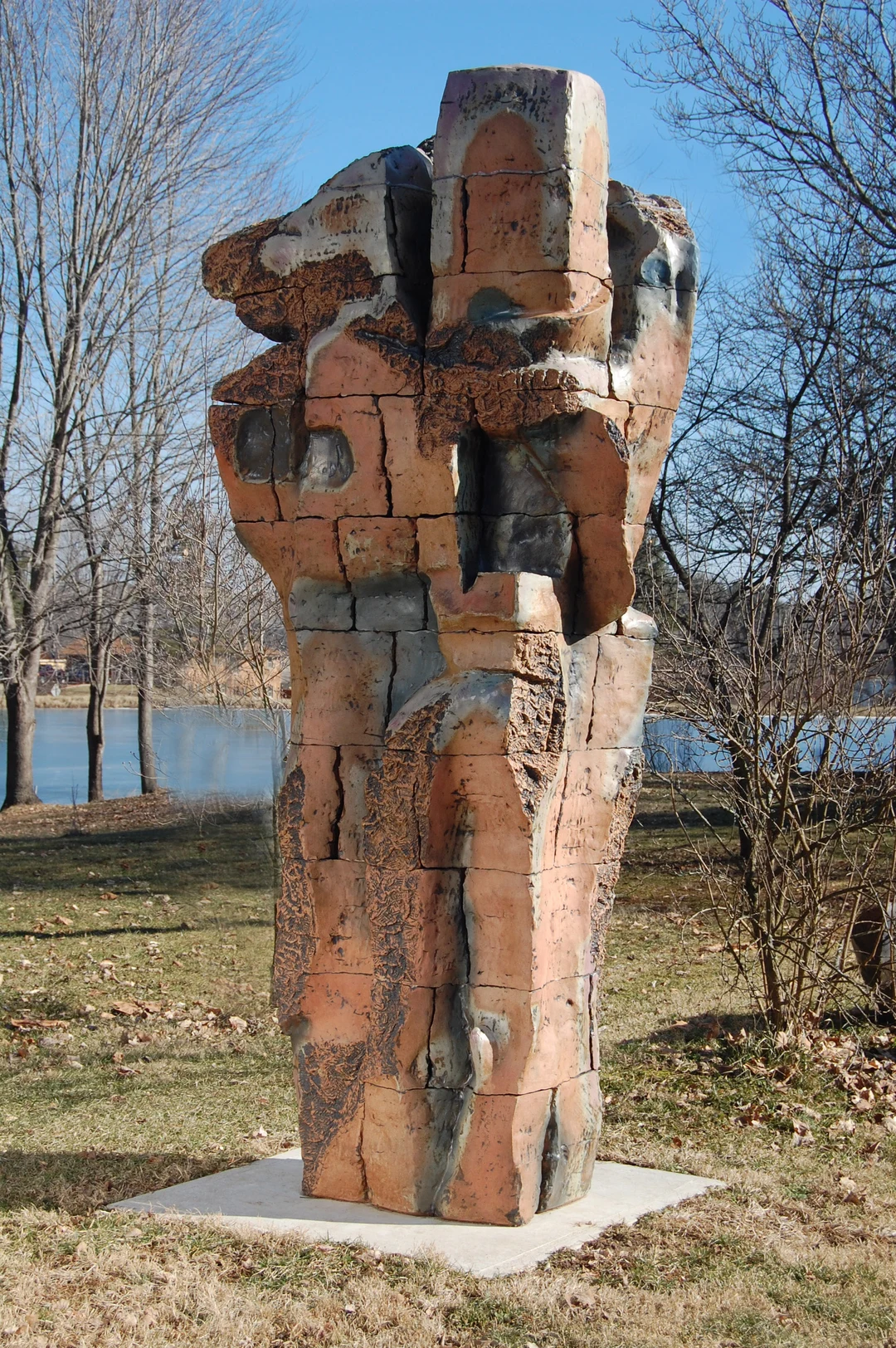
Craggy might be the best word to describe the Columbus, IN, sculptor’s monumental sculptures. Some are over 11’ tall but the smaller works are also monumental in impact. They look like boulders or outcroppings that might have been torn from the earth. Glazed in some areas and left raw in others, their coloration of sandstone, mossy greens, tans with blushes of lavender are suitably rocklike.
Nature is the source for Pulley’s work as he explains in his artist statement. As a child growing “up on the edge of a small town in Northern Indiana, my favorite pastime was walking the fields, woods, and creek banks. My fascination with nature remains.”
Pulley continues, more specifically about his inspiration. “Multicolored granite, basalt, schist, and quartzite stones heave up in the fields after winter freezes. They were split from metamorphic mountains thousands of miles to the north. Their round shapes and scarred skins reflect the tumble and grind of their glacial origins.”
Pulley’s pseudo-natural forms look as if they might have been heaved up from the earth or torn from geologic formations with little thought for aesthetics. They might not be man-made at all, except for the evidence of Pulley’s fingers dragged over some of the smooth surfaces of his sculptures.
“Passage O10” almost directly references menhirs, those standing stones found in Africa, Asia and most numerously in Western Europe, especially Ireland, Great Britain, and Brittany. Here the “menhir” has been split in two vertically and a wedge (phallic from some angles) has pushed them apart. But the scale diminishes its impact, being only 45” high.
This is an issue because Pulley has the capacity to work quite large as demonstrated by “Daughter of the Moon, Nokomis,” which is 136” tall and “Serpent,” which is 135”.
Pulley’s sculptures standing in the gallery brought to mind Chinese scholar’s stones or gongshi. Connoisseurs used large stones, up to six feet tall, to decorate gardens and courtyards, beginning in the Han Dynasty (206 BC-AD 220). The stones were chosen for their resemblance to mythological and famous mountains. Similarly Pulley’s sculptures can be seen as referring back to what he has seen and experienced.
And I see Pulley’s sculptures as objects of contemplation – the gallery has thoughtfully provided a bench — as were the gonshi. A more recent example could be Carl Andre’s “Stone Field Sculpture.” In 1977 in Hartford, CT, the Minimalist sculptor arranged 36 boulders in a triangle formation, starting with eight and eliminating one in each succeeding row on what a present-day art blogger describes as a “triangularish lawn on Gold Street near Main.”
At the time the sculpture was installed, there was an outcry against it and that continues today. One attack is essentially some variation on “that’s not art” – although the epithet that “my kid could have done that” is not voiced given the weight of the rocks. The other criticism is “we paid $87,000 for that?”
Still “Stone Field Sculpture” does have its supporters. At the time, I was working for the gallery representing his work, Sperone Westwater Fischer, and I remember one favorable comment that may have come from a letter to the editor of The Hartford Courant. The writer asserted that the sculpture had activated the odd patch of land, so it attracted nearby residents and workers. I think he said it had become a favorite site for al fresco lunches.
Robert Pulley, Daughter of the Moon (Nokomis), 2011, ceramic. Image from the artist's website.
On Pulley’s website he announced that he was working on his “first public scale horizontal sculpture” and should it turn out well, it may be in this exhibition. He was obviously pleased with it as the “Memory of a Wave,” which measures 66” x 105” x 34”, is on display. This work might be seen as Pulley’s homage to two sculptors who influenced his work: Henry Moore and Isamu Noguchi.
For all the references to the natural world in Pulley’s work, he readily acknowledges there are “hints of the human figure” in his work. Titles like “Daughter of the Moon, Nokomis” (an Iroquois name meaning “Daughter of the Moon”), “Protector,” and “Classic Venus” confirm that. Those hints are blatant in the last as an abstracted and armless goddess stands in a classical contrapposto pose, with one hip shot and one leg advancing.
Pulley’s figuration evokes other ceramic artists to the point that his work appears derivative. That is the word that popped up in my consciousness the moment I saw the announcement card with “Classic Venus” reproduced.
Of course, the rough handling and abstract quality of Pulley’s sculpture immediately recalls Peter Voulkos and the Columbus, IN, sculptor acknowledges him as an influence. But Voulkos must be cited by almost every ceramic artist since the 1950s. Their work, whether it resembles his or not, could not have been conceived without Voulkos moving clay from craft and the decorative arts into the fine arts in the 1950s. His slashed and gouged bowls and plates and mashed together bottle forms completely destroyed their functionality, and Voulkos rejected the prettiness of dainty clay decorative objects such as figurines in his expressionistic sculptures, some quite large. Pulley’s sculpture can be seen as a continuation in this line of artistic exploration.
But other sculptors also came to mind in relation to Pulley because of a shared interest in the figure. The choice of material, expressionistic handling, and figural quality of Pulley’s work reminded me of Stephen de Staebler, who Pulley admits is an influence, and Nancy Jurs. Work by De Staebler in his early career and Jurs allude to the human figure in ways similar to Pulley.
De Staebler’s tall (some as tall as 90”) slender ceramic sculptures, dating from the 1970s to 2000, reference the figure with sometimes a more recognizable limb, foot, or torso than can be seen in Pulley’s work. De Staebler’s sculptures look as though he has slammed chunks of clay together as do Pulley’s sculptures.
Jurs also explored Pulley’s artistic territory earlier. Her totemic Goddess figures date from 1985 to 1990, and her Monuliths (her name for monolith forms) up to 16’ tall begun in1991 continue to the present time. Jurs’ Rocks of Ages from the mid-1990s look like torsos abstracted in ways very similar to some of Pulley’s sculptures, notably “Protector.”
If you can ignore these precursors – and it’s quite likely you can – Pulley’s work is competent, handsome even. And their installation in the Weston’s street-level gallery enhances it. The seven sculptures were not overpowered by gallery’s dauntingly high ceilings.
Still I do wish the largest ones had not been placed on low white plinths. I would have preferred them to sit directly on the green-gray stone floor or perhaps on a bed of gravel. (Dale Chihuly installs his “Nijima Floats,” up to 40” in diameter, on cullet or broken glass, which amazingly does not deter gallery visitors from walking on it.) Even painting the plinths (and bases used for the smaller sculptures) a darker neutral would have worked better.
Although Pulley is proficient as a sculptor, he breaks no new ground artistically and, I’m afraid, offers nothing new.
Standing in Time’s Flow, Ceramic Sculpture by Robert Pulley, Alice F. and Harris K. Weston Art Gallery, 650 Walnut St., Cincinnati, OH 45202, 513-977-4165. Through February 17, 2013. Tues.-Sat., 10 a. m.-5:30 p. m., Sun., noon-5 p. m. Open late on Procter & Gamble Hall performance evenings.













Comments powered by Talkyard.