With its current show By This River and previous show The Weight of Water, the Weston Gallery has devoted both spring and summer to presenting Cincinnati with multiple lenses through which to view water, an essential element of life that has served as inspiration for countless artists. It’s a timely topic too, given the record rainfall this season, extreme flooding in the southwest and drought and fires in some of the wettest areas of the country. Add to that threats to water quantity and quality in the form of fracking, the leaking of agricultural and industrial waste into waterways, and the depletion of clean water sources for use in commercial water production. The Weight of Water offered a political approach, addressing the vulnerabilities of the resource and the impacts of environmental degradation.
By This River, in contrast, celebrates water, river, and ocean, as muse: its fluidity, sound, reflectivity, timelessness, and force serve as the basis for works in multiple media that indulge the viewer in pure aesthetic pleasure. Curated by Carl Solway Gallery director Michael Solway, the exhibit assembles the diverse works of highly accomplished American artists Benjamin Patterson, Steve Roden, Dove Bradshaw, Gregory Thorpe, Jim Campbell, and Jacci Den Hartog.
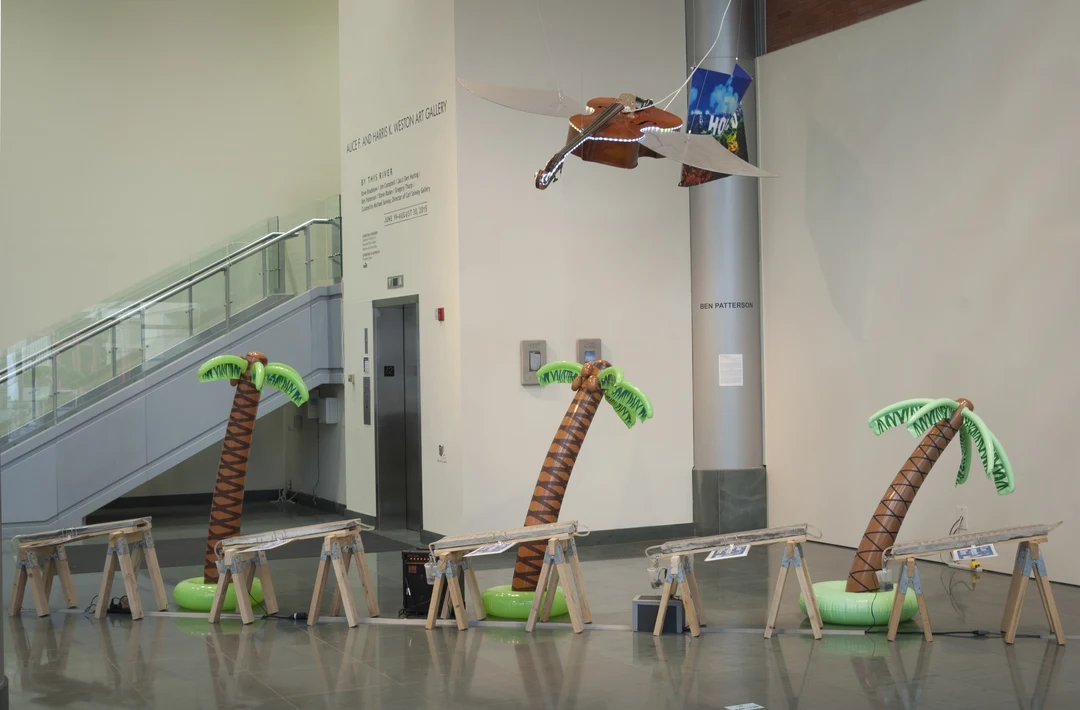
Patterson, a pioneer of the Fluxus movement, exhibits playful pieces that greet exhibition visitors as they enter the gallery at street level. InLos Angeles River Concrete Poem #1-5, Patterson makes literal the notion of concrete poetry by presenting his written compositions on five concrete slabs traversed by tiny channels through which a stream of water flows. Beside each slab is a spiral bound book of photographs that reveal visual sources of inspiration documented while walking along the Los Angeles River. The southern California river environment is completed with the amplified sound of gurgling water along with inflatable palm trees that grace the edge of the installation. The sound and video piece touch strings seep sleep pluck by Steve Roden resonates with the intermittent strum of a zither through the upper gallery and lower stairway, and mixes nicely with the water sound amplified in Patterson’s piece. On two video monitors located at the base of the stairs, images of Ohio River postcards are placed beneath zither strings. A hand plucks the strings in an interpretation of a sound “score” derived from the images, as one might read sheet music. Rosen’s statement says, “the sounds are not illustrations of the images, but suggestions of sound actions, as determined by what can be seen or “read” from the images.” Reading the works of Dove Bradshaw is more a material rather than conceptual matter. She employs time and chemical reactions to create paintings, works on paper, and sculptures that reflect the indeterminate products of interactive natural processes. The two large paintings and four works on paper from her Contingency Series (1984-2011) consist of silver reacting with liver of sulfur, a chemical commonly used for creating patinas on bronze sculpture. The result in each case is a composition of darkly nuanced dried chemical veins and masses that conceal and reveal glowing metallic pools.
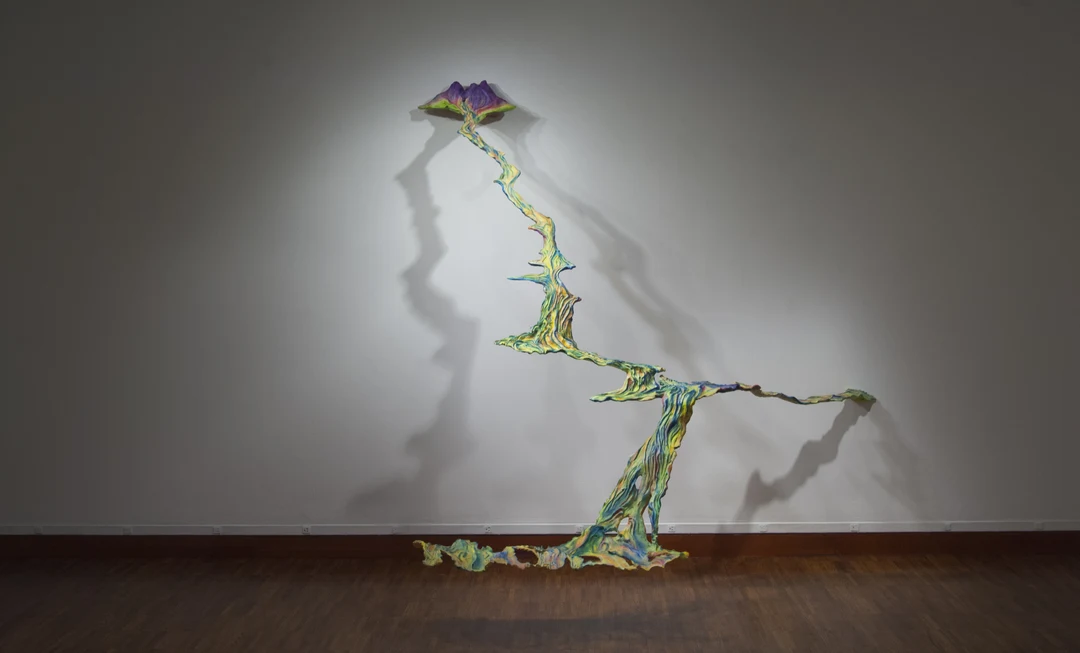
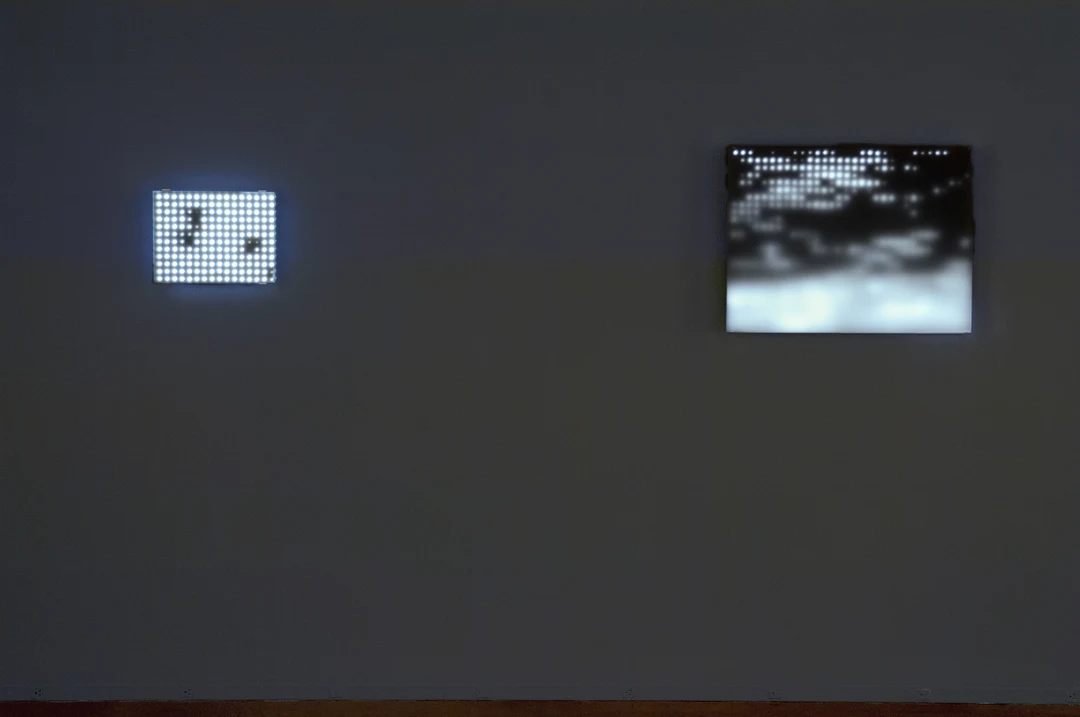
Gregory Thorp’s photographs share a gallery space with Bradshaw’s, and the connection between their very different imagery is clearly the quality of light that emanates from both bodies of work. Thorp is intimately acquainted with the Ohio River through his work with the Ohio River Company and other barge companies. For more than 40 years, he has travelled up and down the Ohio on barges, photographing vessels, workers, bridges and water. In Ohio River Series #1-7, he transform fine details articulating the play of light on water into quasi-abstract compositions that encourage contemplation of the unseen source of a wake, the shape of rising mist, and the way opacity and transparency create an illusion of solid form from a fluid material. The lyrical quality of fluidity is the focus of drawings, painting and sculptures by Jacci Den Hartog. Inspired by traditional Chinese nature painting with its delicate lines and fine details, Den Hartog’s work leaps into pop art territory with her use of reverberating primary colors and polymer clay material. Two clay sculptures, Coming Down and Day Hike, are disembodied waterfalls that appear to spurt right out of the walls in undulating ribbons, painted with intermingled greens, blues, yellows, and pinks. This flowing “water” juts in sharp angles out into the gallery space, and levels out suspended several inches above the floor, while the viewer is left to imagine the landscape that might envelop the form. Alternately in Come Down, an acrylic painting on paper, flowing water is inferred by negative space, while the landscape is detailed in bold horizontal strokes of orange, yellow, hot pink, and blue.