
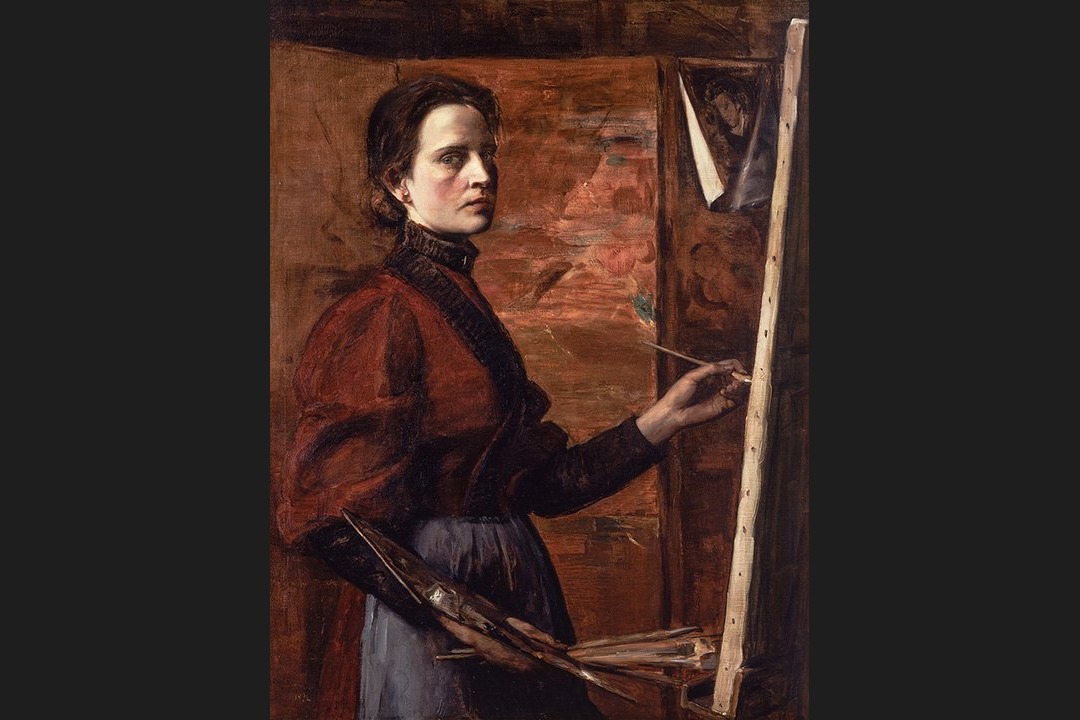
I stood eye to eye with E. Nourse recently at her current exhibition “Rites of Passage” at the Cincinnati Art Museum. The painting: her own lifesized self-portrait. Not given to idealization even when concerned with her own features, she portrays herself actively at work with a clear and unblinking eye. A strong light carves her features and illuminates the brush in hand as she confronts another canvas in her studio. The tacked canvas edge intersects at the corner with her array of brushes, realized as a series of dashed out strokes. She strove to compete at every opportunity on both sides of the cultural ocean and was one of few women artists in her time to achieve international recognition. She was given to signing her name E. Nourse to avoid the gender bias of the exhibition jurors.
Among her tributes:
1893 Contributed to the Cincinnati Room, Woman’s Building, World’s Colombian Exposition in Chicago
1894 Elected president: American Woman’s Art Association, Paris
1910 “Les volet close” (Closed Blind) purchased for the French National Collection at the Musee du Luxembourg.
At a time when commercial industrialism was visiting poverty, immorality and social travesties upon the working classes, the philosophies of John Ruskin sounded a call for the return to nature and simpler values. Nourse, a devout Catholic, strove to create works of art resonating with simple spiritual values. The accolades she won during her lifetime are a tribute to her artistry, yes, but they also reflect her ability to satisfy a desire for spiritual sustenance in the conflicted secular world. Spirituality can be shown to be a prominent theme in her work throughout her lifetime.
In her many portrayals of motherhood, she expressed the ideal in the daily maternal acts of nurturing, tending and teaching. The large work “Le Mere” 1888, signed darkly E. Nourse, is the tender rendering of reverence and maternal attention in the solitude of nap time, inches away from the crib. I couldn’t help but notice the expression of character in the young mother’s hands, placed around the bulk of the child as it lay on her lap. This painting was noted at the Salon in Paris and hung “on the line” or at eye level, a designation of special merit for this modern madonna.
While in Europe, Nourse resourced subjects in industrially untainted villages such as Penmarc’h for many paintings. The large oil “Procession of Our Lady of Joy, Penmarc’h” portrays a religious festival, called ‘the pardon’, a subject often portrayed by Nourse’s contemporaries. Older girls shouldering the bier carrying the statue of the Virgin, are accompanied in the street procession by smaller girls carrying crosses with sail-like banners. She focuses on the devotion of the female population as they carry out the practice, wearing celebratory garb and head dresses. The watercolor study displayed on the left, shows a subset of the same population as examples of a hardworking, pious people of Breton, their uncomplicated existence and simple faith elevated when compared to more industrialized regions. Blazoned above these paintings, Elizabeth herself speaks: “To me these people are not ugly, their toil stained hands tell the story of their lives. I cannot paint “pretty” people, they do not appeal to me.”
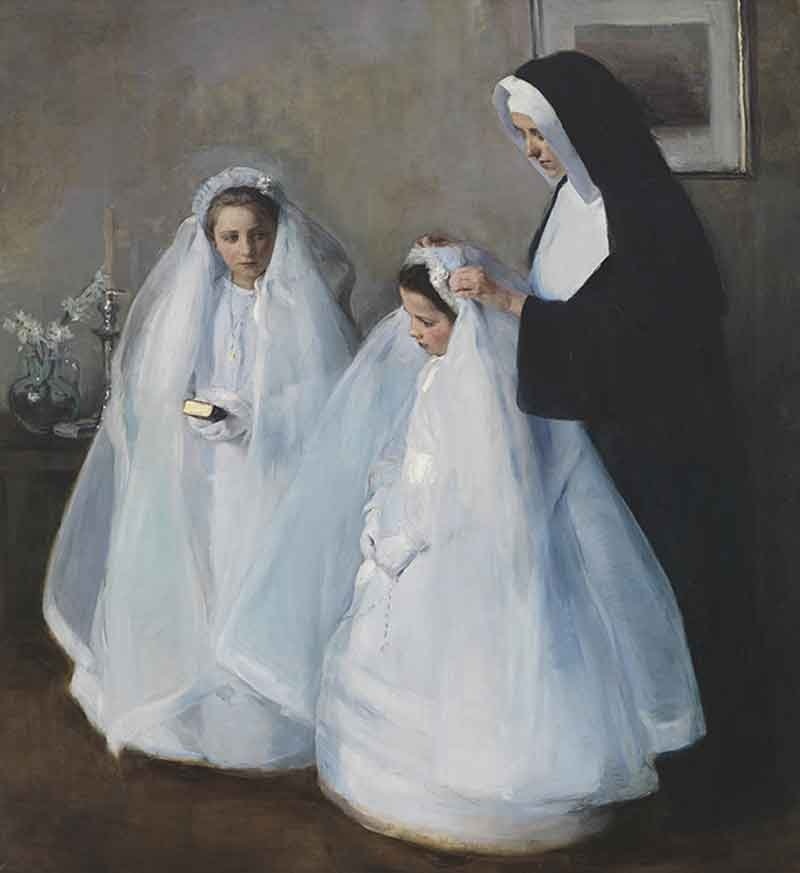
The work “Premier Communion” 1895, and its multiple studies dominate the exhibit. Nourse’s process of conceptualization can be seen maturing through the selection of multiple drafts from sketchbook on display to small studies and portrait panels. The shapes of the painting evolve, a simplification of form gels as her vision intensifies. The entire composition is blocked out in a 9×12″ panel. Comparing this study to the final work will reward you with the refinements that make Premier Communion the statement it was intended to be. The cupcake cones of the young girls patiently enduring the primping attention of the attending nun are a painting marvel. The masterful shaping of the white forms, achieving the gauze-like veils with beautiful glazing, is set off by the bright spank of silk be-ribboned accents on each head and waist. Each girl, both transformed and shielded from the secular world in their array, solemnly clutches a rosary or gold tipped prayer book in gloved hands. At the time of this painting, communicants received the sacrament at 12 or 13 years of age, thus entering adulthood. Intended symbolically to be a prefiguration of the sacrament of marriage, the event was complete with lavish clothing, gifts and intensive preparation. Not until modern times was the age lowered to age 7 by Pope Pius X who decreed that the first Communion of children should not be deferred too long after they had reached the age of discretion.










Comments powered by Talkyard.