“Untitled” by Avery Singer, acrylic on canvas, at the ICA. Singer used the 3-D modeling software SketchUp to render the model before executing the painting by hand.
If I’m being cyncial, Boston’s inferiority complex as a “top U.S. innovation city” is why we have a city-wide partnership between 14 museums and galleries called “Art + Tech. ” Why not, when the theme is so wide-ranging and marketable, a chic outlet for the bursting brain trust we want to show the world? We’re the “Silicon Valley of the East Coast, ” openly pining for the day when Silicon Valley is called “the Boston of the West Coast. ” I mean, we already (successfully) rebranded the Seaport as the “innovation district. ” But there are enough columns about all that—what about the art?
In truth, there is nothing to suggest that “Art + Tech” came down from local city government, no “presented by Mayor Walsh” or “made possible by the General Electric” tagline. Truly, the collaboration is more of a mutually beneficial banner for the anchor exhibition, “Art in the Age of the Internet, 1989 to Today” at the Institute of Contemporary Art/Boston (ICA), and venues that may not have the budget to wallpaper multiple T stops with ads. My initial cynicism is, then, more of a Boston state of mind and less a dig at a sweeping arts initiative. If the ICA and smaller venues can get more attention and support by banding together with a marketable title, more power to them.
It is true Boston that was also an early champion of video art. WGBH produced and aired experimental video footage as early as the 1960s, notably commissioning works from eight artists, including Nam June Paik, to create “music videos” for classical pieces in 1972. But why mount this initiative now, Boston, when new technology is so thoroughly interwoven into every aspect of our lives that we barely acknowledge it—and Boston’s personal art history doesn’t seem to be featured? I only knew that tidbit because I caught a “catalyst conversation” at MIT featuring George Fifield, founder of Boston CyberArts, and multimedia artist Judith Barry, who has been creating video and other multimedia pieces since the 1980s—she also has a piece in the ICA’s exhibition.

“Graft and Ash for a Three Monitor Workstation” by Sondra Perry, video and bicycle workstation, at the ICA. The exhibit is at its best with works like these: Perry’s video is encompassing, raising questions about the representational limits of software skewed toward a white ideal.
Plus, artists have historically proven to be among new technology’s earliest adaptors, from paint tubes to code (here I must mention “The Best Art” by programmer/artist Nicole He, although it’s not featured here), so associating “artists” with “tech” isn’t exactly revelatory. Here, the word “tech” may be a compromise, a catch-all to allow venues to pursue their own angle. And the question “why now” becomes “why not,” when there are so many contemporary artists to pull into the mix.
The “why now” of it may be explicitly addressed in programming I didn’t see, like the initiative’s upcoming adults-only Museum of Science lectures. You’ll forgive me for only visiting three exhibitions and attending one lecture after perusing the exhaustive “Art + Tech” schedule, especially since that includes the ICA’s expansive show—which is thoroughly enjoyable, if not overwhelming. While it covers about as much physical real estate as you’d expect from a major museum show, the vast number of video pieces—not to mention the virtual reality “ride” over the bay—makes it a much more intensive study. I’ve never attended a museum show with so many headsets littered about the galleries. Choosing which piece’s soundtrack would blare through each gallery’s speakers must have been a painstaking curatorial choice.

“GreenScreenRefrigeratorAction” by Mark Leckey, refrigerator, LED panel, inflatable fluorescent light, freon canister, and video, at the ICA. This anthropormothized refrigerator droned a monologue throughout its gallery, creating an eerie, robotic-yet-human atmosphere.
The ICA’s chief curator, Eva Respini, has said that this isn’t a show about the internet, but “how technology has fundamentally changed our culture.” In that, the exhibition certainly succeeds. A few examples: nudes are nothing new, but the small oil portraits in Celia Hempton’s “Chat Paintings” series have a distinct web-cam perspective, featuring often-masturbating men she has encountered online. Harun Farocki’s eight-minute video, “Serious Games IV: A Sun with No Shadow,” documents the U.S. military’s use of video games, exploring how video games are now used not only to prepare soldiers for war, but to combat post-traumatic stress syndrome when they return. In what I found to be the most genuinely chilling series of the show, Rabih Mroué enlarged stills from Syrian protesters’ cell phone footage of gunmen pointing their weapons right at us, the audience, in “The Fall of a Hair: Blow Ups”; some of the protesters were killed right after capturing these moments. The adage “the revolution will not be televised” is rendered nearly obsolete when nearly all citizens carry a supercomputer in their pocket.

“Gfwlist” by aaajiao (Xu Wenkai), steel panels, printer, thermal printing paper, at the ICA. In the “States of Surveillance” gallery, this piece intermittently prints a growling list of websites blocked by China’s “great firewall.”
“Grosse Fatigue,” a 13-minute video by Camille Henrot shown in a black box was one of my favorite pieces in the show, and I realized it’s because it’s my own personal idealized version of the internet: organized, aesthetic, free of nasty commentary. Creation myths are as old as time, but “Grosse Fatigue” seeks to encapsulate those stories through a series of overlapping browser windows, a la internet pop-ups. Henrot notes: “Fatigue is mentioned in a lot of creation myths. It’s the loss of energy, the entropy principle, which is the founding principle of the creation of the universe.” Thanks to her measured pacing, bright aesthetics, and the film’s soothing soundtrack and voiceover (by Joakim and Akwetey Orraca-Tetteh, respectively), this journey is far less fatiguing than the actual internet—and the rest of the exhibition.

“Cat” by Antoine Catala, TV, glass, vacuum-formed plastic, LED lights, and aluminum/wooden stand, at the ICA. It wouldn’t be an internet exhibition without a cat—his projected head rotates above his stationary body.
Our own personal versions of the internet, of course, is the heart of the matter, as is how we conflate our online and IRL (in real life) identities. At the ICA’s show, a whole gallery is devoted to “Performing the Self”. For those baffled by the significance of having an online persona, multidisciplinary artist and activist Juliana Huxtable demystifies the idea in the placard for her self-portrait, “Untitled in the Rage (Nibiru Cataclysm)”:
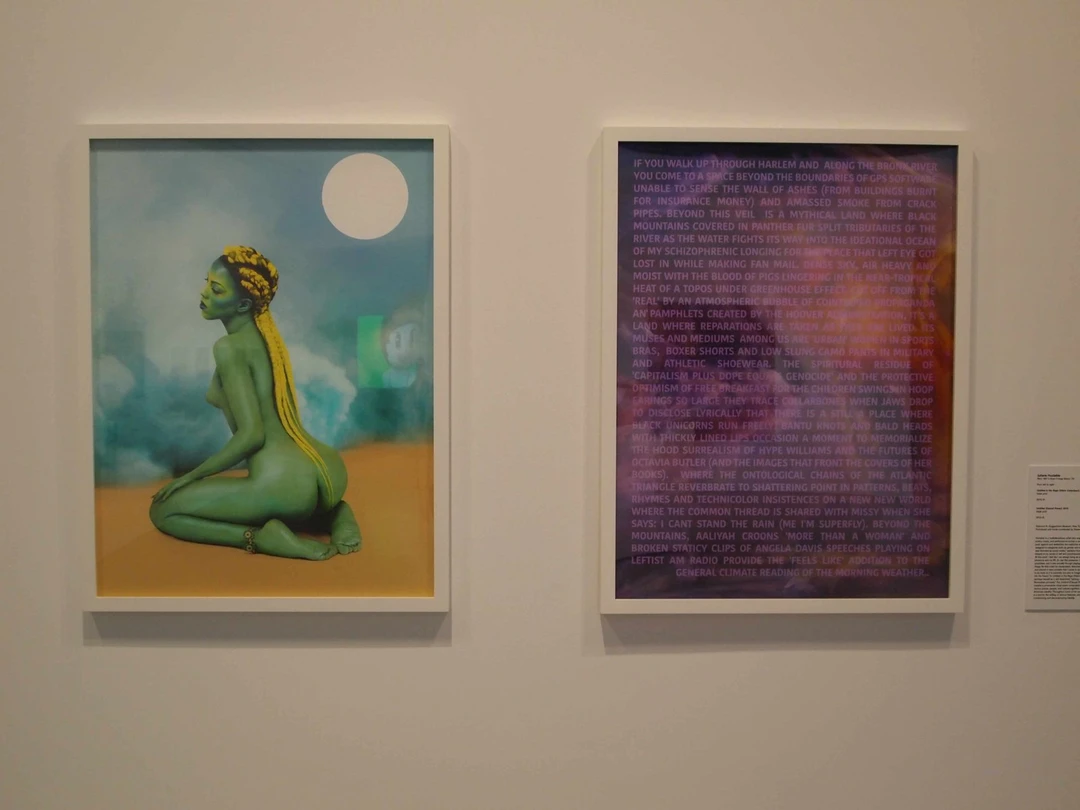
“Untitled in the Rage (Nibiru Cataclysm)” (left) and “Untitled (Casual Power)” by Juliana Huxtable, inkjet prints, at the ICA.
Born intersex and assigned to the male gender, Huxtable faced racist bullying on a daily basis growing up in a rural Texas town—so that sense of controlling one’s own image and virtual entity takes on a very specific meaning for her. But all internet users curate and create their sense of self to a certain degree. Frank Benson’s stunning painted bronze sculpture of Huxtable was inspired by her self-portrait, and modeled after a 3-D printed version Benson created first.

“Juliana” by Frank Benson, painted bronze with Corian pedestal, at the ICA. Background: “Untitled #463” by Cindy Sherman, chromogenic color print
Benson’s use of a 3-D printer in this process is just one example of artists using new technology to create art, in this exhibit and throughout history. Artists’ embrace of new (at the time) technology is evident in the smaller gallery shows in the “Art + Tech” initiative, particularly at MIT’s List Visual Arts Center’s “Before Projection: Video Sculpture 1974-1995.” After the overwhelm of the ICA, it was refreshing to see a smaller, more focused exhibit—and that’s another positive for the larger initiative, as smaller venues can drill down in a way that such a big show can’t. Here, we focus on an era when clunky monitors had to be factored into video art’s display. The effect is not strictly nostalgic, although that feeling does factor in—what’s more interesting is the function of each monitor’s heft in each piece.

“Video Ping Pong” by Ernst Caramelle at MIT List Visual Arts Center. Be warned: you can only play ping pong like the blurry gallery-goers in this photo on Thursday nights. Photo: Peter Harris Studio
For example, in Adrian Piper’s 1990 piece, “Out of the Corner”: a separate room with a classroom set-up that represents each “student” with a television, with the artist herself at the head of the class. Her monologue about being biracial and why she refuses to pass for white—appearance versus genetics—is eventually joined with the Sister Sledge song “We Are Family,” while muted white-presenting people intermittently appear with captions in different languages: “Some of my female ancestors were so-called ‘house niggers’ who were raped by their white slave masters. If you are an American, some of yours probably were too.” At the end, their unmuted voices raise a calm chorus of how a terrible history unites us. Photos of black women from the magazine “Ebony” line the walls, watching from all sides as the monitor-people declare their truth. The weight and dimensional space of these projections feels significant, both as a product of their time, and the hulking history they carry.

Installation view at MIT List Visual Arts Center. Foreground: “TV for TV” by Takahiko Iimura. Iimura—along with Nam June Paik and Shigeko Kubota, who are also in the exhibit— is considered to be one of the founding pioneers of video art. Background: “Equinox” by Mary Lucier. Photo: Peter Harris Studio
Mary Lucier’s seven-monitor piece, “Equinox,” may not depend as much as the monitor’s heft as many of the other pieces, but was created as a result of nature’s effect on her video camera. She realized, while shooting outdoors, that the sun had burned the camera’s internal recording tube. Knowing this, she filmed the sunrise from the roof of her lower Manhattan apartment building every day for a week, progressively zooming in on the sun; each separate monitor displays the worsening state of the lens. What we see is a wearing away—a natural rebellion against technology, while it functions as an enabling medium.

“Slumpies” by Jillian Mayer, fiberglass, epoxy resin, wood, board, paint, and hardward, now at the Aidekman Arts Center at Tufts University. Courtesy of the artist and the David Castillo Gallery
Jillian Mayer’s “Slumpies” at Tufts University are also counter to nature: natural posture, anyway. Her “post-posture,” coral-like melting sandcastles are functional pieces of furniture, molded at specifically odd angles to accommodate a person who is holding and using their mobile phone to scroll through social media, or text, or do whatever else prohibits them from looking up. So perhaps they aren’t counter to nature, but evolving along with us and our slumped devotion to our phones.
That hyper-personalized, virtual community may be why the whole “Art + Tech” endeavor seems pretty tame (and therefore brand-able) now, when screens are inherent to almost every aspect of our lives. We personalize our own internets, amplifying the “content” and voices that reinforce our own worldviews. Seeing the number of headphones provided in each gallery at the ICA, I thought it would almost make more sense to give each person their own personal noise-canceling headset, programmed to play the soundtrack of whichever piece they’re viewing. Then, we would experience the show just as we experience the internet: totally alone.
But—when I went to Tufts on a weekday evening, a group of students had pushed away the “slumpies” to rehearse a dance in the lobby area. Maybe their dance will end up in a video online, but in that active moment, there wasn’t a slumped person in sight.