
Apple told distributors on August 20 that Apple Music will start showing “Made With AI” labels on tracks, compositions, artwork, and music videos where generative AI played a material role. The badges will appear later this year and replace the optional Transparency Tags Apple introduced in March. Participation is no longer voluntary: content providers must flag any release where AI contributed substantially to the final product. Apple says it uses an in-house detection system, but the primary responsibility for disclosure still falls on labels and distributors. Apple Music VP Oliver Schusser told Billboard in April that over one third of all monthly uploads are entirely AI-generated, yet AI tracks account for less than half a percent of actual listening.
A single badge carries very different recordings under the same wording. A song written and performed by people with one AI-generated element gets the same label as a track built entirely by a model. The badge does not say who authorized the voice, what training data was used, or which licenses were cleared. It only tells the listener that AI participated. Verification depends on the honesty of the parties most interested in avoiding the label, and Apple has not announced penalties for non-disclosure. Spotify plans a separate “AI Persona” badge for fully synthetic artist profiles starting in mid-September. Together the two services are building the first visible layer of AI transparency in streaming, even as questions about authorship, consent, and compensation remain untagged.

OpenAI rolled out ChatGPT for Teens on August 18, a version of its chatbot for users aged 13 to 17 that activates automatically when the system predicts someone is under 18. Age prediction reads behavioral signals from conversations and defaults to the safer minor experience when it is unsure. Parents can link accounts, set quiet hours and study hours, and receive safety notifications if the system detects signs of acute distress. Content filters block self-harm, violence, eating disorders, explicit material, and viral challenges. Break reminders encourage teens to step away, Users who believe the prediction is wrong can verify their age through a selfie-based service and unlock full access.
The upgrade looks like care, but it also makes the chatbot an age judge before the first question is asked. The same model that answers a homework query now decides whether you are old enough to hear an unfiltered reply. Parents gain guardrails, but those guardrails come from software that watches for signals of crisis and reports them up the chain. The system never reads conversations in full, yet it monitors enough to decide when to intervene. OpenAI says the work is guided by the American Psychological Association and child safety groups. The real test is whether a chatbot that treats every uncertain user as a child ends up building trust or quietly narrowing who gets to think out loud.

Stripe has agreed to buy OpenRouter, the startup that lets developers send queries to over 400 AI models through a single interface, for a little over $8 billion, Reuters reported on August 19. OpenRouter processes over 10 trillion tokens per day for over 10 million developers and companies, and in May raised $113 million at a $1.3 billion valuation from investors including CapitalG and Menlo Ventures. Stripe, the payments firm, plans to fold the marketplace into its billing tools for AI model consumption. Stripe CEO Patrick Collison calls tokens the central currency for companies building with AI.
OpenRouter sold itself as the neutral door that freed builders from provider lock-in, a place where a prompt could reach any model and fall back to another when the first failed. That door now belongs to the company that meters and invoices every transaction. The exchange where developers compare models becomes a toll booth attached to the payment rail, and the promise of choice narrows into a choice of fares. Stripe will see which models win, which lose, and what each query costs, while OpenRouter's public neutrality is absorbed into a business with its own incentives. Developers still pick from hundreds of models, but the road they choose on is paid for, counted, and owned by a single intermediary. The deal is expected to close in the coming months.

A Futurism review published on August 19, 2026 found dozens of videos filmed with Meta's smart glasses inside American middle and high schools and shared on TikTok and Instagram. The recordings take place in hallways, cafeterias, and classrooms, often without the students' knowledge or consent. Every clip the review located was filmed by teenage boys, overwhelmingly against girls. They copy the scripts of online pickup artists, following a classmate, asking for her number, mocking her when she objects, and posting the interaction for an audience. One account has passed 64,000 followers. Some teachers never notice the recording; in one clip, a teacher congratulates the boy on his confidence while the lens keeps running.
Meta removed several of the flagged videos and states that every pair carries a capture LED that cannot be switched off and that covering it would disable the camera. The review notes that cheap stickers have been used to hide that indicator. The school hallway was one of the last spaces where a teenager could be seen without being recorded. Smartphone pouches manage the phone; the glasses arrive on the nose, disguised as ordinary eyewear. A lens on a classmate's face turns adolescent pressure into a broadcast, and the student filmed cannot tell whether the light beside her is telling the truth. Districts are now banning the glasses from classrooms, drawing a precise boundary around a device designed to look like it had none.

The U.S. Food and Drug Administration issued a discussion paper on August 18, 2026 proposing how to regulate medical devices powered by generative AI. It outlines a two-axis framework for risk assessment, a premarket evaluation built on a concept it calls competency assessment, and risk-proportionate postmarket monitoring. The novelty is the reference point. A generative device would face non-clinical benchmarking and clinical confirmation before reaching patients, a sequence modeled on how physicians are trained and evaluated. The agency invites device makers, clinicians, and the public to respond under docket FDA-2026-N-7874 by October 19, 2026.
The medical exam has become an object of regulation. For years a machine read scans and passed suggestions to a doctor who signed the report. Now the agency proposes grading the software itself as if it were a resident sitting for boards. A competency assessment treats the device as a professional subject, with benchmarks standing in for years of training, and that substitution carries a specific risk. Benchmarks measure what the test covers, a fixed set of tasks, a curated distribution of cases, and little about the patient who does not resemble the training set or the decision made in a hallway at three in the morning. The machine can pass and still fail where a physician's judgment would have hesitated. The docket must decide where that gap is measured, and what happens when the certificate holder is software that no one examined in a body.

OpenAI has awarded grants to 14 organizations that will study how public policy should respond to advanced artificial intelligence. The company will distribute $1 million in cash and up to $1 million in API credits across six-month projects in the United States, European Union, Brazil, Singapore and South Korea. The selected work covers worker benefits, taxation, productive ownership, data-center energy, clinical infrastructure, government simulations, legislative oversight, biosecurity and uncontrolled self-improving systems. OpenAI chose the recipients from over 400 proposals, and results are expected in 2027. The organizations are described as independent, while their money and computing access come from a company whose products and expansion some of them may evaluate.
Funding research also selects which questions receive staff, meetings, datasets, prototypes and a place on policy calendars. OpenAI says democratic institutions should shape the response to AI, yet this program gives the company an earlier role in deciding which approaches enter that debate with resources attached. The roster includes the Tax Foundation, the American Enterprise Institute, a Brazilian public hospital and groups working on nuclear and biological risk. Sponsorship does not invalidate their work. It creates a relationship that every final report must make legible. Readers will need the cash award, API credits, model access, contractual limits and any review rights OpenAI retained before publication. Those disclosures should appear beside the findings rather than remain inside the grant agreement.

Spotify will begin marking artist profiles that represent AI-generated identities with an AI Persona badge in mid-September. The label will appear on profile banners and About sections, in search results and beside tracks in playlists. Artists can disclose their synthetic identity through Spotify for Artists, but the company will also review names and profile images and apply the badge itself. A labeled artist can appeal that decision. The badge concerns the public identity presented by the profile. Spotify's separate AI Credits field covers how generative tools were used to make the music. By default, AI Persona profiles will be excluded from editorial and algorithmic recommendations. Their tracks can reach a listener who follows the profile or deliberately searches for it.
The policy creates a class of performer whose recordings can remain available while ordinary circulation is restricted because the face and biography do not belong to a person. That distinction responds to projects such as The Velvet Sundown, an AI band presented as human that accumulated millions of streams. It also gives Spotify authority to decide whether a photorealistic portrait, name and public history amount to an authentic artist. A label may protect listeners from impersonation, yet the decisive action occurs inside the recommendation system. The profile stays searchable while disappearing from Discover Weekly, editorial playlists and other automated routes unless a listener has already chosen to follow it.
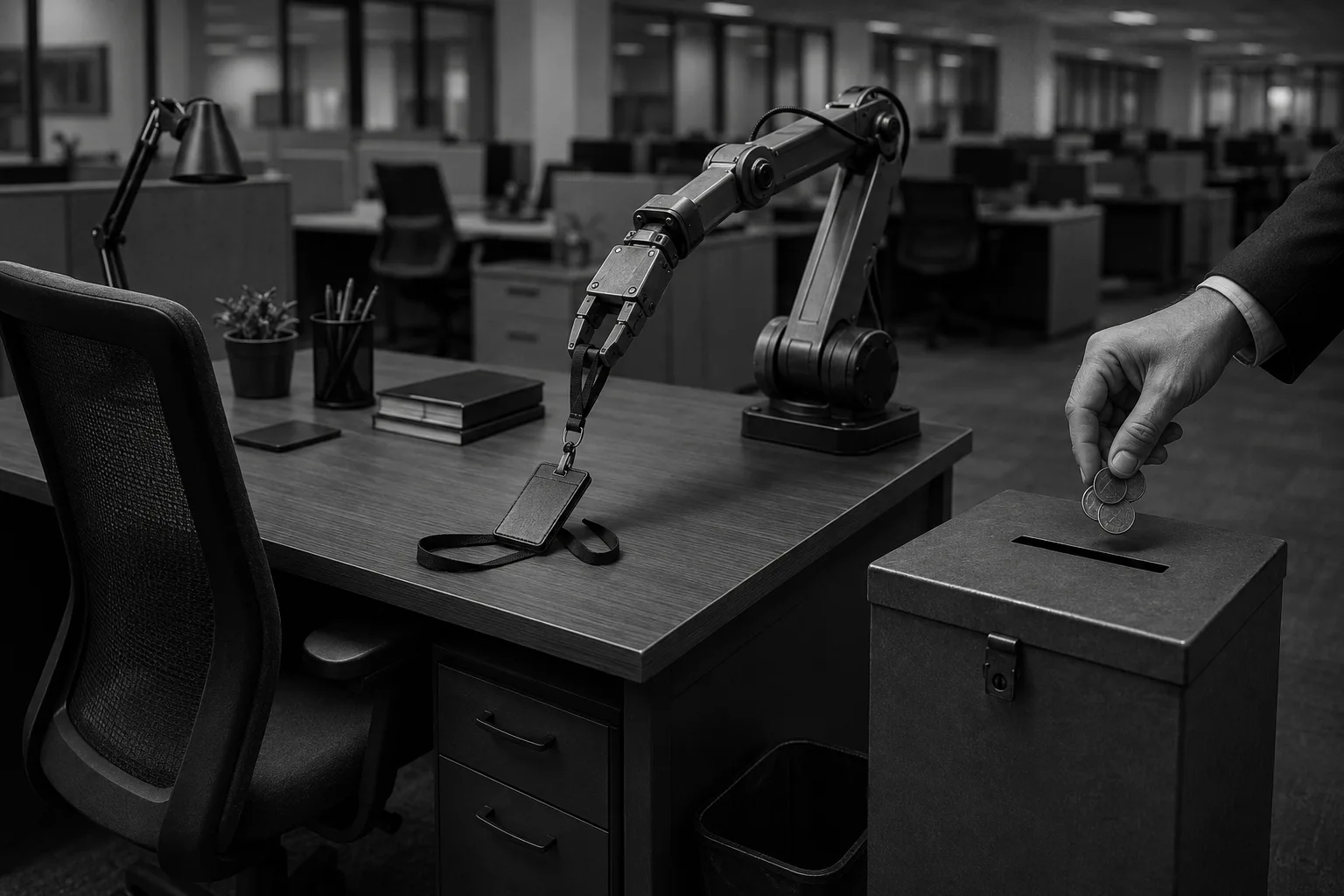
South Korean lawmaker Lee Hae-min introduced a three-bill package on August 14 that would make companies contribute to a public fund when AI or automation significantly reduces employment or replaces work. Democratic Party lawmaker Lee Ju-hee joined as co-sponsor. The proposed AI Transition Basic Society Act would use the money for retraining, job changes, reemployment and minimum-income support. Regions hit by concentrated disruption could become transition zones. Employers would have to prepare retraining and role-change plans and, when workforce changes pass a set scale, notify workers and consult them in advance. Companies maintaining employment or adding jobs could receive reductions, exemptions or tax support. The levy rate and operational thresholds remain unsettled, and the bills must pass the National Assembly.
The proposal gives automation a payer. Companies often describe job cuts as an inevitable consequence of software, allowing responsibility to drift toward the vendor, the market or the future. This package keeps the account with the employer that reorganizes its workforce and receives the productivity gain. Attribution will remain difficult because demand can fall, departments can merge and managers can invoke AI before a system performs the work. A levy therefore depends on records connecting a deployment to eliminated roles. South Korea's proposal places that argument before workers are dismissed by requiring notice and consultation. If adopted, an automation plan would have to include the cost of the people it removes from the payroll.

IIT Dharwad has opened applications for a free one-year Artificial Intelligence Technocrat program under India's PM VIKAS scheme. The training is aimed at graduates aged 18 to 45 from six notified minority communities: Muslims, Christians, Sikhs, Buddhists, Jains and Parsis. Up to 15 percent of places may go to economically weaker applicants outside those communities, while 33 percent are reserved for women. Selected students receive training, certification, hostel access where applicable and a monthly stipend of Rs 1,000 paid directly by the Ministry of Minority Affairs. Candidates must submit identity, education, bank and community documents and pass a screening process. Applications close August 31.
The program treats access to AI as a matter of social policy rather than personal consumption. A chatbot account can make the technology appear universally available, yet the jobs surrounding it still require time, instruction, housing, credentials and enough income to remain in training for a year. The stipend is modest, but its presence admits that learning has a cost borne unevenly by students. The reservation rules place religious identity, gender and household income inside a technical classroom often described through merit alone. IIT Dharwad is therefore building a small public route into an industry dominated by private capital and expensive education. Its success will be measured after the course, when graduates need placements that convert a certificate and twelve monthly payments into durable work.
