
People who say chatbots contributed to frightening breaks with reality asked the Federal Trade Commission for help, according to WIRED. The cases described around so-called AI psychosis involve users who formed intense relationships with chatbots, followed escalating suggestions, or came to believe that the system understood them in a special way. The phrase is still unstable and should be used carefully. It does not name a settled medical diagnosis. It points to a pattern of distress reported by people and families who say a private interface kept answering when a human being might have stopped, interrupted, or called someone else into the room.
The danger sits in the duration of the exchange. A chatbot can remain available at three in the morning, repeat a user's language back with confidence, and keep the conversation sealed inside an account history. It has no ordinary social fatigue, no worried glance, no neighborly sense that the talk has gone too far. Companies can add warnings, crisis links, refusal rules, and reporting paths, but the user still meets the system alone, sentence after sentence. The complaint to a regulator turns a private spiral into a public file. Someone has to decide when an answer should stop behaving like companionship and start behaving like an alarm.

OpenAI launched ChatGPT Atlas, a web browser built around its chatbot, on October 21. The product puts ChatGPT beside the page so it can summarize what is open, answer questions about a site, help fill forms, remember context, and in some cases act through an agent mode. OpenAI presented Atlas as a way to make browsing less fragmented. Reviewers quickly noticed the uncertainty built into that promise. A browser is already a place for search, reading, tabs, passwords, payments, and work. Adding a conversational assistant gives that place a new resident with access to the user's route through the web.
The browser has always looked like a window, even when companies were tracking the hand that moved through it. Atlas changes the image. The page remains visible, but another layer sits beside it, ready to interpret, compress, and suggest the next move. That may save time when a user is comparing products, reading instructions, or managing a task across tabs. It also makes the open web easier to handle without fully entering it. The user can ask the browser what the page says before reading the page. A website becomes material for an answer, and the old act of visiting starts to pass through a quieter act of delegation.

The Federal Trade Commission removed three posts from the Lina Khan era that addressed open-weight foundation models, consumer concerns about AI, and risks including surveillance, fraud, impersonation, and illegal discrimination. TechCrunch reported that the agency had given no reason for these removals. Khan declined to comment. The action followed an earlier purge of roughly 300 FTC posts concerning AI, consumer protection, and cases against technology companies. President Trump had replaced Khan with Andrew Ferguson, whose leadership favored deregulation and had published nothing on the agency technology blog by October.
A public agency website is part of the evidence through which citizens can reconstruct changes in policy. A new administration can reject its predecessor by attaching a notice, publishing a rebuttal, or replacing guidance while leaving dated material available. Deletion makes the disagreement harder to see and turns a searchable institutional record into a display controlled by the current officeholder. That choice is especially sharp for AI policy, where consumer complaints, enforcement positions, and technical vocabulary change faster than statutes. TechCrunch noted that removing such material could conflict with federal record-preservation and open-data duties, while the previous FTC leadership had placed warning labels on inherited pages it disputed. The practical difference sits inside the archive. One method adds a dated notice to an existing page. The other leaves a dead link where a warning about fraud or discrimination used to be.

OpenAI vice president Kevin Weil announced in a since-deleted post that GPT-5 had solved ten unsolved Erdős problems and advanced eleven others. The claim rested on entries marked open at the website maintained by mathematician Thomas Bloom. Bloom corrected the announcement, explaining that open there meant he knew of no paper containing a solution. GPT-5 had found references to existing solutions that Bloom had missed. OpenAI researcher Sébastien Bubeck, who had promoted the result, acknowledged that the system found solutions in the literature and defended the difficulty of that search. The deletion closed the announcement, while the expert correction restored the distinction between retrieving a paper and producing a new proof.
The mistake exposed how easily a database label can become a discovery claim when corporate prestige supplies the verb. Open described the limits of the bibliography, yet the announcement treated it as a description of mathematical knowledge. Literature search can be valuable, especially across scattered publications, and finding overlooked references may save researchers work. A proof enters mathematics through arguments that specialists can inspect. A search result points toward an argument already preserved in a paper. By celebrating first, OpenAI transferred verification to mathematicians outside the company and let deletion substitute for a public correction from the executive account. The durable record consists of the explanation from Bloom, the acknowledgment from Bubeck, and the papers returned by the search.

Wikipedia recorded an 8 percent year-over-year decline in human page views after the Wikimedia Foundation improved its bot detection and reclassified unusual traffic from May and June. Marshall Miller of the foundation attributed the fall over recent months partly to search engines giving direct generative answers and to younger people seeking information through social video. Miller warned that fewer visits could mean fewer volunteers and individual donors. Wikimedia was developing a new attribution framework, assigning two teams to find readers, and asking companies that use its content to send visitors back.
A summary removes the acts that make an encyclopedia legible as collective labor. The reader who lands on an article can inspect citations, notice a disputed sentence, open the history, or correct a date. A generated answer usually delivers the residue of that work inside an interface governed by another company, where provenance may appear as a tiny link or vanish below the response. Traffic is therefore part of the maintenance system, since visits recruit editors, expose errors, and place donation appeals before people who use the resource. Extraction can continue for a while after attention moves elsewhere, much as a reservoir can supply distant taps while its level falls. Wikimedia has identified the practical repair: visible citations that readers can follow, referral links, volunteer recruitment, and a donation button reached before the source disappears from habit.

Facebook began testing a button that lets Meta AI look at photos sitting on a user's phone before they have been uploaded. According to The Verge, the feature appears as a prompt for some users and offers AI-made suggestions from the camera roll. Meta says the user has to agree before the photos are processed, and the company describes the tool as a way to help people edit, organize, or create new material from images they already have. The important detail is the location of the request. It does not begin with a public post. It begins inside the private reserve of pictures that may never leave the phone.
The camera roll is full of almost-images, failed images, family images, private jokes, medical traces, receipts, rooms, bodies, children, and screenshots kept for reasons the platform cannot know. Asking AI to browse there changes the old rhythm of social media. The platform used to wait for the user to choose a picture and offer it to the feed. Here, the suggestion arrives earlier, at the point where memory is still undecided. A photo can be turned into content before its owner has decided whether it belongs to anyone else. The unposted image becomes the next place where the company asks for permission to be useful.
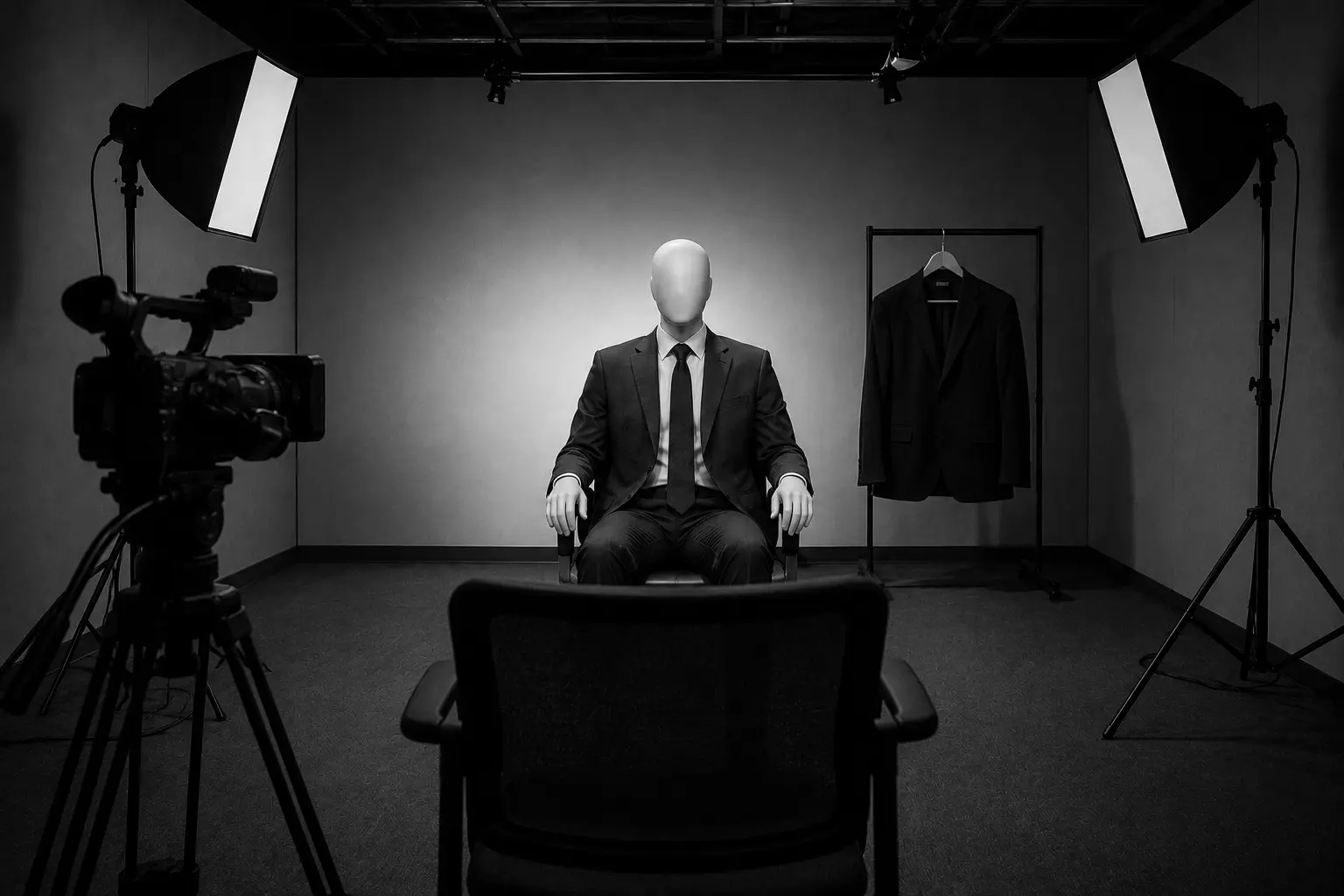
Synthesia has built a large business around synthetic video presenters, giving companies a way to produce training clips, announcements, and instructional material without cameras, studios, travel, or the repeated availability of a human speaker. The Economist's profile of the London unicorn points to the obvious attraction. Corporate video is expensive, slow, and often visually dead before anyone presses play. An avatar that can speak many languages and be revised by editing text solves a bureaucratic problem with brutal efficiency.
The cultural cost appears in the same gesture. A company that once staged authority through a manager, actor, or expert can now generate a face that carries the message without carrying a biography. This suits compliance training, product updates, and global HR, where the speaker is already half a template. It also narrows the distance between communication and ventriloquism. Synthesia's restrictions on political misuse acknowledge the danger, but ordinary corporate use is already a lesson in synthetic authority. The employee watches a face that never waited in the building, never took responsibility for the policy, and can be reissued tomorrow in another language with the same calm mouth.

AI data-center developers are building faster than confirmed demand can comfortably justify. Across the boom, companies are securing land, electricity, cooling systems, debt, and grid capacity on the assumption that language models will keep requiring larger rooms, larger power contracts, and larger financial patience. The risk is no longer hidden inside software. It stands in substations, concrete pads, transformer orders, water negotiations, and local hearings where towns weigh jobs against noise, heat, and pressure on the grid.
This is artificial intelligence as real estate before it is intelligence as software. The public sees chat windows and synthetic images; the balance sheet sees leases, megawatts, interest rates, and buildings that must remain useful even if the demand curve bends. If usage keeps rising, these sites will be treated as national infrastructure. If it slows, many will look like warehouses built for a prophecy that arrived late or elsewhere. The AI boom has produced a strange architectural type, the speculative machine room, financed on the belief that language models need somewhere enormous to keep answering small questions.

Alphabet's Gemini Enterprise is an attempt to make an AI system the front door to corporate software. The product matters less as another model release than as an interface claim. Google wants employees to reach mail, documents, calendars, code, data, search, cloud services, and third-party tools through a conversational layer that can retrieve, summarize, draft, and act. In that arrangement, the assistant becomes a reception desk placed in front of the company stack.
The ambition is familiar from every platform that has tried to own the first screen of work. Whoever controls the entry point can shape habits before the user reaches the underlying application. A spreadsheet, email thread, customer record, or policy document may remain where it was, but the route to it changes. Gemini Enterprise asks the worker to describe intention before choosing a tool, and that apparently small change gives Google a chance to reorganize attention around its own account system, permissions, connectors, and cloud. Corporate AI will not arrive as a dramatic replacement of software. It may arrive as a polite box at the top of the screen, asking what the employee wants to do next.
