Molly Bounds’ Panes: A Study in Motion opened on July 1st at the Museum of Contemporary Art in Denver, CO. I landed in Denver at nine o’clock on the morning of Tuesday the sixteenth of August, having flown overnight from Portland. It was my second visit to Denver and the latter of two visits with Bounds who I’ve known tangentially through various conferences, projects, and print-centric social media outlets over the past half decade. She met me at Union Station and treated me graciously to a visit, which left me deeply impressed and also very thankful. I’ve long admired her work, however mostly from afar, and inasmuch as I’ve known her, there is certainly a difference of degrees in appreciation and knowledge when both become rooted in the immediate and tangible experience of artwork. Tangibility and ownership are important for Bounds’ work, and these aspects for me came as a welcomed subtlety. I’ll explain why further along.
Bounds’ is well known, and respected in the Denver art scene. As she lead me around the city during my layover between Portland and San Antonio I was introduced to a cavalcade of artists, business owners and other creatively involved individuals all of whom greeted Bounds’ with some sort of congratulatory effect as it would appear her star is rising, having recently been accepted into the Redline Residency Program. Recently she has painted several murals in Denver, and as I left Portland she was going there to paint another mural at Disjecta, while the most recent Denver mural had yet to receive her signature. She insists however, that she is not a “mural artist.” I would agree, hers is a purport multifarious in distinctions of media, subject, and style. Her creative brand, if I dare employ a word so constricting, is hungry, eager, well read, and patiently evolving. It would be easy to call Bounds’ an emerging artist, however I do not think it would do her credit. Instead I think I will say that Bounds’ is on the run, traveling circles around herself excitedly, chasing after her influences, hearing and understanding their rhythms; she is chopping and screwing their mana into fleet footed visual frenzy that is remarkably poised and succinct given the stuffed well from which she draws the waters of creative shimmer.
She is resourceful and very much leads the life of a dedicated artist. For instance when she picked me up Bounds’ car was full of paint cans and mural materials. She was also toting around a small collection of funny hats, which had been given to her while she’d been painting. There weren’t enough hats for vending but certainly to furnish a small outfit of friends with similar goals. She thought maybe they could shield her from the sun; apparently they weren’t good at that. We got to the museum before it opened and ended up having to wait. After weaseling some free water from a taco joint, thirst quenched, I was lead into the basement of the MCA to find one of the most enjoyable exhibitions I’ve seen in quite a long time. As someone who has been in close proximity to the art market my entire life, and then professionally involved for the past eight years, I have developed a taste for almost everything. I can generally find for myself a point of entry and some means of exploring and enjoying another person’s headspace even if the inside is gross.
Perhaps it is because Bounds is similarly invested in DIY dogma (or lack thereof), or because we read some of the same comics, or because we are both into printmaking, and have an appreciation for lo-fi culture, it’s definitely a little bit of all of those things; yet the moment I walked into the space I felt the presence of annunciation, concision and fresh air. It wasn’t necessarily what I was expecting. Having seen the show, I don’t think I could’ve anticipated what I had before me, despite my dedicated reading of Bounds’ work up and to this point.
The first time I met Molly she gave me her self published comic First Timer, and since then, nearly six years ago, I’ve watched her lyrical style traverse so many different media with poised voicing, graphic strength, and a formidable perspective that is absolutely feminine but not necessarily Feminist. This tone of speaking from and not for is the vocal quality for which I will always remember the experience of seeing this exhibition. From this posturing Bounds’ achieves something importantly resonant in this day and age of trolling and blame shaming.
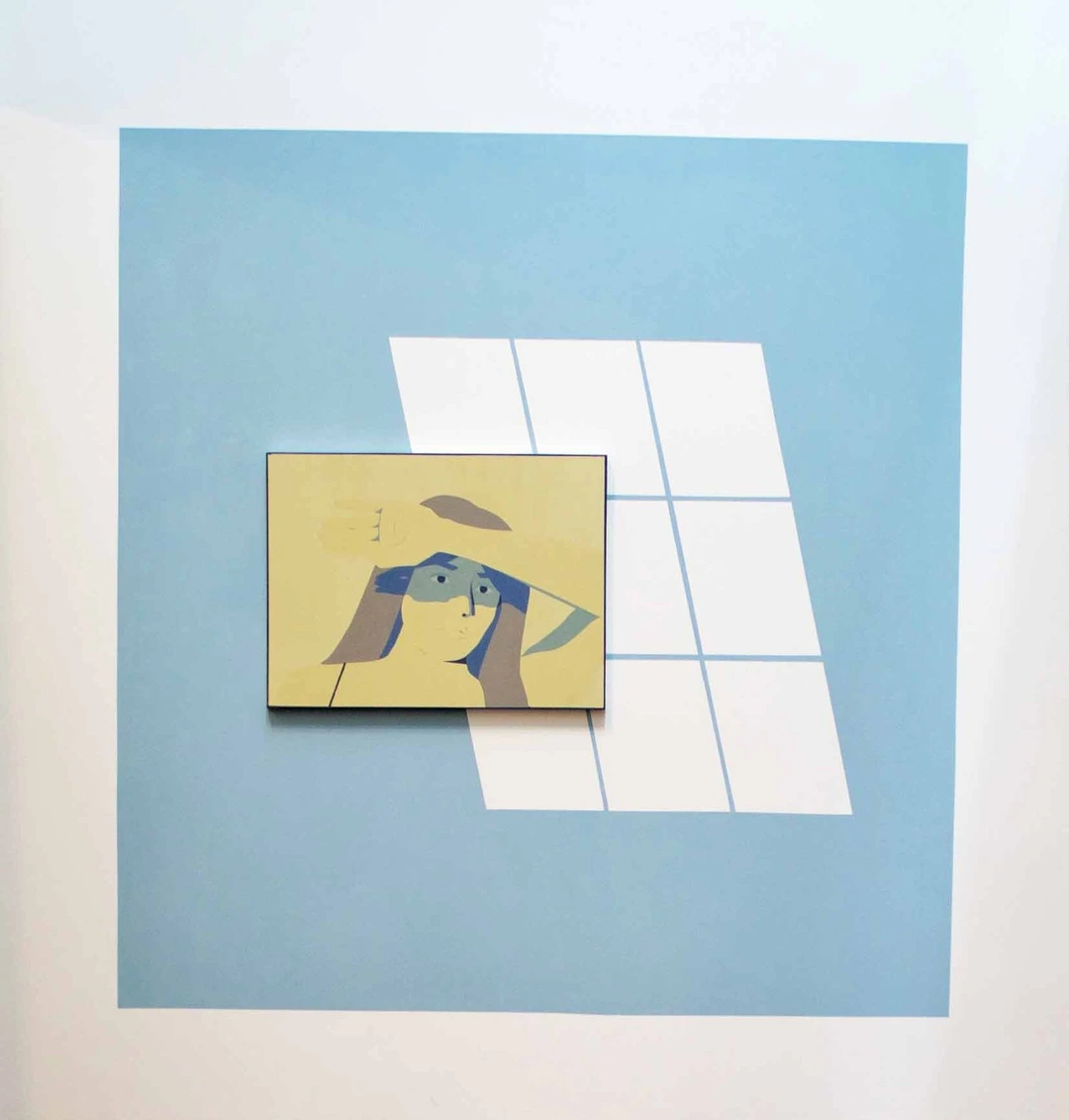
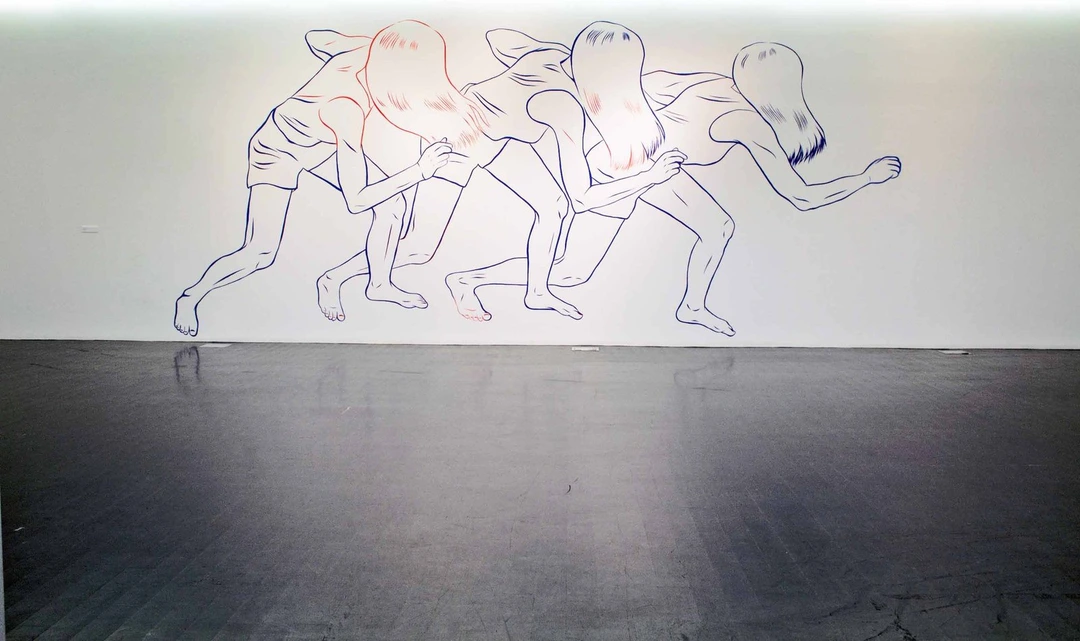
The exhibit is composed of three large wall drawings depicting female bodies in sequenced motion, sort of frame by frame. Both whole bodies and more detailed limb specific movements are attentively explained with quiet momentum. Their titling is indicative of great intention and thoughtfulness as it should be. These larger drawings in red and blue, which stand about fifteen feet high or more, are conservatively curtailed with sections of shadow painted on in large swathes of pale blue and gold. In these sections areas are left white to suggest light shining through a windowpane. The swathes of color, which traverse areas of wall meeting floor or ceiling, are hung with two paintings. One painting depicts a seated female figure in profile, cropped about the waist, she is backed by the profile of a male figure, his hand on her shoulder, we can only see the portion of his body descending from mid bicep to just above the knee. The painting features an array of shadows and the figures are painted in flat values of blue and grey that are placid and simultaneously punchy. The other painting features a female figure straight on from shoulders up, her hand raised to shield her eyes from light, which again is casting shadows. This painting is interestingly hung below the museum’s staircase, which ascends to the rooftop and is framed with a skylight. At around 1pm the sun’s light enters the space providing the painting with a reaction that is alive for a small time. I gathered that Bounds’ was especially pleased by this, and rightfully so. The paintings are formally derived of Bounds’ approach to screen-printing, which relies on colors printed in flat layers. This intersection of media reflects Bounds’ current studio situation, which is limited by an inability to easily support a printing operation. The third swath of color is without a painting, which makes poignant allusion to the message.