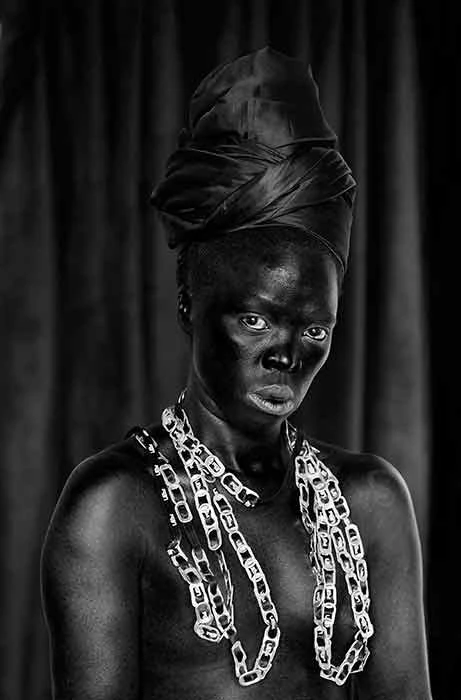
Cincinnati’s National Underground Railroad Freedom Center brings the history of US slavery into conversation with human rights abuses across varied national and cultural contexts. From October 1, 2016 to January 23, 2017, the museum hosts an exhibition of works by Zanele Muholi, a Johannesburg-based photographer who mounts stirring condemnations of violence against Lesbian, Gay, Bisexual, Trans, and Intersex (LGBTI) people in South Africa, as well as the racist labor relations that trouble her home country. Her show “Zanele Muholi: Personae” blends the LGBTI documentary project “Faces and Phases” with “Somnyama Ngonyama,” a series of self-portraits centering on family, resistance to the body-scripts imposed on black women, and the politics of work. A self-identified visual activist, she makes her arguments through gelatin silver prints, which affirm her dedication to justice and her unflagging technical rigor. Muholi’s civic artistry helped initiate the Forum for Empowerment of Women (FEW) in 2002, and later sparked Inkanyiso, an international venue for queer media. While keeping a remarkable schedule of showings, she remains a visible participant in social movement discourse while also making time to hold photography workshops for South African women (“Zanele,” Stevenson). “Personae” affords Freedom Center visitors an intimate glimpse of her catalogue, which not only challenges persistent forms of social division in South Africa but refuses distinctions between documentary and advocacy
That refusal fits her corpus especially well to the theme of the 2016 Fotofocus festival, “Photography, the Undocument.” The festival takes a nuanced approach to the photo as a historical document, “questioning its claims to objectivity and observing its tendency toward subtle fantasy” (Fotofocus). Muholi reproduces numerous tendencies traditionally associated with documentary, including the effort to record lived experience for coming generations and thus guard certain populations against historical effacement. Such efforts code the photograph as a testament to being and a contribution to archival memory. But in focusing on a population that experiences not only the danger of historical diminishment but an immediate, deadly threat from its antagonists, Muholi insists on the continuity of documentary with partisan discourse and collective action. In one way, her images exemplify the “undocument” by disturbing the genre’s purported “claim to objectivity”; in another way, they question whether that claim ever held legitimacy, and whether the negative prefix in the undocument entails a certain redundancy. She indulges in fantasies both subtle and extravagant while never shedding the mantle of documentarian.
As she embraces that title, Muholi rejects the luxury of distance. In an interview with Vuyiswa Xekatwane, she explains that
I haven’t been documenting the LGBTI community as an observer, I document it as a member of the community […] I speak, produce and document these visuals so that those who exist today and will be born tomorrow can have access to a factual visual history of the South African LGBTI black community.
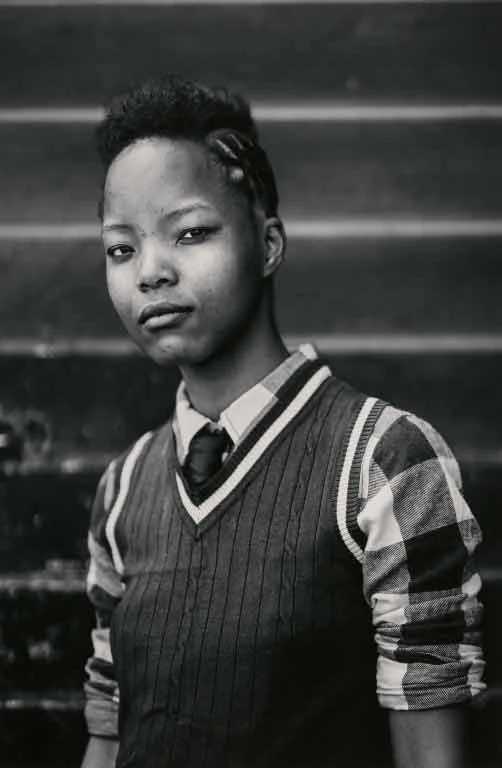
As visitors enter the “Personae” exhibit, they first encounter a selection of pieces from “Faces and Phases,” a project she began in 2006. That project concentrates on LGBTI identities, gathering serene black-and-white portraits of Muholi’s friends or people for whom she feels political affinity. Although the portraits sometimes exist in pairs, and sometimes in grids of as many as twenty-seven images, they generally situate the evolving self within a coordinated social sphere. Violence permeates that sphere, though the subjects of the portraits face it with solemn composure and even defiance. The violence includes a history of “corrective rape” wherein perpetrators attempt to enforce gender norms by brutalizing nonconforming subjects (“Zanele,” Artsy; Hunter-Gault; Wortham). The singular photos exhibit a kind of placidity, yet in combination they pose a determined challenge to sexual hegemony. Muholi features the same people in multiple photographs, the variations in their attire and hairstyles spurning the gender codes their assailants attempt to mandate. With such techniques, she not only bears witness to LGBTI community but also works to build and strengthen it.
She began recording oral narratives of violence in the early 2000s while also taking pictures that would speed the initiation of “Faces and Phases.” The interviews occurred against a contradictory backdrop, given that South Africa’s Bill of Rights pioneered the explicit prohibition of sexuality-based discrimination, and yet the kidnapping, rape, and murder of LGBTI people remain all too common occurrences even today. Charlayne Hunter-Gault contends that despite the Mandela government’s defense of human rights, multiple rapes occurred every minute in 2009 South Africa, and lesbians still undergo violation twice as often as their heterosexual counterparts. Many victims fear going to the police, so that “the number of sexual offenses that occur in a given year is nine times as high as the number reported” (Hunter-Gault). The subjects of Muholi’s portraits often have distinctively harrowing stories to tell, but her evocation of a growing visual community also signals solidarity with those who have not yet broken silence. It signals a project that is still gaining traction, and one Muholi foresees continuing throughout her career.
That career involves bringing a social movement ethic into the space of the gallery. Rebuking forms of cultural and economic elitism that sometimes permeate gallery culture, she sees the museum as a place of dissidence. “Fine artists deal with finery,” she tells BBC’s Bidisha,
but I deal with painful material […] Looking at where we’re at right now in the struggle [against homophobic violence], there’s nothing to laugh at, there’s nothing to enjoy except when one is intimate with her lover. I ask my sitters to think about the situation, think about being black, being a lesbian, being a woman.
While partly revealing the impetus for those sitters’ contemplative expressions, she challenges viewers not to divorce the beauty from the suffering, not to extract the person from the social milieu. When Bidisha questions whether the showing constitutes a bourgeois appropriation of her efforts, Muholi insists on the images’ potential to transform the audience: “Showing [my work here] is political. Especially in this space. The very same kind of posh people who come here are the unconverted who should see this work.” She then layers her reflection on audience politics with attention to apartheid in the South African art world: “Black people, people of colour were excluded from these kinds of spaces for years. So now we’re here and we’re showing the way for other artists” (Bidisha). Her photos thus work to thwart many visitors’ interpretive assumptions, as well as the hateful traditions that inform those assumptions, while also inspiring those who share her passions to visualize new creative pathways.