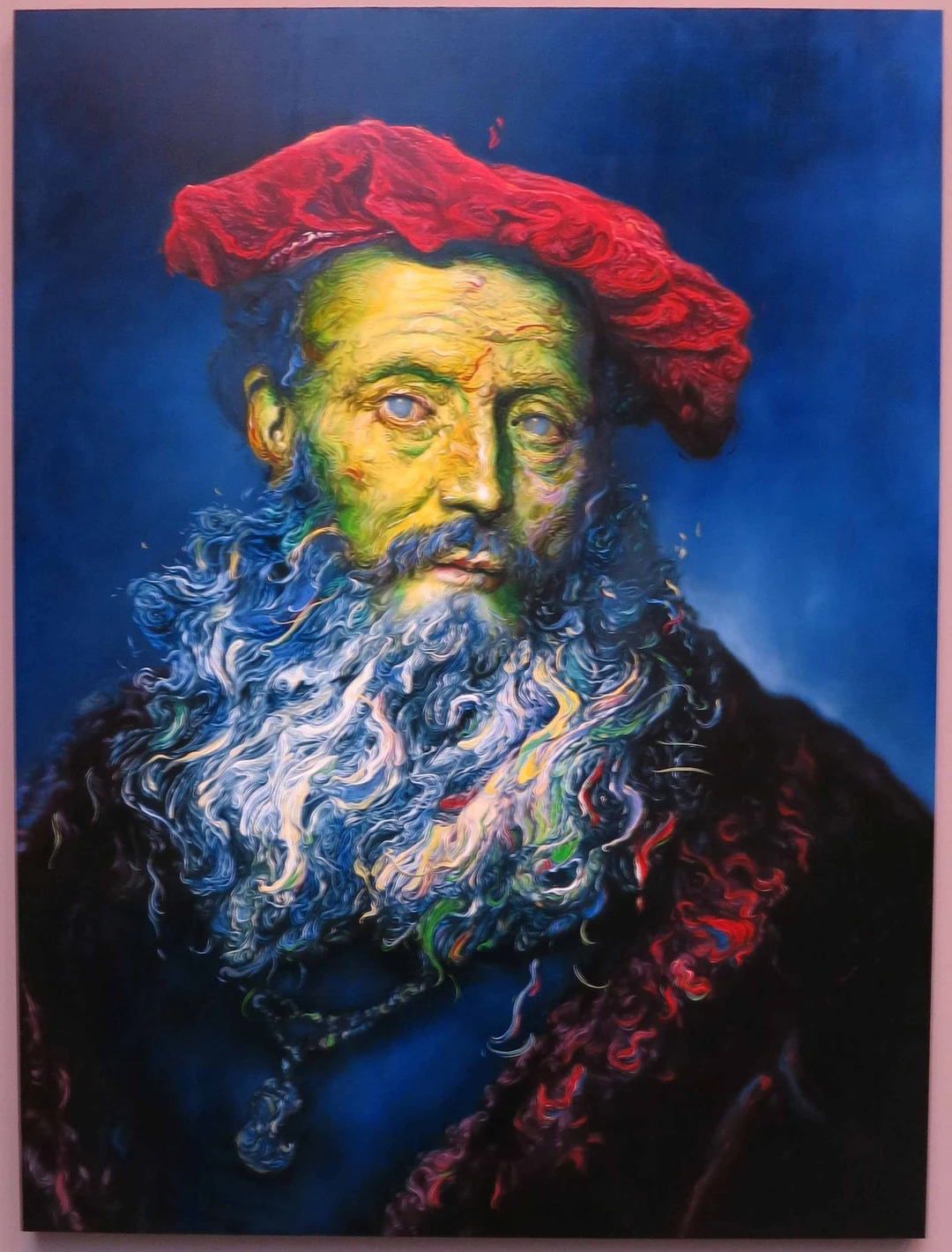
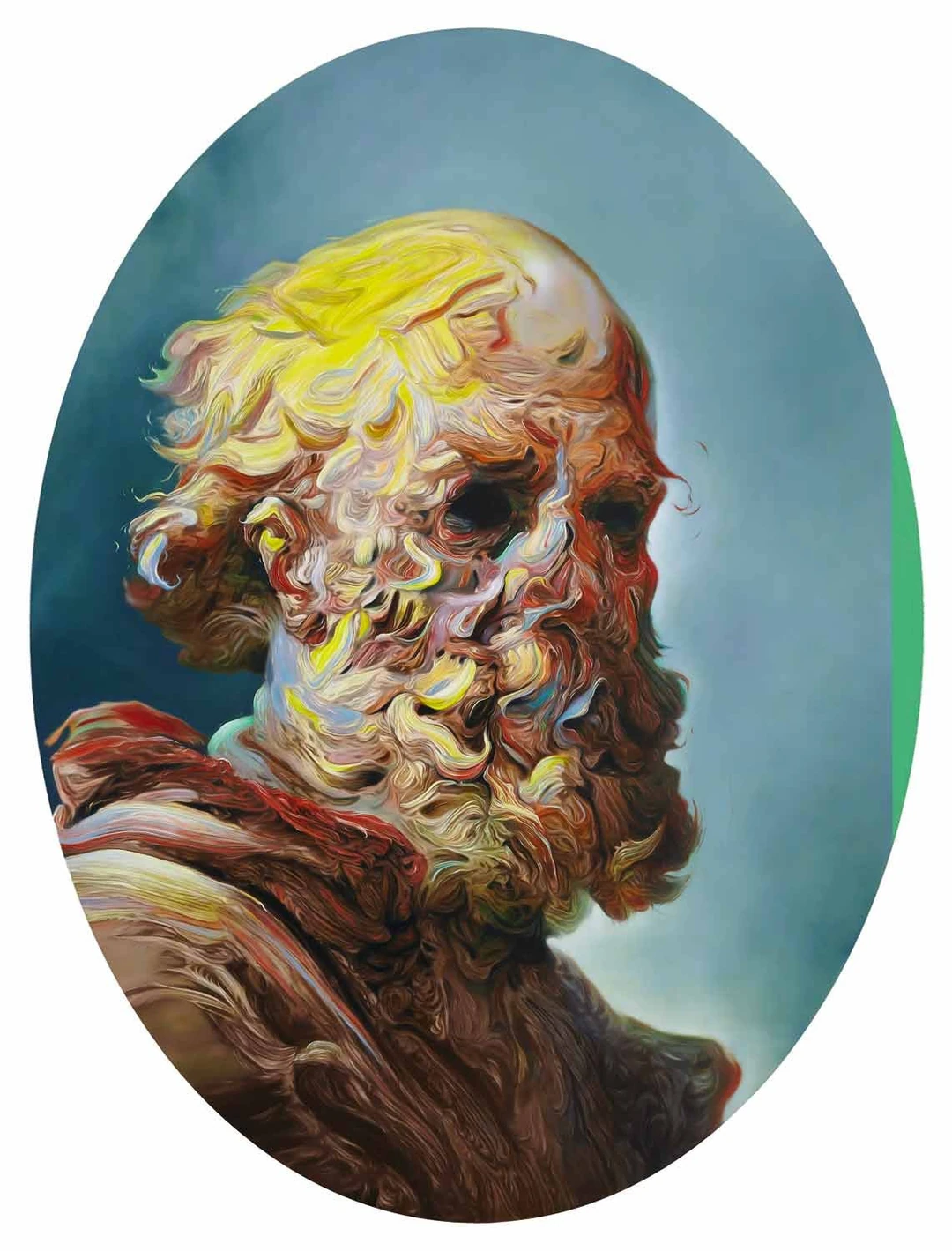
Glenn Brown “Reproduction” 2014.
I have been aware of the work of artist Glenn Brown ever since he was first introduced in the 1990s as a loose member of the British YBA group. The artists’ paintings have changed minimally over time, Brown has found great success to the tune of auction prices into the millions of dollars. In Britain, Brown is considered something of a unicorn, a conceptually motivated artist who is absolutely committed to the practice of painting.
Glenn Brown Is on view at the Contemporary Arts Center through January 15. The exhibition is a generous survey of many paintings as well as as a handful of sculptures, drawings, and even a recent suite of etchings. This show represents Brown’s first US Museum survey.
One can easily make a list of the virtues of Brown’s painting practice. Brown is a meticulous craftsman in a time when provisional or quick approaches to painting are popular. The artist clearly loves the history of art, his own works reference any number of canonical or historical sources. He is seriously invested in the fertile relationship between painting and the reproduced image. He is enormously ambitious, his paintings stretch across the traditional genres of still life portrait and landscape. Furthermore, Brown is a champion of painting, wanting his works to stand alongside great works from history. Perhaps most importantly, he is instantly recognizable. His spooky writhing surfaces and acidic color are unmistakable.
Yet, standing in front of Brown’s work, quietly with no-one else around, which I did on three separate visits, is not just underwhelming-it is virtually boring.
Glenn Brown “The Shallow End” 2011.
The problem is in the paintings themselves. They are flat-footed literal affairs, with little room for mystery or interest. The ideas are transparent and the execution is painfully programmatic. For an artist seemingly engaged with history and paint, these are dreary results.
For art objects to work there must be a transformation when the parts become the sum. Brown is essentially a conceptual artist engaged with the reproduction of art historical images recast as living dead- the death of painting treated like a joke, a morbid sense of humor taken seriously. Brown embraces paradox in his paintings, optically active surfaces, created by accumulating small string like marks are rendered super flat, so that the surface of the painting itself is as level as a poured concrete floor. This literal “surfacing” of his historical sources reads more like cgi than material investment.
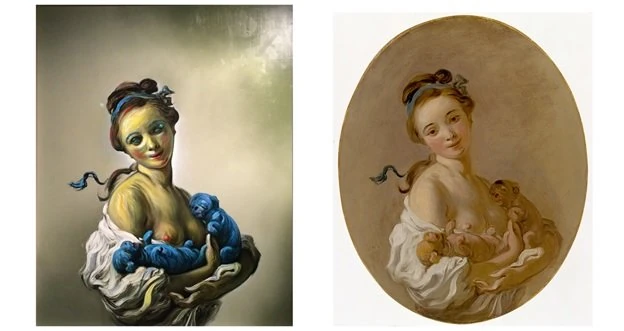
Take Stardust, 2009 for example. The work is based on Young Girl Holding Two Puppies by the French painter Jean-Honore Fragonard.
Glenn Brown “Stardust” and Fragonard “Young Girl with Two Puppies.”
Brown reproduces the image faithfully, then turns up the volume. The color becomes painfully clear and nameable, the contrast gets juiced, and the surface appearance takes on Brown’s signature shiver. The fact that the most recognizable aspects of the painting referenced have been cribbed whole cloth gives the work an “important by association” quality. Brown reminds the viewer of an old master, thereby creating a relationship of shallow scholarship with the history of painting. The public should question an artist whose work hinges on a single technical gimmick and an idea that is self evident.
I will admit that I have an exceptionally biased read on Brown’s work, I believe painting to be a serious endeavor, so I am obligated to to have a strong opinion. I have respect for Glenn Brown the craftsman. Appreciation of Brown’s work is expected, and those viewers who hold summer blockbusters and mass produced popular music in high esteem will be especially enamored.