
I first encountered Katie Swartz’s work in “All the Usual Suspects” at Thompson House Shooting Gallery (see aeqai.com, July 2012). She showed three crocheted animals: “Bartholomew,” 2010, an 11” tall, cuddly bear, and two friendly octopi: “Mario,” 11” tall, and “Myron,” 9” tall, both 2011.
In that review, I placed her work in the context of the DIY – do-it-yourself – aesthetic/culture. To define that simply, it is the interest of specifically Gen X’ers (born between 1965 and 1982) in making things for themselves in the craft hobbyist tradition. They do not consider themselves fine artists.
Still this aesthetic has been adopted by self-identified artists with the ironic intention of making fine art – thank you, Marcel Duchamp. So Swartz’s cuddly crocheted creatures ended up on a gallery wall, not Brianna’s bed.
I think another way to look at this hobbyist aesthetic is as a post-9/11 cultural development. The traditional crafts became the visual equivalent of comfort food. After meatloaf and mashed potatoes, thousands settled down with knitting needles and crochet hooks.
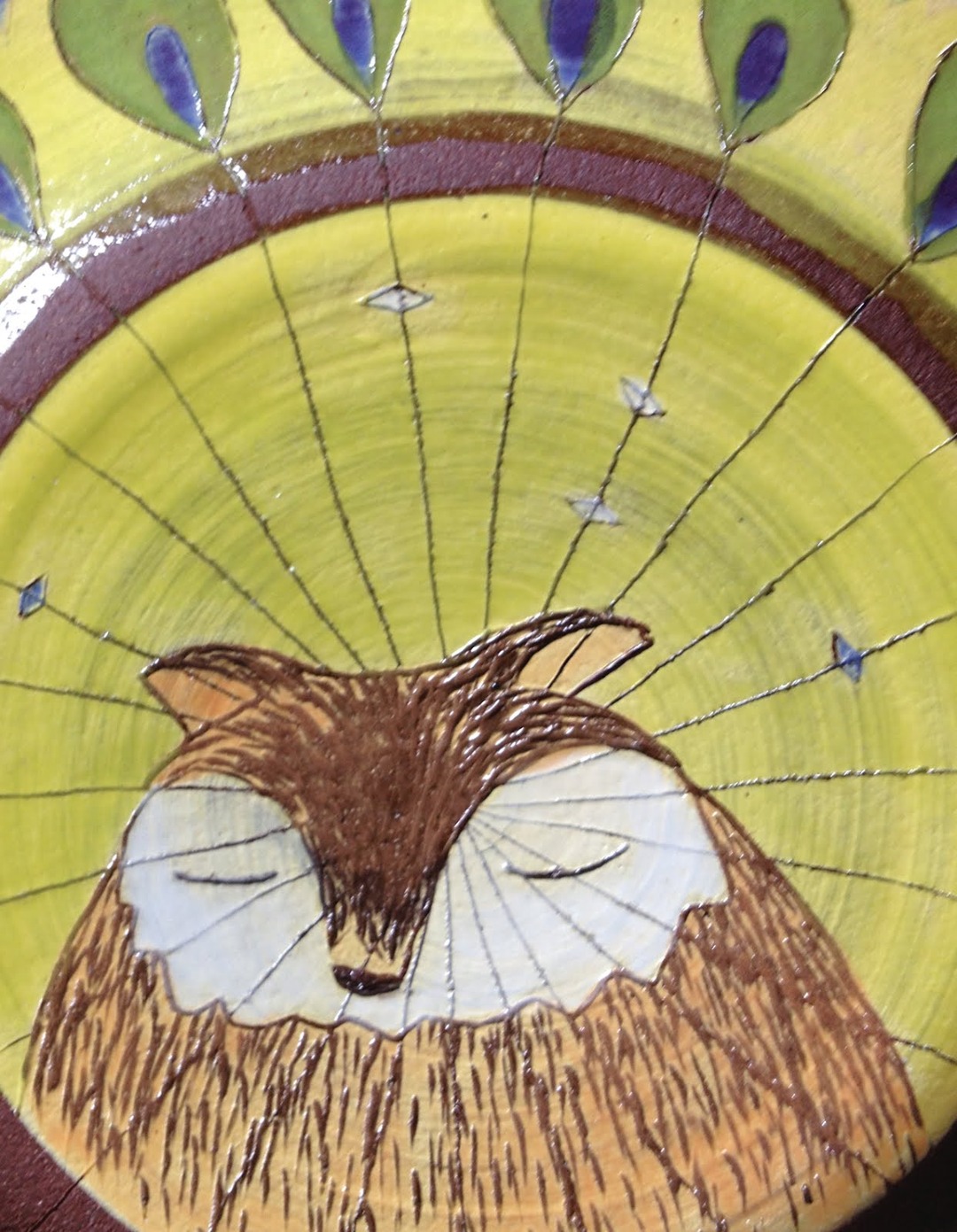
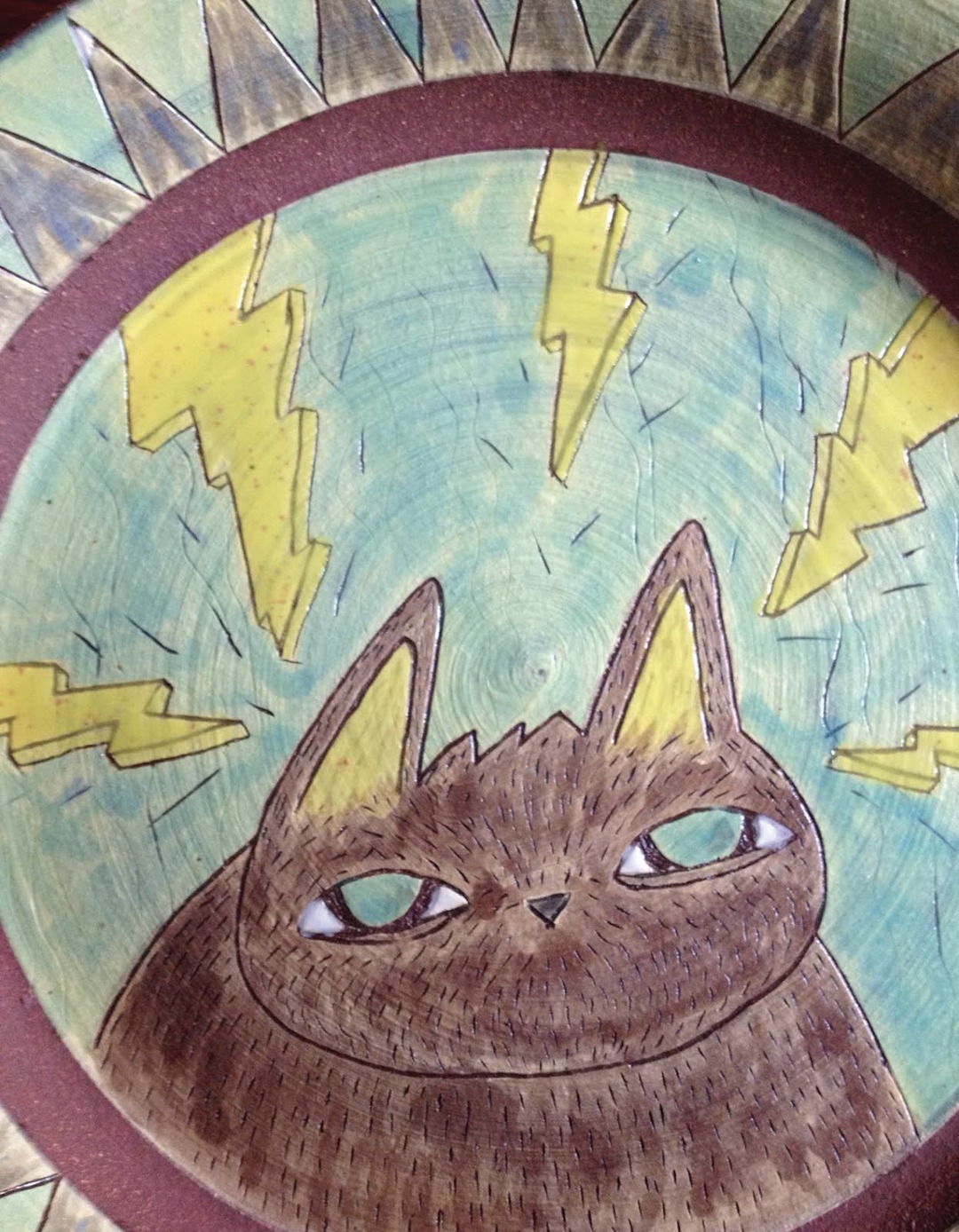
But in Swartz’s “be easy” exhibition of ceramic pieces at 1305 Gallery, instead of DIY, I saw them somewhat differently. Her plates, bowls, mugs, and plaques do look like a hobbyist might have made them, maybe even in a “paint-it-yourself” shop like Our Name Is Mud. That’s the kind of place you where might hold your 10-year old’s birthday party and have them paint on ceramic blanks. Voilà – they’re china painters, and what they’ve made is a decorative art object.
And it is in the context of the decorative arts that I understand Swartz’s work in clay. To my mind decorative art objects are functional (I think even objects like figurines do have a purpose – to please the eye) and are made of the traditional craft materials. So you have glassware, metal hinges, table linens, furniture, and china. I see Swartz’s ceramics as decorative art, knowing full well that the decorative arts do not command the same prestige – or price – as “fine arts.”
For example, a c. 1900 Limoges tea service of 23 pieces is priced at $800 but Cindy Sherman’s “Madame de Pompadour” Tea Service of 21 pieces is $7,000 on the Gagosian Gallery website. Swartz’s prices go from $30 or so dollars to about $150 for a large bowl, definitely in the dec arts range. But when she decorates a piece with a character like “francis fox,” her intent is the same as Sherman’s with “Madame de Pompadour”: both are portraits decorating usable forms that probably won’t be used.
Swartz’s ceramic pieces are all food safe, and thus usable, and decorated to please the eye. At 1305 Gallery, most are handsomely displayed on the gallery’s rough wooden walls, like collectible china has often been.
Swartz is a 21st-century china painter. She carries on a rich Cincinnati tradition of the genteel art, most famously exemplified by the hobbyist china painter Maria Longworth Nichols Storer. She established Rookwood Pottery in 1880 to sell her own decorated wares. Just an aside, like the customers of My Name Is Mud, she also painted on ceramic blanks.
Swartz is a skilled potter having done her undergraduate work at the University of Cincinnati in ceramics, and she has sold her functional ceramics at craft fairs.
In the pieces at 1305, Swartz uses a naïve drawing style to incise simple line drawings of people and animals — soulful bears, wise cats, slithering snakes — on her forms. Her characters could have stepped out of a children’s book. She then paints them with glazes and colored clay slips (essentially liquefied clay) in a palette of what I can only describe as “pleasant” colors: chartreuse-y greens, bluish grays, buttery yellows, and the aqua of the Mediterranean.











Comments powered by Talkyard.