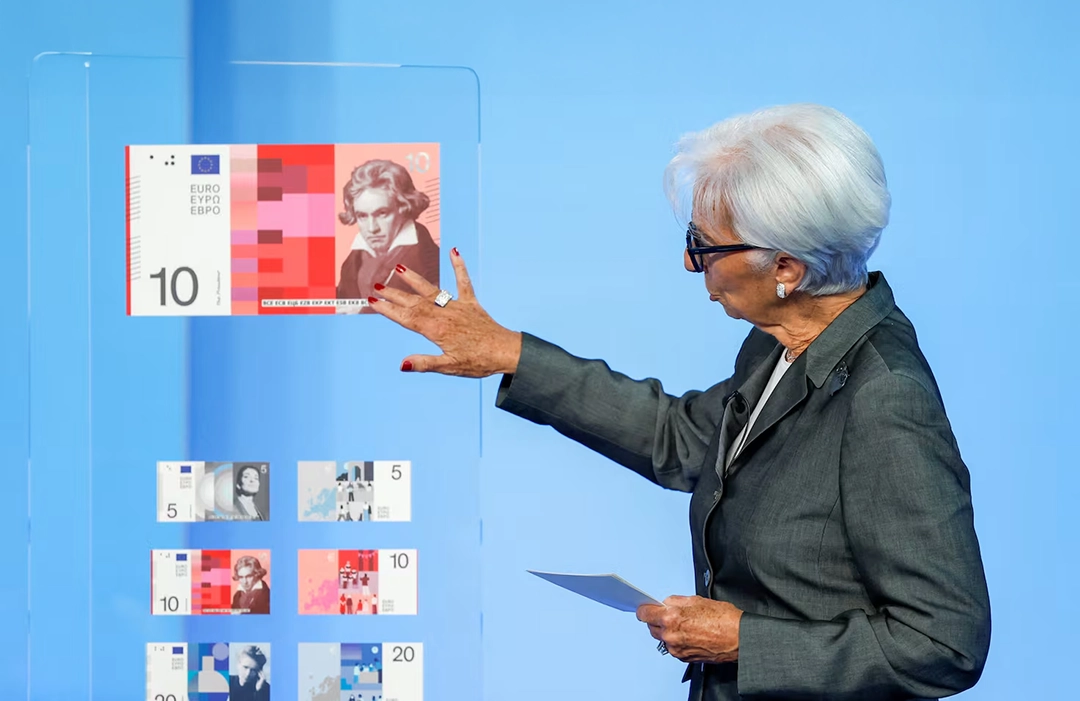
Christine Lagarde, President of the European Central Bank, presents one of the ten finalist proposals for the future euro banknotes during the launch of the public consultation. She was not a member of the design jury but chairs the ECB’s Governing Council, which is expected to select the final design by the end of 2026.
Designing the banknotes destined to circulate throughout a monetary area such as Europe is among the most prestigious and consequential commissions a professional or design studio can receive. Creating an image to be shared by millions of people, condensing an identity into visual form, and meeting complex demands of legibility, security, symbolism, and instant recognition constitute a task at which even a demigod like Hercules might have failed. A successful solution, by contrast, can inscribe its creators in the global history of design, travel for years through millions of pockets, and eventually become part of the visual memory of entire generations.
Although we tend to regard them simply as instruments of payment, banknotes are also small graphic manifestos that condense an idea of nation, history, and identity.
Designing the first euro banknotes was especially difficult given the circumstances of the time. When the common currency entered circulation on January 1, 2002, the challenge lay in representing a Europe composed of countries with different traditions, heroes, and cultural legacies. The chosen solution avoided any specific national reference. Austrian designer Robert Kalina conceived a series based on windows, doorways, and bridges drawn from successive European architectural styles, from the Romanesque to contemporary architecture. None of those monuments actually existed. They were imaginary structures intended to symbolize openness, dialogue, and connection among Europe’s peoples, without granting the history of any one state precedence over another.
More than two decades later, the European Central Bank believes the time has come for a second renaissance. As with every major currency in the world, the redesign responds first to technical concerns. New security systems must be incorporated, counterfeiting must become economically pointless, and advances in printing and authentication must be put to use.
There is another reason, considerable though oblique. Over the intervening years, the accumulated sediments of the collective spirit have begun to demand images that feel closer, more inclusive, and more attuned to the way ordinary Europeans now understand themselves.
A public consultation was held in 2021, while groups of experts began studying the stories that the future banknotes should tell new generations. Two themes emerged. The first displays culture, the continent’s most formidable weapon, through some of its most influential figures in music, science, literature, and the arts. The second, unexpected to me, unfolds through Europe’s natural world, its rivers and birds. With considerable justice, it abandons an emphatically anthropocentric vision and directs some attention toward what grows and exists without human intervention. Biodiversity, landscapes crossing national borders, and the metaphor of a connected, diverse, and resilient Europe. Resilient, naturally. How could one forget the most overworked adjective in today’s realm of the spirit?
In July 2025, the European Central Bank invited graphic designers based throughout the European Union to apply. More than 1,200 professionals submitted their candidacies. Following an initial selection, twenty-five were invited to develop complete proposals for one or both themes. An independent jury composed of specialists in graphic design, communication, history, and neuroscience eventually reduced the competition to ten projects.
A year passed. On July 23, 2026, the ECB unveiled the ten finalist series and, perhaps to distribute responsibility in advance for a hypothetical disaster, invited European citizens to choose their preferred design. They have until September 21 to make their selection. No one should be surprised later if the popular will fails to produce a masterpiece.
At the same time, an independent company will conduct a statistically representative survey among residents of the euro area. The Governing Council of the European Central Bank will select the final proposal before the end of the year. January will not suddenly bring brightly colored banknotes and audacious new designs. Several years of technical development and testing will be required before they enter circulation. The current banknotes will remain valid and circulate alongside the new series for a period yet to be determined, until some important office announces that their time is up.
Pablo Hernández de Cos, a Spanish economist and General Manager of the Bank for International Settlements, chaired the independent jury responsible for evaluating the proposals and selecting the ten finalist designs. Its assessment, together with the public consultation, will inform the Governing Council of the European Central Bank when it chooses the future series of euro banknotes.
The ten proposals offer an uncommon opportunity to observe how some of Europe’s finest designers imagine the continent’s visual representation. Whatever the final choice, every project confronts the same question. Can these images represent a modern Europe? Security and printing recede into the background. At stake are the symbols that will accompany, for decades, the continent’s most widely seen and reproduced object of design.
That this is a fascinating and beautiful undertaking is clear enough. The harder question concerns the wisdom of embarking on such a monumental enterprise, redesigning an entire system of paper currency at a moment when physical money is losing ground to cards, e-wallets, and every other form of electronic commerce. Is this redesign an answer to a question some people have asked in a whisper? Is this exercise in graphic renewal truly necessary?
No items found.
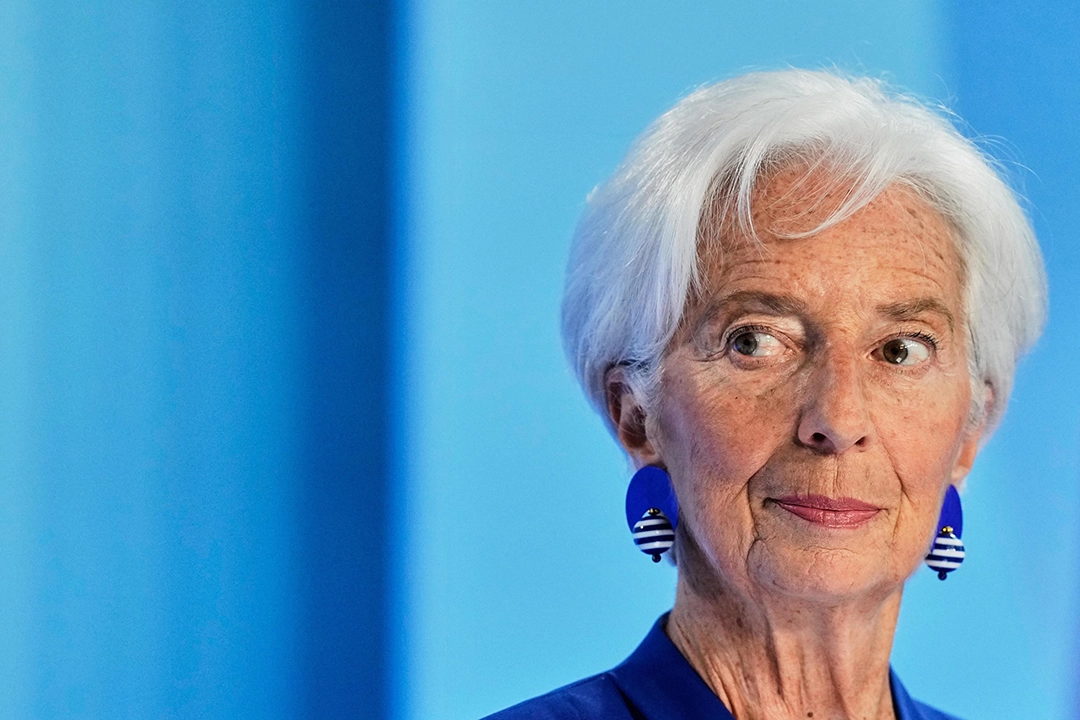
des\_4. Caption: Christine Lagarde, a French lawyer and politician, has served as President of the European Central Bank since 2019. She previously held the positions of Managing Director of the International Monetary Fund and France’s Minister of Economy and Finance, a career that has made her one of the most influential figures in international economic policy.
Perhaps the ECB’s leadership sees farther ahead. In a hyper-digitalized world, material objects may acquire greater symbolic weight. Governments now possess fewer sensory and tangible proofs of their omnipotent presence. Perhaps they still understand the pleasure of running one’s fingers across the textured surface of a high-denomination banknote. It functions as a calling card, a reminder, a warning that crosses every social class and every generation, reaching every corner of the community. Nothing rivals paper money in reach and presence.
Let us take the opportunity to remember a beloved soldier who fell in battle against time. The postage stamp. Throughout much of the nineteenth and twentieth centuries, stamps served as national heralds. Within a tiny surface, they certified the treasures of the nation. Its immortal heroes—perfectly dead—its monuments, historical events, landscapes, little animals, and even its dispirited artists. They became major instruments of modern visual pedagogy. They circulated profusely, became objects of collection, and in certain cases rose in value from a few cents to millions. Banknotes inherited part of that responsibility. Their mass circulation amplified whatever the country had decided to sacralize. Far more sophisticated than postage stamps, they had to integrate design, imagery, typography, and printing with countless security devices, all within a single surface.
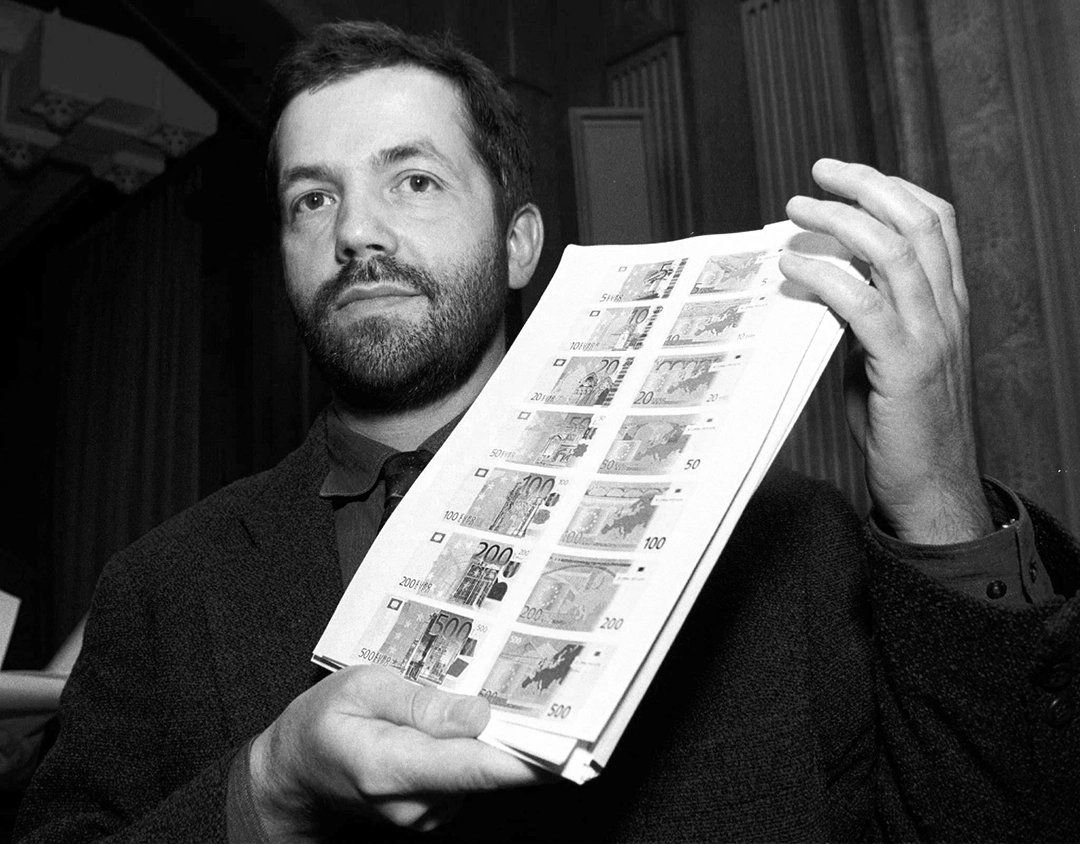
des\_5. Caption: Robert Kalina, designer of the first series of euro banknotes and the final issues of the Austrian schilling. His presence carries an almost historic significance: the creator of the euro’s original visual identity has now taken part in selecting its possible successors.
In the next article—perhaps in more than one, given the number of images—you will see how Europe wishes to picture itself over the next twenty or thirty years. Decision-makers will discard some symbols and embrace others. Their vision of Europe’s past and history will be redirected toward new readings. Above all, they will exalt the values they wish to offer the social body. In this sense, banknotes constitute a cultural declaration.
In any case, the project is an immense logistical, artistic, and design adventure. The money hidden inside our cards can buy things and little else. It builds no visual memory. Banknotes will be touched, seen, and recognized every day. Few objects whose symbolic charge exceeds their practical function can aspire to such a presence in everyday life. Putting them into a wallet is delightful. Taking them out, less so. We will look at them briefly in the next article.











Comments powered by Talkyard.