
By: Kevin Muente
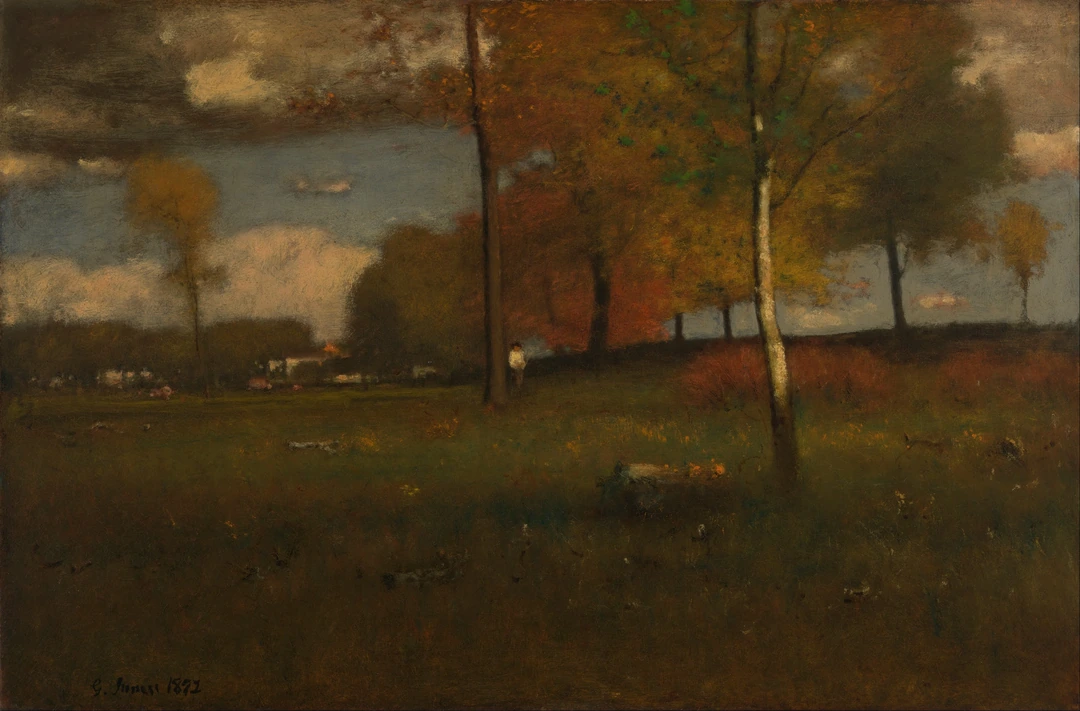
I stand before George Inness’s Near the Village, October on the last hot day of June and long for fall. This medium size painting, 30 x 45 inches, seems larger to me. Perhaps its stately frame makes it feel more formidable. Near the center of the painting in the middle ground we see the suggestion of a man in a white shirt leaning against a tree. The foreground that reaches to the middle of the painting is non-descript, with brushwork that is soft and hazy. There are no blades of grass, but instead we navigate through tonal gradients of warm browns and greens. Inness handles the trees in a similar manner, soft as cotton candy, ethereal. The fall foliage, yellow ochres, golden yellows, and Indian reds adorn the upper half of the painting and comfort the sleepy village in the background. The clouds float on, sweeping through the space and merging easily into the tree shapes as if in Inness’s world trees and clouds are brothers.
This painting keeps me busy. I admire how Inness weaves the formal elements together in this late work (The artist dies two years later). Tonal shapes read harmoniously throughout. Grass plains flow and mysteriously turn into a stand of trees. Buildings in the village Inness handled in a similar fashion to an overturned log in the foreground. The trees taunt their color to the clouds, but otherwise share the same DNA, identical in size and shape as well as retaining the softness of their edges. The tree trunks divide and subdivide the picture plane in interesting variations. A lone tree illuminated by light on the right hand side resides at equal distances to the furthest yellow tree to the right and the tree against which our mysterious man leans in the middle of the painting. The number of size and distance relationships I find continues. Inness’s formal construction of this painting is masterful. Turn the crown of a tree horizontal and, voila, you now have a cloud! On the far left side a swatch of sky, cloud bank and stand of trees are all about the same height, and completely interchangeable. Every time I look at this painting , I find more formal associations. I urge you to try to find your own, just remember not to touch the painting.
Inness depicted this living breathing landscape, in slow motion as if in a dream. Some of the tree forms or clouds resemble the dawdling, mesmerizing shapes found in a lava lamp, and are just as hypnotizing. The soothing blurred edges, uncanny timing, and rhythm put us under Inness’s spell. Reality is not as it seems here. Nothing is definite, only suggested. Individual leaves and blades of grass are non- existent, yet Inness evokes the true sensation of trudging through fields or following the falling leaves as they blow in the wind.
Our mystery man lingers for us to greet him, but there’s something not right about him. In some ways he seems more like a spirit in the way he emerges from a green field of color any chance of grounding him held in the whimsical brushwork of feathery strokes. This landscape questions the integrity of forms and appearances perhaps delving into spiritual interpretations of the metaphysical. The sense of place is found not through concrete detailed specifics as some of Inness’ Hudson River School peers sought, but through the veil of memory.










Comments powered by Talkyard.