

Alice F. and Harris K. Weston Art Gallery through March 22
Nellie Taft was a hometown girl, born in 1937 in Indian Hill and died in 2012 in Boston. She attended Lotspeich and Hillsdale Schools in Cincinnati, which answers the burning question among natives: Where did you go to high school? She finished her high school education at St. Timothy’s School in Baltimore.
Nellie (I’ll explain using such a familiar way to refer to her in a bit) was the great-great grand niece of William Howard Taft and had connections to William Henry Harrison. She was also a member of the Taft Broadcasting Company family. Ca-ching. Lineage counts in the Queen City.1
Befitting her social standing and her financial resources, not to mention her artistic leanings2, of course, she served on the national committee at the Whitney Museum of American Art from 1993 until her death in 2012. Chairwoman Flora Whitney Biddle, granddaughter of the Museum’s founder described her in a Boston obituary as “both a lover and creator of art. Spirited, talented, and fun to be with – we all treasured her involvement.”
Carrie Blackmore Smith in “Lives Remembered” in The Enquirer, wrote, “Described as witty, courageous, and vivacious, she could fly a plane, drive a speed boat, and traveled the world, from India and China to Portugal and Spain, Colombia – even lived a year in a log cabin in the Scandinavian region of Lapland, in the Arctic circle.” (Damn, I would have liked to have known her.)
In The Boston Globe obit (Taft moved to Boston in 1990 to study at the School of the Museum of Fine Art Boston), Anita Lincoln, a friend and neighbor from Back Bay, said, “Because of her artistic sense, she was always beautifully presented, She dressed impeccably. She just had exquisite taste.”
Withstanding all of that, Nellie was anything but a society grande dame with Sunday painter syndrome. A little deeper look into her C. V. reveals her artist bona fides. After two years at Briarcliff, she transferred to the progressive Reed College in Oregon where she first began to paint in 1959.
In 1966 she received a B. A. in art history from Columbia. (Barak Obama was right when he noted you can’t make a living as an art historian. He apologized, averring that art history was one of his favorite subjects in high school. But he was spot on: Art history doesn’t lead to a lucrative career path, as I well know. Also, I’ve noticed in my recent reading of chick lit [don’t ask], art history is the go-to profession for middle-aged divorcées. But I digress.) A little more practical was her 1968 M. A. degree in art education, also from Columbia, which she did use.
Back in Cincinnati, Nellie spent 1982 at the Art Academy before moving to Boston where she earned a diploma from the School of the Museum of Fine Art in 1990 and graduated from the fifth-year program the following year. In conjunction with that, she received two traveling scholarships and spent a year in Rome.
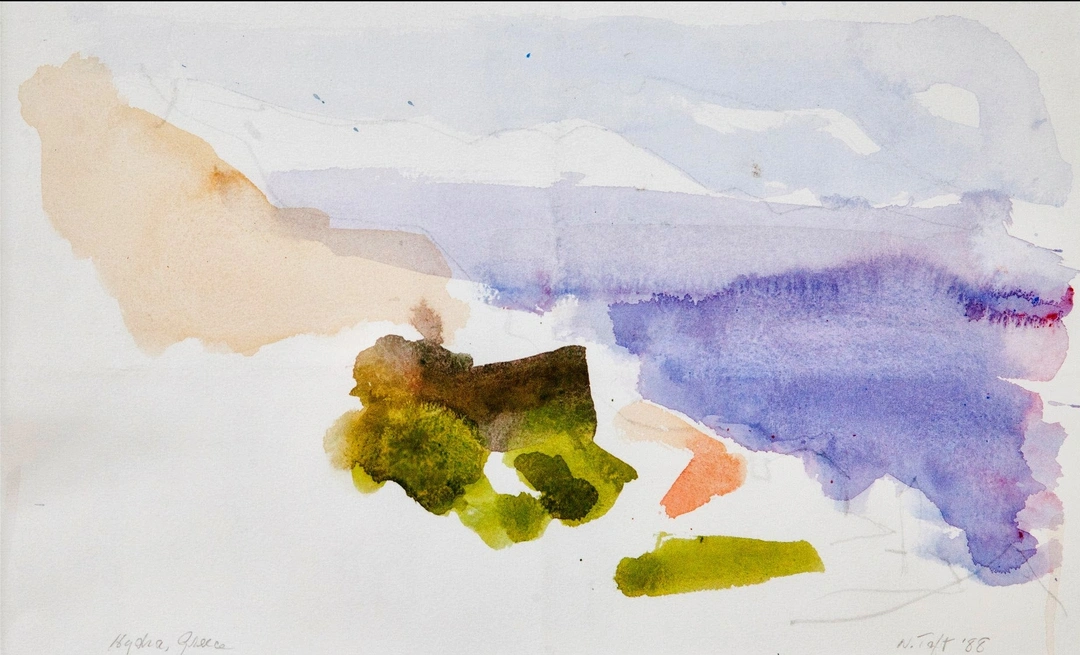
Nellie was certainly aware of art history and contemporary artists, and it shows in the retrospective at the Alice F. and Harris K. Weston Art Gallery, curated by Denny Young, former curator of painting at the Cincinnati Art Museum and, by-the-by, a cousin. The exhibition, “Nellie Taft: Odyssey, A Lifelong Journey through Art,” is described as a tribute to her. (Tribute, huh. Sounds like a “tribute bands,” which play the hits of well-known bands.)
Nellie’s odyssey was not on the Weston’s original 2013-2014 schedule as released. But Harrington explains there is always “a challenging place in our schedule each year when we present “CANstruction” in the upper gallery that leaves a three-week gap where we have had to either extend or stagger exhibitions in the lower galleries. Utilizing this time and shortening our installations allowed us to present Nellie’s exhibition without disrupting the remainder of the season.”
The Taft family had brought the work back to Cincinnati last summer and wanted to present it as soon as possible since Nellie had died in December 2012.
The title is particularly apt. The exhibition does trace her lifelong journey, an intellectual and artistic quest. As I made a circuit of the gallery, which Harrington hung with a view to formal connections not chronology3, I could pick out those who influenced and inspired her.
While at Columbia in the late 1960s, Nellie had a studio in a loft in lower Manhattan and presumably got to know the Abstract Expressionist crowd. (Did she hang out at the Cedar Bar?) Alison Hunt in a 1991 profile in The Beacon Hill/Bay Bay Chronicle writes she was “involved with emerging artists such as Willem de Kooning and Franz Klien (sic).”
Whether or not there was a direct involvement, it’s easy to pick out the AE influences, inspirations, “tributes” in paintings from the 1990s – a little after the fact.
Although I will say that the earliest works in the show done in 1959 when she was at Reed College, the Jungle series (to my eye her “jungle” looks more like a stand of aspens or alders or birches – tall slender trunks reaching upward, not a dense tropical forest), does show a touch of Kline as well as Chinese brush paintings.
In Heart Soundings, 1996, there are touches of de Kooning, Cy Twombly, as well as graffiti art, also after the fact. This painting is part of the Palimpsest4 Series and beneath an active surface you can discern her handwriting.
The strong, jagged shapes and paint application in After and Before, 1991, recall Clyfford Still while her narrow vertical canvases evoke Barnett Newman as does the single sculpture in the exhibition, the monolithic Vanderwalker.
PHOTO:
PHOTO:
Sea Sand seems to reference Joan Mitchell or a more robust Helen Frankenthaler. You can easily see the connection in the Dry Salvage series to Robert Motherwell’s black paintings or a very restrained Rauschenberg combine with the attached corroded iron pipe, which she called “sea scrap.” Untitled 2 quotes Rothko: a white rectangle floating on top of a black field occupies about three-quarters of the canvas; the far left quarter shows a door into a room with a drum or table (rather like two segments of Brancusi’s Endless Column) lying on its side.











Comments powered by Talkyard.