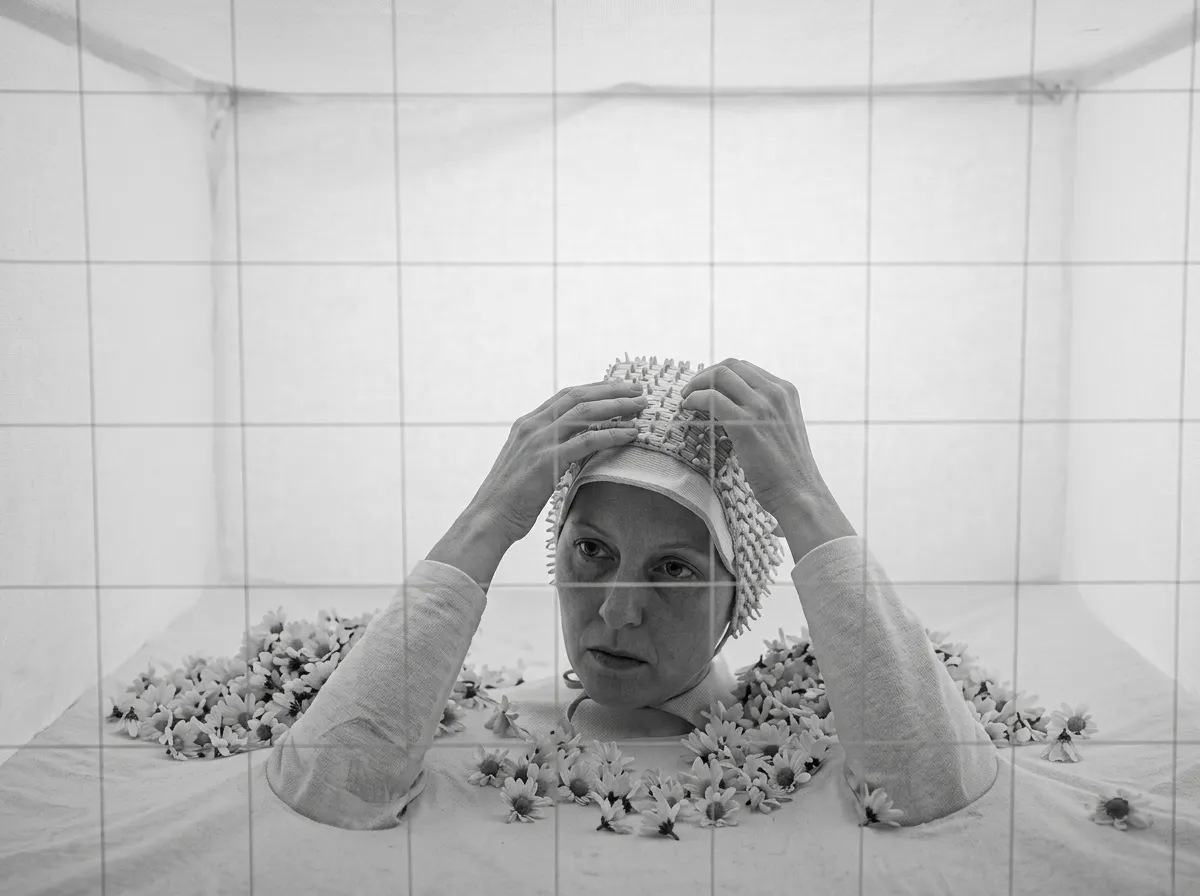
Alison Crocetta, Fill, 2003, Super 8 mm film, production photograph by David Pardoe.
Initial Impression: Darkened rooms, interestingly arranged for multi-screened film projections. Walls and partitions simultaneously displaying black and white events. A slim man scatters a white powder over a grassy area. He is printing the universal signal for help, SOS, in large letters by drizzling a white powder on the grass. Written material nearby indicates that this piece reflects the questions of what SOS means, who should request it and why.
This film is viewed in a small alcove affording a rather private viewing. Combining the manner of the installation with the slow labor of the man can be thought-provoking if one pauses too long enough to become involved.
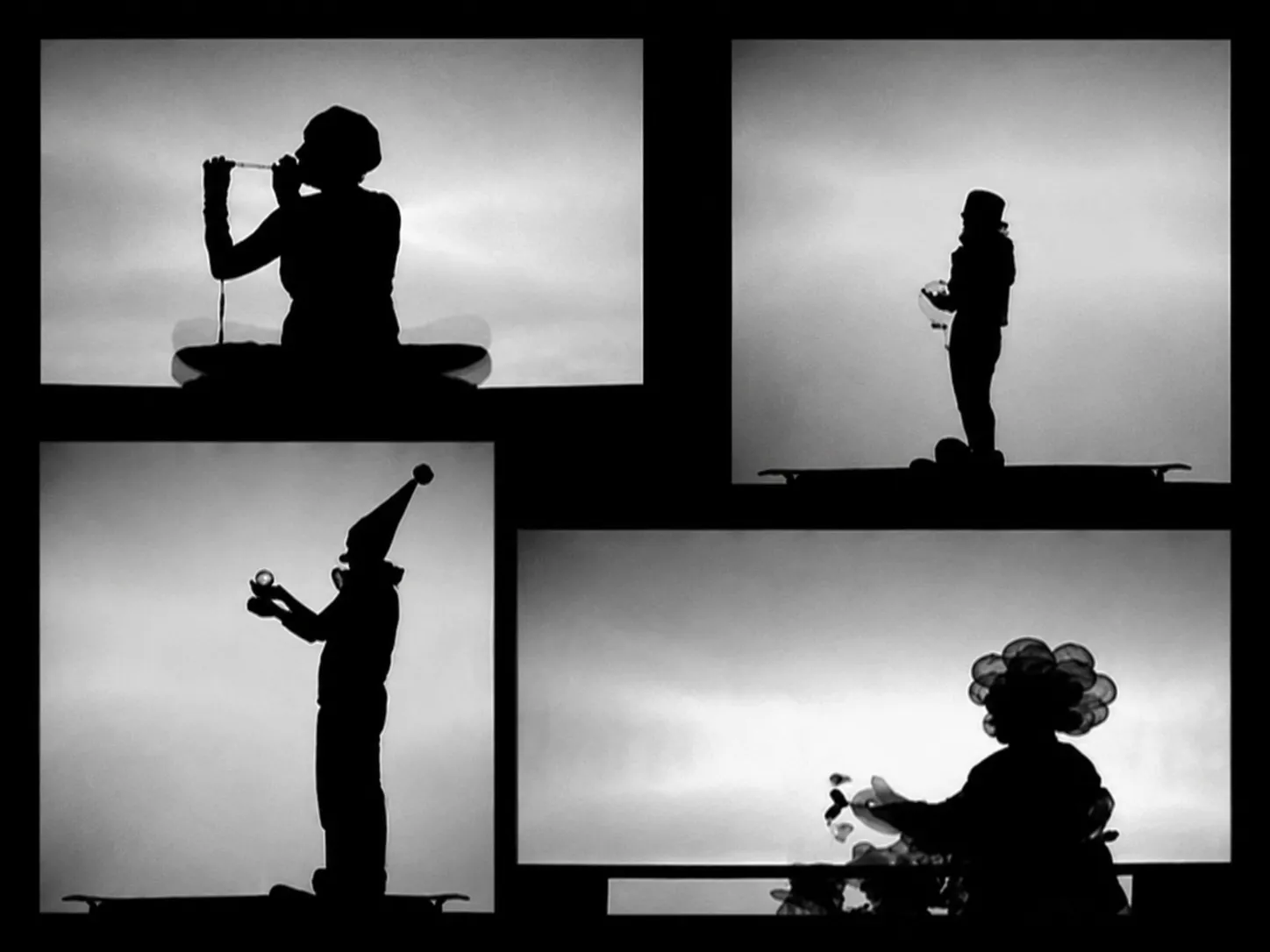
Across another wall,”Track” depicts a toy circus train bearing animals moving slowly from right to left. Adjacent to that, “ Galanty” is seen as a series of moving figures performing monotonous tasks, i.e. constructing a fantastic hat of balloons, playing with a slinky toy, a hula hoop performance, etc., all seen through a scrim as moving silhouettes.
There are fifteen works in the show, “Moving Images”, by Alison Crocetta at the Weston Gallery through August 28, 2011. All of which rely solely on you, the viewer. The show’s value, incorporating performance, sculpture and installation is what you choose it to be, and how much of your time and energy you invest. Crocetta’s gallery talk on June 24 explored her reasons for each piece and her message, which, unfortunately, was too concerned with personal introspection to be of much use for visits by the general public.
Her visible interpretations bear little impact without having the artist handy to explain them. She describes them as involving her body as art, with extensions including singing, and *bags of breath, and most of all an introspection which, while solidly founded in her philosophy, is difficult to translate to an uninitiated viewer. And herein lies the problem in this kind of art.
Alison Crocetta and Joe Casey Doyle, The Galanty Show, 2009, silent digital video, video still.
Quite simply put, art is communication. It is not elitist, it is not a secret wavering in smoke and shadow, and it’s not an unsolvable puzzle. Each new pair of eyes may see the art as something only they can, but when any possible message is obscured, the art has failed. Written works explaining the art can’t truly make it more viable. By breaking with the art to read the explanation, an important connection is broken. And by simply feeling an explanation is necessary, the art has lost the game. The images must translate independently, and they must have an enduring quality. Often it seems the more confusing the show, the bigger the success in their native circles.
Film, videos, and electronic production are fleeting, sometimes replaced and outmoded in mere months. Documentation becomes useless in a changing parade of gadgets. Electronic art has been described as “plugged in Dadaism”, but I find even this to be overly forgiving. At least Dadaism declared a purpose and left a legacy in the movement of modern art. Ego in art is a given, a necessity in that tough vocation, rendering the “I” in “Moving Images” acceptable. Yet there are limits to the ratio of ego to finished item.
“Twins”, which records the movements of two toy cats manipulated by unseen means, could have deep meaning to unique experiences in individual histories, if such viewers could hang on to the repetitious performance long enough to delve into their experiences and relate. Repetitive monotony may be designed for hypnotic effect, and given time would surely be successful. However, the average art lover won’t feed several hours worth of quarters to the meters on Seventh Street to find out. Even artists must consider logistics.
Ms. Crocetta has explored many academic art media, obtaining degrees in ceramics at Alfred University and in sculpture at the Tyler School of Art . She is currently an assistant professor of art at Ohio State University. Her credits include a very impressive list of academic awards, and exhibits at top Universities, and prestigious galleries across the nation. She also attended a clown school to learn to walk on the stilts used in one of her performances. It cannot be said that she hasn’t put in the time and effort to become an artist. She is endowed with an intellect which explains her vision of her work well. Yet, they remain her visions. Now, it’s time to use her creativity to amaze, not obfuscate , without separate comment.
-Fran Watson











Comments powered by Talkyard.