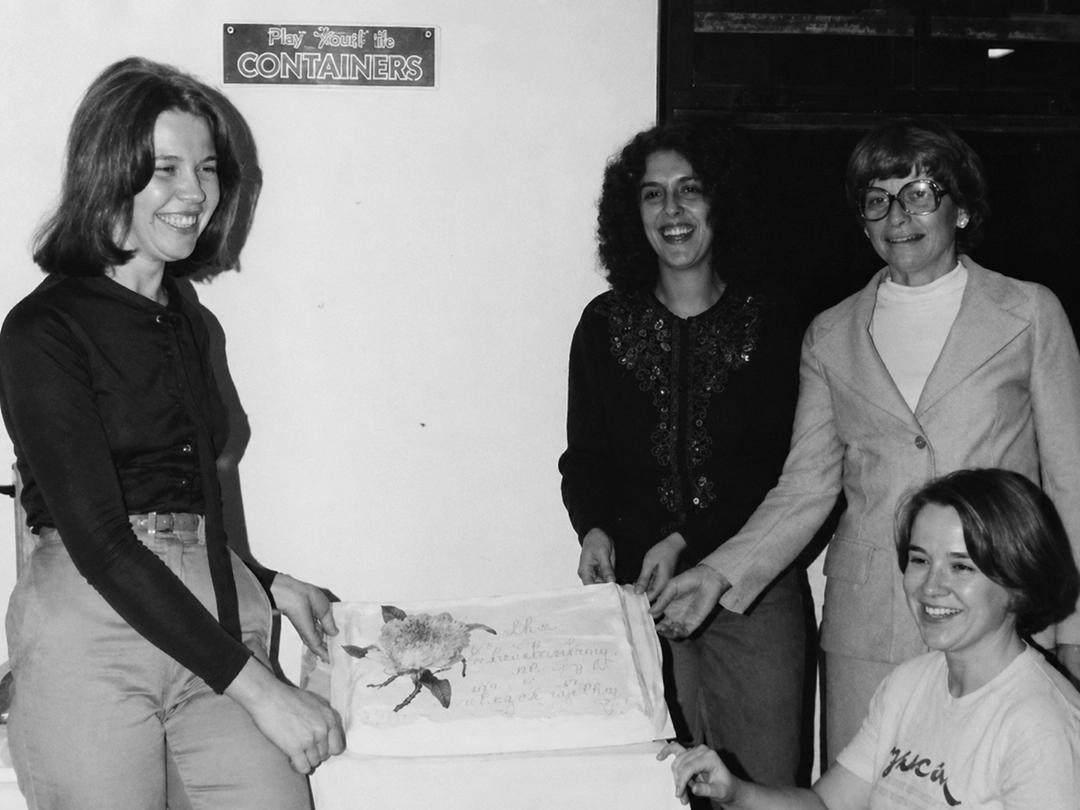
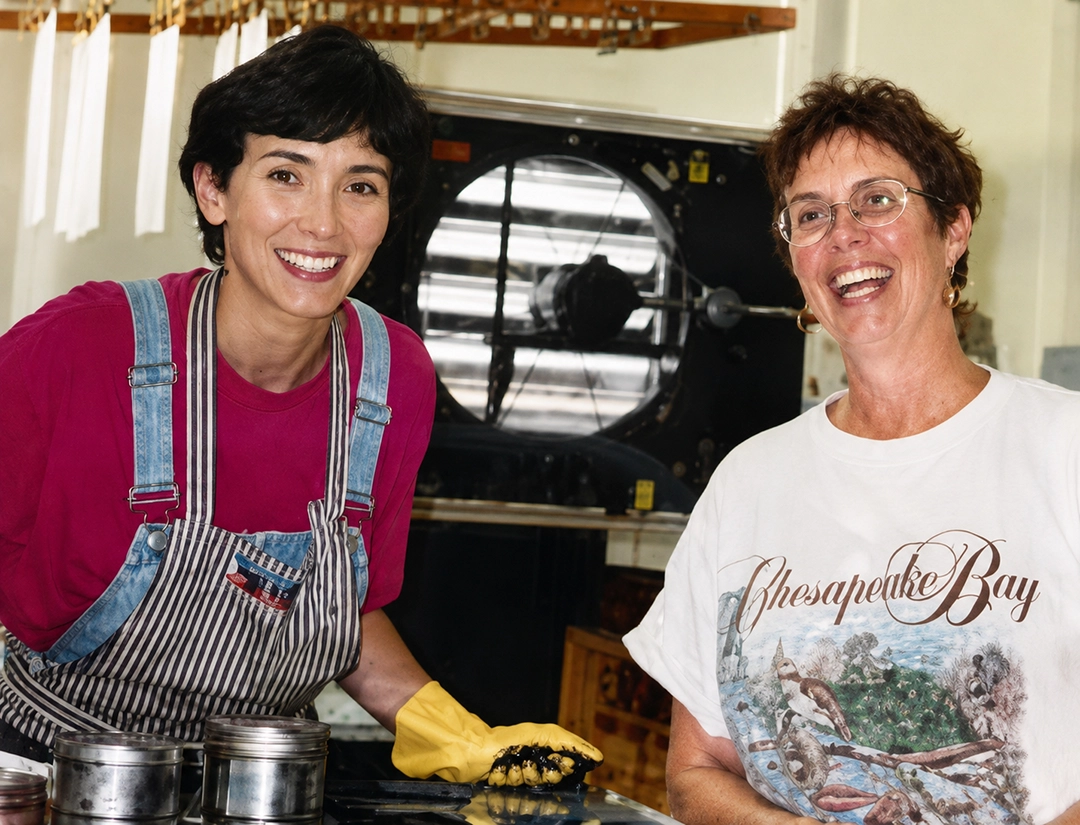
Charlene Ventura, Mary Rose Ventura, Joy Ferguson and Kate Maynard.
The smell of fresh ink on a print just lifted from the press has a remarkable ability to turn devotees into addicts. So do the uneasy intervals built into the process, which forge a very particular bond with the craft. This lies at the origin of nearly every printmaking and screen-printing workshop. Another trait they tend to share is an unusual capacity for endurance. Taken together, these elements account, to a considerable degree, for the history of Tiger Lily Press.
From its founding in Cincinnati in the late 1970s to the present day, the workshop has changed locations, administrative structures, and funding models. It has passed through periods of expansion, threats of closure, forced relocations, and profound shifts in the city’s artistic ecosystem. Yet across almost five decades, it has continued to provide a space where artists can work with printing techniques that demand specific infrastructure, shared technical knowledge, and the sustained presence of other artists familiar with those procedures.
That continuity has rested on no single institution or individual figure. Tiger Lily Press has endured because, at different moments, artists, administrators, educators, cultural organizations, universities, and public agencies have assumed responsibility for sustaining it. Its survival also owes much to the workshop’s ability, as a structure, to relocate, reorganize, and adapt while preserving its original purpose.
1978–1982 / The Origins: The YWCA and the Women’s Art Center
The immediate origins of Tiger Lily Press can be traced to the cultural environment fostered during the 1970s by the Women’s Art Center of Cincinnati’s Metropolitan YWCA. The center offered exhibition space, rental studios, theatrical productions, and poetry readings, and formed part of a broader network of initiatives intended to create viable opportunities for women artists.
A survey conducted among the artists themselves identified the need for a printmaking press. In response, Kate Maynard submitted a proposal to the Ohio Arts Council for the creation of a cooperative fine-art printmaking workshop inside the YWCA building at Ninth and Walnut.
The workshop came into being through a combined effort of organization and fundraising. Charlene Ventura, the YWCA’s Director of Public Relations, and Mary Rose Ventura, Director of the Women’s Art Center, were actively involved in preparing grant applications and securing institutional support. The necessary funding came from the Cincinnati Foundation, the Crosset Foundation, the Crosley Foundation, the Ohio Arts Council, and the YWCA itself.
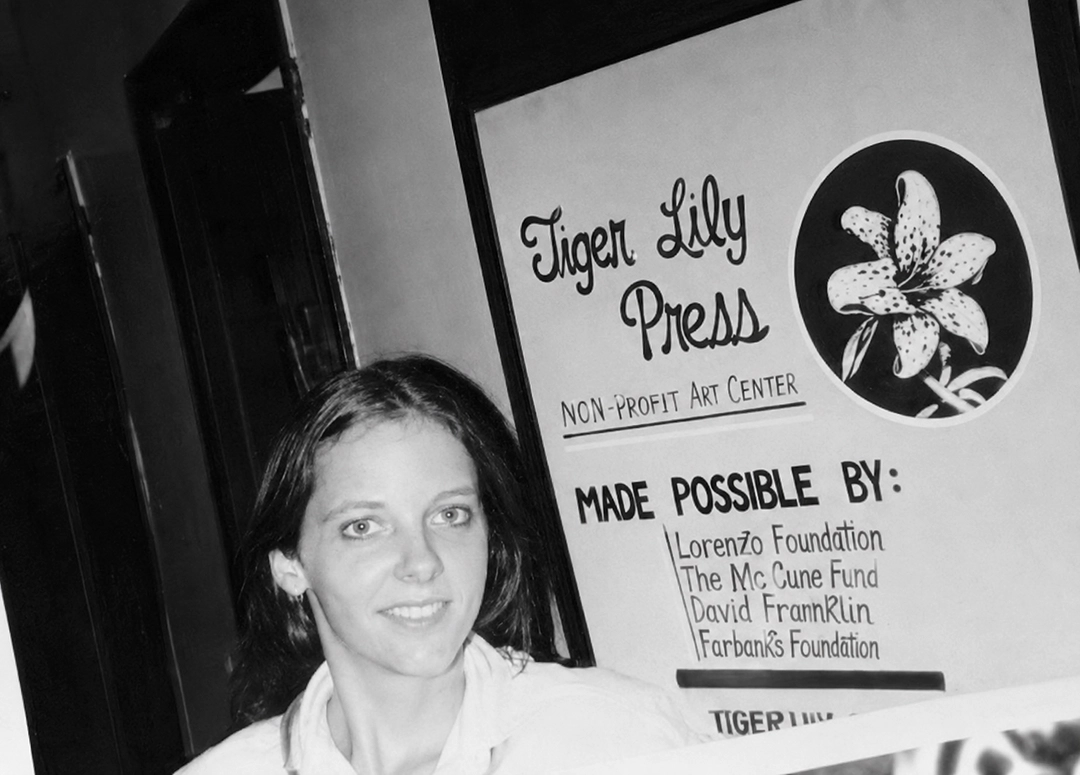
Kate Maynard, who had recently completed an MFA at the University of Cincinnati, became Tiger Lily Press’s first director. The workshop was installed on the fifth floor of the YWCA building. As a CETA staff member, Maynard also directed the Visual Arts area of the Women’s Art Center and took on the practical work of turning an institutional idea into a fully functioning studio.
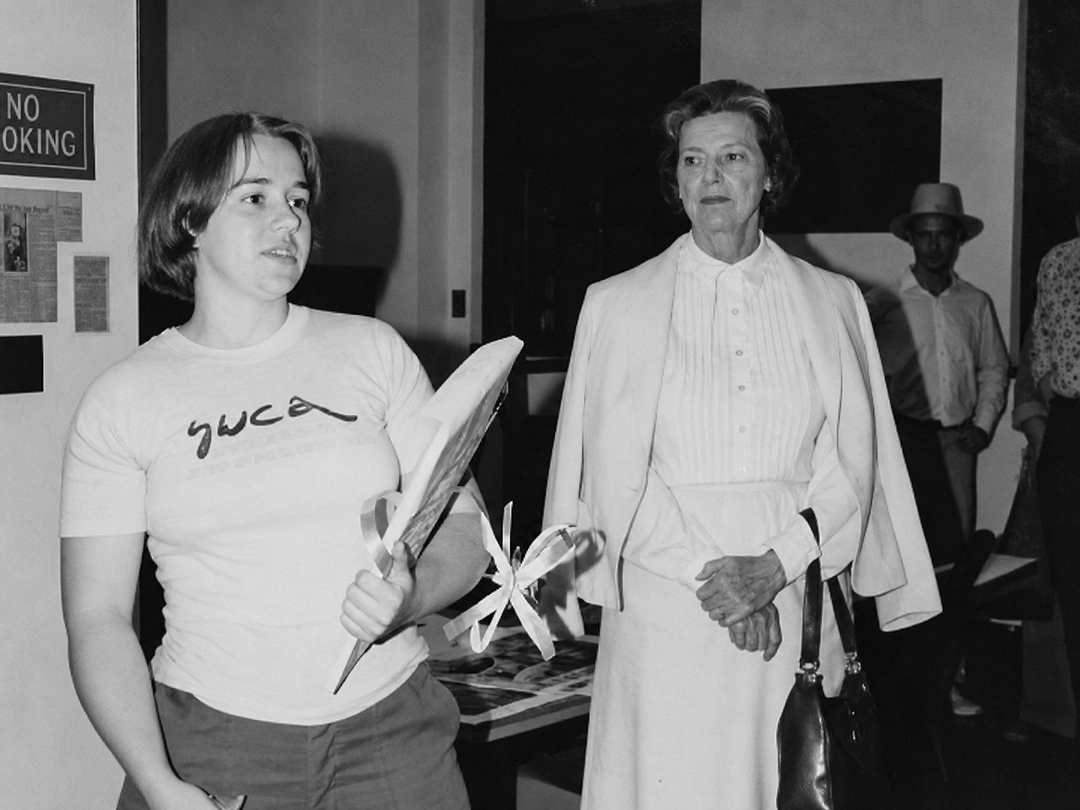
Kate Maynard and Mayor Bobbie Stern.
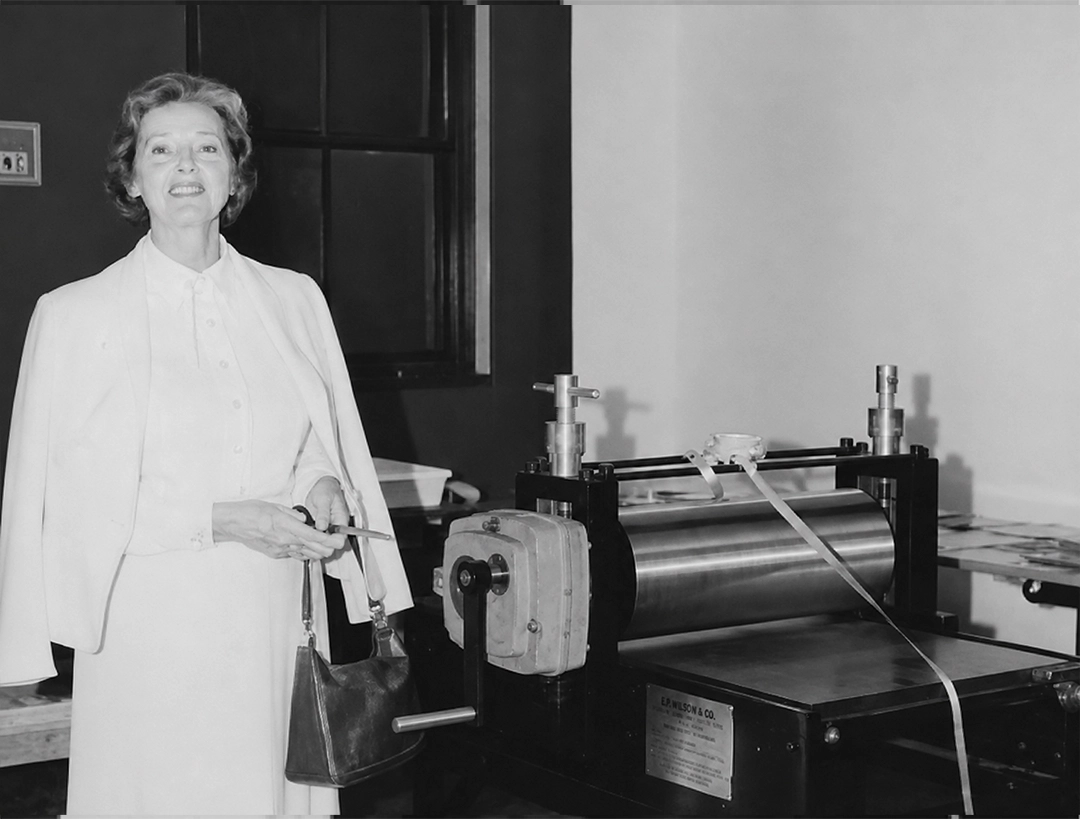
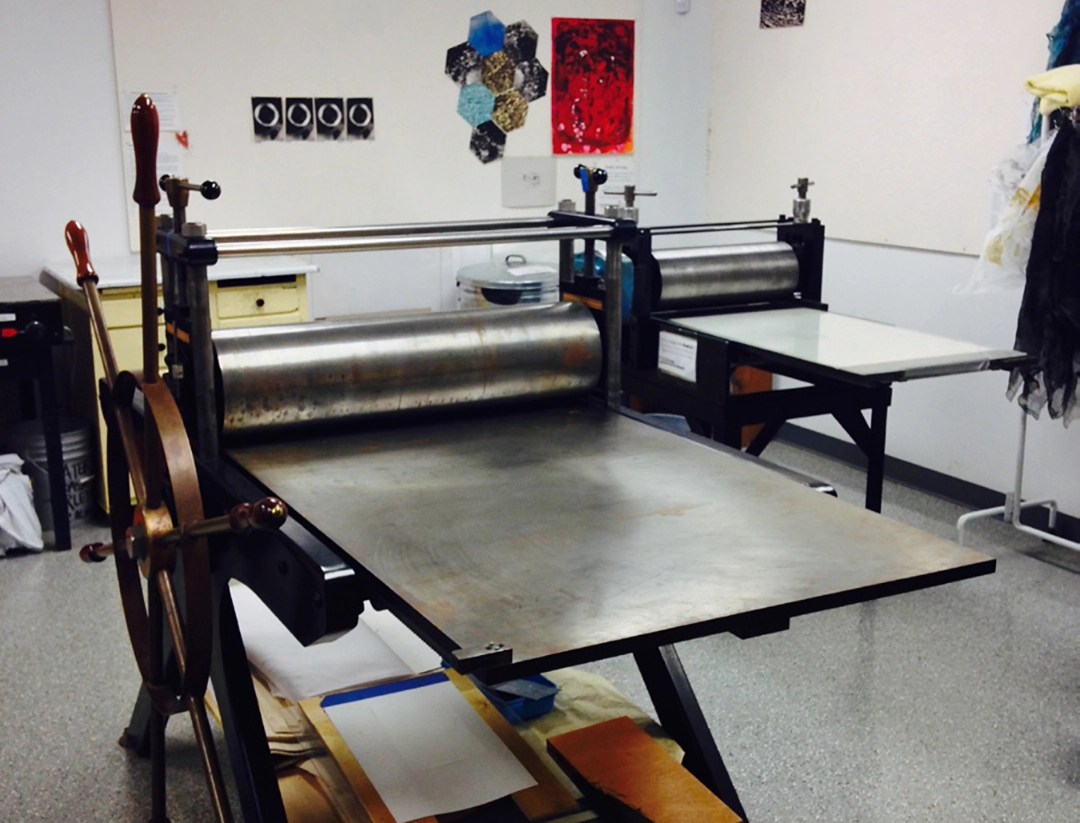
The aim was to establish a printmaking workshop open to the public through a rental system, an exceptional model in Ohio at the time. Funding made possible the purchase of a 22 × 44-inch Charles Brand intaglio press. The Crosley Foundation, the Comprehensive Employment Training Act, and the Fine Arts Fund helped finance additional tools and equipment. Other needs were met through a combination of loans, handmade construction, and personal resources. Kate Maynard acquired, built, or adapted tables, a hot plate, and palettes, and also constructed an acid-etching box equipped with a ventilation system.
By October 1979, Tiger Lily Press was fully operational.
The official opening took place on September 30, 1979. On that occasion, Mayor Bobbie Stern formally christened the Charles Brand press, while Kate Maynard was recognized by those who had supported the creation of the project. The ceremony gave public visibility to an initiative that, from the outset, brought together technical infrastructure, teaching, and community access.
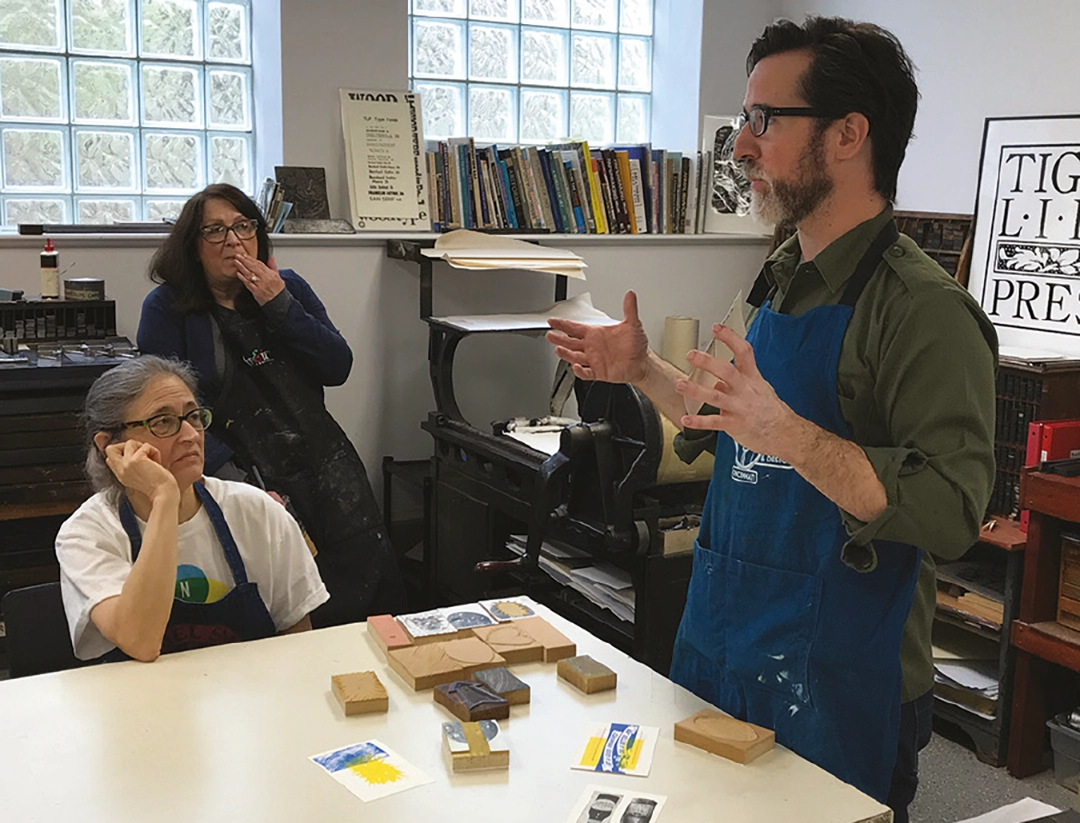
When the CETA program ended, the YWCA continued to provide space and financial support for day-to-day operations. Kate Maynard offered technical assistance to those renting the workshop and taught introductory and advanced intaglio courses.
Tiger Lily also began very early to connect with other printmaking networks in Cincinnati. In 1980, Mark Patsfall, who operated his own press, led a photo-etching workshop for members of CAGE, Cincinnati Artists Group Effort. The experience resulted in a portfolio of ten prints, editioned by Mary Mark and later acquired by the Cincinnati Art Museum.
When Kate Maynard left the project in 1981 to concentrate on other artistic pursuits, Mary Mark assumed the workshop’s administration on a volunteer basis. Under her direction, the range of available techniques expanded through workshops in collagraphy, aluminum-plate lithography, color printing, and chine-collé. Mark also undertook a broader regional outreach effort, presenting Tiger Lily Press at institutions including the Art Academy of Cincinnati, the University of Cincinnati, Wright State University, and the University of Kentucky. The underlying model had by then become unmistakable: an open press, shared access, technical training, and the natural circulation of knowledge.
1982–1984 / Fourth and Plum Street
In 1982, renovations to the YWCA building forced Tiger Lily Press to leave its original home. Mary Mark then decided to purchase the press and move it into the heart of Cincinnati’s gallery district on West Fourth Street.
The new space was located at 308 West Fourth Street, near the intersection of Fourth and Plum. Tiger Lily shared a loft with Merchants Co-Op Gallery. Once again, setting up the workshop required manual labor and cooperation. Mary Mark and other members of the Merchants Gallery Cooperative spent many hours cleaning and painting the space before it could open to the public in December 1982.
At this new location, Tiger Lily retained its character as a rental workshop open to printmakers from across the region. At the same time, it broadened its programming even further with workshops in linocut, mounting and framing, papermaking, and mezzotint.
April Foster taught a workshop in aquatint and spit bite on zinc for ten members of Merchants Gallery. Mary Mark produced and published A Suite of Prints, a portfolio of ten prints that also entered the collection of the Cincinnati Art Museum.
Christine Cotting first became involved as a workshop participant, then began renting the space regularly, and eventually became Mary Mark’s operational collaborator. Her arrival proved especially important at a time when sustaining Tiger Lily required a careful balance of responsibilities: teaching classes, maintaining a stable base of users, keeping the studio in working order, and securing enough income to cover the rent.
Collective production also occupied an important place during this period. Tiger Lily produced another edition, titled IMAGES, featuring work by Joan Effertz, Charles Grund, April Foster, Mary Mark, Philippe LeJeune, and Barbara Young. The six artists self-published, packaged, and distributed an edition of twenty copies among several institutional collections, including those of the Cincinnati Art Museum, the University of Michigan Museum of Art, the Museum of Fine Arts Boston, the Miami University Art Museum, and the Dayton Art Institute.
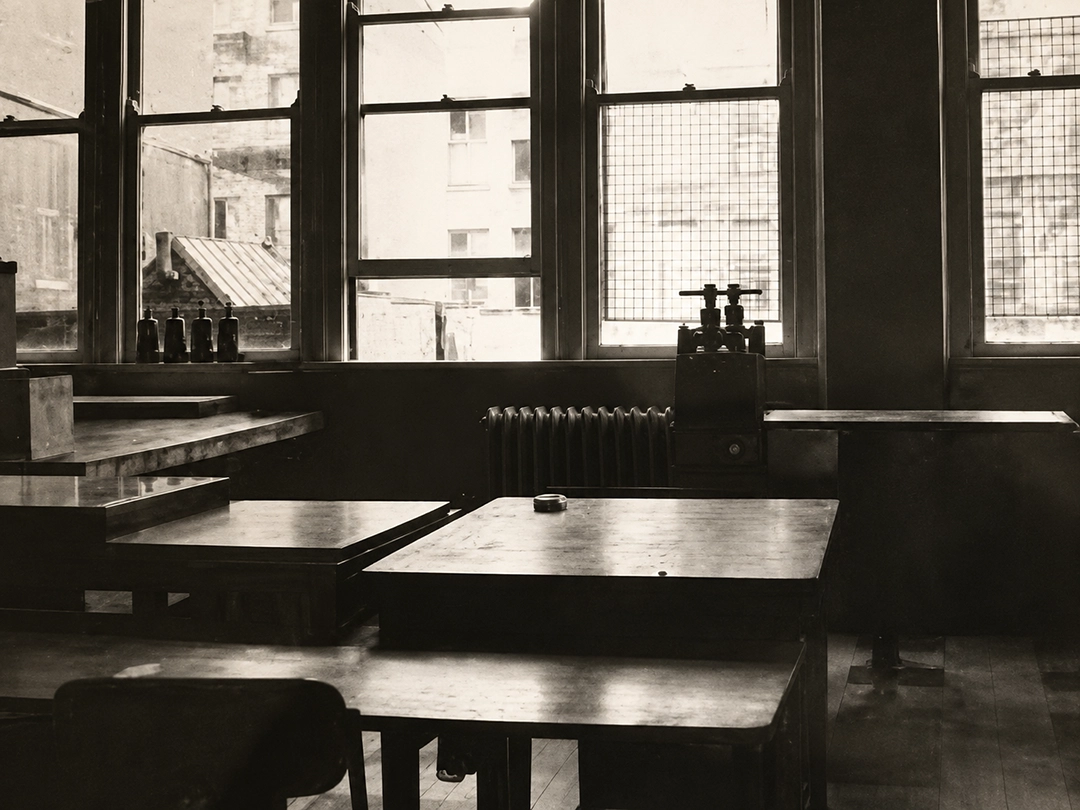
Second floor renovation and new home for Tiger Lily Press and the Merchant's Gallery Cooperative.
Among the workshop’s regular monthly users were Christine Cotting, Barbara Young, Joan Effertz, and Philippe LeJeune. LeJeune came to Cincinnati to produce a series of urban landscapes as hand-printed multicolor etchings, which he later sold through Miller Gallery in Hyde Park.
Financial and administrative pressures eventually led Mary Mark to share the directorship with Christine Cotting. Cotting’s background in public relations and her willingness to take on practical responsibilities strengthened TLP’s day-to-day management. Together they continued to offer classes in etching, collagraph, papermaking, and relief printing.
Mary Mark also maintained an active strategy of outreach to universities. She contacted printmaking professors to introduce Tiger Lily to students approaching graduation and to make them aware that Cincinnati had a cooperative workshop where they could continue working after completing their studies. She gave presentations at Wright State University, Northern Kentucky University, and other institutions.
The end of this period was shaped by a personal decision that might have altered the entire subsequent history of Tiger Lily. Mary Mark decided to move to Boston, drawn by the reputation of that city’s printmaking community. Her initial intention was to buy out her partner’s share and take the press with her.
Several members of the local community opposed that prospect. Christine Cotting, Mary Ann Butkovich, Leslie Glass, and others argued that Tiger Lily Press should remain in Cincinnati and offered to purchase Mark’s share.
The subsequent intervention of the Art Academy Alumni Association made an institutional solution possible. The press remained in the city, and a new chapter began.
1985–1998 / The Art Academy of Cincinnati
In 1985, Mary Mark left Cincinnati and sold the contents of Tiger Lily Press to five local artists: Mary Ann Butkovich, Joan Effertz, Joyce Howe, Leslie Shiels, and Barbara Young. They, in turn, donated the entire workshop to the Art Academy Alumni Association, which agreed to provide it with a home. Mary Ann Butkovich played a particularly important role through her involvement with the Alumni Association. The Art Academy of Cincinnati preserved the open-press model and offered community classes through its Community Education department. Tiger Lily moved into 1125 St. Gregory Street, where it would remain for the next thirteen years.
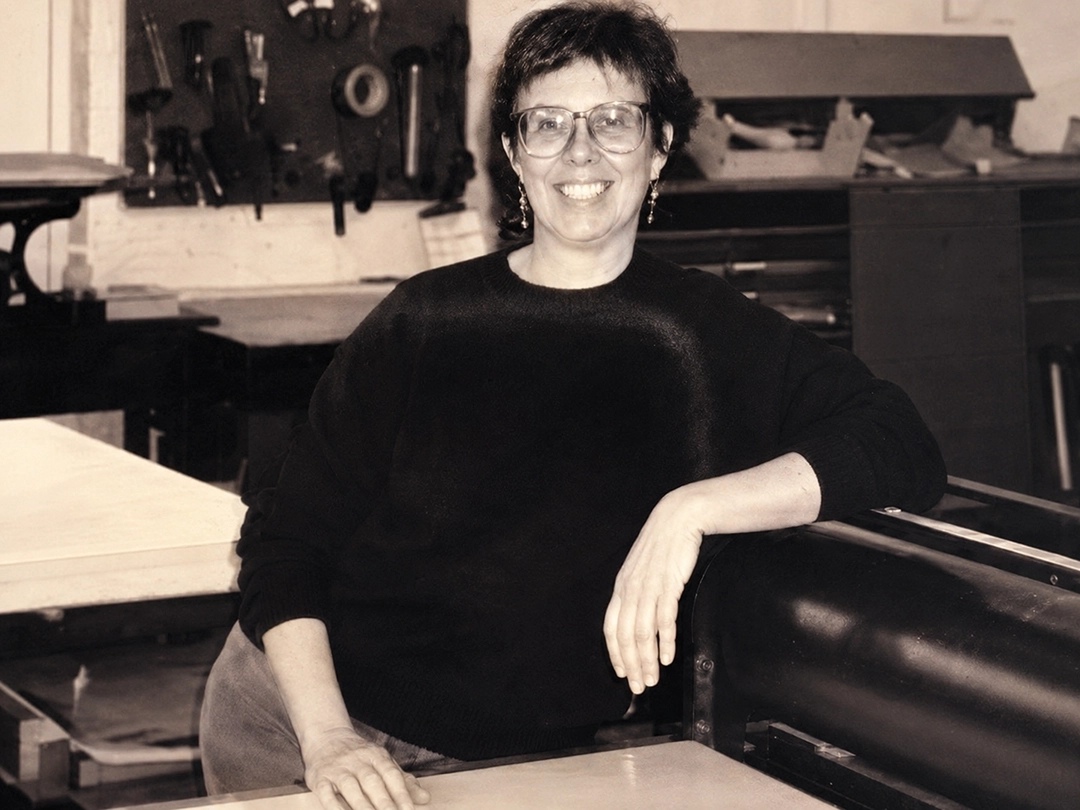
Joan Effertz, director from 1985 to 1991 and a recent graduate of Pratt Institute with an MFA in printmaking, took responsibility for designing the new space, organizing the move, and establishing Tiger Lily’s operations within its new setting. During her tenure, two support initiatives were created, one a printmaking scholarship for Art Academy students and the other for professional artists. Tiger Lily also hosted the Japanese artist Soichi Ida, who produced an edition of four prints there, printed by Mark Patsfall. Educational activities continued through the Community Education department, with classes offered to both children and adults.
After Effertz, the directorship passed successively to Louann Elliott, from 1991 to 1993; Theresa Gates, from 1993 to 1994; and Susan Naylor, from 1994 to 1998. The workshop continued to function as a place of production as well as a site for demonstration and technical transmission. In 1994, Cincinnati artist Thom Shaw gave a woodcut demonstration. That same year, Chicago-based artist Tony Fitzpatrick and his printer demonstrated their color-etching process.
In 1997, under Susan Naylor’s direction, Tiger Lily organized a Printmaking Marathon. Several printmakers from the region committed themselves to producing editions for public sale. The initiative raised nearly $3,000, which was donated to the Mid America Print Council conference held in Cincinnati that year. The conference was jointly organized by the Art Academy of Cincinnati, the University of Cincinnati, Northern Kentucky University, and Tiger Lily Press, and brought together more than three hundred printmakers from across the United States. Tiger Lily’s participation in the conference indicates how far the workshop had moved beyond the scale of a strictly local facility. By the end of the 1990s, it had become part of a regional and national network of institutions devoted to printmaking.
Immediately after the conference, however, the Art Academy announced that rising enrollment required it to reclaim the space occupied by Tiger Lily. Once again, the workshop’s continuity depended on finding another home.
1999–2001 / Butterfield Recreation Center and the Transition to Dunham
It was at this point that the Cincinnati Recreation Commission agreed to bring Tiger Lily Press into its facilities.
In 1999, the workshop moved temporarily to the Butterfield Recreation Center at 22 Garfield Place in downtown Cincinnati. It would remain there for roughly two years while a permanent home was prepared in the Arts Building at the Dunham Recreation Center in Western Hills. Susan Naylor again played an important role in the transition. She recruited Cara Bardes, Elizabeth Foley, and Theresa Gates Kuhr, all artists with master’s degrees in printmaking, to share the directorship following Tiger Lily’s departure from the Art Academy. The move into Cincinnati’s recreation-center network marked a different institutional phase. Tiger Lily ceased to rely on university space and entered into a long-term relationship with the Cincinnati Recreation Commission, one that would eventually become a fundamental source of its stability.
2001–2011 / Dunham Recreation Center
Beginning in 2001, Tiger Lily Press operated out of the Arts Building at the Dunham Recreation Center, 1945 Dunham Way. Theresa Gates Kuhr maintained a long association with the organization’s leadership from 1999 to 2015. During Tiger Lily’s first decade at Dunham, she shared responsibilities with Elaine Mullen Zumeta, Don Desander, and Rick Finn.
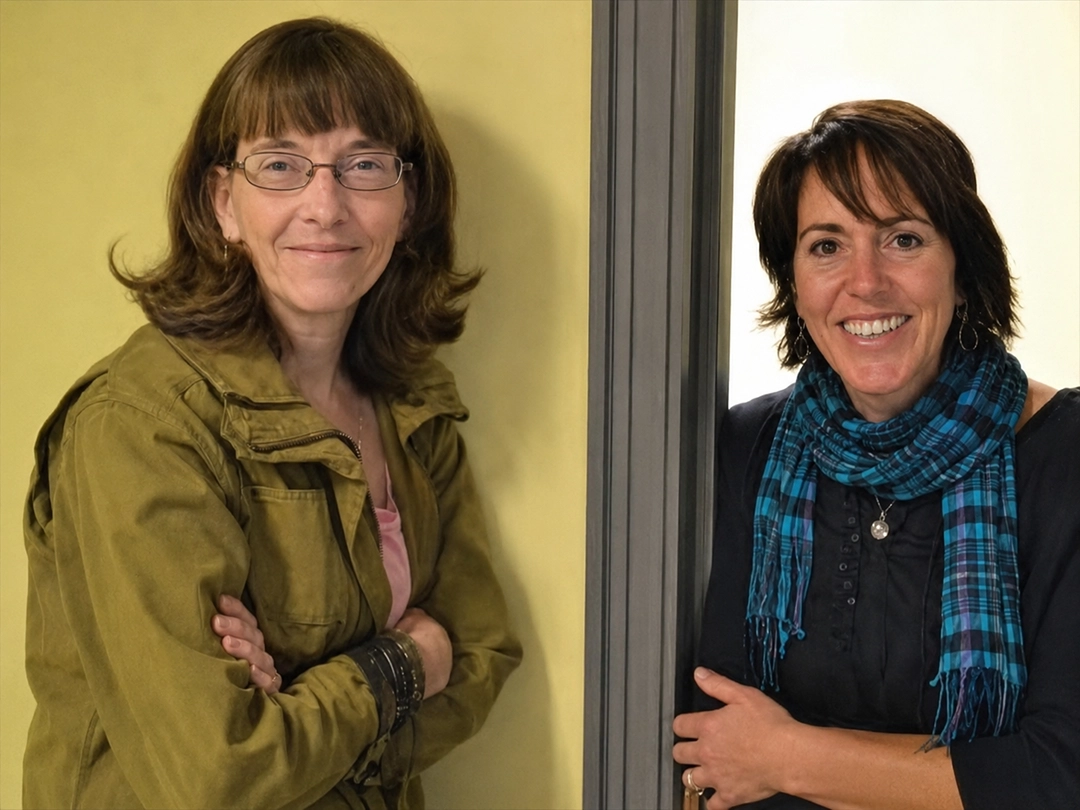
Elaine Mullen Zumeta and Theresa Gates Kuhr.
This new period brought a broadening of Tiger Lily’s ties with artists and institutions. In 2002, the workshop collaborated with Katherine Kadish, April Foster, the Ohio Arts Council, and the Art Academy to bring Korean printmakers Ha Dong Chul and Ha Won to Cincinnati.
Over the course of a week, father and daughter took part in lectures, demonstrations, and exhibitions at the Art Academy, the University of Cincinnati, and Tiger Lily Press. Their visit strengthened the workshop’s educational dimension and gave local students and printmakers direct access to other traditions and methods of printmaking. Yet Tiger Lily’s permanence at Dunham was not entirely secure. Declining municipal financial support raised the possibility that the center might close. Faced with that prospect, Tiger Lily’s directors and members began developing new fundraising mechanisms.
Two projects emerged from this context and eventually became permanent fixtures, the Annual Print Sale and the Bi-Annual Calendar Project. Both combined artistic production, the public circulation of work, and financial support for the workshop’s operations.
When Elaine Mullen Zumeta and Rick Finn stepped down as co-directors, Susan Naylor returned to assist with management. Naylor assumed the role of Studio Manager, while Theresa Gates Kuhr became the principal director. Rick Finn, meanwhile, developed and managed Tiger Lily’s blog and Facebook page, bringing digital networks into the organization’s communication practices.
The range of activities continued to expand during these years. The Paper Doll Challenges exhibitions were held in 2007 and 2010. The first Next Generation gathering was organized for university printmaking students. Figure-drawing and monotype sessions were also held, alongside collaborations with The Greater Cincinnati Calligraphers Guild and gatherings with The Cincinnati Book Arts Society. In 2009, a statewide exhibition of printmakers in Massillon, Ohio, gave rise to the annual Ohio Print Gathering.
2011–2020 / Dunham Schoolhouse
In 2011, the Dunham Arts Building closed and Tiger Lily moved once again. This time, however, the relocation took place within the same complex. The workshop was invited to occupy the recently renovated Schoolhouse at 4356 Dunham Way. The move strengthened Tiger Lily’s relationship with the Dunham Recreation Center and the Cincinnati Recreation Commission. The new location helped consolidate an institutional partnership that had been developing over the previous decade.
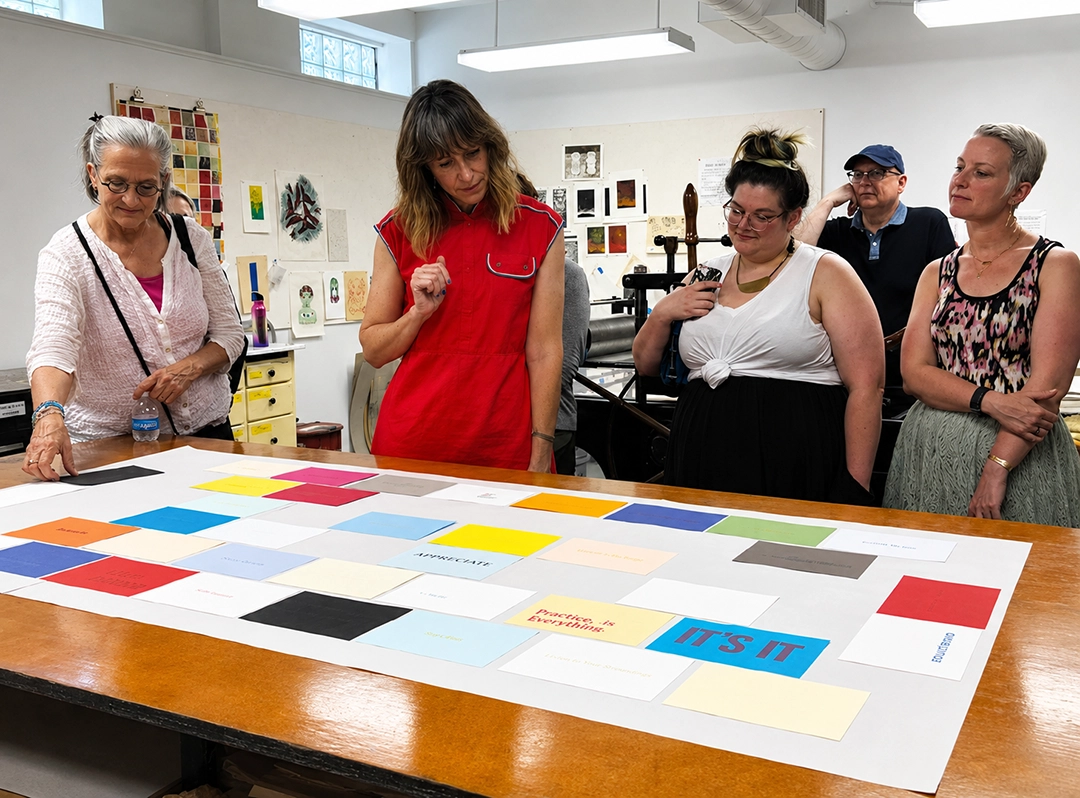
A working Artists Residency was established in 2012. Breanne Trammell was the most recent resident artist.
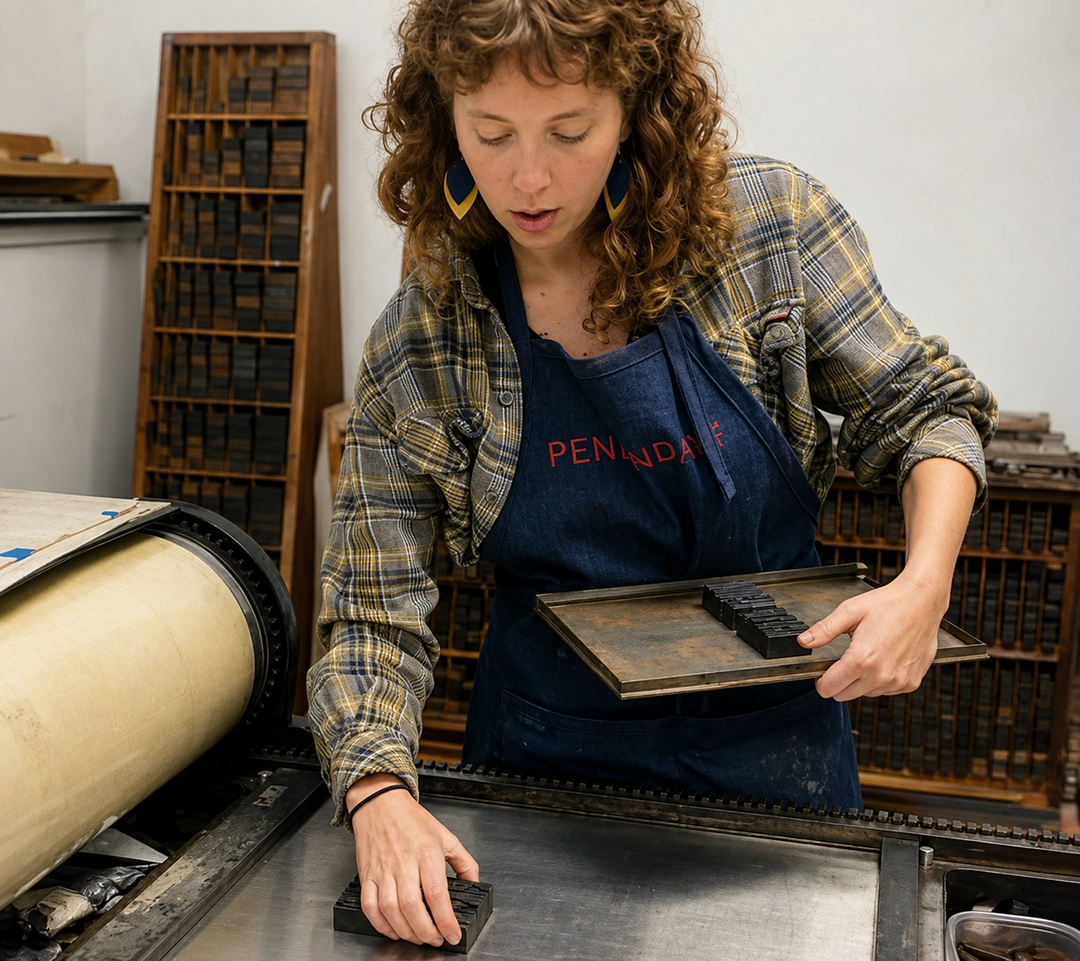
The facilities improved gradually through donations and equipment purchases. A small etching press had already been added in 2001. In 2002, the workshop acquired a Vandercook proof press along with type and materials for letterpress printing. A large etching press was added in 2014, together with rollers, tools, and other supplies. The screen-printing facilities also expanded with the addition of a large exposure unit, screens, and printing materials.
In June 2013, Tiger Lily hosted the Ohio Print Gathering. Printmakers from Ohio’s four principal printmaking cooperatives came to Cincinnati for workshops, panel discussions, and the opening of Prints for Peace and Justice, a regional juried exhibition coordinated by TLP. Participants included Phoenix Rising in Columbus, Zygote Press in Cleveland, Dayton Printmakers Cooperative, and Tiger Lily Press itself.
A year earlier, in 2012, Theresa Gates Kuhr had established the Working Artist Residency Program. The residency was conceived as a way to connect Tiger Lily with local artists deeply committed to both their practice and the artistic community. Its purpose was to provide a context in which an artist could extend an existing body of work into printmaking or deepen a print-based practice already underway.
Residents were also expected to serve as active figures within the Tiger Lily community and to participate in educational and outreach activities.
The technical programming of those years was particularly broad. Denise Bookwalter had taught a Pronto Plate workshop in 2007. April Foster offered a Photocopy Transfer class in 2009 and a letterpress workshop in 2012. Jeremy Plunkett gave a mezzotint demonstration in 2014, while Theresa Kuhr organized a summer series that same year under the title Monoprint Wednesdays.
Lectures likewise expanded the workshop’s historical and cultural frame of reference. In 2007, collector and author Dr. Alan Bernard presented his collection of Benjamin Miller woodcuts. In 2016, Susan Goldman, owner of Lily Press in Rockville, Maryland, spoke about her printmaking practice. In 2019, April Vollmer, an artist and author specializing in mokuhanga, gave a demonstration at the studio and later delivered a lecture at the Cincinnati Art Museum on the Japanese woodblock tradition, co-sponsored by the Cincinnati Asian Art Society.
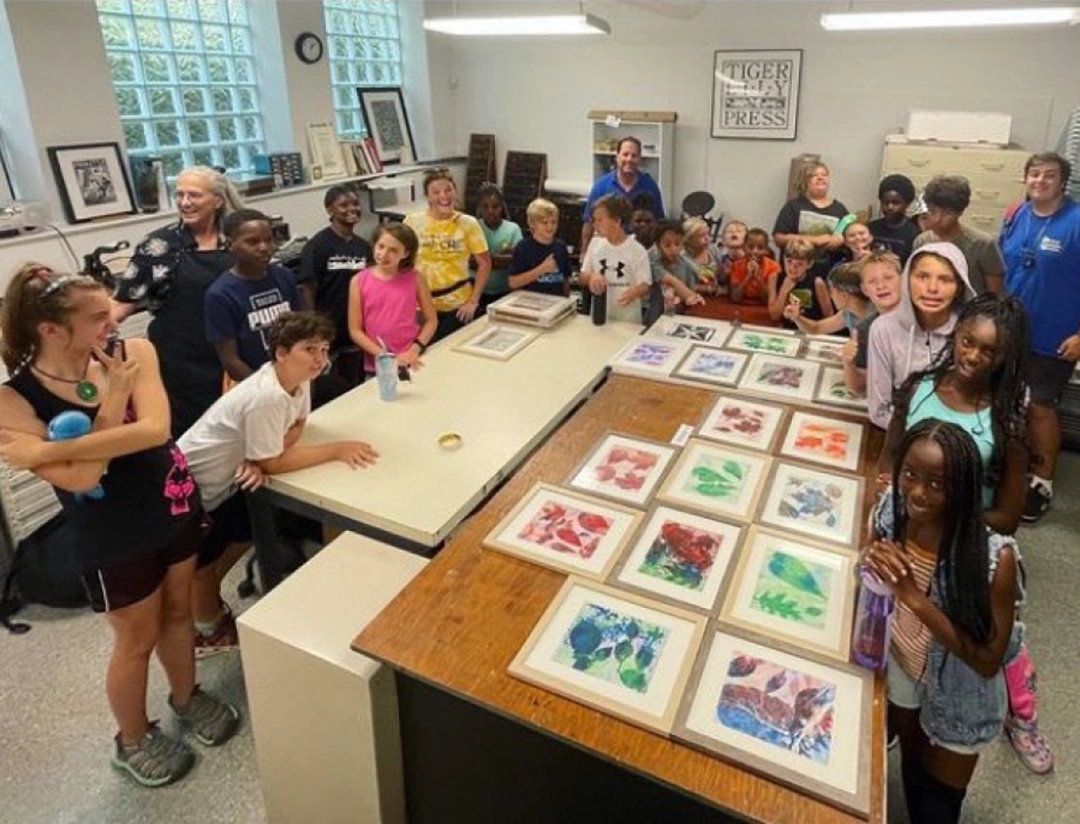
Tiger Lily’s educational reach also extended beyond the studio. Its members participated in programs organized by the Cincinnati Art Museum Teacher Education Program, the Taft Museum Summer Camp Program, and Dunham’s summer camps. The annual program included classes in etching, screen printing, polyester-plate lithography, collagraph, relief printing, monotype, and letterpress.
2016 / Recognition as a Nonprofit Organization
One of the decisive moments in Tiger Lily’s institutional history came in the middle of the 2010s.
On February 25, 2015, the organization’s new leadership convened a Board retreat with consultant Linda Dietrich. The purpose was to establish a formal governance structure, organize committees, and revise the bylaws in preparation for seeking recognition as a tax-exempt organization under Section 501(c)(3) of the Internal Revenue Code.
Preparing the application required roughly a year and a half of work. Board members reviewed five years of financial records, gathered different versions of the bylaws, and assembled a historical inventory of activities, exhibitions, and events. Once the documentation had been put in order, members of the executive committee met at the Northside Library to submit the application formally. On December 3, 2016, Tiger Lily Press received 501(c)(3) status.
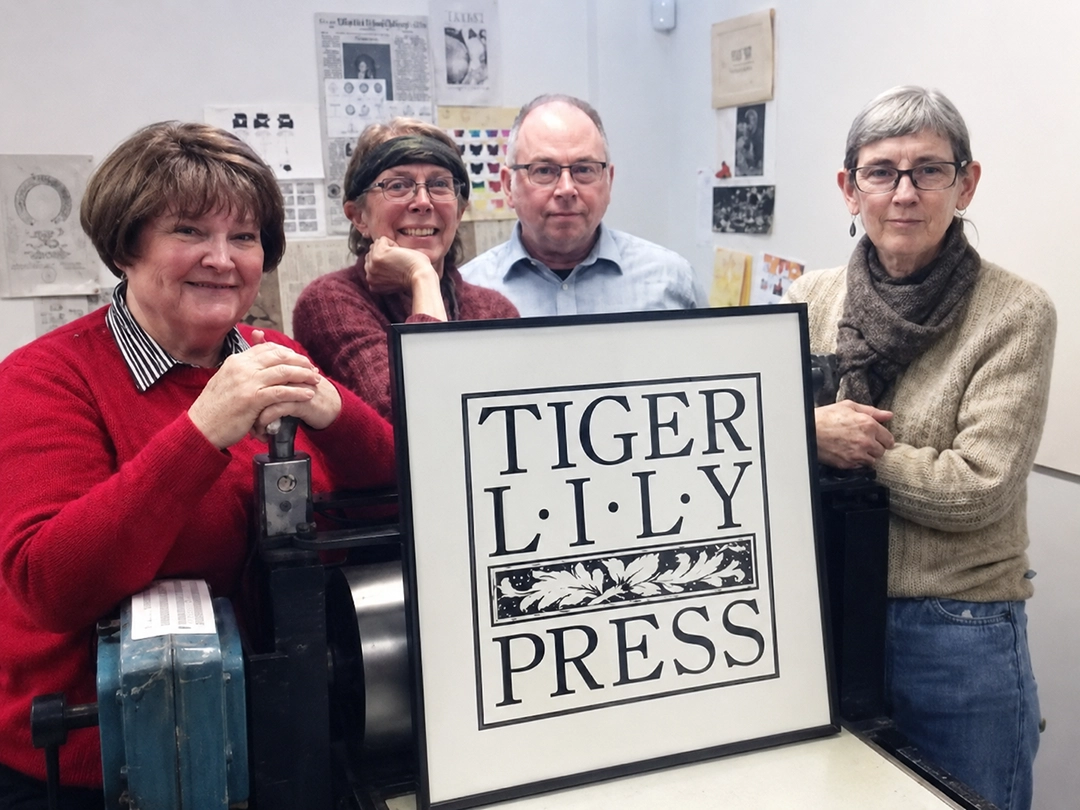
Louann Elliot, Susan Naylor, Jay Harriman, and April Forster.
The new legal status made it possible to accept tax-deductible donations and, above all, to apply for government and foundation grants that had previously been beyond the organization’s reach. Susan Naylor, then president and Studio Manager, described the recognition as a turning point. She emphasized that the achievement grew out of years of work by numerous members, among them Theresa Kuhr and April Foster, and argued that the new structure would allow Tiger Lily to develop programs, produce events, and eventually pursue full-time leadership and staff.
Vice President Jay Harriman likewise stressed that formal recognition positioned Tiger Lily before Cincinnati and its cultural community as an arts organization with an explicit mission to promote printmaking as a vital form of expression. The change in legal status left the workshop’s historical purpose intact. Tiger Lily continued to define itself as a fine-art printmaking facility open to local artists and as an educational resource for the public.
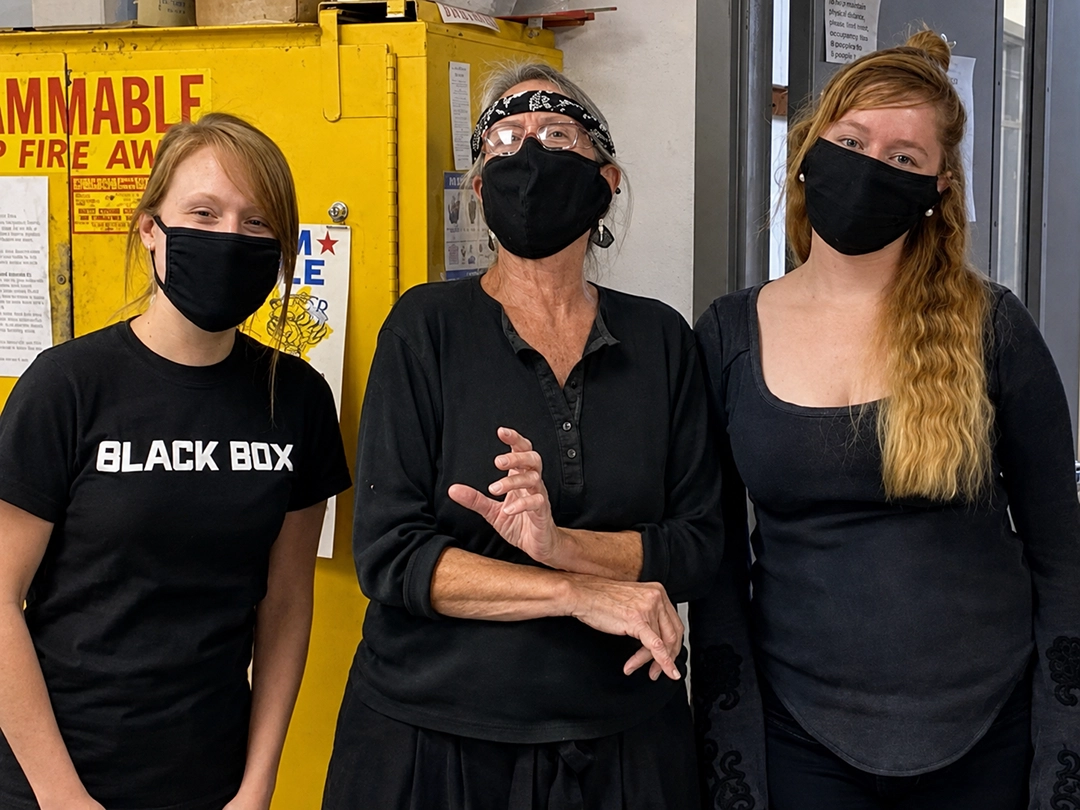
Becky Roman, Susan Naylor and Nicole Hollon donning masks during the COVID pandemic.
2020–2022 / Pandemic and Reorganization
The arrival of the COVID-19 pandemic in March 2020 brought a disruption more profound than any previous relocation. The studio was forced to close. Classes and group activities were suspended, and those enrolled in spring courses received refunds. With the space unavailable for nearly a year, Tiger Lily decided to waive membership dues for the same period. Stephanie Berrie’s artist residency was also extended by a year.
In 2022, the Working Artist Residency Program was awarded to Alex McClay, whose interests centered particularly on letterpress printing and the artisanal production of books.
The post-pandemic recovery coincided with a new phase in Tiger Lily’s financial development. In early 2022, the organization received what its own records describe as its first grant from the Ohio Arts Council, an ARI Operating Funds Grant. The funds were used to compensate Stephanie Berrie for her work as assistant to the Studio Manager and to support the promotion of several activities. Carole Winters, Diane Stemper, and other Board members participated in preparing the application.
In 2022, Tiger Lily organized one of the most striking public events in its recent history, Big Ink. Through the efforts of Jonpaul Smith, the Dunham complex welcomed The Big Tuna, a portable press designed to print from large-scale blocks. Twenty printmakers prepared large woodcuts for the event. Over two days, groups of ten printers worked each day, producing as many as three impressions from each block. The event was open to the community, giving the public a direct view of a process usually confined to the specialized environment of the print studio. It also produced tangible results for Tiger Lily, attracting new members and generating interest in its classes.
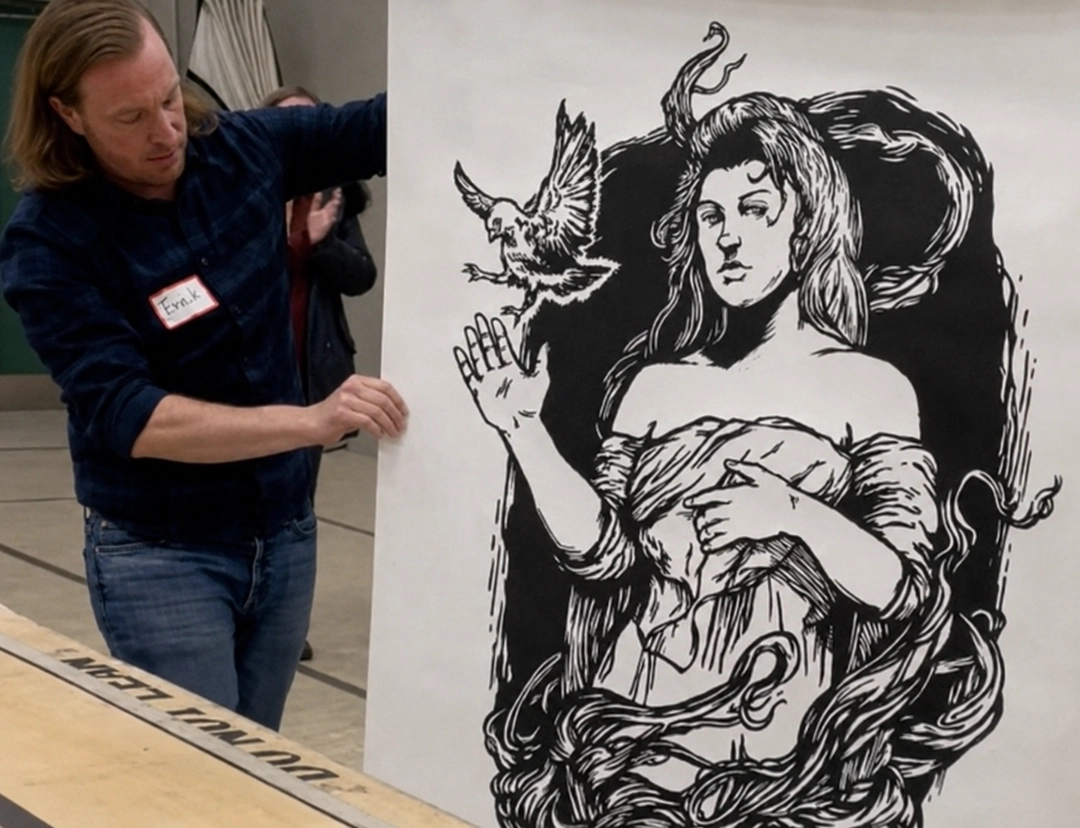
Fred Daniell with his super-sized print at the Big Ink event in the Dunham Recreation gym.
Participation in Gathering of the Guilds also emerged during this period. In 2022, Fred Daniell received an invitation for TLP to take part the following year in a fair organized by the Weaver’s Guild. The gathering brought together guilds and organizations that offered demonstrations and sold work by their members.
Tiger Lily participated in 2023, selling, among other items, pages from its traditional calendars. Attendance exceeded expectations to the point of creating parking problems around the event. For TLP, the gathering generated both sales and greater public visibility.
Educational activities were also strengthened through grants from the Greater Cincinnati Foundation. Funding from the Summertime Kids program in 2023 and 2024 covered materials and stipends for instructors working with kindergarten through sixth-grade students at the Dunham Summer Camp and with high school students connected to the ROMAC program in Over-the-Rhine. Jennifer Baldwin and Blanche Pringle Smith were responsible for preparing these applications.
An Ohio Arts Council grant for 2023–2024 made possible the development of a program identified internally by Tiger Lily as Urban Printmakers and later presented by the Contemporary Arts Center under the title Urban Printers. The initiative was designed for artists from diverse and historically underserved communities. Up to ten participants could receive a one-year membership, materials, and classes introducing them to a range of printmaking techniques. Marvin Davis, Abriljoanna Huerta, Charles Lewis, Emma Wiersma, and Christina Zorn ultimately took part. Their training included linocut, screen printing, and drypoint, together with tools related to the professional development of an artistic career. The project culminated in Tiger Lily Press: Urban Printers, an exhibition presented in the Contemporary Arts Center’s Collective Gallery from February 20 through March 30, 2025.
The program marked an important transformation in Tiger Lily’s social role. The workshop’s long-standing commitment to regional access was beginning to expand through programs specifically designed to increase participation among communities with historically limited access to printmaking infrastructure and training.
2024–2026 / Exhibitions, Markets, and Institutional Continuity
In 2024, Tiger Lily Press presented Indelible Ink: Tiger Lily Press Members Exhibition at The Annex Gallery. The exhibition brought into public view a selection of works produced within the workshop’s collective environment and revealed the range of processes practiced across its community.
Tiger Lily’s relationship with institutions historically connected to Cincinnati printmaking continued to deepen. In November 2025, the eighteenth edition of Local Ink was held at the Art Academy of Cincinnati. More than forty artists from the region presented etchings, screenprints, woodcuts, collagraphs, monotypes, letterpress works, lithographs, linocuts, risographs, artist’s books, notebooks, cards, and other printed objects.
The return to the Art Academy carried particular historical resonance. The institution had housed Tiger Lily from 1985 to 1998, and decades later it once again served as a site of encounter and circulation for one of the organization’s most important public events. That edition of Local Ink also featured the sale of Tiger Lily’s 2026 calendar, evidence of the durability of an initiative born during a period of financial uncertainty at Dunham and eventually transformed into one of the organization’s established traditions.
The Working Artist Residency Program also remained active. A new annual residency call opened for 2026, aimed at experienced printmakers from the Greater Cincinnati and Northern Kentucky area. The program combines studio access, professional guidance, mentorship, community participation, and the development of a public activity or exhibition as the culmination of the residency.
2026 / Tiger Lily Press Today
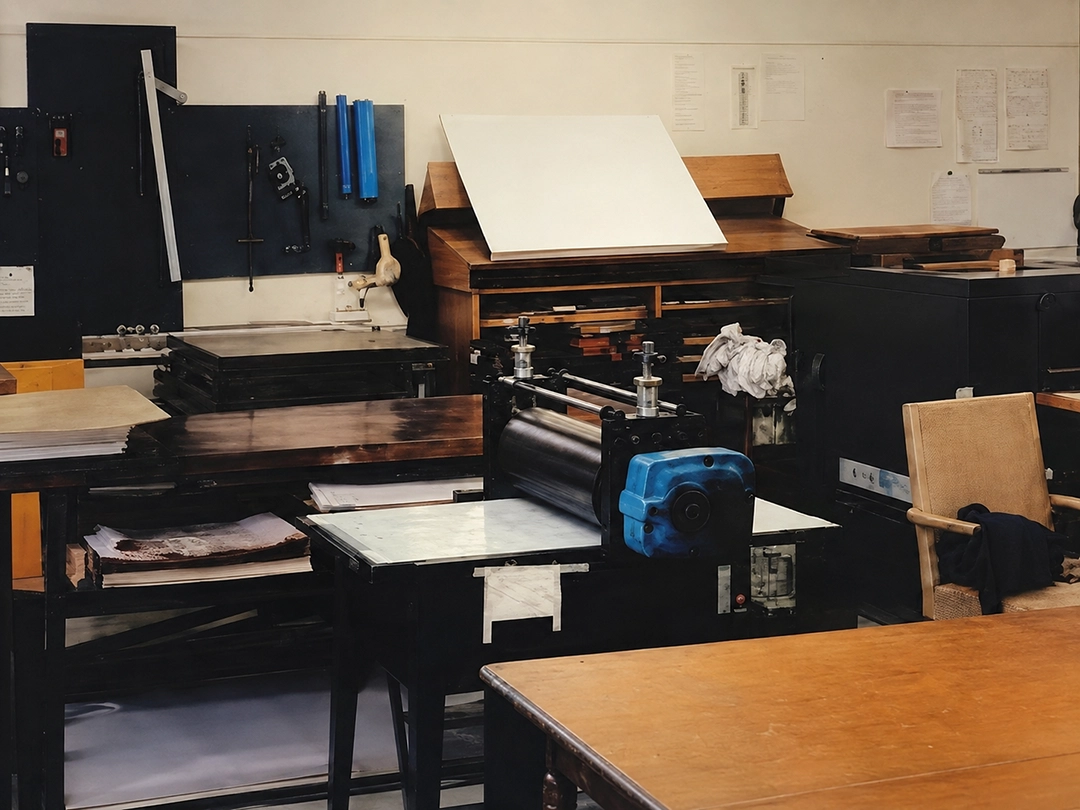
Tiger Lily Press currently occupies the lower level of the Schoolhouse at the Dunham Recreation Center. Its facilities include two large workrooms, storage areas, a washout room, and specialized equipment for a range of printmaking processes. Members have regular access during Dunham’s operating hours, while supervised open-studio periods are available to those who need technical guidance. The administrative structure has also evolved considerably since the years when Tiger Lily depended on a single workshop director.
In 2026, Cecelia “Cece” Tio serves as President of the Board of Directors; Carley Hayes as Secretary; and Susan L. Mueller as Treasurer. Susan Naylor, whose association with the organization extends back several decades and who served as director from 1994 to 1998, continues as Studio Manager. Stephanie Rae Berrie serves as Assistant Studio Manager. The Board also includes members responsible for membership, communications, education, exhibitions, development, and the artist residency program. Its operations continue to rely fundamentally on volunteer work.
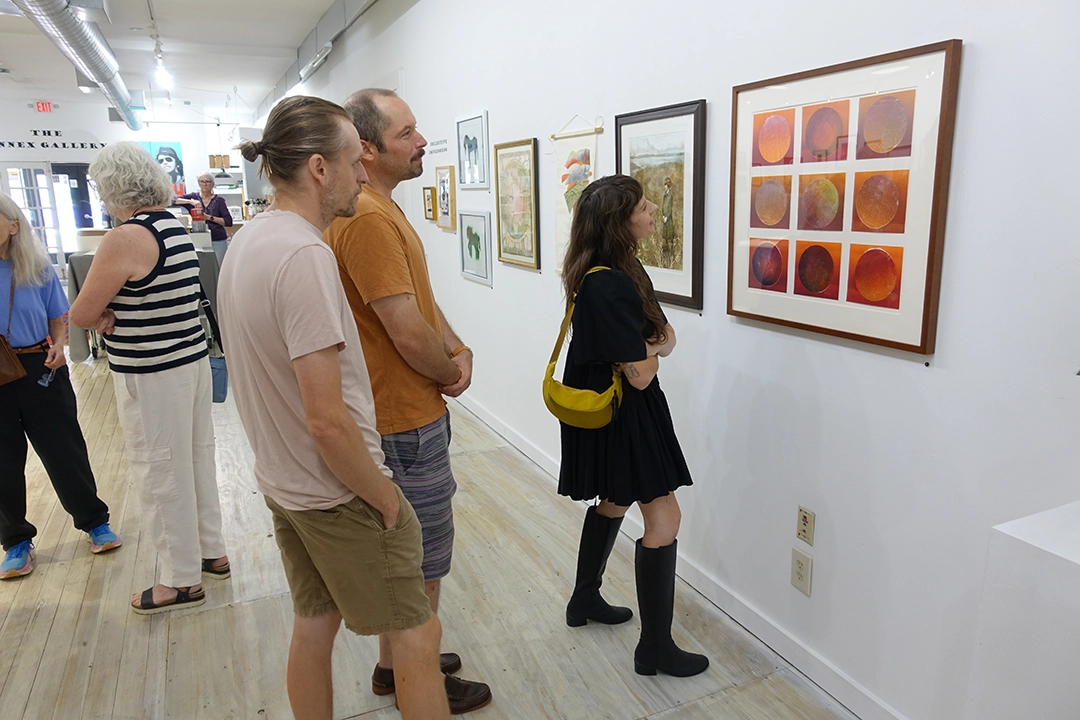
Tiger Lily Press members gathered at The Annex Gallery on Saturday, August 15, 2026.
Collective Impressions: Tiger Lily Press Members Exhibit at The Annex Gallery
The most recent chapter in this history opened on August 12, 2026, with Collective Impressions: Tiger Lily Press Members Exhibit, presented at The Annex Gallery in Cincinnati. The exhibition brings together works by Jennifer Baldwin, Stephanie Berrie, Beth Brann, Shelley Creech, Joan Effertz, Maureen George, Leslie Hanna, April Huerta, Susan Irwin, Madison Longshore, Susan Mueller, Kathleen Piercefield, Emil Wiersma, Carole Winters, Mary Woodworth, Christina Zorn, and Blanche Pringle Smith.
Joan Effertz’s presence carries particular significance within this history. Effertz was one of the five artists who, in 1985, helped keep Tiger Lily in Cincinnati, taking part in the acquisition and subsequent donation of the press to the Art Academy Alumni Association, and she directed the organization from 1985 to 1991. More than forty years later, she appears here as an active artist in a members exhibition, with her work belonging fully to the present life of the workshop. Carole Winters and Jennifer Baldwin, both connected to more recent stages of the organization’s leadership, are also represented. This convergence of generations turns the exhibition into a kind of cross-section of Tiger Lily’s institutional history.
Collective Impressions shares with its audience a selection of individual prints while also making visible the model of production Tiger Lily has sustained from the beginning. These are artists working within a common infrastructure, learning procedures, exchanging technical experience, and producing work through resources that belong to a community.
Seen retrospectively, the history of Tiger Lily Press follows a markedly irregular course. The workshop began within the YWCA, moved to a shared loft in the gallery district, was purchased by artists determined to keep it in Cincinnati, found a home for more than a decade at the Art Academy, occupied a temporary location at the Butterfield Recreation Center, and eventually became part of the Dunham complex. It survived budgetary threats and further internal relocations, formalized its nonprofit status, and later endured the shutdown imposed by the pandemic. At every stage, continuity depended on concrete decisions made by concrete people.
Kate Maynard transformed a proposal into a functioning workshop. Mary Mark kept the press open when its first institutional phase came to an end. Christine Cotting helped sustain it through a period of financial precarity. Mary Ann Butkovich, Joan Effertz, Joyce Howe, Leslie Shiels, and Barbara Young intervened when there was a genuine possibility that the press might leave Cincinnati. Susan Naylor returned at different moments to assume administrative responsibilities. Theresa Gates Kuhr sustained the organization’s leadership for years and developed new initiatives. Later, successive boards, directors, administrators, and members continued adapting the organization to changing circumstances.
Many of the strategies created to solve immediate problems eventually became enduring traditions. The annual print sale and the calendars grew out of the need to raise funds. The residency emerged as a way of deepening exchange with local artists. Members exhibitions carried beyond the workshop a practice that might otherwise remain invisible to the public. Educational programs extended technical knowledge into schools, museums, and summer camps. More recent grants have broadened access and opened the workshop to new communities. Through all these transformations, the organization has retained a recognizable connection to the intention that gave rise to the project in the 1970s.
Within an artistic context in which many forms of production have become increasingly individualized or digital, that continuity has acquired a particular significance. Printmaking preserves a material dimension inseparable from its tools. Preparing a matrix, inking it, cleaning a plate, adjusting pressure, dampening paper, registering colors, or lifting a sheet after it has passed through the press are actions that require time, space, and accumulated experience. They also demand a degree of attention and care that can be intensely rewarding. Tiger Lily Press has preserved that ecosystem for nearly half a century.
Returning to the exhibition, it will remain on view through August 28, 2026. The artists’ reception took place today, August 15, while the Artist Talk will be held on Friday, August 28, as part of Final Friday.





Comments powered by Talkyard.