 Go to English Version
Since Wednesday, August 12, Annex Gallery has been presenting Tiger Lily: Collective Impressions. Tiger Lily Press is a cooperative printmaking workshop founded in Cincinnati in 1979, conceived as an open space for practice, teaching, and the preservation of artistic printing techniques. Over several decades, it has brought together printmakers from different generations, providing access to presses, tools, workshops, and shared technical knowledge, while establishing itself as one of the city’s longest-standing independent printmaking communities.
To understand what a place like Tiger Lily Press means, one must therefore look less toward the recent history of cultural organizations and further back, toward the history of workshops, trades, and collective forms of transmitting knowledge.
Those who know little about art and artists—and those who know everything about both—tend to imagine artistic practice as something carried out in solitude. They imagine painting, drawing, and even certain forms of sculpture as radically individual practices. Printmaking belongs to a different genealogy, one bound to the workshop, to craft, and to shared knowledge. Even when a work emerges from strictly personal experience, its realization almost always leads back to a community that commands a specific technique.
Perhaps this is because printmaking requires instruments and machines more readily associated with collective workshops than with private spaces. Its execution also demands knowledge of processes and procedures that have little to do with the mystique of pure creation. These machines usually exceed the scale of the domestic environment, and operating them draws upon an ancestral memory of solutions accumulated and transmitted through time by thousands of artisan printmakers.
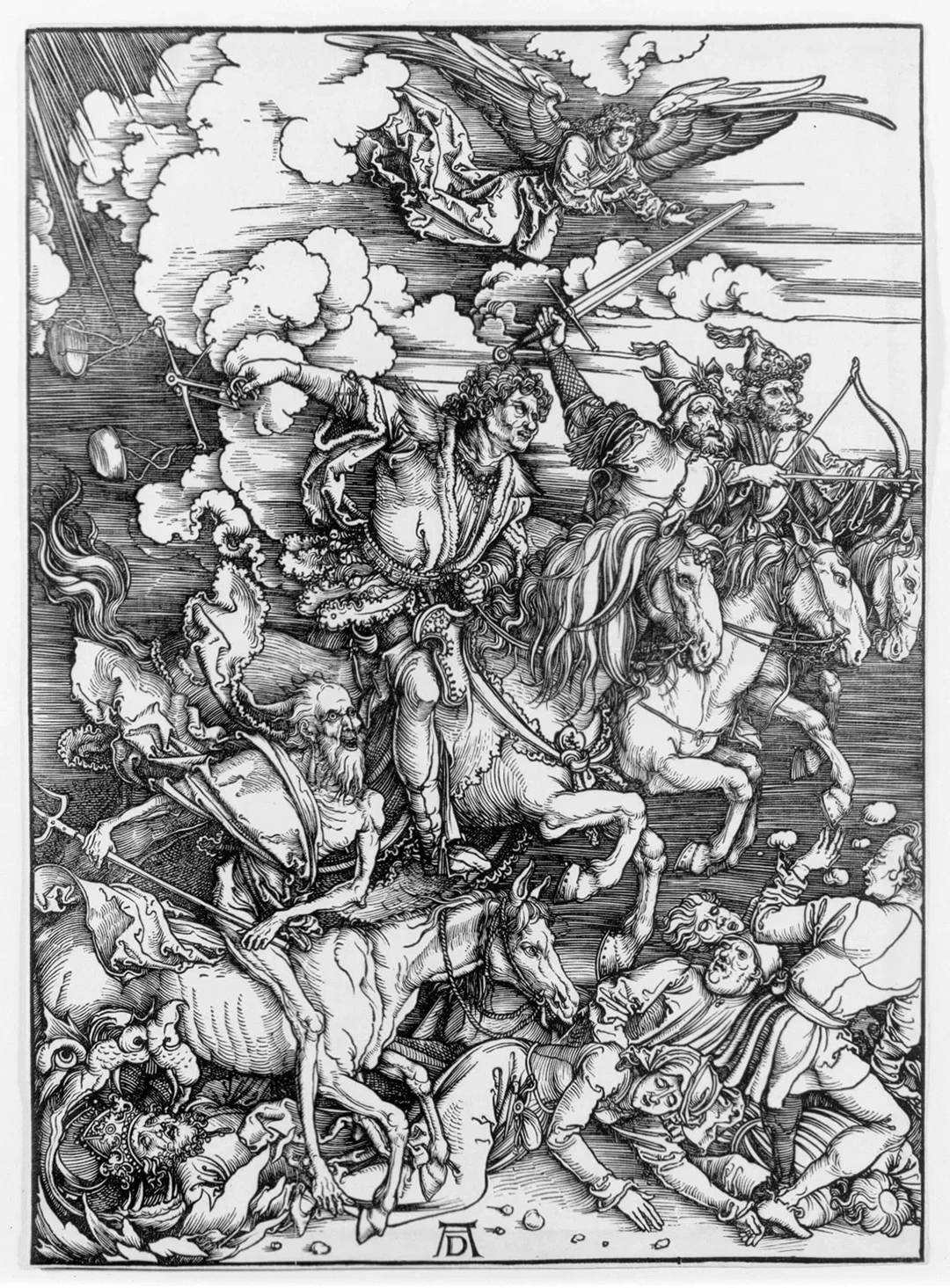
The Four Horsemen of the Apocalypse (B. 64; M., Holl. 167) by Albrecht Dürer (1471 - 1528)
Woodcut, circa 1497-1498, from The Apocalypse, a fine, early impression from the rare German text edition of 1498, before the crack at lower left to the foot of the figure of Death, printing with great clarity and contrasts, an area of slightly uneven printing behind the top of Famine’s scales, on laid paper, framed
Sheet: 390 by 278mm / 15¼ by 11 in
For this reason, and for a few others, a workshop such as Tiger Lily Press belongs to a history far older than that of any contemporary art institution of distinguished pedigree. Its remote antecedents lie in Chinese workshops around the seventh century and, on this side of the world, in the European print workshops that began to proliferate around 1400. These were spaces where knowledge was inseparable from execution, and where learning meant working alongside someone who knew how something was done.
The medieval guild system was an economic and social structure organized through hierarchies, privileges, and controls very different from those we take for granted today. It requires no idealization. It did, however, leave behind a conception of technical knowledge that remains fully relevant, understood as a body of knowledge inherited and accumulated, one that exists in its fullest form when it circulates among practitioners, tools, and successive generations.
Some crafts are impossible to transmit through instructions alone. One must observe how a tool is held, how much resistance a material can bear, when pressure becomes excessive, when a surface is ready, and so forth. This kind of learning depends upon proximity. Master, journeyman, and apprentice share the same space and the same temporality of work.
That structure persists today, among other places, in the world of direct printing, in screen-printing studios, and in printmaking workshops. In the latter, one can speak at exhaustive length about the proper way to ink a plate, yet recognizing the precise moment when the ink reaches a particular consistency belongs to a form of knowledge difficult to reduce to words. The same applies to the moisture of the paper, the pressure of the press, the cleaning of a matrix, or the registration of colors produced through combinations. Anyone who has worked repeatedly with these processes recognizes signs that can be explained, although they are truly understood through practice.
Michael Polanyi called this dimension of knowledge that exceeds explicit formulation “tacit knowledge.” It is the knowledge we are unable to verbalize. The workshop is one of the places where this form of knowledge is safeguarded. A community printshop therefore amounts to far more than a room filled with machines.
An etching press may be described as one of those machines. Technically, it is. Yet without a community capable of using it, maintaining it, correcting its deviations, and transmitting its possibilities, it becomes little more than a heavy object. That infrastructure acquires meaning only when it is surrounded by a human infrastructure.
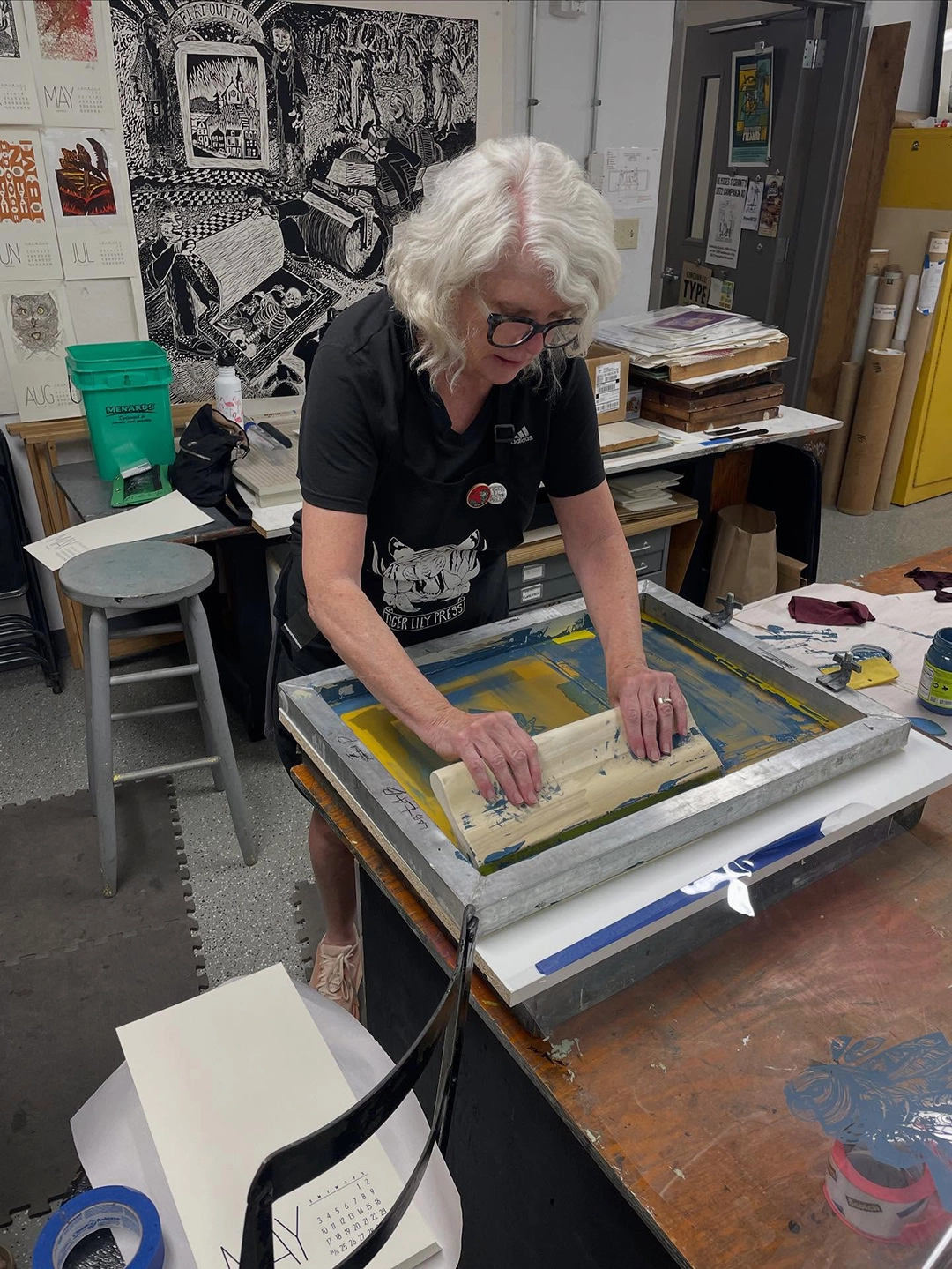
Photograph taken from the workshop’s Facebook profile.
This is how Tiger Lily Press has operated for almost half a century. Its endurance through the years has come from the succession of printmakers and artists who have gathered around those presses and remain willing to teach and learn from one another. By introducing this healthy form of interdependence, it naturally creates community.
Each of those artists may conceive an image individually, yet its graphic realization requires a negotiation with systems governed by their own rules and properties. Acid acts at a particular speed, ink has a specific viscosity, paper absorbs ink unevenly, the matrix preserves and loses detail. Then the press applies uneven pressure. The result never depends exclusively on intention, and the result is almost always a surprise.
These limits are philosophically significant. Much of the modern conception of the artist was built around individual sovereignty and around the work understood as the singular expression of a creative will. The print workshop introduces a correction to that image, because creation there also depends on established procedures that precede the artist’s arrival. Printmaking begins from the premise of using inherited techniques, of drawing upon knowledge that does not originally belong to the artist.
Drypoint, woodcut, aquatint, and letterpress contain the memory of earlier gestures. Each technique incorporates decisions accumulated over centuries about what a particular material can receive, retain, and transfer as an image. Innovation itself frequently begins within a material tradition. A technique can only be altered once it has been fully mastered.
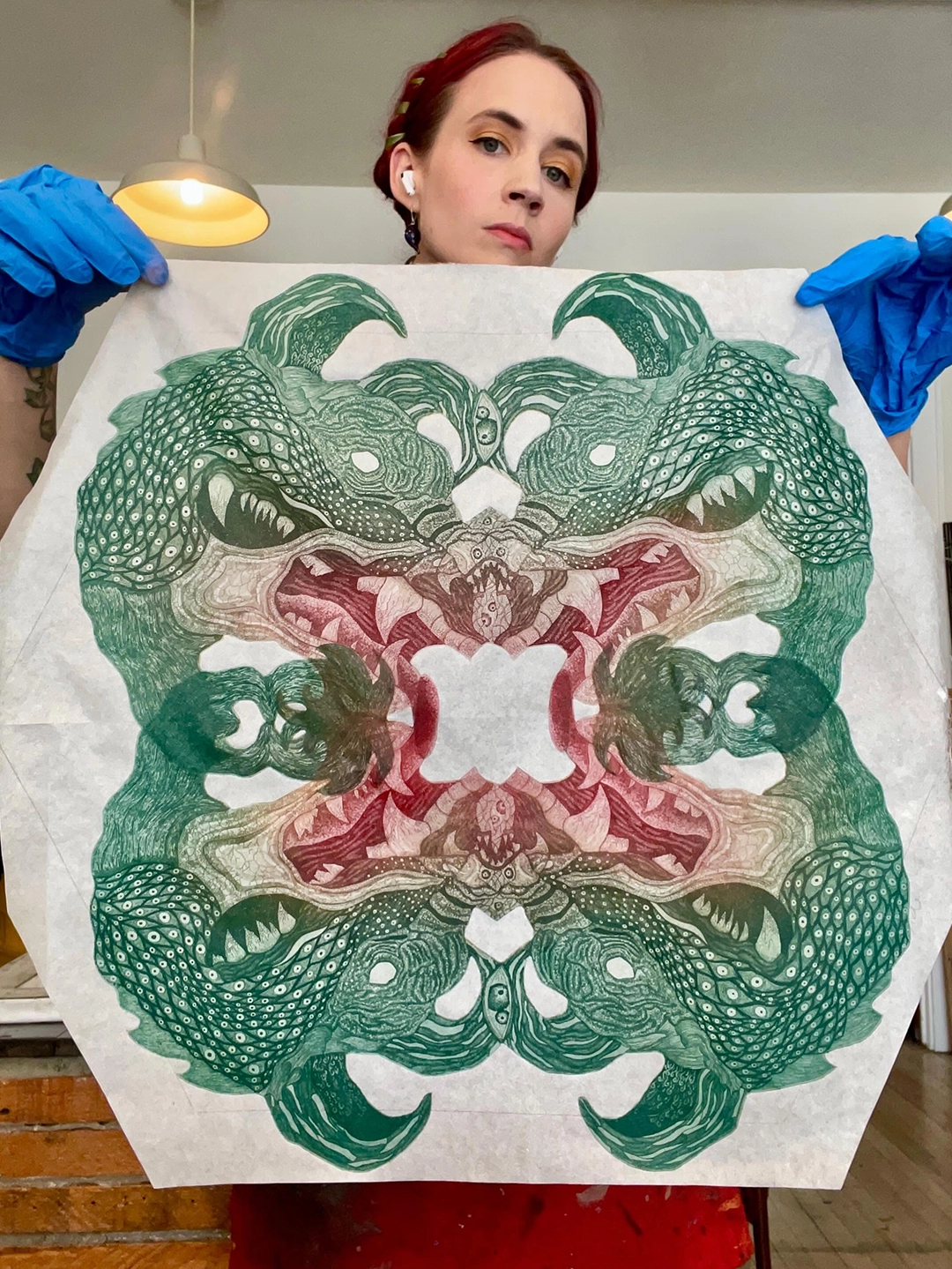
Photograph taken from the workshop’s Facebook profile.
That transmission also helps us understand printmaking’s peculiar relationship with reproduction as a phenomenon of communication. For centuries, reproducing an image was one of the fundamental tasks of a highly localized graphic culture. Before photography and electronic media, prints allowed images, maps, portraits, religious scenes, and works of art to travel great distances from their place of origin. They radically transformed the relationship between image and territory. A painting could remain for centuries inside a church or a collection. A matrix could produce multiple impressions and disperse them. The image could escape its necessary attachment to a single object.
Walter Benjamin recognized this as one of the central problems of modernity when he examined the work of art in the age of mechanical reproduction. Yet the history of printmaking shows that the relationship between original and copy began long before photography.
A print is not exactly a copy. Each impression comes from a matrix, yet each sheet is also a specific material object. Pressure may vary. Inking may vary. The paper may change, a matrix may wear down. Every edition possesses a temporal sequence. Printmaking introduces a singular category, multiplicity without the complete loss of singularity. An edition of twenty prints produces twenty objects related to the same matrix, yet none of them becomes a mere secondary reproduction. This obvious fact challenges one of the market’s most persistent obsessions, the identification of value with uniqueness.
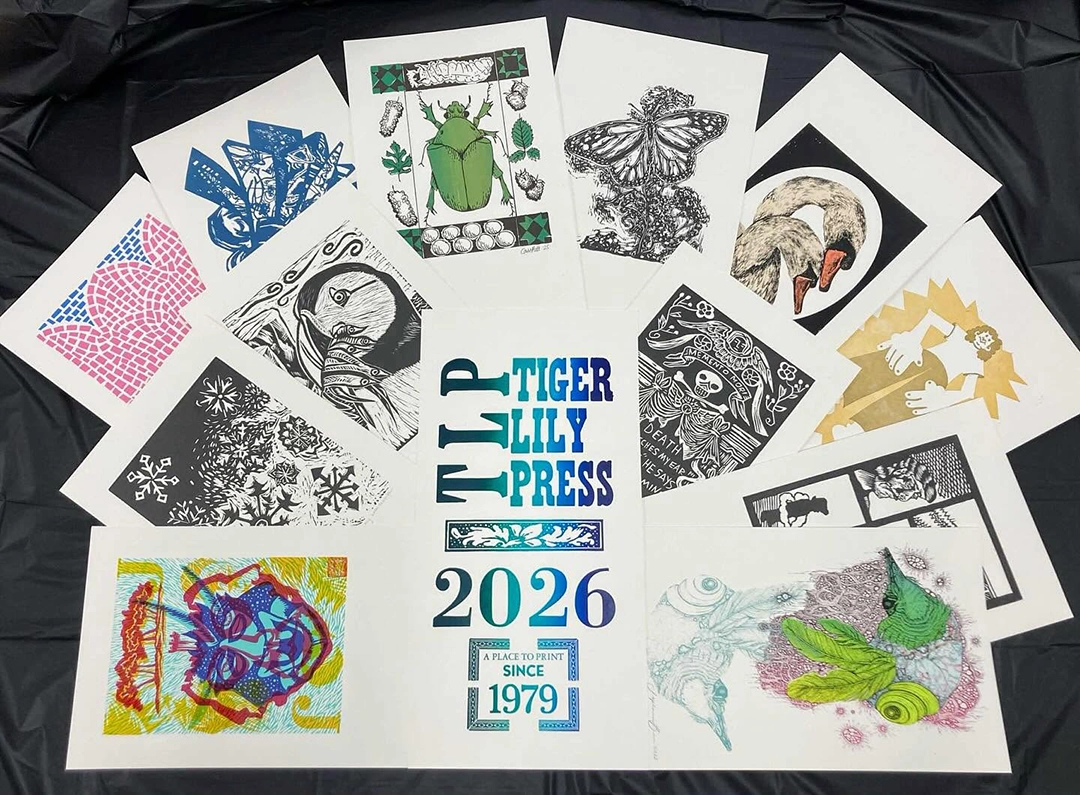
Photograph taken from the workshop’s Facebook profile.
Consider, too, its symbolic economy. It multiplies and remains art. Multiplication may be the artist’s original intention. There is no sovereign original that deteriorates as copies accumulate. There is a matrix conceived precisely to generate plurality. Reproduction becomes the natural condition of the work’s aura. This is profoundly social. A unique painting may belong to one person. An edition may be distributed among twenty. A portfolio may enter several collections simultaneously. An image may circulate.
It is therefore perfectly natural that the history of Tiger Lily Press should be filled with collective editions, portfolios, calendars, and print sales. All of this belongs to the medium’s own logic. These forms allow individual production to enter shared structures of circulation. That relationship between singularity and community runs through the entire history of printmaking.
The space, the workshop itself, also possesses a very particular kind of magic. It is a place for pleasure. Technical pleasure, of course, a subject that receives little attention in contemporary art criticism. Everything becomes contexts, tensions, relationships, identities, markets. Criticism frequently forgets that a considerable part of this practice is sustained by the pleasure of doing something well.
The pleasure may lie in making a plate print correctly, in hearing the press as it moves through the rollers, in lifting the paper and seeing the image for the first time, or in cleaning a matrix so that it can be used again. There is also a less individual pleasure, the pleasure of working near people who understand exactly this kind of satisfaction. A community takes shape around that shared knowledge.
Specialized knowledge creates a particular form of intimacy. Two printmakers can talk for half an hour about papers, inks, rollers, or pressure and, in reality, be talking about an experience of the world. They are discussing how matter responds most fully to manipulation. There is an almost alchemical impulse in it. That conversation unfolds constantly inside a community workshop.
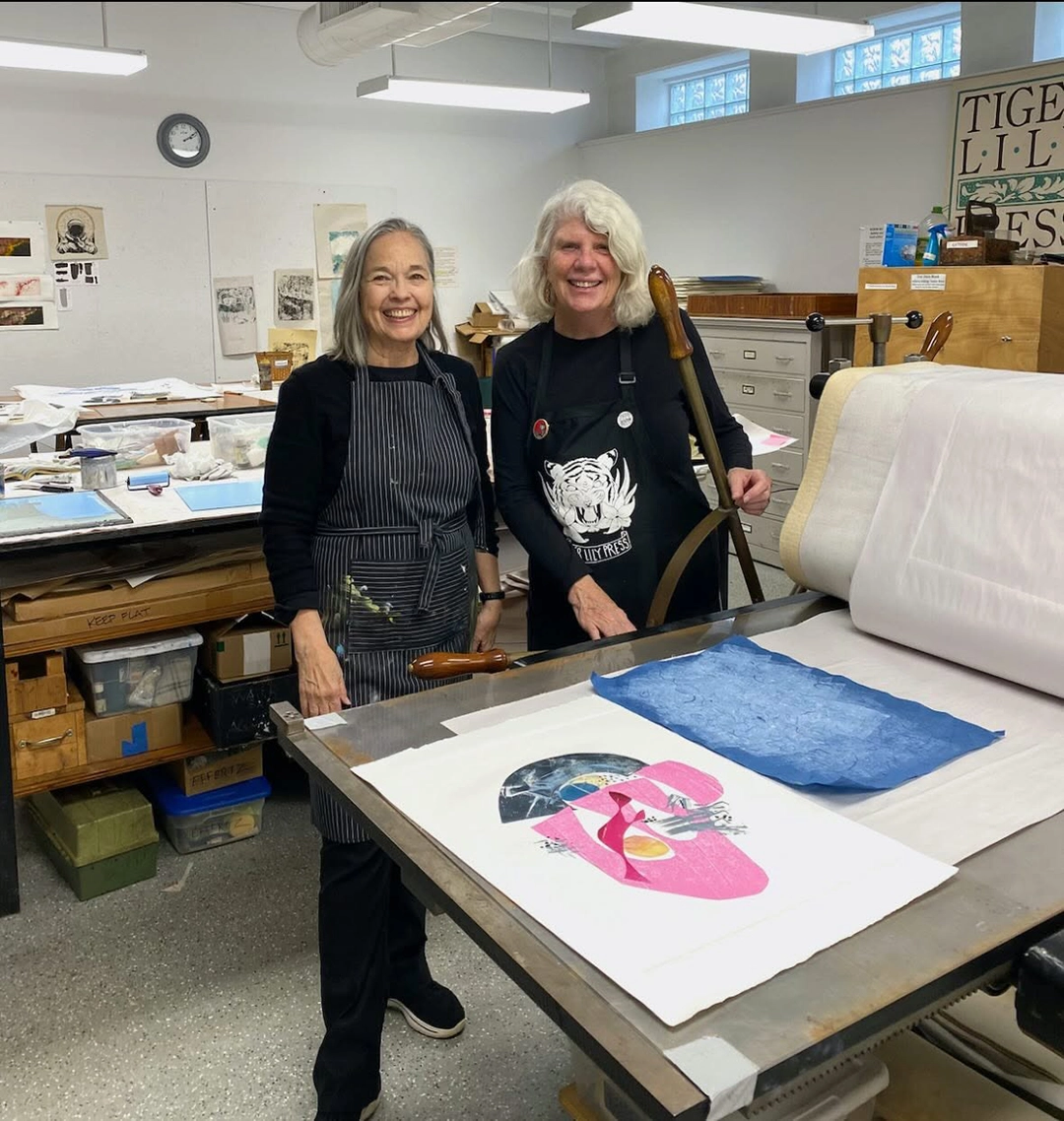
Photograph taken from the workshop’s Facebook profile.
The mere existence of spaces such as Tiger Lily Press carries a meaning that exceeds the preservation of an artistic discipline. Beyond the vigilance of custodianship lies the task of establishing the conditions under which the discipline can continue to evolve. It needs users, mistakes, people who learn badly and then improve, a space of continuity. Contemporary culture is increasingly dominated by interfaces designed to conceal their mechanisms. Printmaking preserves an extraordinarily transparent relationship with its process.
Imperfections are what distance this technique from digital multiplication, which replicates images infinitely and with scarcely any material weight. Every print requires work with matter. Every impression consumes ink, paper, time, and energy. Every copy passes through the physical world. Today, it is an almost subversive technique, obstinate and stubborn. That is one of the keys to its continuing relevance. Tiger Lily Press has sustained this practice for decades. That is its deeper history.









Comments powered by Talkyard.