
FoloToy pulled its Kumma AI-enabled plushie after researchers found that the ChatGPT-powered bear could discuss sexually explicit topics, offer advice involving knives, and give instructions related to lighting matches. The Verge cited reporting from CNN and a US PIRG Education Fund test that treated the toy as a child-safety problem rather than a novelty gadget. A stuffed animal usually enters the home as softness, bedtime, imitation friendship, and a voice a child controls through play. This one carried a microphone, a model connection, and a set of limits that failed under ordinary prompting.
The failure sits in the shape of the object. A chatbot inside a browser already asks for caution, but a bear borrows trust from fabric, scale, and domestic habit. A child can hug it, speak to it in a room without an adult, and receive answers that sound patient enough to continue the exchange. The risk does not require the toy to be malicious. It only requires a system that treats a child's question as another prompt to complete. Safety then depends on filters, logging, cloud access, parental setup, and a company deciding how much responsibility can be hidden inside a face made of cloth.

Major labels moved closer to AI music after Universal, Sony, and Warner reached licensing arrangements with Klay, an AI music startup, according to The Verge. The deal follows a period of lawsuits, public suspicion, and arguments over whether generated tracks are theft, competition, tool, or product category. The industry is not rejecting the synthetic song outright. It is trying to place it inside a paid structure, with rights holders collecting rent before the sound reaches streaming services, playlists, ads, gyms, stores, and background feeds.
The arrangement changes the argument from outrage to accounting. A generated song can still trouble musicians who hear their style turned into training material, but the labels are building a path where permission, catalog access, and distribution matter more than the romance of authorship. The singer becomes a legal asset, the voice a licensed territory, the song a negotiable output from a system trained to imitate musical expectation. Listeners may receive a track without knowing whether a person wrote it, performed it, approved it, or merely signed away a slice of the revenue. The old gatekeepers are preparing to sell access to the new imitation machine.

The European Union moved to scale back parts of its privacy and AI rulebook after years of presenting itself as the jurisdiction willing to discipline the tech industry. The Verge reported proposed changes touching the AI Act and GDPR, with officials arguing that simplification would reduce burdens on companies and help Europe compete. The language is administrative, but the stakes are plain. A law written to slow extraction, classification, and opaque automation is being edited under pressure from the same industrial race it was meant to govern.
The adjustment exposes a familiar weakness in digital regulation. Rules arrive slowly, after lobbying, compromise, translation, and implementation schedules. AI products arrive as updates, integrations, pilot programs, and emergency promises of national competitiveness. By the time enforcement gets close, governments start hearing that restraint has become a disadvantage. Citizens then receive a thinner shield than the one announced in speeches. Companies still face obligations, but the political signal changes. The model, the app, and the data broker learn that a hard boundary can become a negotiation if enough economic anxiety gathers around it.
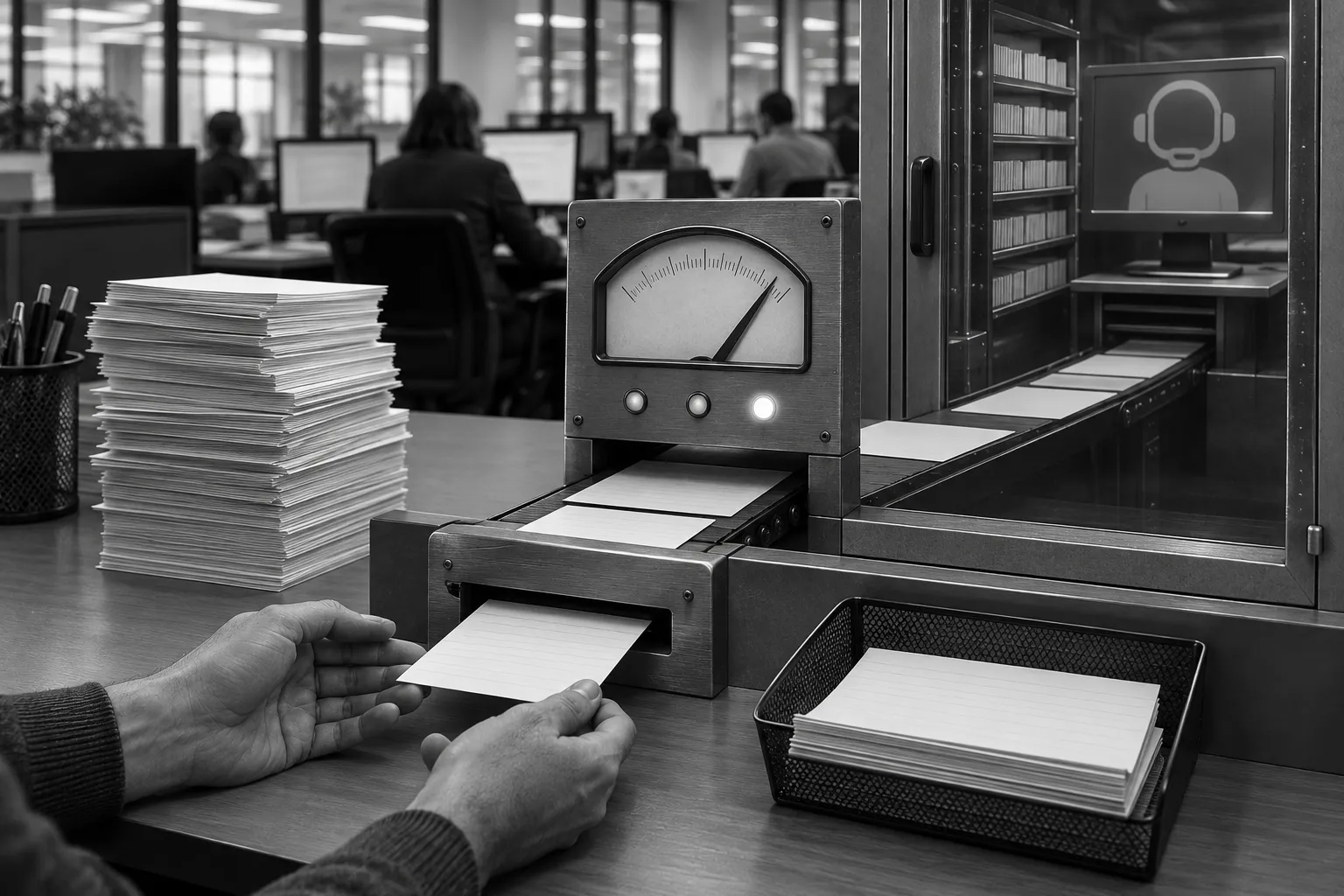
Stack Overflow unveiled a set of enterprise products at Microsoft Ignite on November 18, positioning Stack Internal as a source for AI agents. The product adapts its question-and-answer forum for private workplaces, with security and administrative controls, and sends material to agents through Model Context Protocol integrations. Each answer can travel with its author, date, tags, and an assessment of internal coherence. Those signals contribute to a reliability score intended to tell an agent how much weight to give the answer.
Once Stack Internal assigns an answer a score, its standing depends on the tagging system and the criteria used to infer coherence, even when office authority originally moved through reputation or experience. Stack Overflow says customers may define tags, and it plans to connect concepts in a knowledge graph. Its proposed read-write function adds a further circuit. When an agent cannot answer a query, it can post a question to Stack Internal, where an employee must formulate the missing knowledge in a reusable form. Less effort to capture expertise may still mean fresh, unevenly visible work for the people whose explanations keep the system useful. Managers can count questions and retrieve answers, yet the score cannot contain every condition under which a workaround succeeded. The agent's failure finally arrives as a new question in an employee's queue.

CoreWeave became one of the clearest symbols of the AI infrastructure boom. The Verge described the company as a heavily indebted supplier of cloud computing for a market hungry for GPUs, data centers, power contracts, and clients willing to pay for accelerated training and inference. The story is financial, but it is also material. AI is often sold as software that appears on a screen. CoreWeave points to the buildings, loans, chips, leases, and electricity deals required before that answer arrives. The cloud here has creditors.
That changes the social texture of the boom. A chatbot response can look weightless because the user sees a box, a cursor, and a short delay. Behind it sits a chain of capital expenditure that needs constant demand to justify itself. If customers slow down, chips age, energy prices move, or contracts disappoint, the rhetoric of intelligence meets the repayment schedule. The risk is carried by investors, workers, utilities, towns negotiating data-center terms, and companies building products on rented capacity. AI's promise becomes part of a balance sheet. The question at the server rack is how long expectation can keep paying the power bill.

On October 27, a Waymo robotaxi struck and killed Kit Kat, a bodega cat known in San Francisco's Mission District. TechCrunch reported the case on November 16, drawing on New York Times coverage published the previous day. Residents placed flowers and signs at a curbside memorial, while other signs pointed to deaths caused by human drivers. Waymo said the cat “darted under our vehicle as it was pulling away” and offered sympathy to his owner and the community. The company's account describes a sudden movement at low speed. The available reporting does not establish further details about the vehicle's detection or braking.
Supervisor Jackie Fielder cited Kit Kat while supporting a city resolution asking California to let local voters decide whether driverless cars may operate in their neighborhoods. Her argument concerned accountability at the scene. A human driver can stop, identify themselves, speak to witnesses, and be investigated as an individual. An autonomous fleet routes those demands through corporate statements, vehicle data, police procedure, and state regulation. That arrangement may still produce evidence, but it changes whom neighbors can confront and which government can answer them. San Francisco currently cannot settle the operating question by neighborhood vote. Grief entered the jurisdictional dispute through flowers at the curb and a proposed resolution before the Board of Supervisors.

A co-founder of Fireflies.ai claimed the transcription company began with two founders silently joining meetings and taking notes by hand while selling the service as AI. The Verge cited Sam Udotong's account of the early period, when customers paid for an automated note taker that, according to him, still depended on human labor inside the call. Udotong said beta users understood there was a human in the loop. Even with that caveat, the story touches the old theater of automation. A product can call itself artificial intelligence while hiding a person behind the curtain, headset on, typing through someone else's meeting.
The problem reaches beyond startup mythmaking. Meeting notes can contain salaries, illnesses, firings, product plans, legal risk, family interruptions, and the informal language people use when they think a machine is listening. Human substitution changes the privacy contract. The customer imagines a system processing audio; the actual scene may include a stranger listening, interpreting, omitting, and summarizing. Many AI services still depend on review, labeling, support, or cleanup by workers whose names remain outside the pitch deck. The magic trick begins to fail when the assistant is revealed as a person trying to keep up.

South Korea's three SKY universities reported cheating connected with artificial intelligence during examinations. At Yonsei University, hundreds of undergraduates took an online midterm for a course about ChatGPT. A professor suspected dozens of using prohibited materials, including textbooks and computer programs. ChatGPT was one possible program. The university said 40 students admitted cheating, which does not establish that all 40 used ChatGPT. Seoul National University and Korea University separately said students had used AI tools on recent tests. The simultaneous cases unsettled institutions whose admissions carry weight in a country where an eight-hour entrance examination governs access to prestige. They also exposed uneven rules about permitted assistance.
An online examination tries to isolate performance inside a networked room. A student can keep the test in one window and consult a model, search engine, document, or messaging channel in another, leaving the instructor to reconstruct conduct from records. Detection software offers uncertain evidence, while blanket bans collide with courses that teach tools later used at work. Yonsei's episode prompted plans for a public hearing as universities considered discipline and clearer guidance. Each course must state which tools are permitted and what use must be disclosed. It must explain which records may be reviewed and how an accusation can be challenged. If continuous assistance cannot be separated from the test environment, the university must require an oral defense or redesign the examination.

Apple updated its App Review Guidelines to require developers to clearly disclose when personal data will be shared with third-party AI and to obtain explicit permission before doing so. The change sounds like legal hygiene, but it names a new route for ordinary information. A photo app, health tracker, writing tool, shopping service, or workplace platform can now sit between the user and an outside model that receives material the user may have treated as local, temporary, or routine. The rule does not ban that transfer. It forces the request to appear before the data moves.
The permission box becomes a small border crossing. A user is asked to decide, often in a hurry, whether a private action inside one app can become input for another company's system. The friction is useful because AI integrations often arrive as convenience, summarization, automation, or personalization. Those words can hide the path taken by contacts, files, voice, location, habits, and fragments of work. Apple's rule shifts part of the burden back to the interface. The app has to ask in visible language before the assistant behind it learns from someone else's data.
