
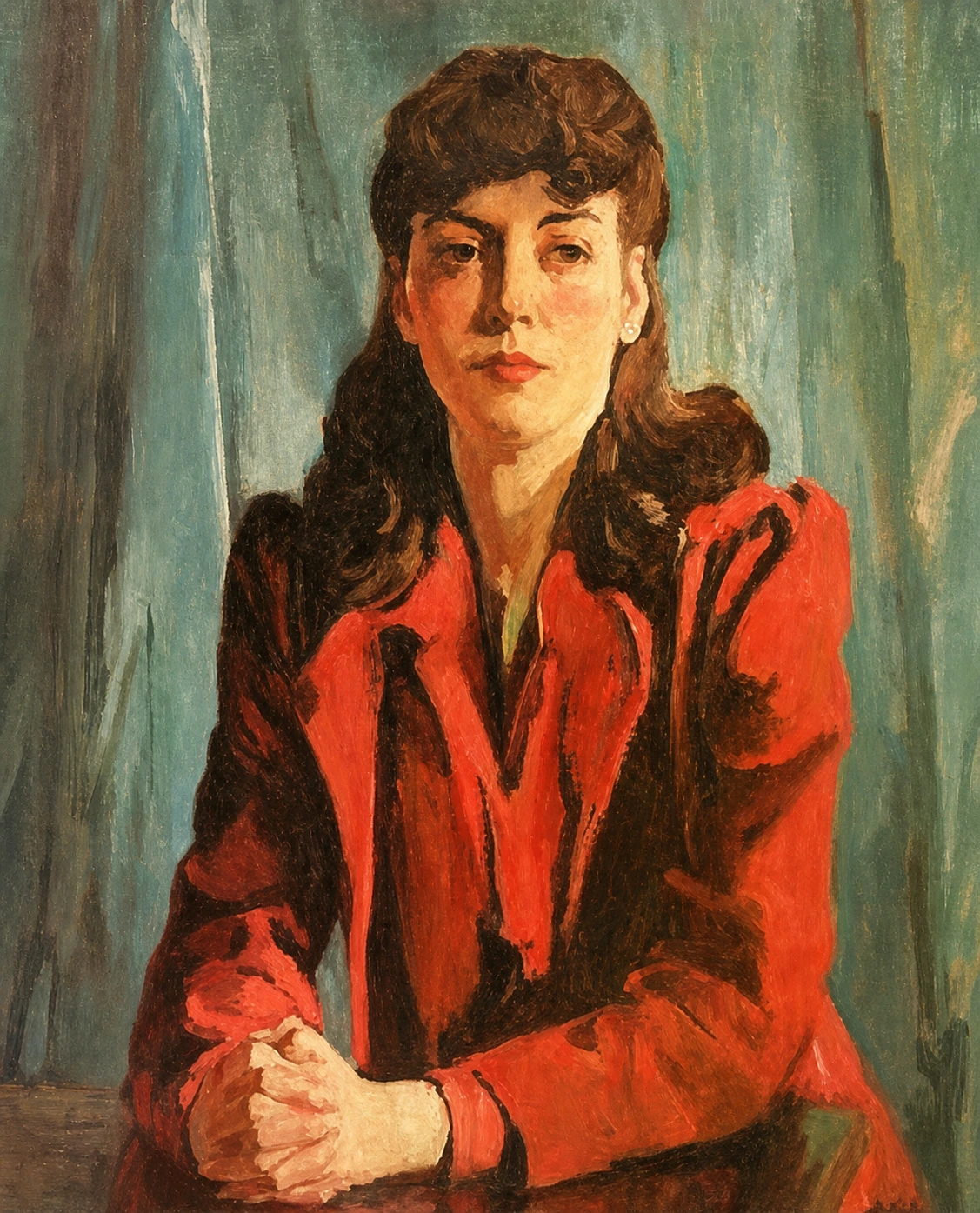
Once I thought of Bessie Wessel with some pity, a victim of her times, when women were permitted to study, but not to enjoy a full, satisfying career. Men, like Bessie’s husband, Herman, would pursue success in the world, while the ladies, God bless ‘em, tended the comforts that would enable the men to fight the good fight. Then I saw Bessie’s self portrait at Ran Gallery, painted in her mature years. In it she looks straight ahead with calm, sure, straight-backed complaisance, …and a touch of iron.
Along with so much of art history in the Cincinnati area, Bessie and Herman were Art Academy of Cincinnati people. He became dean of the school and Bessie taught there, until she found herself so caught up in the personal problems of her students, that she became unable to think of her own concerns. It was there, though, that she and Herman deepened their friendship, eventually marrying.
Herman made his mark on the times by becoming president of the Cincinnati Art Club, then a strictly male organization located on Fourth Street in Cincinnati, and Bessie had joined the Woman’s Art Club while still a student. Both ardently supported new organizations furthering artists and the arts, while continuing to paint until their deaths.
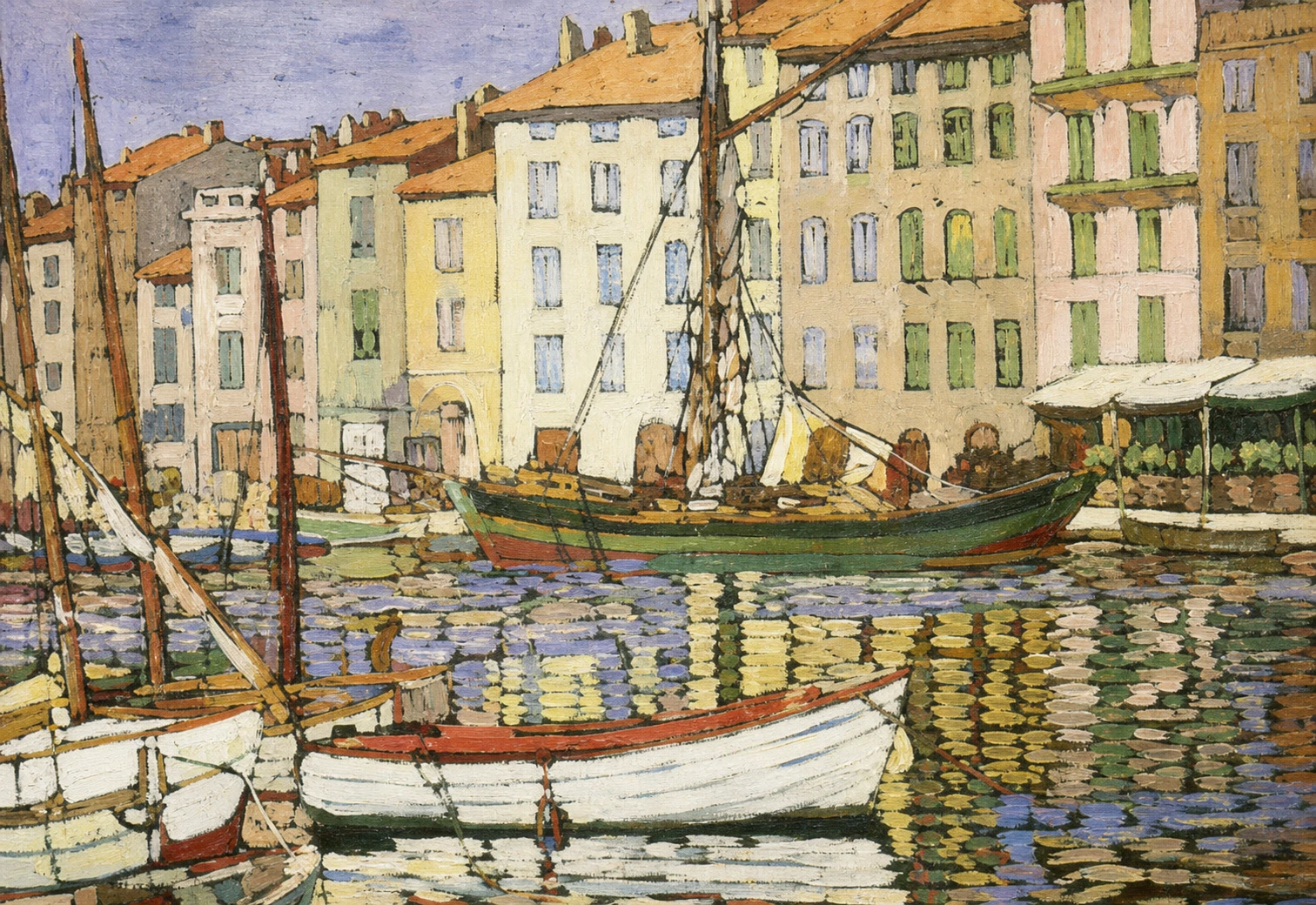
Bessie had never shared Herman’s admiration for the “modern” trends in painting which began to appear in the U.S. during the 20’s and 30’s. However, her “mosaic” style paintings, three of which are included in the Ran exhibit, nod at Prendergast’s segmented style of painting. These are painted on dark green window shades. Shades were inexpensive, easily available, and conveniently provided an appropriate ground for her Maine landscapes, as well as one included of the harbor at St. Tropez. The couple usually summered in Maine, and both produced works featuring the clear light and seaside subjects from that location. Window shades , at that time, were usually canvas or other heavy woven material, adding an easily perceived texture to the images.
Native Americans were a popular subject at the time, and Bessie succumbed to the genre. While others, Farney, Sharp, etc., concentrated on the fierce light of the west, Bessie painted her Indians in dignified portraits with the same knowledgeable hand that she applied to the other of her 200 plus portraits. These lack something of Bessie’s usual involvement , possibly due to the unfamiliar personalities. The most admired of Bessie’s talents was the ability to portray her subjects with a nearly tangible insight. This didn’t alter her style, concerned much with paint quality, but it did bring to her portraits an added element that many portraitists miss.
Two of the pieces in this show are especially interesting. “Mary Snow” a small 20” x 24” oil, is a soft, young African-American, painted with a gentle concern that tells of the artist’s connection with the girl. She poses obediently, possibly a bit leery of the situation. “Mary Snow” is one of those paintings which makes the visitor wish to know more about her secrets.












Comments powered by Talkyard.