
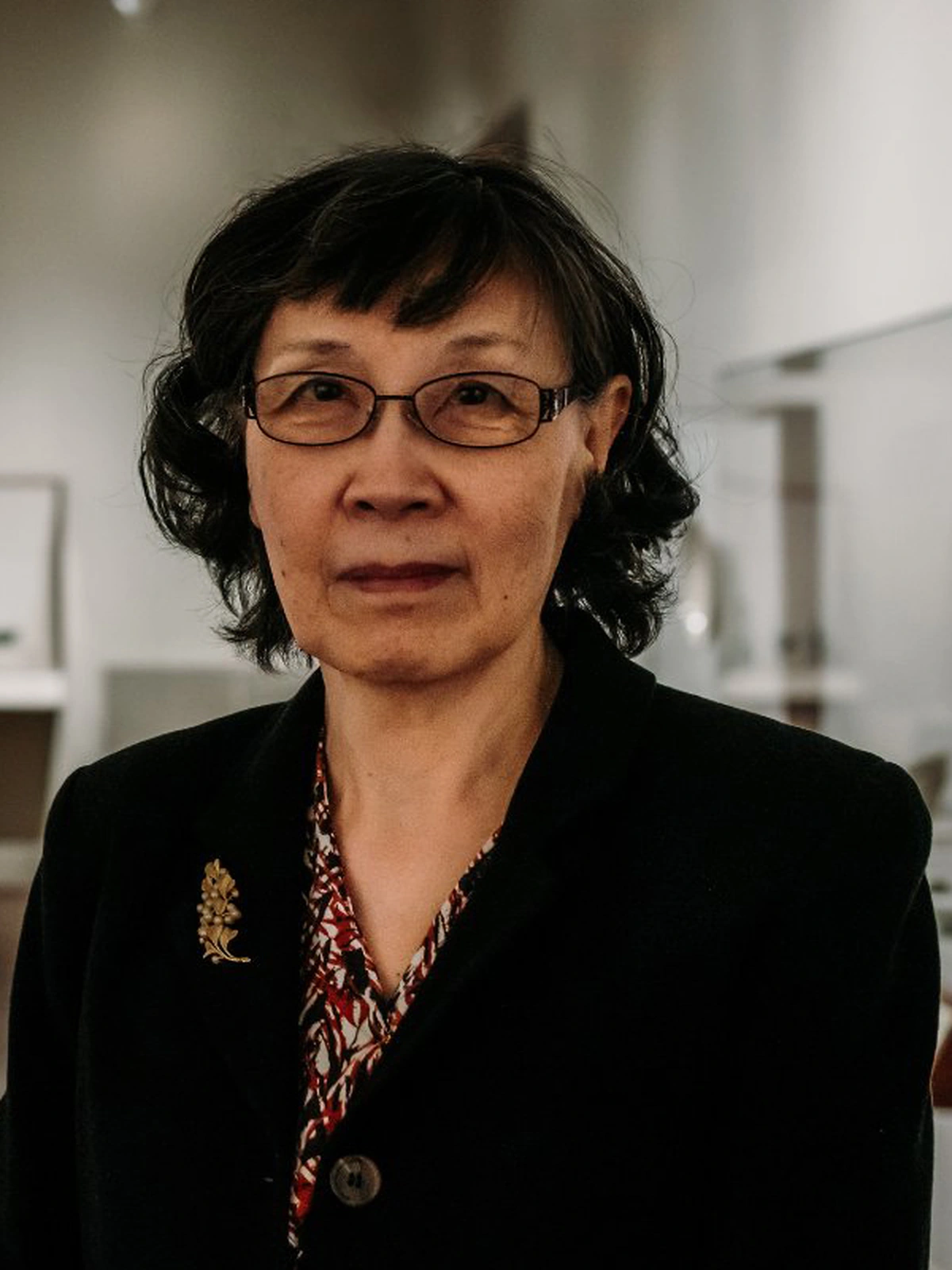
Dr. Sung has served as the curator of Asian art at the Cincinnati Art Museum since 2002. In her 2009 show, Roaring Tigers, Leaping Carp: Decoding the Symbolic Language of Chinese Animal Painting, Dr. Sung drew on ten years of research to present more than 100 paintings that illustrated the use of animal symbolism in Chinese art. China has the longest recorded history of any culture, and even the most cursory look at the art reveals layer after layer of referenced cultural history, word play, and even subversive political criticism during various periods of history. The catalogue may be found at the exhibition catalogue.
AEQAI editor Daniel Brown, who has a Masters degree in Chinese and Japanese painting, was delighted by both the quality of the exhibition, the astute choice of paintings selected by Dr. Sung, and the obvious vastness of her knowledge of Chinese painting and culture. “I hope the museum allows her to do more shows of this stature, especially as so many local corporations do business in Asia.”
“The barrier to understanding Asian art is, number one, you have to change your mindset. If you look at it as you do Western art, you are not going to see anything,” says Dr. Sung. “In Western art you look for the light source, the vanishing point, all that perspective, how realistic it is. However, Asian art is not trying to convey that realistic image. The artist is trying to portray a sort of cumulative visual image – how looking at a landscape is a totality. They travel in the mountains, and with that experience, they go home and paint everything in their minds. In that way, you’re going to see all the artist’s experience, on the top of the mountain and in the valley. It’s like a composite without a single perspective, but far more. What they are also are trying to portray is the concept of nature. The Asian concept of nature does not have the human as the center of the universe. Humans are instead part of nature. You then paint it as thought you are in there, not looking from outside. And that is the difference. You don’t need a special focus, but if you have the context, it helps you see more.”
To begin to read about symbolism in Chinese art is to get immersed in the nation’s history, religions, folklore, and language. One quickly realizes that art in any country cannot be totally separated from the whole of its human history and cultural evolution, but nowhere does this seem as deep and complicated as when confronting Asian, and especially Chinese art as a single discipline. [It is inter-disciplinary, integrating Chinese philosophies and cosmologies. Chinese art is holistic, including and integrating most disciplines that we, in the west, call the humanities. – Ed.]
Dr. Sung adds that there is also Asian cosmology involved, so that when they paint there is, for instance, a contrast of mountains and water, solid and void, yin and yang. “So if you don’t understand how they see nature, you can not appreciate the art. I did the animal painting show, because I wanted to introduce this new perspective. Animals have yin and yang. For instance, the dragon is the yin; the tiger is the yang; each is an integral part of the other.
“The Chinese say that when the yin and yang join, the hero arises. Once you understand the complexity, you can apply this to many Chinese cultural messages, from martial arts to medicine, cosmology, or feng shui . It’s all built on their cosmology and understanding of nature, so it’s helpful to know the basic differences. When you talk about a tiger, within 5000 years of Chinese history, you have to know whether you are talking about a tiger of the tenth or twelfth century.”
Dr. Sung says the associations change and sometimes are sociological and sometimes political. For instance, in the Song Dynasty (960 to 1279) a tiger with cubs was a negative message referring to a corrupt official or government. “There was an official in the Han Dynasty (206 BCE to 220 CE). He was extremely harsh on the people, to the extent that people advised the ruler not to let him rule people directly, so the emperor put him in a mountainous region. Even so, the people would say ‘I would rather face the danger of a tiger with cubs than the rage of this official.’ But in the Ming Dynasty the same image would mean filial piety.” In both cases, observation of the actual nature of the animals is the same – a mother tiger protecting her cubs.
There are also shared symbols across cultures, like the hawk or eagle being heroic. The Chinese rate their animals by their merit, by the nature of the animal, so hawk or eagle (same word in Chinese) symbolizes heroic fierceness, the king of birds – military spirit, heroes, and rulers.
Of her own life, Dr. Sung says, “I came here after I finished my Masters Degree (a B.A. in foreign languages and literature and an M.A. in Chinese history, both from the National Taiwan University), so learning the language and culture was indeed difficult, especially in a university setting where one has to write and compete.” She earned a Ph.D. in museum studies from Case Western Reserve University.
Dr. Sung was two when her family escaped the Communists in China, so she grew up in Taiwan understanding Taiwanese and speaking Mandarin Chinese, one of many, many dialects in China. She says it is still difficult to write comfortably in the English language.
Art was an interest in Dr. Sung’s family, and although her father never had an art education, he was a very good painter. Dr. Sung’s education did not include art history, as there was no such field of study in Taiwan or China when she was growing up. “Art history as an independent discipline really started in the West. The number one choices in Taiwan for people interested in the humanities were English and literature.” Her father couldn’t get a promotion in his government job, because he did not speak English.
Her first job was at the National Palace Museum, which contains nearly every important Chinese treasure from dozens of centuries. [The art was the most important part of China’s history and patrimony, taken by boat by Chiang Kai-shek to Taiwan after the victory of Mao Zedong on mainland China. – Ed] “It just so happened that the American organization, the Asia Society was in Taiwan at that time. They proposed a course in Chinese art history, saying, ‘you have a wonderful collection here and a wonderful university – why does no one study Chinese art history?’ The Asia Society provided the funds for a masters program to accept five students, so we all competed for the five slots, and I got in. It was sponsored by the National Palace Museum and the National Taiwan University. However, the university refused to recognize the curators in the museum, because they didn’t have a degree. Basically what we studied at the museum was the same course work as any masters’ degree. So we had to do one year with no credit. At the museum we really had much more; we got to study the actual objects. We got to see and touch the real objects. How ever can you do that if you study in a regular art history program?” She kept her job, part time, at the museum while studying.
“After that I wanted to get a further degree, which was not possible in Taiwan.” So she came to the United States, and for financial reasons, she applied for Museum Studies, because it was the most generous scholarship program. I studied with Dr. Sherman Lee,” she says, “it was wonderful.” [Lee was director of The Cleveland Museum of Art, where he built one of the greatest collections of Chinese art outside of The Palace Museum. – Ed.]
After she graduated, she did part time teaching, because she had young children and didn’t want to leave Cleveland. Later she worked as the executive officer of the Chinese American Faculty and Staff Association and program director of the Chinese Arts and Culture celebration at Cleveland State University before she came to The Cincinnati Art Museum.
The present economy affects all levels of society, and for CAM, as for many other institutions; it means few big shows with works from other museums. “We have to use what we have,” says Dr. Sung. “I could do so many wonderful shows, if there were the funding for them.”
What would be her choices if she suddenly had funding? “First I would like to finish a life-long dream project of mine. My in-depth research is the Ming Dynasty (1368 to 1644) court painters, organization, institutional history – because it has been a gap in Chinese history. We don’t understand the court painters. We don’t know about the history, the painting academy, when it started, and what was their ranking system. I realized when I started research what an important role these artists had in Chinese painting history, and I have discovered a great deal. For instance the court painters’ positions changed. They used to be court employees, but they were removed from their official status and became almost the emperor’s personal employees, becoming deeply involved in the political power struggles. They were supervised by the court eunuch. That’s why they were not represented in the Chinese art history that was written by the scholars.” Powerful eunuchs during this period commanded armies, managed imperial workshops and participated in matters of appointment and promotion of officials, running a huge bureaucracy parallel to but not part of the Civil Service.
And exhibitions? She continues her thoughts about as yet unfunded ideas: “I want to help introduce Chinese culture to the general public, because as a curator, I think it is my job is to make the culture more understandable. This was the reason I did the animal show. Chinese history may be complicated, but it has continuity, because although the language has evolved, the characters we use are actually connected to the first oracle bones. Those characters were the inscribed on the shoulder and leg bones of animals that were used for divination. From those ancient times, we have continued to use the same language. [All Chinese painting is based upon calligraphy. – Ed.]. I think I can use different subjects to introduce the art, a little at a time. The reason I use the Ming period is because it was the last Chinese rule of the ethnic Han Dynasty.”
Dr. Sung is the Asian Department at CAM, the whole department, so writing a grant is a challenge. She says that for something like the National Endowment for the Arts, one has to write almost the equivalent of a book. “It becomes like the chicken and the egg – we don’t have the money for me to take the time to write a grant, and then we don’t have a grant to fund the exhibitions.”











Comments powered by Talkyard.