Leonardo da Vinci, The Virgin of the Rocks, c. 1483–1486. Oil on wood transferred to canvas, 199 x 122 cm. Musée du Louvre, Paris.
In London, on the day I went to both exhibitions, it seemed that everyone who wasn’t at the National Gallery’s stunning Leonardo da Vinci: Painter at the Court of Milan had come to the Royal Academy for David Hockney’s knock-your-eye-out responses to the English landscape. Each show was at controlled maximum attendance but the crowds were mannerly and pretty clearly caught up in what they were seeing. Wholly different in tone, imagery, and purpose, and separated by some five hundred years, works by these two artists provided certain unexpected counterpoints between them.
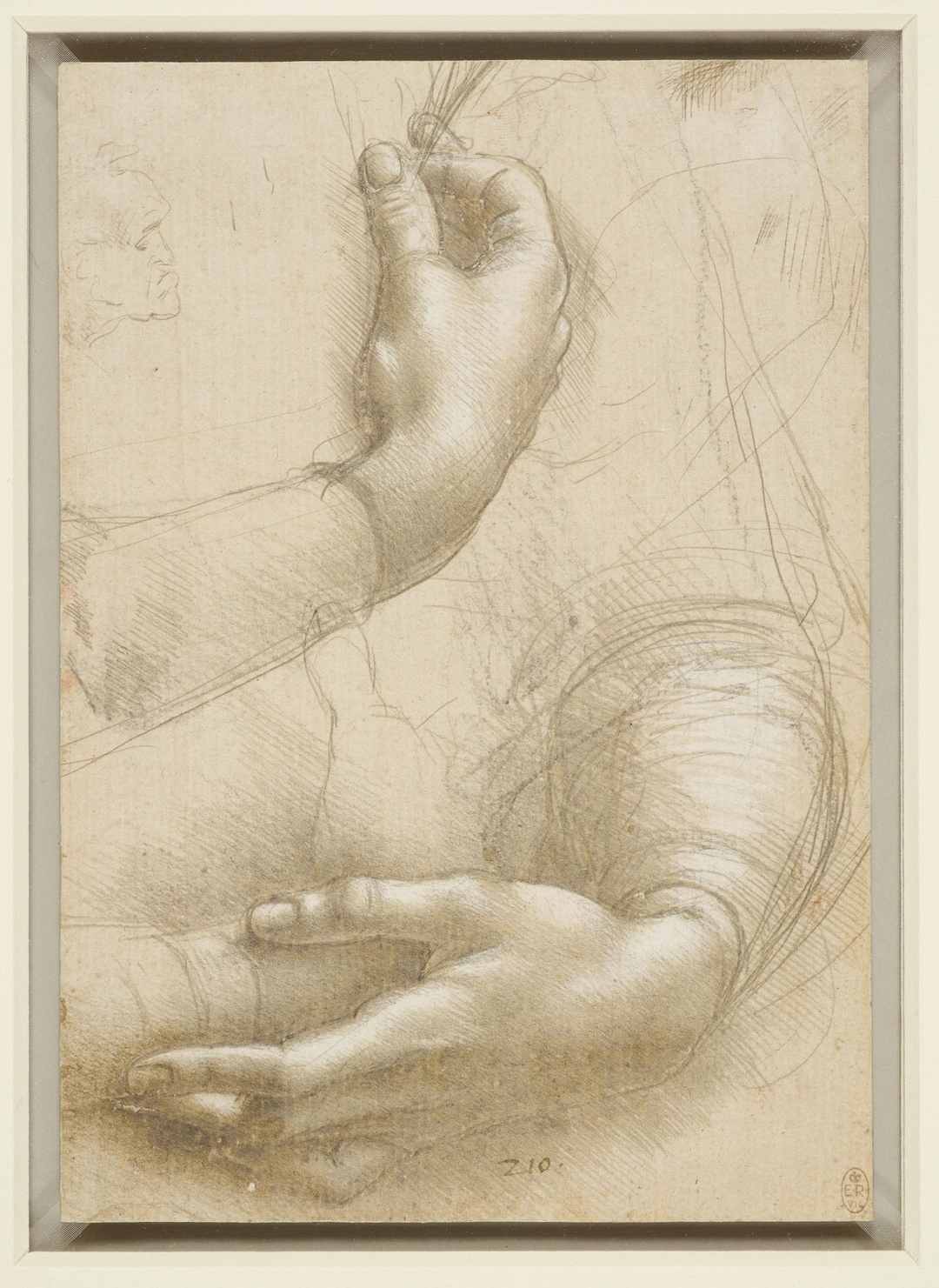
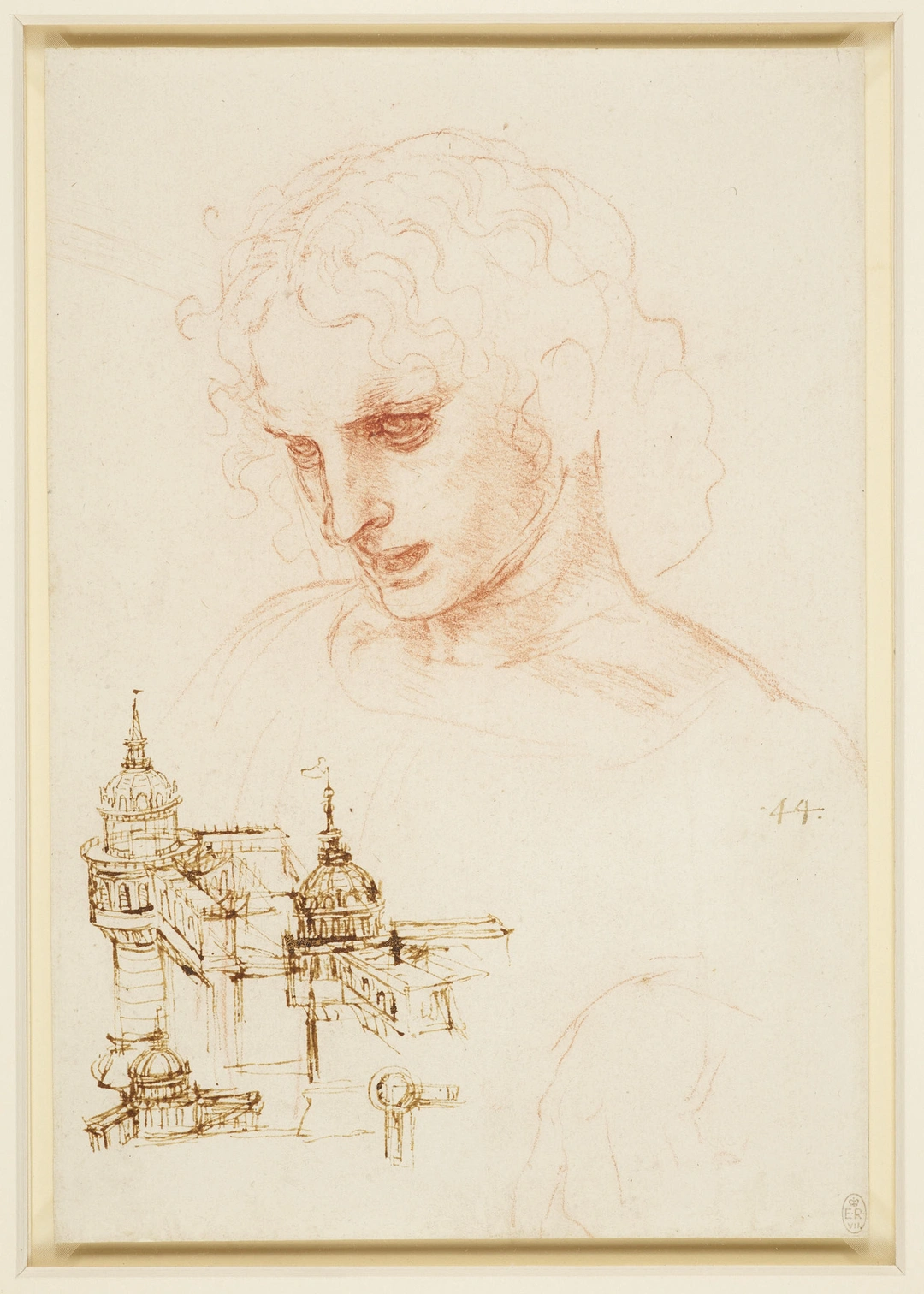
Leonardo, closed now, was an extraordinary example of what happens when the genteel horsetrading that curators engage in has successful results. (“If I lend you X, is there any chance you’d lend Y? And. . .this plum painting Z is promised; surely you want R to be seen with it?”) For old, fragile works the likely-hood of a “yes” diminishes. Perhaps twenty Leonardo paintings are still in existence. Nine of them were in London in this show, which was sponsored by Credit Suisse.. Drawings, many from England’s Royal Collection and thought to have been purchased by that man of parts, Charles II, were an important segment of the exhibition, as were related works by Leonardo’s apprentices/assistants.
Leonardo da Vinci, Study of Hands, c. 1490. Silverpoint on paper with white heightening, 21.4 x 15 cm. Royal Collection Trust, RCIN 912558.
Two of the paintings, the same subject depicted in works completed twenty years apart, had never before been seen together, probably not even by Leonardo himself. One theory is that the patron who first commissioned Virgin of the Rocks reneged on his offer and the work had gone to another owner when the original patron changed his mind, years later, and commissioned it again. The first, completed around 1485, now belongs to the Louvre; the second, thought to have been finished 1506-8, has been in London, at the National Gallery, since the Gallery bought it from the Earl of Suffolk in 1880. To bring them together was the most brilliant idea of this uniformly fine exhibition.
The two were hung facing one another in a medium-size gallery, to be viewed individually, but a turn of one’s head registered their eerie samenesses and real differences. Composition, background details, gestures tally almost perfectly but color takes on stronger definition in the second. A recent, meticulous restoration of London’s version may contribute to that, but the palette itself seems at odds. The surprise, though, is the difference in the faces. A default holiness marks the expressions of the Virgin, the Christ Child, his little cousin John the Baptist, and the angel who has joined the group in the Louvre’s earlier version. In the later work, by subtle miracles of brush, these figures have become thinking people and their thoughts are not only holy but profound. The angel is an exception; her look in the first painting is, well, almost human, but in the second she has gone remote and lowered the finger that earlier pointed to Christ. Angel-hood is a burden, perhaps?
Leonardo da Vinci, Study for the Head of St James with Architecture, c. 1495. Red chalk, pen and ink on paper, 25.2 x 17.2 cm. Royal Collection Trust, RCIN 912552.
Over at the Royal Academy, David Hockney’s roiling colors careen through the galleries in a show the critics have mostly been hard on. Too big, they say. Too diffuse. Too much color. Too much – can we say – too much fun? The visitors there the day I was seemed to be ignoring the critics and having fun where it was to be had, looking seriously when they wanted to.
David Hockney can’t get enough of looking. He is obsessed with what he sees, and with how to make those three dimensions into two. He uses every technique that comes to hand – reminiscent of Leonardo, who also took on new means to any conceivable end. So we have here, in The Bigger Picture, I-Pad drawings and the results of banks of cameras driven slowly down country lanes in various seasons of the year. He also draws, in charcoal, and paints, in California colors brought home.
He lives in Yorkshire now, and is learning again his ancestral countryside. This is an exhibition brimming with ideas and if some are not yet resolved how much more estimable than ideas whose outcome we already know.
Right now, at the Saatchi Gallery on the Kings Road in Chelsea, is New Art from Germany. This space consistently shows new art from all over the world. Its splendidly proportioned galleries are fitted within an 18th century Palladian-style building, originally designed to house a thousand bereft orphans, children of soldiers of the regular army. One hopes the children felt as at home as the art appears now. The Gallery is open every day and charges no admission. Admirable indeed, although we would have liked fuller label information on what we were seeing. No label information is needed to enjoy the range of visitors, who have a propensity to patterned stockings and interesting hats.
Saatchi has a single permanent exhibit, a trompe l’oeil puzzle which fills a two-story room and is viewed from a gallery half way up. Richard Wilson’s “20:50” (1987) incorporates used sump oil and steel and will astound and surprise you.
We went to the Saatchi on Saturday, for the added advantage of lunch from vendors in Duke of York Square, hard by. I had something Moroccan and would have it again. It’s also rewarding, when in that neighborhood, to pop into John Sandoe Books Ltd at 10 Blacklands Terrace. For Cincinnati book buyers with long memories, Sandoe’s is Acres of Books writ small. It has perhaps a third the footprint our old Main Street icon had, but similar multiple floors and the same sense of overflowing shelves. I bought, for plane reading coming home, Mary Wortley Montagu’s letters from her early 18th century travels to Constantinople when her husband was named British ambassador to the Turks. Lady Mary is a wonder, and one of the most delightful writers extant. What would she have thought of airplanes, in light of the months their party took to get to Turkey?
It’s important, when going to the British Museum, to set out the parameters of one’s visit. The place encompasses so much that over-kill is a hazard. In the cab on the way we settled on Room One, the Enlightenment Room, where the 18th century’s curiosity of all things is explored and, implicitly, the kind of thinking that led to the Museum itself is lined out. This room presents the possibility of tangents of all sorts, of course, and we settled on Etruscan, moving from there directly to the Etruscan gallery and more on those mysterious people than I had known existed. We still were there when the Museum closed. Must come back another day.
We caught the last day of a show of William Morris’s work at 2 Temple Place, overlooking the Thames and built by William Waldorf Astor in 1895 on the lines of a French Renaissance palace. The house, now a corporate headquarters with an occasional flurry of a show, somehow looks more like New York excess than British excess and is distinguished by its woodwork. The woodwork is the marvel of the place, so much so that a sharp-eyed member of our party noted a gas pipe painted to imitate wood and metal doors on a significant looking safe that are faux wood as well. William Morris’s work is perhaps the ideal art for the place and 2 Temple Place the ideal place for his art. Both traffic in make-believe.
Chinese New Year, a few days after the fact, was being celebrated with fireworks in Trafalger Square that evening and we walked along the river from Temple Place to turn up to the Square. The production proved to be disjointed, but the sight of a dragon projected in red light on Nelson’s column will stay with me.
London, as usual, has more to do than time to do it in. What a pleasure.
–Jane Durrell














Comments powered by Talkyard.